

Multifamily financing rates are the all-in interest costs lenders attach to debt on apartment properties with five or more units, and they are set by a benchmark index plus a credit spread rather than by any single published number. The index moves with the Treasury curve or the relevant floating benchmark. The spread is negotiated, and it reflects the property, the leverage, the cash flow coverage and the capital source behind the loan. That is why two owners shopping the same week can receive quotes separated by a full percentage point or more.
Most pricing pages stop at a rate table. The harder questions sit underneath it. A borrower needs to know which program the building actually qualifies for, how the loan will be sized once a lender applies its coverage and debt yield tests, what the prepayment structure costs if the asset trades in year three, and whether a floating structure with a rate cap beats a fixed coupon with heavy exit penalties. Those decisions change the real cost of capital far more than a quarter point of coupon does.
This guide explains how multifamily financing rates are constructed, how property class and occupancy type are confirmed before anyone prices a deal, which capital sources compete for apartment loans, and how experienced investors use structure rather than headline pricing to protect returns. It is educational and does not quote rates. Pricing always comes from independent third-party finance providers after they review the property and the sponsor. For a broader primer on how index and spread interact, see commercial loan rates explained as index plus spread.
Key takeaways
- Multifamily financing rates are built from a benchmark index plus a lender spread, so two borrowers quoted on the same day can see very different pricing on the same building.
- Agency programs, bank balance sheet debt, life company money, CMBS, credit union paper and bridge debt each price differently because each capital source has a different funding cost and risk tolerance.
- Leverage, debt service coverage, debt yield, occupancy history and the sponsor's liquidity usually move pricing more than a borrower's personal credit score does.
- Fixed-rate agency and life company quotes often carry yield maintenance or defeasance, so the cheapest coupon is not always the cheapest total cost once an early sale or refinance is priced in.
- Rate locks, loan sizing tests and prepayment structure should be compared side by side before a term sheet is signed, because the structure decides the real cost of capital.
What Multifamily Financing Rates Are and What Sets Them
Multifamily financing rates are the sum of a funding benchmark and a lender spread, and the spread carries almost all of the negotiation. Agency executions backed by Fannie Mae and Freddie Mac price off Treasuries and tend to sit tightest for stabilized, well-occupied properties. Bank and credit union debt prices off internal funding costs and deposit relationships. Debt funds and bridge lenders price off floating benchmarks and accept more risk for wider spreads. The property's loan-to-value, its debt service coverage ratio and its debt yield then push the quote up or down within whatever range that capital source can offer.
Investors comparing options should look at the whole package rather than the coupon alone. Term length, amortization, recourse, interest-only period and prepayment penalty all carry a price, and lenders trade them against one another.
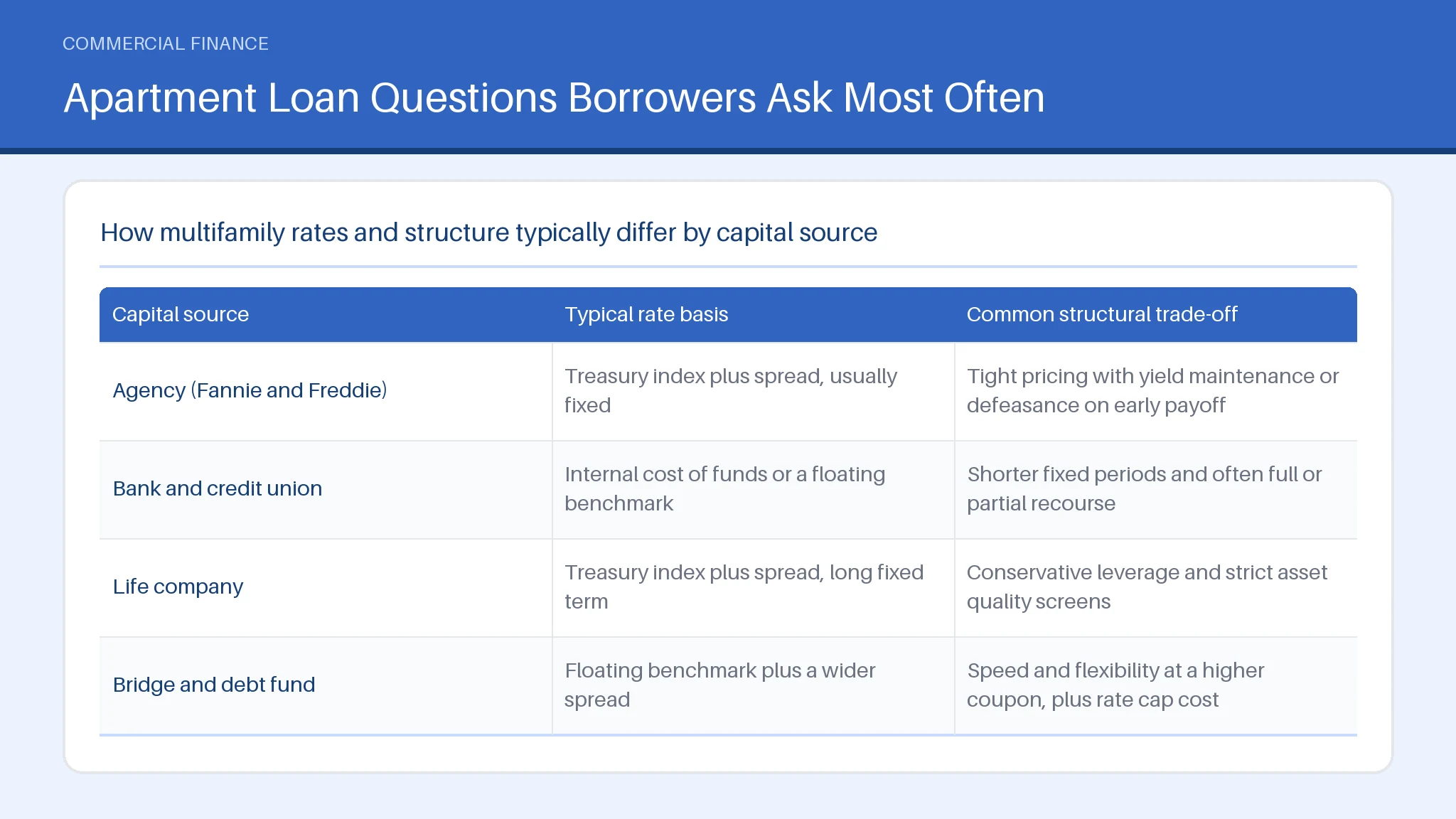
| Capital source | Typical rate basis | Common structural trade-off |
|---|---|---|
| Agency (Fannie and Freddie) | Treasury index plus spread, usually fixed | Tight pricing with yield maintenance or defeasance on early payoff |
| Bank and credit union | Internal cost of funds or a floating benchmark | Shorter fixed periods and often full or partial recourse |
| Life company | Treasury index plus spread, long fixed term | Conservative leverage and strict asset quality screens |
| Bridge and debt fund | Floating benchmark plus a wider spread | Speed and flexibility at a higher coupon, plus rate cap cost |
Confirming Property Class and Occupancy Type Before Pricing
Lenders confirm the asset class and occupancy profile before they price anything, because those two facts decide which programs are even available. A five-unit walk-up with month-to-month tenants, a 180-unit garden community with twelve months of stabilized occupancy and a student housing building near a campus all draw different quotes, different loan sizing and sometimes different underwriting desks. Fannie and Freddie Mac both run separate guidance for conventional, affordable, seniors, student and manufactured housing collateral, and the spread moves with that classification.
Occupancy history is the second screen. Most permanent programs want ninety days or more of stabilized physical and economic occupancy, with trailing rent rolls that match the bank statements. Properties still leasing up, or those with heavy concessions, usually move to bridge pricing until the cash flow is provable. The vacancy factor a lender applies, the expense load it underwrites and the resulting coverage ratio then set the loan amount before multifamily financing rates are even discussed.
Investors can reduce surprises by preparing a clean trailing twelve month operating statement, a current rent roll, unit mix detail and a capital expenditure history. Those documents are also the backbone of multifamily due diligence, and having them ready early keeps quoted multifamily rates from being re-traded later in the process.
Current Apartment Building Mortgage Rates Updated Daily
Apartment building mortgage pricing moves every business day because the underlying index moves every business day. A commercial mortgage quoted off the ten-year Treasury repriced overnight; a floating structure tied to a short-term benchmark repriced with that benchmark. Rate sheets published online are indicative ranges, not offers, and they rarely reflect the specific leverage, market and sponsor strength that a real mortgage quote depends on.
Two mechanics matter more than daily watching. First, most lenders do not fix a rate at application. Pricing is typically locked at commitment, sometimes with an early rate lock option for an extra fee, so an investor carries index risk between term sheet and lock. Second, loan sizing can change when rates move even if the spread holds, because a higher coupon raises debt service and a coverage-constrained deal shrinks to keep the ratio intact.
Investors tracking multifamily financing rates should therefore ask three questions on every term sheet: what index is this priced on, when does the lock occur, and what happens to proceeds if the index rises fifty basis points before closing. Fannie and Freddie Mac programs, bank paper and life company debt all answer those three questions differently, and the answers often decide which quote is genuinely better.
Apartment Loan Questions Borrowers Ask Most Often
The questions apartment owners ask most often cluster around sizing, recourse and exit cost rather than the coupon itself. A borrower typically wants to know how much proceeds the property supports, whether a personal guarantee is required, and what it costs to leave the loan early.
Loan sizing comes from the lowest of three tests: a loan-to-value cap, a minimum debt service coverage ratio and a minimum debt yield. Whichever test binds first sets the proceeds, so a borrower in a low cap rate market is often constrained by coverage rather than value. Recourse is the second question. Agency executions through Fannie Mae and Mac are generally non-recourse with standard bad-boy carve-outs, while bank and credit union lending more often asks for a guarantee; the mechanics are covered in detail in our guide to non-recourse limits and carve-outs.
Exit cost is the question most often asked too late. Yield maintenance and defeasance can cost a borrower a meaningful share of the loan balance if Treasuries have fallen since closing, which is why multifamily financing rates should always be evaluated alongside the prepayment schedule and any step-down alternative.
Financing Options for Buildings With Five or More Units
Buildings with five or more units sit outside residential underwriting entirely and draw on six main capital categories. Agency debt from Fannie Mae and Freddie, including small balance programs built for loans well under ten million dollars, generally offers the longest fixed terms and non-recourse structure for stabilized assets. HUD insured programs through FHA offer very long amortization and high leverage for qualifying properties, at the cost of a longer application process and ongoing mortgage insurance premiums.
Banks and credit unions compete hardest on local assets and relationship deposits, usually with shorter fixed periods. Life company debt targets high-quality collateral with conservative leverage. Securitized debt is another option, and CMBS loans provide fixed-rate CRE financing for borrowers who accept servicer-administered terms. Bridge and debt fund lending covers lease-up, repositioning and value-add business plans where cash flow is not yet stabilized, and ground-up projects fall under multifamily construction financing with draws and terms.
Choosing among them is less about chasing the lowest multifamily financing rates and more about matching the hold period, the business plan and the tolerance for prepayment restrictions to the right capital source. continue with the qualification form below.
Using Low Multifamily Financing Rates to Boost Investor Returns
Low pricing improves returns only when the structure around it supports the business plan, and that is where experienced sponsors separate themselves. A multifamily mortgage priced twenty-five basis points tighter but carrying a seven-year lockout can destroy more value than it creates if the asset is meant to trade in year three. Cost of capital is the coupon plus the exit penalty plus the cost of any required rate cap, measured over the actual hold period rather than the stated term.
Understanding how multifamily rates translate into returns starts with the leverage decision. Higher proceeds reduce the equity check and lift cash-on-cash returns while the property performs, but they also tighten coverage and raise refinance risk at maturity. Many investors deliberately size a multifamily loan below the maximum so the exit is not forced, accepting slightly lower leverage in exchange for a wider coverage cushion. The arithmetic is straightforward: divide net operating income by annual debt service and test the result against a coupon one to two points higher than today's, which approximates the refinance a maturing loan will face.
Structure choices follow. An interest-only period raises early distributions but delays principal paydown, so the loan balance at exit is higher. A fixed multifamily mortgage removes index risk and makes the hold predictable. Floating debt costs more in coupon but allows a cheap exit when the plan calls for a sale or a refinance into agency debt after stabilization. For renovation-heavy plans, borrowers sometimes ask whether an FHA 203(k) rehab loan applies to apartment buildings; that program is a residential product limited to one to four unit properties, so apartment rehab generally runs through bridge debt or a HUD insured multifamily program instead, and CMBS is rarely the right fit for an asset still being repositioned.
The practical test for multifamily properties is simple. Model the deal at the quoted rate, then model it again at a stressed refinance rate and with the prepayment penalty applied at your intended sale date. The quote that survives both tests is the one that actually protects returns. Our guide to cap rates and NOI covers the valuation side of that same calculation.
Flexible Loan Structures for Varied Property Investment Scenarios
Flexible structure is what lets one borrower finance a stabilized ninety-unit asset and another finance a half-empty building needing new roofs, and the differences show up in term, amortization, recourse and prepayment rather than in rate alone. Fannie Mae and Freddie offer fixed terms commonly running five to thirty years with partial or full-term interest-only available at lower leverage. Banks and unions often pair a shorter fixed period with a longer amortization schedule and a balloon, which suits owners who expect to refinance or sell inside that window.
Freddie Mac and other agency executions also allow supplemental debt later in the term, which gives an owner a way to pull equity after a successful value-add plan without unwinding the senior loan. Where leverage needs to go higher than senior lenders will allow, mezzanine financing sits behind the first mortgage at a higher cost. Every one of those choices feeds back into the coverage ratio a lender will underwrite, and lending decisions on all of them rest with independent third-party finance providers. Reviewing how CRE loan matching works and the frequently asked financing questions shows what information lenders typically request before they structure a term sheet.
Summary
Multifamily financing rates come from an index plus a negotiated spread, and the spread reflects the property class, occupancy history, leverage and coverage far more than a headline rate sheet does. Agency, bank, credit union, life company, HUD, CMBS and bridge capital each price differently and carry different prepayment and recourse terms. Compare the coupon, the lock timing, the sizing test that binds and the exit cost together. CRE Loans USA is a lender-matching service that connects borrowers with independent finance providers who make all pricing and credit decisions. More explainers sit on the CRE financing blog and the about page.
You may also find these related guides helpful: Commercial Property Insurance: What It Covers and Costs and Industrial Property Loans: How Lenders Structure Them.
Frequently asked questions
What are interest rates today for multifamily?
Interest rates for multifamily debt today are quoted as a benchmark index plus a lender spread, so there is no single national number. Pricing varies by program, leverage, property class and sponsor strength, and it resets daily with the Treasury curve or the relevant floating benchmark. Any range published online is indicative only; actual pricing comes from an independent lender after it reviews the rent roll, operating statements and loan request.
Will we ever see a 3% mortgage rate again?
A return to 3 percent commercial pricing would require the underlying benchmark index to fall back near the levels seen during the 2020 to 2021 period, combined with tight credit spreads. No one can forecast that reliably, and market commentary is not a prediction. The practical approach is to stress test a deal at rates above today's pricing rather than to plan around a specific future number.
Will mortgage rates get to 4% in 2026?
Whether rates reach 4 percent in 2026 depends on inflation, Federal Reserve policy and Treasury yields, none of which can be forecast with confidence. Borrowers get more value from testing a refinance at a coupon one to two points above current pricing than from timing a market. A structure with a reasonable coverage cushion performs whichever direction rates move.
Will mortgage rates drop to 5%?
A drop to 5 percent would require a sustained decline in the benchmark index or a meaningful tightening of credit spreads. Investors who want to capture a future decline often choose shorter fixed terms, step-down prepayment or floating debt with a rate cap, accepting a higher coupon today in exchange for a cheaper exit later. That flexibility has a measurable price, and it should be modeled rather than assumed.
Is 3.75% a good mortgage rate?
Whether 3.75 percent is a good rate depends entirely on the program, the term, the leverage and when it was quoted. The same number can be strong on a thirty-year fixed non-recourse execution and unremarkable on a short-term floating loan with full recourse. Compare quotes on identical term, amortization, recourse and prepayment before judging the coupon.
What is a decent mortgage rate right now?
A decent rate right now is one that sits at or inside the market spread for the program, leverage and property class in question. The useful benchmark is not a number but a comparison: gather two or three term sheets structured the same way, then compare spread, lock timing, loan sizing and exit cost together. FHA and HUD insured programs, agency debt, bank paper and CMBS will each answer differently.
How many people have a 3% mortgage rate?
The share of owners holding 3 percent debt is a residential statistic and does not translate to commercial property. Apartment loans are generally shorter and roll every five to twelve years, so a large portion of the multifamily market has already refinanced or will refinance into current pricing. FHA loans themselves are residential products for one to four unit owner-occupied homes, including an owner who lives in one unit of a small multifamily building, and they are not used for pure investment apartment portfolios. Identifying the commercial property type you need to finance, whether apartments, industrial, retail or hospitality, is the first step toward the right program.