
A non recourse commercial loan is debt secured by a commercial property where the lender's remedy after a default is generally limited to the property itself, plus the rents, reserves, and contracts pledged with it. If the sale proceeds fall short of the balance, the shortfall usually stays with the lender rather than following the sponsor into personal bankruptcy court.
That sounds absolute, and it is not. Every non recourse commercial loan sits on top of a guaranty document that lists exceptions, and those exceptions decide how much protection you actually bought. This guide explains what the structure covers, what it never covers, which programs offer it, and what underwriters want before they give up their claim on your balance sheet. For broader context on structures and pricing, the commercial real estate finance guides cover adjacent programs in detail.
Key takeaways
- A non recourse commercial loan limits the lender's claim to the pledged property and its income, not the sponsor's outside net worth.
- Almost every non recourse structure carries bad boy carve-outs, so fraud, unauthorized transfers, or diverted insurance proceeds can restore full personal liability.
- Agency, HUD, and securitized debt account for most true non recourse lending, while banks, credit unions, and bridge lenders usually want a personal guaranty.
- Non recourse pricing generally reflects tighter leverage, stricter coverage tests, and single-purpose-entity ownership rather than a simple rate premium.
- The practical test is whether your deal can carry conservative sizing; if it can, the guaranty relief is usually worth the structural constraints.
What Is a Non Recourse Commercial Loan?
A non recourse commercial loan shifts credit risk onto the collateral rather than the sponsor. In a full recourse loan the lender holds a personal promise; in a non recourse commercial loan the lender holds the asset. The recourse vs non recourse loan choice therefore drives how a borrower structures ownership, and it explains why a non recourse construction loan is rarer than a stabilized multifamily loan: unfinished work has no income to seize. The same logic applies to short-horizon bridge debt, which is why non recourse fix and flip loans are uncommon in practice.
| Feature | Recourse | Non recourse |
|---|---|---|
| Lender claim after default | Property plus the borrower's other assets | Property and pledged income only |
| Guaranty scope | Full personal guaranty | Limited bad boy carve-out guaranty |
| Typical investor use | Bank and credit union deals, transitional assets | Agency, HUD, and securitized stabilized assets |
Are Your Personal Assets Protected If Values Fall?
Falling values are exactly the scenario a non recourse commercial loan is designed for. When a commercial real estate asset trades below the outstanding balance, the lender forecloses on the collateral and absorbs the deficiency, so the borrower's personal asset base stays outside the claim. If the borrower has behaved within the loan documents, no deficiency judgment reaches brokerage accounts, a primary residence, or unrelated property equity.
Two limits matter. A market decline is protected, but misconduct is not, and cross-collateralized debt on a second asset can pull that asset in. Sponsors who understand the coverage math behind loan sizing tend to survive value swings without ever testing whether each personal asset is truly ring-fenced.
Recourse or Non Recourse: Which Structure Fits Your Deal?
Fit depends on the asset's stability, not on the sponsor's preference. Stabilized, income-producing commercial real estate with documented history supports non recourse commercial loans; a ground-up project rarely supports a non recourse construction loan until completion and lease-up. If a borrower needs maximum leverage or fast closing, recourse bank financing often wins on flexibility even though liability is broader.
An investor should also weigh the entity structure. Non recourse debt requires single-purpose ownership, which complicates portfolio-level refinancing. If the borrower plans to reposition and sell within two years, a recourse bridge mortgage with a clean prepay may cost less overall, even with a full guaranty and a bad boy carve regime attached. The lender matching process starts with those deal facts.
How HUD 223(f) Funds Multifamily Acquisition and Refinance
HUD's 223(f) program provides long-term, fixed-rate, non recourse financing for the acquisition or refinance of existing multifamily properties. The obligation runs to the single-purpose entity that owns the asset, with amortization terms reaching 35 years and repairs limited to moderate work rather than major reconstruction. Because the insurance is federal, underwriting focuses on sustained occupancy, replacement reserves, and third-party reports.
The trade-off is timing. A borrower should expect a longer application cycle, prevailing-wage and compliance review, and mortgage insurance premiums. That patience is why the program rarely suits short-hold strategies such as non recourse fix and flip loans. Investors comparing programs can review FHA apartment loan programs, which sit alongside recourse financing options a borrower might otherwise choose.
How Lender Remedies Differ After a Default
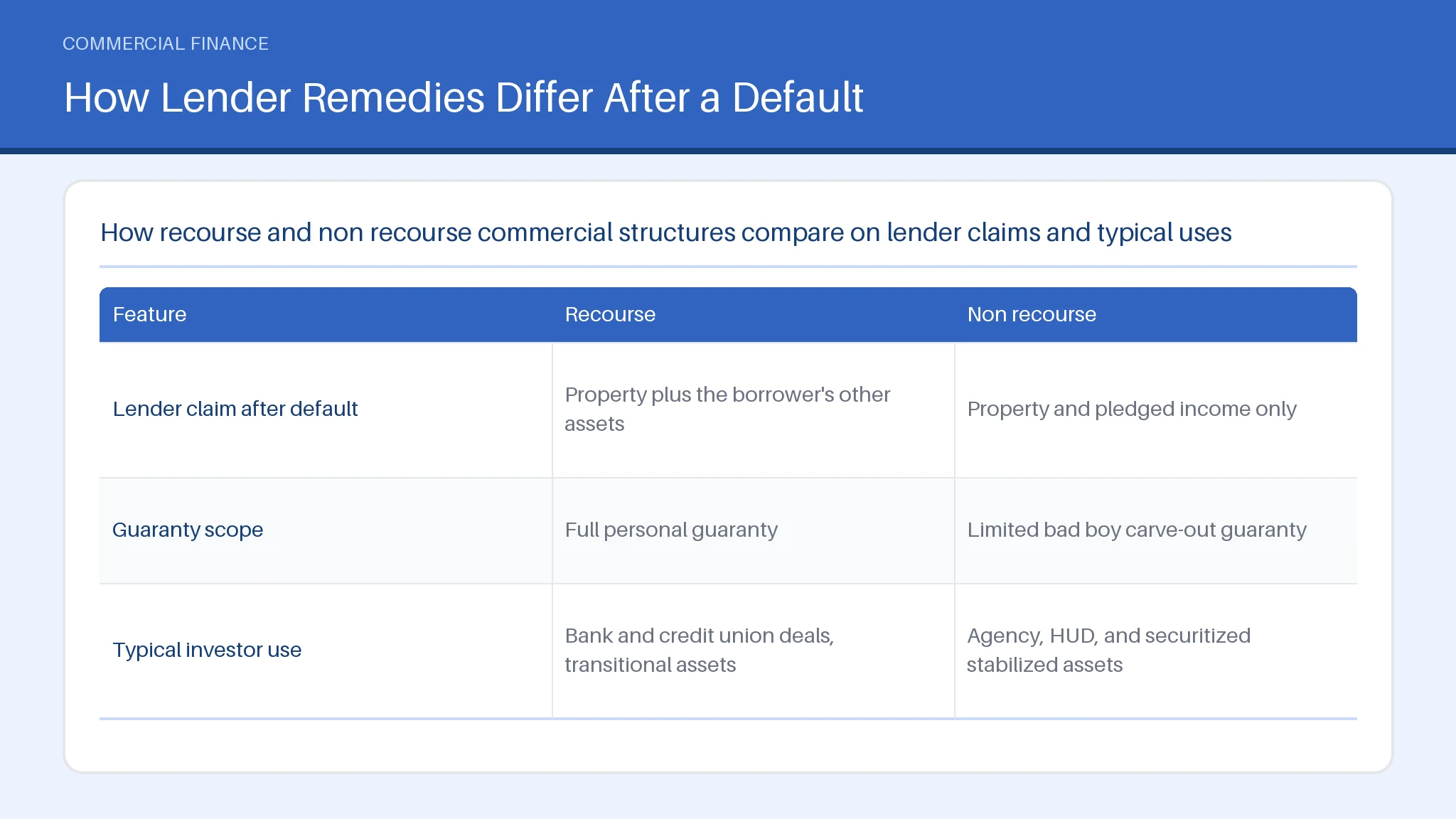
Remedies split sharply at the deficiency stage. Under recourse financing the lender forecloses, sells the property, and then sues for the unpaid balance. Under non recourse debt the lender forecloses, sells, and stops, absorbing the gap.
Before foreclosure, the toolkits look similar. A lender can sweep rents through a lockbox, draw on reserves, appoint a receiver, and accelerate the note. A securitized lender typically transfers the file to special servicing, where a workout lender negotiates modifications, while a balance-sheet lender may restructure directly. What a non recourse lender cannot do is skip the collateral and start with the sponsor's bank accounts. Sponsors often first meet this distinction through a lender inspection triggered by covenant concerns.
Qualifying for a Non Recourse Commercial Loan: Requirements
Qualifying turns on the asset's measured cash flow rather than the sponsor's willingness to sign. Because the lender releases most personal liability, non recourse commercial loans carry conservative sizing: lower leverage, higher coverage and debt yield minimums, funded tax and insurance escrows, and single-purpose-entity ownership with the mortgage lien filed against that entity alone.
Underwriters still review the borrower. Expect a schedule of real estate owned, liquidity and net worth tests, and asset-class experience, since a borrower default on a mismanaged property still costs the lender money. Third-party appraisal, environmental, and engineering reports control final proceeds. HUD 223(f) adds federal compliance review on top of that file. Recourse financing forgives weaker metrics in exchange for a guaranty, which is the core recourse trade: a construction loan or transitional deal usually cannot meet the non recourse requirement set until it stabilizes. An organized application package shortens the review for any investor.
Cost, Leverage and Flexibility Trade-Offs Between the Two Structures
Non recourse financing is usually priced through structure, not just spread. A lender that cannot pursue a borrower's outside assets protects itself with lower loan-to-value, stricter cash management, and defeasance or yield maintenance that limits early exits. Recourse debt often allows higher proceeds and a simpler prepayment, because the guaranty absorbs the tail risk of a borrower default.
Flexibility is the real cost. A non recourse commercial real estate loan restricts additional debt, transfers, and entity changes, and a non recourse DSCR loan applies the same discipline to smaller rental assets. Recourse deals accept broader personal liability but let an investor refinance or add a partner faster. A commercial mortgage loan typically prices where those constraints and the bad boy carve out regime settle. Review prepayment penalty mechanics before locking either structure.
Using HUD 221(d)(4) for Construction and Substantial Rehab
HUD 221(d)(4) is the main route to non recourse financing for apartment construction and substantial rehabilitation. It combines the build period and the permanent mortgage into one fixed-rate instrument, typically 40 years of amortization after completion, so the borrower avoids a separate takeout. That single close is what makes the recourse vs non recourse loan question answerable on a commercial real development project at all.
Completion risk does not disappear. The borrower personal guaranty is narrow, but a completion assurance agreement, cost certification, and Davis-Bacon wage compliance replace it with performance liability, alongside the usual bad boy carve out language. Investors weighing a non recourse DSCR loan on a stabilized building against ground-up debt should compare construction draw and term mechanics first.
Carve-Outs That Can Make You Personally Liable
Carve-outs are the contractual exceptions that convert limited liability into full personal exposure, and they are where non recourse financing is won or lost. Standard bad boy carve language names fraud, material misrepresentation, misapplied rents or insurance proceeds, unpaid taxes, voluntary bankruptcy filings, unpermitted transfers, and physical waste. Springing carve provisions go further, making the borrower liable for the entire mortgage balance rather than just the resulting loss.
Read each carve for its trigger and its measure. A loss-only carve caps damages at the lender's actual harm; a full-recourse carve does not. Negotiate cure periods, exclude involuntary insolvency, and confirm which borrower personal signatures are required, since a passive partner can become personally liable through a springing clause. Nonrecourse carve-out review belongs with experienced deal advisors, and the recourse discussion in self storage financing shows how these terms shift by asset class. continue with the qualification form below.
Summary
A non recourse commercial loan trades leverage and flexibility for balance-sheet protection that holds only as far as the carve-outs allow. CRE Loans USA is a lender-matching service that passes your deal details to independent finance providers, who make every lending decision. Learn more about the network.
Frequently asked questions
What are the risks of non-recourse loans?
The main risks are structural rather than personal: lower proceeds, rigid prepayment costs, cash management lockboxes, and carve-outs that can reinstate full liability if documents are breached. Single-purpose ownership also limits how quickly a sponsor can restructure or add partners.
Are SBA loans recourse or non-recourse?
SBA loans are recourse. Both the 7(a) and 504 programs require personal guaranties from owners of 20 percent or more, and the SBA can pursue guarantor assets after liquidating collateral, as outlined in the SBA 504 requirements.
What are the advantages of a non-recourse loan?
The advantage is contained downside. A market decline, tenant loss, or foreclosure generally ends at the property, keeping unrelated investments, savings, and residences outside the lender's claim.
Who typically uses non-recourse loans?
Institutional sponsors, syndicators, private equity funds, family offices, and experienced apartment owners use non recourse debt most, largely because passive investors will not sign personal guaranties on a shared deal.
Do you have to pay back a non-recourse loan?
Repayment is fully required. Non recourse only limits what happens after a default; principal, interest, escrows, and reserves remain contractual obligations for the borrowing entity.
Why would a bank give a non-recourse loan?
Banks and agency lenders extend it when the collateral itself services the debt through documented income, conservative leverage, and strong third-party reports, which makes the property a sufficient source of repayment.
What are the current interest rates for non-recourse loans?
Pricing changes constantly with Treasury and SOFR benchmarks, spreads, leverage, and asset class, so no fixed figure applies. The index plus spread explainer shows how quotes are built, and the FAQ page covers how matching works.