
Self storage financing is the set of commercial debt structures used to buy, build, refinance, or reposition storage facilities, and the structure you end up with depends far more on the property's cash flow history than on your personal balance sheet. A stabilized facility with three years of clean rent rolls can usually support long-term fixed debt. A half-leased conversion or a ground-up project needs shorter, staged capital first, then a takeout once occupancy and revenue stabilize.
That split matters because storage behaves differently from other asset types. Leases are month to month, so rent can be repriced quickly, but income can also fall quickly when a competing facility opens two miles away. Lenders price that volatility into loan-to-value limits, coverage tests, and reserves. Understanding the structures before you shop, as our commercial real estate finance guides explain across property types, keeps you from chasing terms your deal cannot carry.
Key takeaways
- Self storage financing splits into three broad buckets: bank and credit union balance sheet debt, SBA programs for owner-operators, and conduit or bridge debt for stabilized or transitional assets.
- Underwriting now leans on trailing 12-month net operating income and physical plus economic occupancy rather than pro forma rent assumptions.
- True zero down deals are rare; low equity structures usually come from seller financing, cross-collateralized equity in an existing property, or SBA programs with third-party subordinate debt.
- Recourse language, prepayment terms, and reserve requirements often move total cost more than the headline interest rate.
- Lenders that already hold storage in their loan book tend to underwrite square footage mix, climate control, and unit turnover more accurately than generalists.
What Banks and Credit Unions Offer Storage Borrowers
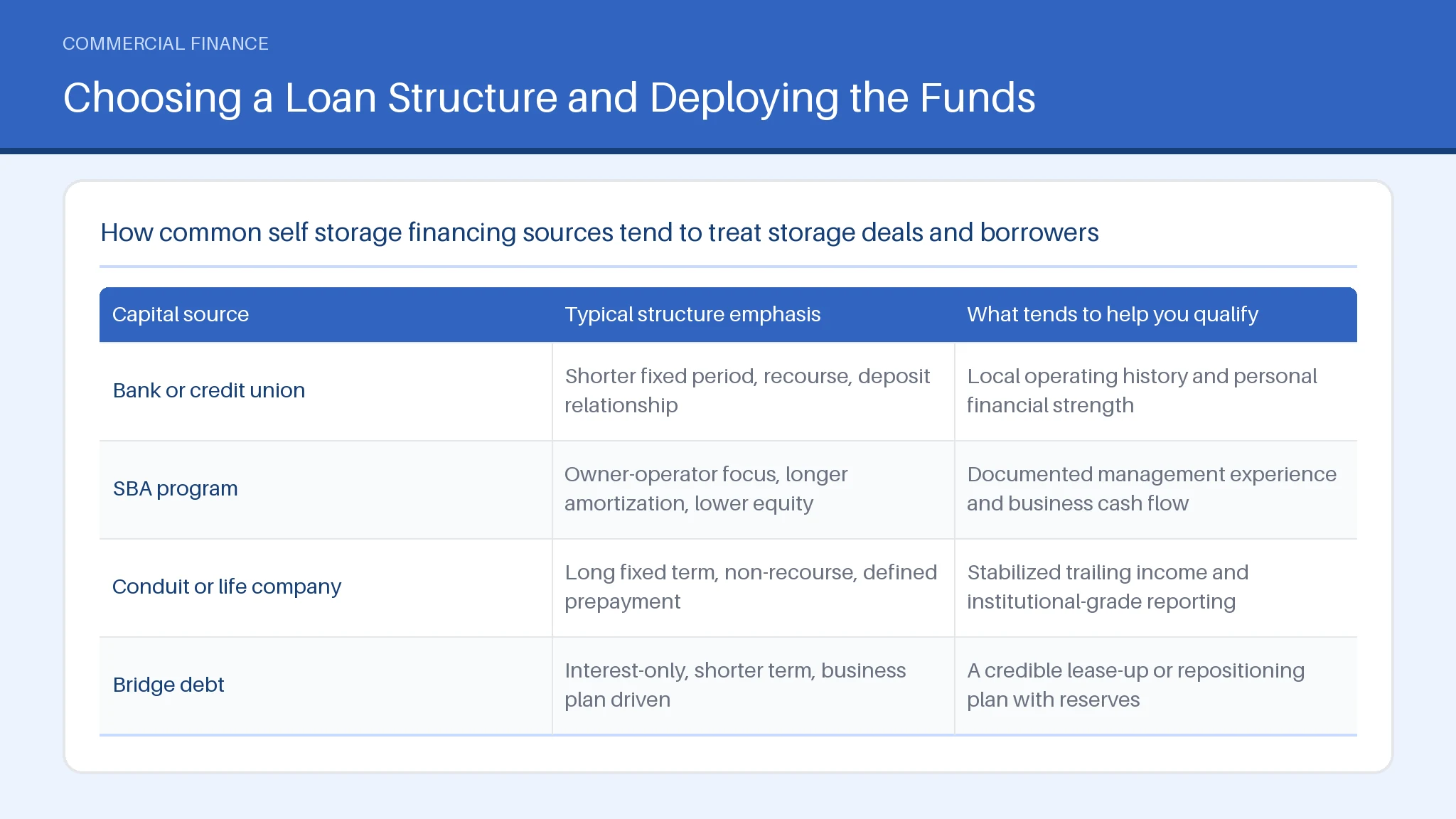
Regional banks and credit unions are the most common source of self storage financing for a single-facility owner, and they typically hold the loan rather than sell it. That means flexible structuring, local market knowledge, and a real relationship, but usually shorter fixed periods, full recourse, and deposit relationships as a condition of lending. A borrower who wants long fixed terms and limited personal liability generally has to look at conduit debt instead. The table below compares how each route tends to treat a self storage facility and the borrower behind it.
| Capital source | Typical structure emphasis | What tends to help you qualify |
|---|---|---|
| Bank or credit union | Shorter fixed period, recourse, deposit relationship | Local operating history and personal financial strength |
| SBA program | Owner-operator focus, longer amortization, lower equity | Documented management experience and business cash flow |
| Conduit or life company | Long fixed term, non-recourse, defined prepayment | Stabilized trailing income and institutional-grade reporting |
| Bridge debt | Interest-only, shorter term, business plan driven | A credible lease-up or repositioning plan with reserves |
Fund a Storage Acquisition With No Money Down
Zero down storage acquisitions almost never come from a single loan. They come from stacking sources: a first mortgage sized to the property, seller financing on a subordinate note, and equity pulled from another property you already own. An SBA loan can reduce the cash you bring by allowing lower injection than most conventional self storage financing, though the agency still expects real skin in the game and personal guarantees. Sellers carrying paper are more willing when occupancy is soft and they want the price supported. Ground-up deals are different again, since self storage construction financing funds by draw and requires equity in first. Low-equity lending raises your payment, so run coverage before you celebrate the structure.
How Self Storage Financing Works From Application to Close
Self storage financing moves through five practical stages: intake and property summary, term sheet, third-party reports, underwriting, and closing. Expect 45 to 90 days for a permanent loan and longer when an SBA package is involved.
Permanent financing is the end state for a stabilized facility, with amortization typically running 20 to 25 years and a fixed period that may be shorter than the amortization schedule. Self-storage financing terms hinge on three numbers: coverage on trailing income, loan to value from the appraisal, and the debt yield a lender needs to hold the loan. Underwriters want a unit-level rent roll, 12 to 36 months of operating statements, and both physical and economic occupancy, since discounts and concessions can hide a gap between the two.
Repositioning a property, whether that means adding climate-controlled units, converting a retail box, or replacing a weak management system, generally runs on bridge debt first and a refinance once income proves out. Property types range from single-story drive-up and multi-story climate controlled to RV and boat storage, portable container yards, and mixed-use flex. New construction is financed nationwide, but rural markets face tighter feasibility tests. Bring documents, not a polished pitch deck, and ask how self storage financing rates are indexed and when they lock.
Funding Routes for Your First Self Storage Investment
A first-time investor generally has four realistic routes into a self storage facility: an SBA program if you will actively operate it, a local bank loan with a personal guarantee and stronger equity, a partnership where an experienced operator signs on the debt, or buying a smaller stabilized asset where the mortgage is easy to cover. The fastest way to weaken your case is a thin operating plan. Lenders want to know who manages the gate software, sets rates, and handles delinquency. Self storage financing rates quoted to a first-time buyer usually reflect that management risk. Study how self storage loans are typically sized before you make offers.
Choosing a Loan Structure and Deploying the Funds
Choosing a structure starts with your hold period. If you plan to sell in three years, a long fixed loan with heavy prepayment cost works against you, and prepayment penalty mechanics deserve as much attention as the rate. A ten-year hold argues the opposite way. Compare proceeds, prepayment, recourse, and reserve holdbacks side by side rather than ranking quotes by rate alone. Deploying funds is its own discipline: an investor who spends the full self storage financing allocation on units before fixing security, paving, and signage usually sees slower lease-up. An SBA loan can fund equipment and working capital alongside the self storage facility, which many buyers overlook.
Recourse vs Non-Recourse Debt and Your Personal Liability
Recourse debt lets a lender pursue your personal assets if the property fails to cover the loan; non-recourse debt generally limits recovery to the collateral, subject to carve-outs for fraud, unpaid taxes, environmental issues, and unauthorized transfers. Most bank and SBA loan structures for a self storage facility are full recourse with personal guarantees. Conduit and life company debt is where non-recourse usually lives, and it requires stabilized income. Self storage construction financing is almost always recourse, because there is no cash flow yet. An investor should read the carve-out schedule closely, since a badly drafted one can turn nominal non-recourse into practical exposure. That detail rarely surfaces in financing news, but it decides how much a storage loan really risks.
Why Asset Class Experience Matters in a Storage Lender
A lender that already holds storage debt reads the asset correctly. Experience shows up in small judgments: whether a 78 percent physical occupancy is healthy for the submarket, how quickly month-to-month rents can be raised, what expense ratio is credible, and whether drive-up units in a flood-prone parcel deserve a discount. A generalist lender often applies retail or industrial assumptions and sizes the storage loan too conservatively, or worse, too aggressively and then retrades after appraisal. Ask any prospective lender how many storage credits they closed last year and who inside the institution approves them. Lending committees without asset class familiarity add weeks and surprises. Comparing lender behavior is easier when you understand the process, and how CRE loan matching works sets that expectation early.
How to Evaluate an SBA Lender for Storage
Evaluate an SBA lender for storage by volume, delegated authority, and asset familiarity, in that order. A lender with preferred lender status can approve in house rather than routing every file to the agency, which typically shortens timelines by weeks. Ask how many storage credits the lender closed in the past 12 months, whether they handle both 504 and 7(a) structures, and who prepares the eligibility analysis. Compare their equity injection expectations and their view on a self storage facility with a resident manager, since passive ownership can fail SBA eligibility. Reviewing SBA 504 versus 7(a) structures before the first call helps you judge whether the lending team's recommendation actually fits your self storage loan.
Buy Your Next Commercial Property With Zero Down
Buying your next commercial property with no new cash usually means borrowing against equity you have already built. A cash-out commercial property refinance on a seasoned self storage facility can fund the down payment on the next one, and cross-collateralization lets a lender secure both assets under one credit. Each approach raises leverage across your portfolio, so the coverage requirement on the existing property becomes the real constraint. An investor scaling this way should stress test at higher rates before committing. Financing self storage facilities in sequence works when income is genuinely stabilized, and lending teams look hard at whether the first asset can carry its own self storage loan without the second one helping.
Summary
Financing choices hinge on trailing income, occupancy quality, recourse terms, and hold period rather than headline rates. Financing works best when you match the structure to the property's stage. CRE Loans USA is a lender-matching service that introduces borrowers to independent finance providers, who make all lending and pricing decisions. continue with the qualification form below.
You may also find these related guides helpful: CMBS Loans: How Fixed-Rate CRE Financing Works, Commercial Construction Loans: How They Work and Qualify, and Commercial Loan Rates: Index Plus Spread Explained.
Frequently asked questions
What disqualifies you from an SBA loan?
Disqualifiers for SBA support include ineligible business types such as passive real estate holding, prior default on federal debt, delinquent taxes, certain criminal history, and failure to meet size standards. A storage facility owned purely as a passive investment with no active management role is the most common eligibility failure for buyers who expected an SBA loan.
How much do self storage owners make a month?
Owner income varies widely with facility size, rent levels, and debt service. A small 30,000 square foot facility at healthy occupancy may generate several thousand dollars a month in net operating income before debt payments, while larger multi-story assets generate far more. Our cap rate and NOI guide shows how to run the numbers for a specific property.