The SBA 504 vs 7A loan decision comes down to what you are buying and how long you plan to hold it. A 504 structure is built for long-lived fixed assets, chiefly owner occupied commercial real estate and major equipment, and spreads the debt across a conventional first mortgage lender, a Certified Development Company and your equity injection. A 7(a) loan is a single guaranteed facility from one lender that can also fund working capital, inventory, business acquisition and refinancing. Both sit inside the same federal SBA loan program family, yet they price, size and close differently, so the right answer depends on the use of proceeds rather than on headline rates.
Key takeaways
- The 504 program funds long-term fixed assets such as owner occupied buildings and heavy equipment, while the 7(a) program covers a wider mix of business uses including working capital and business acquisition.
- A 504 deal is split across three parties: a bank or credit union first mortgage, a debenture funded through a Certified Development Company, and the borrower's own injection, commonly around 10 percent.
- 7(a) financing is typically one loan from one lender with a partial federal guarantee, which usually means faster structuring but more variable pricing.
- Project size, how much of the building you occupy, and whether you need non real estate proceeds usually decide the SBA 504 vs 7A loan question before rate comparisons do.
- Eligibility, pricing and timelines are set by independent lenders and CDCs, not by any matching service.
Structure, Funding and Down Payment for Each SBA Loan
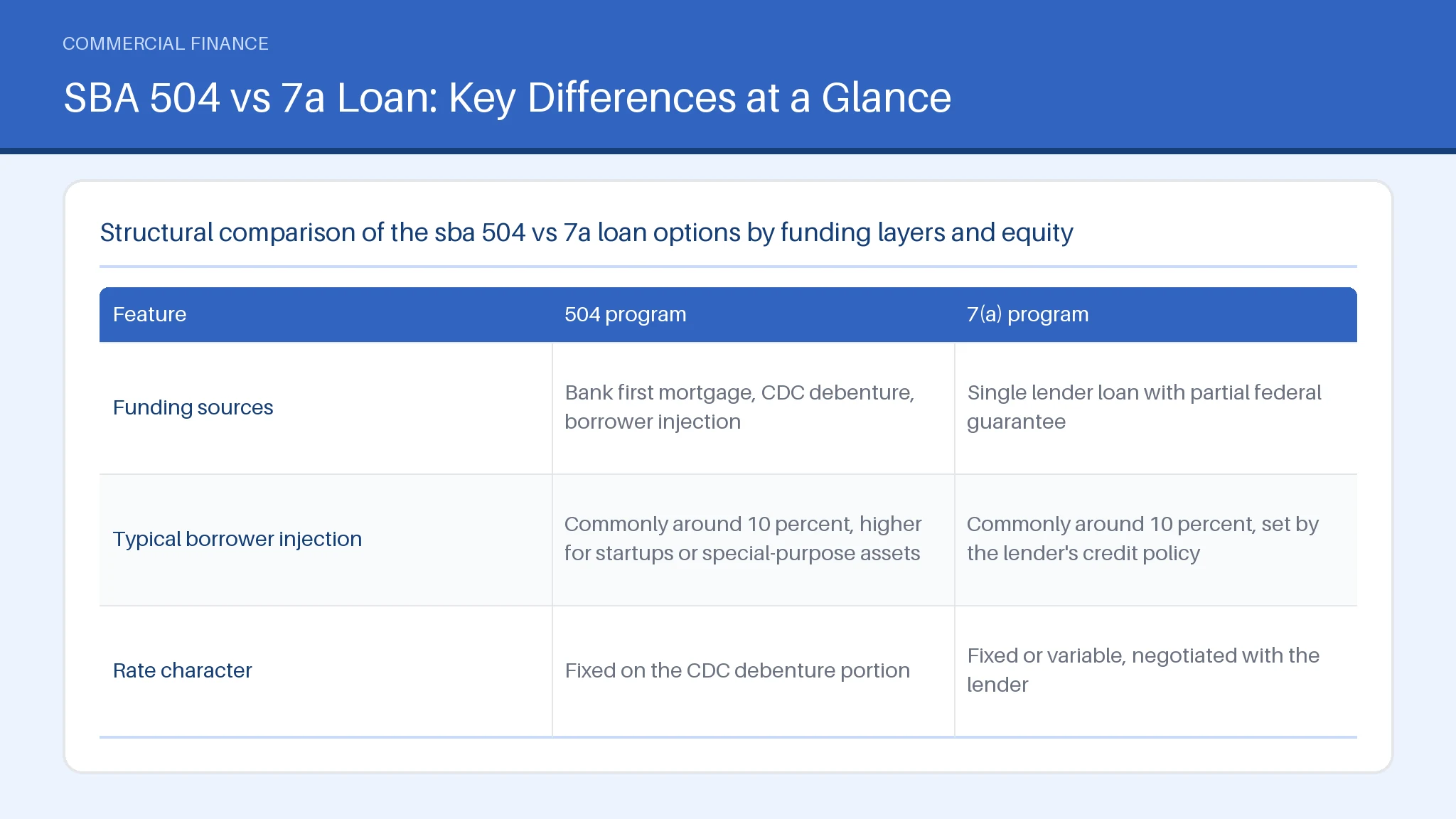
Structure is the clearest difference between SBA 7A and 504 loans. A 504 project layers a bank first mortgage, a CDC debenture and a borrower injection, while a 7(a) loan comes from one lender in a single note. That layering is also what separates SBA 504 loans from conventional CRE loans, where a single lender holds the whole position. Down payment requirement levels rise for a startup or special-purpose property, and an acquisition of a business rather than a building usually points away from 504.
| Feature | 504 program | 7(a) program |
|---|---|---|
| Funding sources | Bank first mortgage, CDC debenture, borrower injection | Single lender loan with partial federal guarantee |
| Typical borrower injection | Commonly around 10 percent, higher for startups or special-purpose assets | Commonly around 10 percent, set by the lender's credit policy |
| Rate character | Fixed on the CDC debenture portion | Fixed or variable, negotiated with the lender |
Maximum Loan Amounts Under the 504 and 7(a) Programs
The maximum 7(a) loan amount is $5 million, which caps the guaranteed exposure on a single facility. The 504 program works differently: the CDC debenture is capped per project, commonly $5 million and up to $5.5 million for qualifying manufacturing or energy projects, but the bank first mortgage sits on top of that, so total project size can run well past the debenture ceiling. That matters for larger real estate financing and for an acquisition of land plus building. Sizing also drives the SBA 504 vs 7A loan choice, and conventional CRE loan requirements differ again on equity.
Approval and Funding Timelines for 504 and 7(a) Loans
Timelines diverge because 504 deals need two credit approvals and a debenture funding cycle. The bank and the CDC each review the project, and the debenture settles on a monthly schedule after closing, so the bank often bridges the second position. A 7(a) file moves through one lending decision, which usually closes sooner. Compare document requirement lists early: appraisal, environmental review, inventory schedules and fixed asset invoices drive most delays. Differences between SBA 504 and conventional CRE loans show up here too, since conventional files skip agency review.
Choosing Between an SBA 504 and a 7(a) Loan for Your Business
Use of proceeds should decide the SBA 504 vs 7A question first. If the money buys a building your business will occupy long term, the 504 route fits, because the CDC portion carries a fixed rate on a long amortization. If you need working capital, inventory or a partner buyout alongside the property, one 7(a) facility is simpler. Also weigh collateral reach: a 7(a) lender can take broader business assets and personal guarantees, while conventional debt may require a larger asset base but fewer program conditions.
SBA 504 vs 7A Loan: Key Differences at a Glance
Five practical differences separate the two programs. The 504 route always involves a Certified Development Company alongside a bank, while 7(a) is one lender. Fixed pricing is standard on the CDC debenture, whereas 7(a) rates vary with the index and the lender's spread. Occupancy rules are strict on 504: you must occupy a majority of the building. Proceeds are narrower under 504 and broader under 7(a). Fee structures depend on loan size and program, and conventional debt follows its own pricing logic entirely.
When a 504 Loan Is the Stronger Choice
A 504 structure is the stronger choice when you are buying or building an owner occupied property you expect to hold for a decade or more. Long fixed pricing on the Certified Development Company debenture protects the payment against rate movement, and the bank first mortgage keeps the senior piece at conventional terms. Eligible projects can also refinance qualifying fixed asset debt. The federal guarantee on the debenture supports lender appetite. In an SBA 504 vs 7A loan comparison, the SBA loan program's 504 side wins on stability, while differences between SBA 504 and conventional CRE loans favor 504 on equity. Our guide to SBA 504 loan requirements goes deeper.
Working Capital, Equipment and Other 7(a) Loan Uses
Working capital is the use case 504 cannot serve. A 7(a) borrower can fund payroll during ramp-up, seasonal inventory swings, tenant improvements, soft costs and closing expense items that a fixed asset program excludes. Equipment with a shorter useful life also fits better here, since terms track the asset. The difference between SBA 7A and 504 loans becomes obvious in a mixed deal: buy an owner occupied building, install equipment and hold reserves under one note. A lender will still certify eligibility and size to cash flow, and a specialty project such as a car wash follows the same test.
How the 504 Program Finances Real Estate and Fixed Assets
The SBA 504 Loan Program finances fixed assets through a three-part split rather than a single facility. A bank or credit union takes roughly half the project cost in first position, the CDC debenture covers about 40 percent in second position with a government guaranteed bond behind it, and the borrower injects the balance. Eligible costs include land, existing buildings, ground-up construction, renovations, long-life machinery and some soft costs. Pricing sits on the debenture at a fixed rate set when the bond sells, and the bank piece is negotiated separately, so effective blended cost depends on both. Fees typically include a CDC processing fee, a servicing fee and standard closing costs, and interest rates, fees and terms in 504 financing differ from 7(a) financing because the guarantee attaches to a bond rather than to a lender's note. Compare SBA structures on blended cost, not on the debenture rate alone. Our finance guides and matching process explain the inputs lenders review. continue with the qualification form below.
Summary
Use of proceeds, occupancy and holding period settle the SBA 504 vs 7A loan question before pricing does. Independent lenders and CDCs set terms. CRE Loans USA matches your property details to finance providers who review the file. See common questions.
Frequently asked questions
What are the disadvantages of an SBA 504 loan?
The main drawbacks of a 504 loan are its narrow use of proceeds, the need for two approvals, a longer closing path and prepayment penalties during the early debenture years. It cannot fund working capital or inventory.
Who qualifies for an SBA 504 loan?
An operating for-profit US business that occupies at least 51 percent of an existing building, or 60 percent of new construction, and meets size and net worth limits can qualify. Owners generally provide personal guarantees.
Is SBA 7A or 504 better?
Neither is universally better. 504 suits long-hold owner occupied property with fixed pricing; 7(a) suits deals needing working capital, an acquisition or mixed uses under one note.
How much down payment do you need for an SBA 504 loan?
Borrowers commonly inject about 10 percent, rising to roughly 15 percent for a startup or a special-purpose property, and about 20 percent when both conditions apply.
What is the current SBA 504 interest rate?
Debenture rates reset with each monthly bond sale and vary with market yields, so check the current published rate rather than relying on an older figure.
Can you pay off an SBA 504 loan early?
Yes, though a declining prepayment penalty usually applies during the first half of the debenture term, and payoff is tied to the bond schedule.
How large can an SBA 504 loan be?
The CDC debenture is generally capped at $5 million, or $5.5 million for qualifying manufacturing and energy projects, but total project size can exceed that because the bank first mortgage sits above it.