To refinance commercial property is to pay off an existing mortgage with a new loan secured by the same asset. Owners do this for two reasons. The first is to improve the terms they are living with, such as a lower payment, a longer amortization, a fixed rate in place of a floating one, or the removal of a personal guarantee. The second is to take cash out, converting equity that has built up through rent growth, principal paydown, or capital work into money that can be deployed elsewhere.
The decision is rarely about interest rates alone. What actually governs the outcome is how the property performs today, how much of its value a lender will advance, and what it costs to exit the current debt. An owner with a stabilized building and clean financials can often refinance commercial property on materially better terms than the ones originally written, while an owner with vacancy or deferred maintenance may find the appraisal, not the rate sheet, sets the ceiling.
This guide walks through the mechanics, the qualifying factors, the real cost of closing, and the trade-offs that decide whether the exercise is worth doing at all.
Key takeaways
- To refinance commercial property means replacing an existing mortgage with a new one, either to improve terms or to pull out accumulated equity as cash.
- Cash-out proceeds are usually capped by loan-to-value limits and by the property's debt service coverage, so income performance matters more than the owner's personal balance sheet on most deals.
- Closing costs on a commercial refinance typically include appraisal, environmental review, legal work, title, and lender fees, and any prepayment penalty on the loan being retired.
- A fixed rate stabilizes payments, but many commercial structures still end in a balloon payment, so the exit plan should be set before closing.
- Timing usually beats rate shopping: refinancing after a lease-up, rent increase, or capital improvement program often unlocks more proceeds than waiting for a small rate move.
How Cash-Out Refinancing Turns Property Equity Into Cash
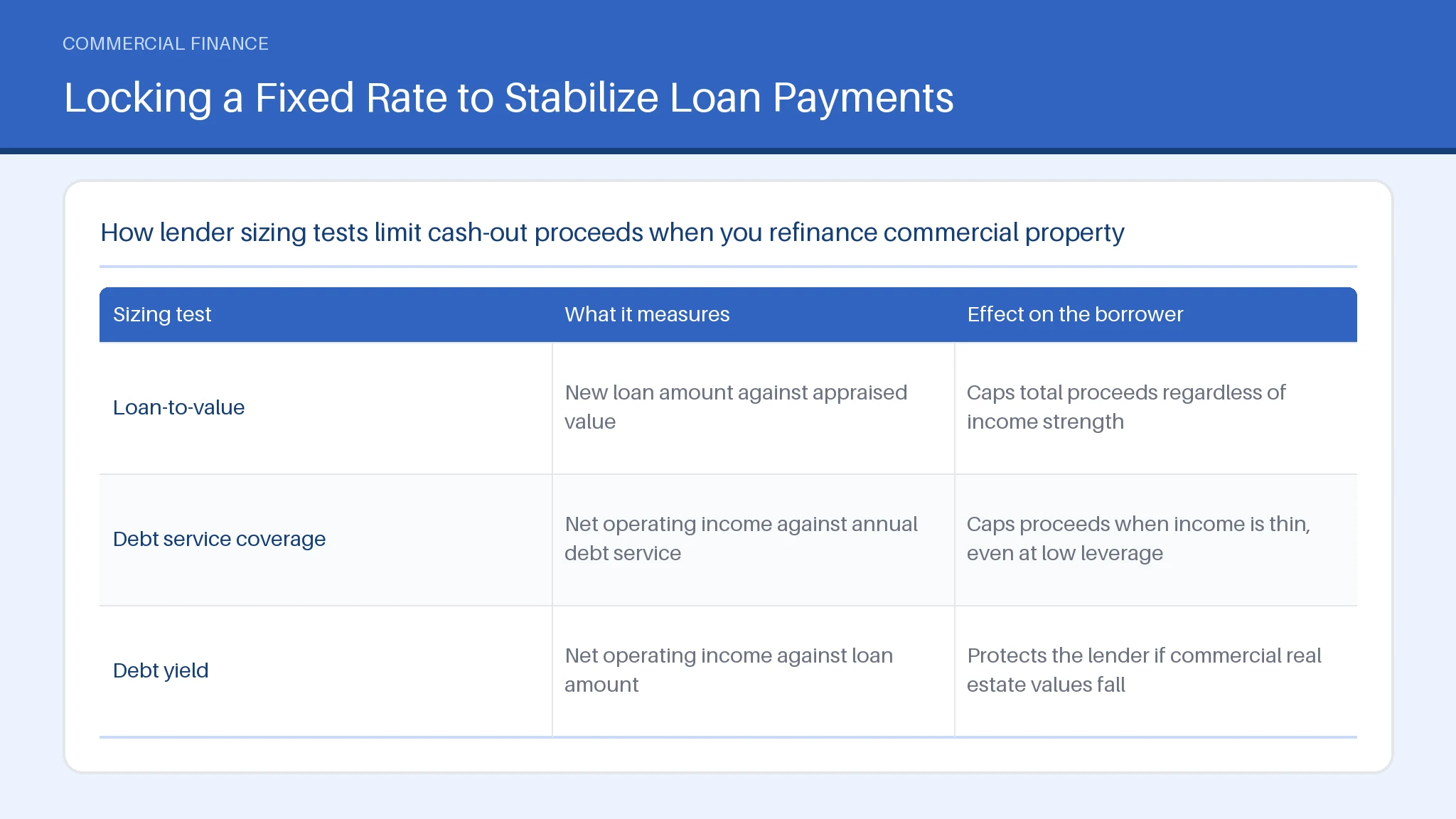
Cash-out refinancing releases equity by writing a new loan larger than the balance being retired and paying the difference to the owner. Equity accumulates in three ways: net operating income growth lifting appraised value, scheduled principal amortization reducing the balance, and market cap rate compression. A cash out refinance commercial investment property strategy monetizes that equity without triggering a sale, which is why many owners prefer refinancing to disposition. The proceeds figure is set by the lower of two tests a lender applies, and commercial property refinance loans are almost always sized by whichever test binds first.
| Sizing test | What it measures | Effect on the borrower |
|---|---|---|
| Loan-to-value | New loan amount against appraised value | Caps total proceeds regardless of income strength |
| Debt service coverage | Net operating income against annual debt service | Caps proceeds when income is thin, even at low leverage |
| Debt yield | Net operating income against loan amount | Protects the lender if commercial real estate values fall |
In practice, the binding test tells the borrower what to fix. A commercial real asset limited by coverage needs income work, not a bigger appraisal.
Benefits of Refinancing an Existing Commercial Mortgage
Refinancing an existing commercial mortgage delivers benefits that go well beyond a lower headline rate. Replacing a maturing mortgage removes near-term balloon risk, which is often the single largest exposure on a leveraged asset. Extending amortization from 20 years to 25 or 30 reduces the monthly expense even when the rate is unchanged, improving cash flow that can service other debt. A new mortgage can also release a co-guarantor, consolidate a second-position mortgage into one first mortgage, or reset covenants that no longer fit the business.
Owners also use commercial property refinance loans to restructure how a portfolio is held, moving from several small mortgages into a single facility with one reporting cycle. A cash out refinance on commercial property can fund a capital improvement program that raises rents and, in turn, supports the value the next mortgage will be written against.
The trade-off is real. To refinance commercial property is to reset the clock, pay costs again, and borrow against value that may not hold. Refinancing works best when the mortgage improvement is structural, not cosmetic.
Loan Options Available for a Cash-Out Commercial Refinance
A commercial cash-out refinancing is a loan that pays off the debt on an income-producing property and returns surplus proceeds to the owner at closing. To refinance a commercial loan simply means substituting a new obligation for the old one on the same collateral, and the loan category chosen determines the term, the rate structure, and how much flexibility the owner keeps.
Commercial cash-out refinance loans generally fall into a few broad categories. Bank and credit union loans tend to offer competitive pricing with recourse, shorter fixed periods, and ongoing covenants. Agency-backed multifamily loans favor stabilized apartment assets with long terms and non-recourse treatment. Conduit loan structures fix the rate for ten years and are typically non-recourse, but they restrict prepayment tightly; the mechanics are covered in our guide to CMBS loans. A bridge loan suits property still being repositioned, priced higher in exchange for speed and tolerance of an incomplete story. An SBA-eligible refinance loan can work for owner-occupied buildings where the business, not a tenant roster, carries the debt.
Key features of commercial cash-out refinancing are consistent across these categories: sizing by appraisal and coverage, escrow for taxes and insurance, and a defined limit on cash returned. The benefits of a commercial cash-out refinance are liquidity without a sale, deferral of capital gains that a sale would trigger, and a refinance loan structure matched to the current business plan rather than the one that applied when the exist loan was written.
Closing Costs and Fees on a Commercial Refinance
Closing cost on a commercial refinance is heavier than on residential debt because the diligence is heavier. A borrower should expect an appraisal, a Phase I environmental report, a property condition assessment, title and survey work, lender legal fees, an origination fee, and recording taxes that vary sharply by state. On commercial real estate loan files these third-party items are ordered early and are payable whether or not the deal closes.
The largest single item is often not a fee at all but the prepayment charge on the debt being retired. Yield maintenance and defeasance provisions on commercial real estate debt can exceed every other closing cost combined, which is why the payoff letter should be requested before any application is signed. Our explainer on prepayment penalty costs sets out the math.
One overlooked detail: a lender may require the new loan to clear a looming balloon payment early, and a commercial real estate borrower who waits until the final 90 days loses negotiating leverage. Documents carrying a lender logo do not fix pricing, so read the term sheet as a proposal. Deciding to refinance commercial property should follow a full cost tally, not a rate comparison.
Locking a Fixed Rate to Stabilize Loan Payments
A fixed-rate loan stabilizes debt service by holding the coupon constant for a defined period, which makes budgeting and distributions predictable. Floating loan pricing moves with an index, so a rate increase raises the loan payment and compresses coverage on a loan sized when money was cheaper. Owners who refinance commercial property into a fixed structure are buying certainty, and that certainty has a price: tighter prepayment terms on the new loan and less freedom to sell or refinance again mid-term.
The fixed period rarely matches the amortization schedule. A commercial real estate loan may amortize over 25 years but fix the rate for five, seven, or ten, with the balance due as a balloon at the end of the loan term. Matching the fixed period to the hold period is the practical rule. A five-year fixed loan on an asset you intend to own for fifteen years simply moves refinancing risk down the road, and a ten-year fixed loan on a property you plan to sell in three can make a cash out refinance expensive to unwind. Loan structure should follow the business plan.
Requirements to Refinance Commercial Property: LTV, Credit and Documents
Traditional commercial refinance loans are underwritten against the property first and the sponsor second. To refinance commercial real estate means proving that the asset generates enough income to service the proposed debt, and the core requirement set reflects that. Most stabilized files are sized to a loan-to-value ceiling in the 65 to 75 percent range, with cash-out requests generally held to the lower end, and to a minimum debt service coverage ratio the lender sets by property type. Our breakdown of the debt service coverage ratio shows how that calculation works line by line.
The second requirement is sponsor credit. Personal credit scores, liquidity after closing, net worth relative to the loan amount, and prior loan performance all get reviewed, and a recent default or unresolved litigation can stop a refinance loan regardless of property quality.
The document requirement list is predictable: two to three years of operating statements, a current rent roll, executed leases, trailing twelve-month income, tax returns for the entity and guarantors, a personal financial statement, entity formation documents, insurance certificates, and a schedule of real estate owned. Whether you should refinance your commercial property depends on comparing the total cost of the new refinance loan against the measurable benefit, whether that is proceeds, extended term, or removed balloon risk. If the benefit does not clearly exceed the cost, holding the current loan is a legitimate answer. continue with the qualification form below.
The Commercial Refinance Process From Application to Closing
The commercial refinance process runs in five recognizable stages and typically takes 45 to 90 days on a stabilized asset. It starts with packaging: rent roll, trailing income, and a payoff letter showing any prepayment charge. A lender then issues a term sheet setting the new loan amount, rate structure, repayment schedule, and conditions. Third-party reports come next, and an appraisal below expectations is the most common point where proceeds shrink.
Underwriting follows, where the file is tested against coverage and leverage limits and the borrower answers questions about tenant credit, capital improvement history, and any deferred maintenance. Legal documentation and closing complete the process, with the old debt paid off through escrow.
Knowing how to refinance commercial property well is mostly about sequencing. An investor who orders reports before the term sheet is final risks paying twice, and a commercial real owner who lets leases roll during underwriting invites a re-trade. To refinance commercial real estate cleanly, freeze the story: no new vacancies, no unfunded capital projects, no unexplained transfers. Commercial real estate lenders reprice on surprises.
Reinvesting Released Equity Into Growth and New Acquisitions
Released equity is most productive when it funds an asset that earns more than the debt costs. A cash out refinance that pulls $800,000 of equity at a blended cost of 7 percent creates value only if the next deal, expansion, or capital project clears that hurdle after taxes and reserves. Owners who borrow against one stabilized building to seed a down payment on another are effectively using the first property's equity as growth capital, and lending markets price that risk into the new loan.
The limitations deserve equal weight. A cash out refinance raises leverage across the whole position, so a downturn hits a thinner equity cushion. It also usually resets a balloon payment date, and a lender that funded the proceeds will expect a credible refinance or sale plan at maturity. Commercial property refinance rates quoted on a term sheet under a lender logo are indicative until locked, so proceeds should never be committed to a purchase contract before rate lock. Understanding how to refinance commercial property responsibly means sizing proceeds to the plan, not to the maximum offered.
Using Refinance Proceeds to Fund Renovations and Raise Rents
Renovation-funded rent growth is the most self-reinforcing use of refinance proceeds. A cash out refinance on commercial property that funds unit turns, HVAC replacement, facade work, or common-area upgrades can support higher asking rents, and higher net operating income raises the value the next estate loan is written against. A borrower running this play should model the rent premium per dollar spent, the downtime during the work, and the lease expiration schedule that allows repricing.
Documentation matters here. A lender reviewing a cash out refinance commercial investment property request wants a scope of work, contractor bids, a reserve for overruns, and evidence that comparable renovated space in the submarket actually achieves the projected rent. Some lenders escrow proceeds and release them against completed work rather than funding the full amount at closing.
Commercial property refinance rates on a fixed rate loan are set at closing, so the improvement program must pencil at that cost. An investor who replaces an exist loan and then underdelivers on renovations carries the higher payment without the income. Disciplined investor teams stage the work, verify the premium, and only then extend the approach across a portfolio, which is how a borrower keeps future credibility with each lender.
Summary
Refinancing works when the numbers justify it: proceeds limited by leverage and coverage, costs including any prepayment charge, and a fixed period matched to the hold. CRE Loans USA is a lender-matching service that passes property and deal details to independent third-party finance providers, who make all lending and pricing decisions. Start by confirming what your property supports.
Frequently asked questions
What is the monthly payment on a $1,000,000 commercial loan?
The monthly payment on a $1,000,000 commercial loan depends on the rate and the amortization schedule, not the loan size alone. At 7 percent over 25 years the payment is roughly $7,070; over 20 years at the same rate it is about $7,753. Interest-only periods lower the payment temporarily but leave the full balance outstanding at maturity.
What is the 2% rule for refinancing?
The 2 percent rule is a rough screen suggesting a refinance is worth examining once the available rate sits about two percentage points below the current one. It is a starting filter rather than a decision, because commercial deals turn on prepayment charges, closing costs, term extension, and proceeds, all of which can outweigh the rate gap in either direction.
How much does it cost to refinance a $300,000 loan?
Refinancing a $300,000 loan on commercial property typically costs 2 to 5 percent of the balance, or roughly $6,000 to $15,000, covering appraisal, environmental review, title, legal work, and origination. Small balances carry proportionally higher costs because third-party report fees are largely fixed.
What disqualifies you from refinancing?
Weak property income, high leverage against a low appraisal, recent bankruptcy or default, unresolved title or environmental issues, expired leases, and insufficient post-closing liquidity are the common disqualifiers. Preparing a property for refinancing means fixing those items first: stabilize occupancy, document rent increases, clear deferred maintenance, and assemble clean operating statements.
How much does it cost to refinance a $500,000 mortgage?
Refinancing a $500,000 commercial mortgage generally runs $10,000 to $25,000 in costs, plus any prepayment penalty on the debt being retired.
What credit score is needed to refinance?
Most commercial lenders look for personal credit scores in the high 600s or above from guarantors, though property performance carries more weight than any single score.
What is the best time to refinance?
The best time to refinance is after income has stabilized and before a balloon comes due, ideally with nine to twelve months of runway. Refinancing is worth it when the measurable benefit exceeds total cost.