
CMBS loans are commercial real estate loans that a lender originates with the intent to pool them with other loans and sell them to bond investors. If you are researching CMBS loans, you are usually weighing a fixed-rate, longer-term option against a traditional bank loan for a stabilized, income-producing property. Understanding how the structure works helps a borrower decide whether the lower cost of capital is worth the reduced flexibility.
The name is shorthand for commercial mortgage-backed securities. A property owner takes out a first-position mortgage, and the loan is later packaged into a security that trades on the secondary market. Because the debt is designed to be sold rather than held on a balance sheet, the terms tend to follow standardized rules rather than case-by-case negotiation. That trade-off shapes everything from pricing to prepayment.
This guide explains how the structure functions, which property types fit, how repayment and servicing work, and where the practical limitations show up. CRE Loans USA is a lead-generation and lender-matching resource, so the goal here is to help you understand the mechanics, not to sell you a product. You can also explore our commercial real estate finance guides for related structures and terminology.
Key takeaways
- CMBS loans are commercial property loans that get pooled and sold to bond investors on the secondary market, which is why they are also called conduit loans.
- They usually carry fixed interest rates, are secured by a first-position mortgage, and are structured as non-recourse debt with standard carve-outs.
- Stabilized income-producing assets such as retail, office, industrial, hotel, and multifamily properties are the typical fit.
- Prepayment is restricted through defeasance or yield maintenance, so borrowers should weigh flexibility against the lower cost of capital.
- CRE Loans USA is a lender-matching service, not a lender; it helps borrowers see which financing structures may fit before they compare offers.
What Are CMBS Loan Options and How Do They Work?
A CMBS loan is a commercial mortgage secured by a first-position lien on the underlying property, which serves as the collateral. After a lender originates the loan, it is combined with hundreds of other loans and turned into a commercial mortgage-backed security. Bond investors buy tranches of that pool, and their required yield helps set the fixed interest rate a borrower pays. This is why the structure is often described using the phrase back security cmb: the property loans back the security that trades in the market.
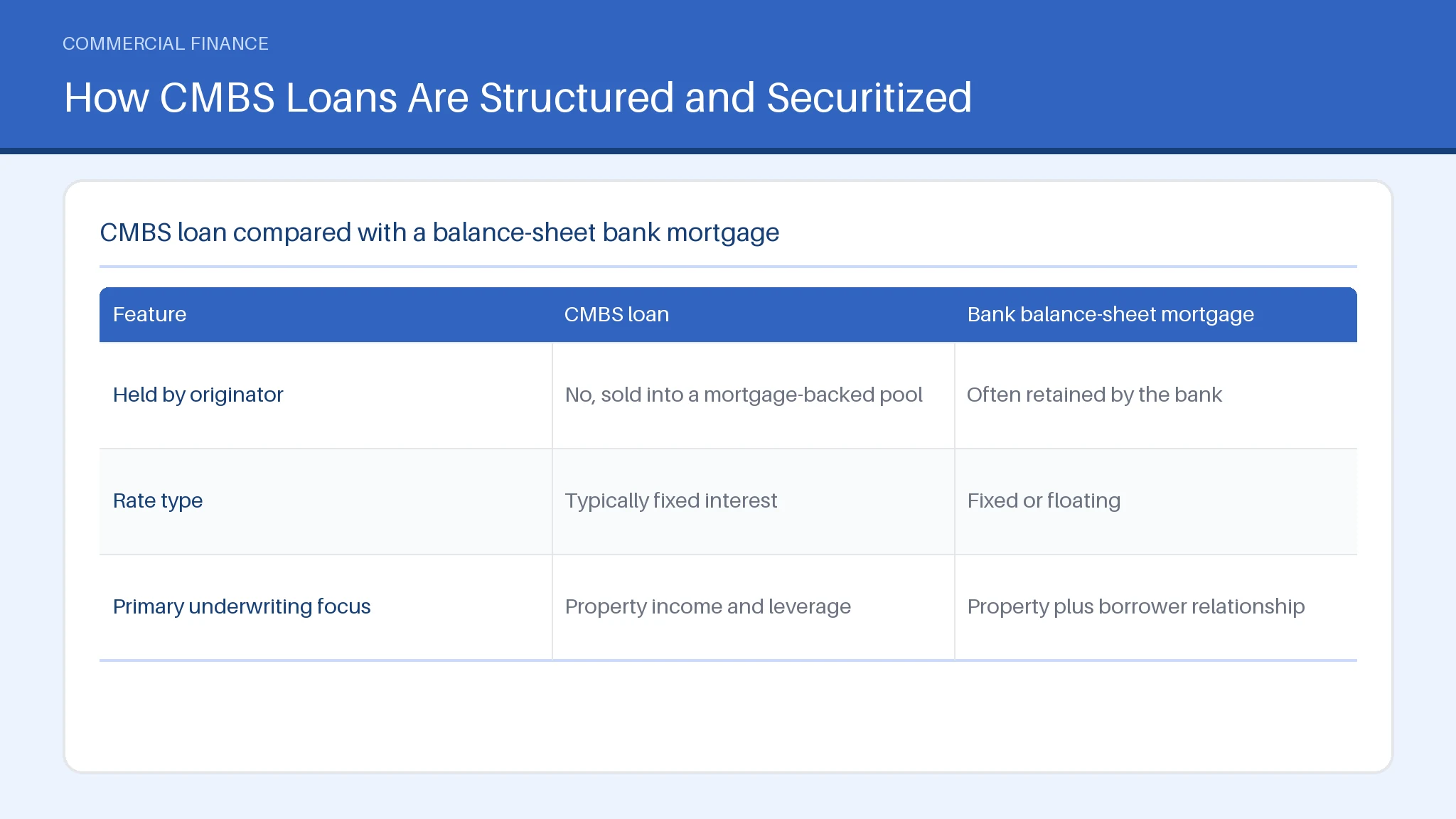
Because a bank does not keep the debt on its books, the lending decision leans on the property's cash flow and value more than the sponsor's balance sheet. That reliance on the asset is central to how these deals are underwritten and how default risk is priced across the security cmb pool. The table below compares a CMBS loan with a conventional mortgage held by a bank.
| Feature | CMBS loan | Bank balance-sheet mortgage |
|---|---|---|
| Held by originator | No, sold into a mortgage-backed pool | Often retained by the bank |
| Rate type | Typically fixed interest | Fixed or floating |
| Primary underwriting focus | Property income and leverage | Property plus borrower relationship |
The commercial mortgage back structure means residential-style flexibility is limited once the loan closes.
Which Property Types Qualify for CMBS Financing?
CMBS loans work best for stabilized, income-producing commercial property. A lender pooling loans into a commercial mortgage-backed security wants predictable cash flow, so the asset usually needs a track record of occupancy and rent collection. Typical property types include multifamily apartments, office, retail centers, industrial and warehouse space, self-storage, and hospitality. Unlike a residential mortgage on a single home, the security cmb structure is built around commercial cash flow rather than a homeowner's income.
Because the mortgage back model prices risk on the property, a borrower with limited operating history can still qualify if the building performs. Lenders evaluate leverage through loan-to-value and debt service coverage, and they expect meaningful equity in the deal. Ground-up construction and heavy value-add projects are generally a poor fit, since a mortgage-backed security favors liquidity and stability over speculative upside.
If you are unsure whether your asset fits this type of financing, review how CRE loan matching works before comparing options. A commercial mortgage under this model rewards clean, well-documented income more than aggressive projections, and a bank conduit desk will focus on what the property actually produces today.
Key Benefits of Using CMBS Loans for Investors
The main draw of CMBS loans is access to competitive fixed interest rates and higher leverage than many balance-sheet options offer. Because the debt is sold as a commercial mortgage-backed security, pricing follows bond-market demand rather than a single bank's appetite, which can benefit a borrower with a strong asset. The commercial mortgage back structure spreads risk across many loans, and that diversification supports pricing that is often attractive relative to the collateral involved.
Another benefit is the non-recourse nature of most deals. In a standard non-recourse structure, the property is the primary collateral and the borrower's other assets are generally shielded, subject to standard bad-boy carve-outs. This is a meaningful difference from full-recourse bank debt. The phrase back security cmb captures why lenders can extend these terms: the mortgage-backed security absorbs risk across the pool.
Longer fixed terms also improve liquidity planning, since payments stay predictable for years. For investors holding stabilized property, a mortgage back structure can free up cash for other opportunities while keeping the underlying asset financed on stable terms.
Making Commercial Property Financing Simple and Accessible
One reason CMBS loans became popular is that the standardized process makes commercial financing more accessible to a wider range of borrowers. Because a bank conduit desk follows consistent rules when packaging loans into a commercial mortgage-backed security, the terms are more predictable, and that predictability helps borrowers compare a real estate loan across different sources. The commercial mortgage back model also broadens the pool of capital, since bond investors, not just deposit-funded banks, ultimately fund the debt.
Standardization has trade-offs. Once a loan enters the mortgage-backed security, changing terms or negotiating a workaround becomes harder, which matters if a borrower later wants to refinance or restructure. Equity requirements and default provisions are set upfront and rarely bend. Still, for a stabilized property, this structure can deliver dependable financing without the relationship hurdles of some lenders.
Matching services help here. CRE Loans USA connects borrowers with independent providers so you can weigh a mortgage back option against alternatives. To gauge fit before comparing, continue with the qualification form below.
How CMBS Loans Are Structured and Securitized
Securitization is what defines CMBS loans. A lender originates individual commercial mortgages, then a sponsor pools them and works with rating agencies to securitize the pool into a commercial mortgage-backed security. Investors buy tranches with different risk and yield profiles, and the underlying loans serve as collateral. This process is similar in concept to a residential mortgage-backed security, but the loans are larger, fewer, and tied to commercial cash flow.
The pool is divided so that senior tranches get paid first and junior tranches absorb losses if borrowers default. That waterfall is why the back security cmb structure can offer competitive pricing: risk is layered rather than concentrated. Once loans are in the security cmb pool, servicing is handled by third parties, and any request to modify or refinance runs through a defined process rather than a direct lender conversation.
Most deals are non-recourse, so the collateral property carries the risk. A borrower should understand that the real estate loan is now an asset owned by many investors, which is exactly why default and prepayment rules are so tightly defined.
The Role of Loans in Commercial Real Estate Markets
Commercial mortgage debt keeps real estate markets liquid. When a lender can sell a real estate loan into a mortgage-backed pool, capital recycles quickly and more money becomes available for new deals. That flow matters to owners who need equity for acquisitions or repositioning, and it explains why the mortgage back market is watched as a signal of broader credit conditions. A single commercial mortgage on its own is illiquid, but a mortgage-backed security turns many such loans into tradable instruments.
Underwriting discipline shapes the market. Lenders size loans using loan-to-value and coverage ratios, and the back security cmb structure prices default risk into each tranche. Because most CMBS debt is non-recourse, the collateral property is the primary protection, unlike a typical residential mortgage where a homeowner is personally liable.
For investors, understanding this market helps time decisions. When bond demand is strong, an estate loan on a stabilized property can be cheaper. To learn related valuation concepts, see our guide on estimating after-repair value.
How Borrowers Repay and Service a CMBS Loan
Once a borrower closes a CMBS loan, repayment runs through a servicer rather than the original lender. A master servicer collects the monthly commercial mortgage payments, and a special servicer steps in only if a borrower struggles or defaults. This split matters, because a borrower who wants to change terms cannot simply call the desk that issued the estate loan. Every request follows the servicing agreement that governs the pool.
Most CMBS structures amortize on a long schedule with a balloon at maturity, so a borrower makes level payments and then repays or refinances the remaining balance. A borrower should plan for that balloon early, since the property must still perform when the loan comes due. Unlike a residential mortgage, where a borrower often prepays freely, a borrower here faces defined restrictions.
A disciplined borrower keeps clean financials, because the servicer reviews performance throughout the term. When a borrower needs relief, the special servicer evaluates options, but a borrower has less direct control than with a relationship mortgage. Understanding servicing before a borrower signs helps that borrower avoid surprises, since a borrower who assumes bank-style flexibility can be caught off guard by how strictly the process protects investors.
Loan Terms, Rates, and Prepayment Rules Explained
CMBS loan terms are more rigid than typical bank debt, and prepayment rules are the clearest example. Most commercial mortgage-backed structures block a simple payoff. Instead, a borrower faces either defeasance, where the loan is replaced with government securities, or yield maintenance, a prepayment penalty that compensates investors for lost interest. Either way, prepayment is expensive, so a borrower should model the cost before assuming an early exit is realistic. This prepayment protection is what makes the fixed cash flow attractive to bond buyers, and it is why a prepayment analysis belongs in every deal review.
Rates are usually fixed for a five, seven, or ten year term, with a long amortization and a balloon at maturity. Because a commercial mortgage in this format prices off the bond market, the lender passes investor demand through to the borrower. Terms are set by independent lenders, not by a matching service.
The asset drives the size of the loan, and lending desks weigh residential-style flexibility against the discipline that this structure requires. Comparing a lender's payoff terms early prevents costly surprises later.
Summary
CMBS loans give owners of stabilized commercial property access to fixed-rate, non-recourse financing funded by bond investors, in exchange for strict prepayment and servicing rules. Weigh the lower cost of capital against reduced flexibility before committing. CRE Loans USA is a lender-matching service that helps borrowers understand these structures and compare independent providers, so review the mechanics and check your fit early.
Frequently asked questions
What are the disadvantages of a CMBS loan?
The main drawbacks are inflexibility and cost of exit. Once a borrower closes, changes run through a servicer, and prepayment usually requires defeasance or yield maintenance, both of which can be expensive. Terms are standardized, so a borrower has limited room to negotiate after the loan enters the securitized pool.
What is a CMBS loan?
A CMBS loan is a commercial real estate loan secured by a first-position mortgage that is pooled with other loans and sold to investors as a commercial mortgage-backed security. It typically carries a fixed rate and is designed for stabilized, income-producing property rather than speculative development.
What is the minimum loan amount for CMBS?
Minimums vary by provider, but conduit lenders commonly focus on loans starting around one to two million dollars, with many transactions well above that. Smaller deals often do not fit the securitization model, since pooling favors larger, cash-flowing assets.
Are CMBS loans interest only?
Some Loans include an interest-only period, and a few are fully interest-only for the term, but many amortize on a long schedule with a balloon at maturity. The structure depends on leverage, property performance, and what the lender and investors require, so a borrower should confirm the amortization terms before closing.