Real estate cap rate analysis answers one direct question: what annual return would a property produce if you bought it in cash today? The capitalization rate divides a property's net operating income by its price or value, then states the result as a percentage. A building generating $80,000 in net operating income at a $1,000,000 price carries an 8 percent cap rate. That single figure lets you weigh very different deals against each other in seconds.
Investors lean on this metric because it strips out financing and focuses on the asset itself. It reflects income relative to price, not the size of your down payment or your loan terms. Understanding cap rate math also clarifies where a deal sits on the risk spectrum, since higher rates and lower rates each tell a story. In the sections below you will learn how to calculate the number, how to read it, and how to use it when comparing multifamily and other commercial properties. For deeper context on financing, see our commercial real estate finance guides.
Key takeaways
- The cap rate is net operating income divided by property value, expressed as a percentage, and it lets you compare properties on a level footing.
- A high cap rate often signals higher return potential paired with more risk, while a low cap rate usually reflects a stable asset in a strong market.
- There is no universal good cap rate. The right benchmark depends on property type, location, and how you weigh income against appreciation.
- Accurate results start with clean numbers, so verify rental income and every operating expense before you calculate.
What Is a Cap Rate in Real Estate Investing?
In real estate investing, a cap rate measures the unleveraged annual yield an asset produces. You take net operating income, or NOI, which is rental income minus each operating expense, and divide it by the property value. The result reflects how hard the property works before any mortgage payment. A cap rate figure does not include loan costs, appreciation, or your tax situation, which is exactly why it isolates the property's own performance.
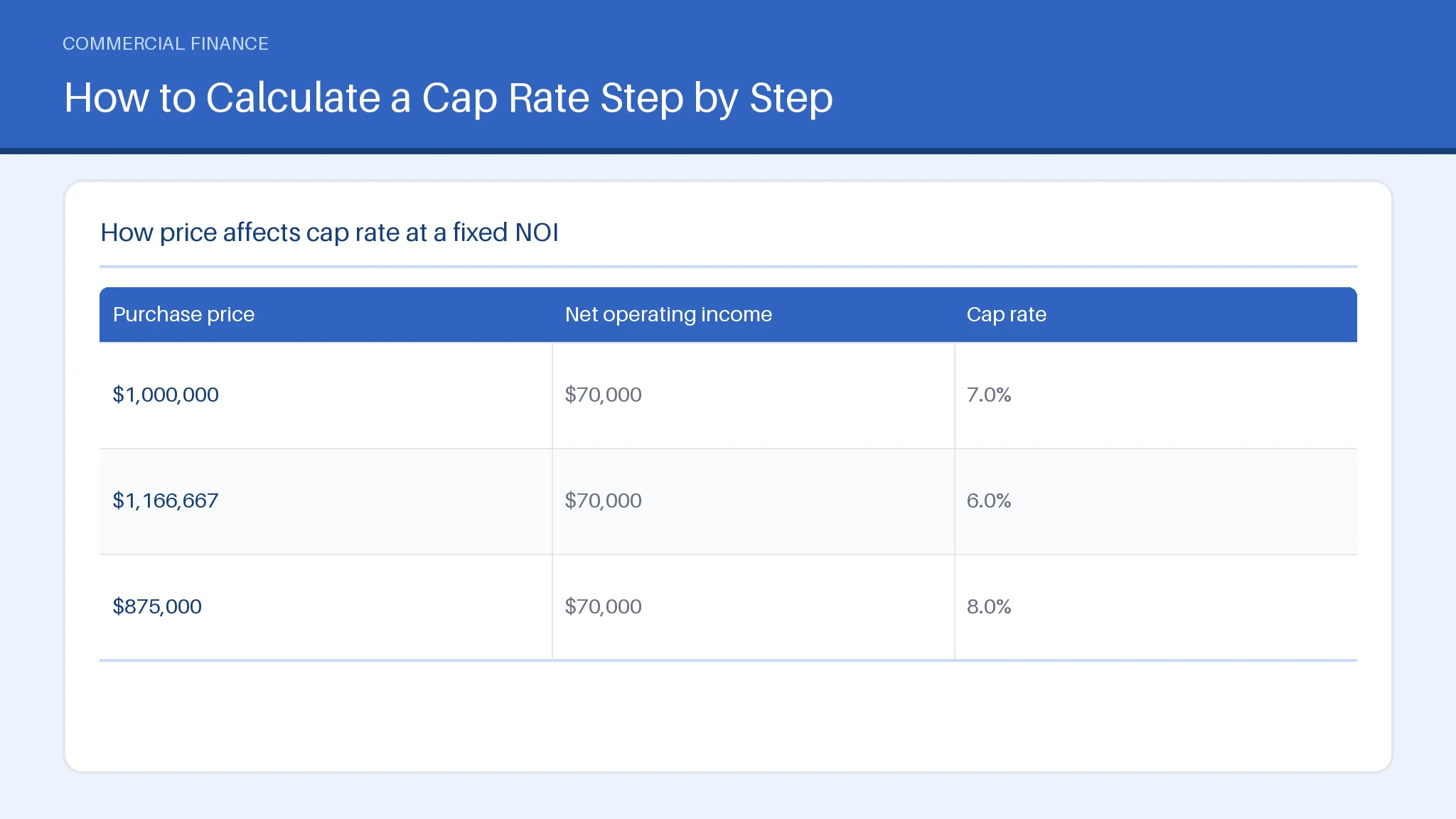
The table below shows how the same NOI produces different cap rates as price changes.
| Purchase price | Net operating income | Cap rate |
|---|---|---|
| $1,000,000 | $70,000 | 7.0% |
| $1,166,667 | $70,000 | 6.0% |
| $875,000 | $70,000 | 8.0% |
As the price rises, the cap rate falls, even when rental performance holds steady.
Why Cap Rates Matter for Multifamily Property Investors
For a multifamily investor, the cap rate is a quick sanity check on price. Apartment buildings trade heavily on income, so a cap rate reading tells an investor whether the asking price lines up with the rents the property actually earns. When one investor pays a higher price for the same NOI, the cap rate drops, and that gap should reflect something real, such as a better location or lower turnover.
The metric also helps an investor spot upside. If rental income sits below market, a hands-on investor can raise rents, trim costs, and push NOI higher, which lifts value at any given cap rate. This is why an experienced investor treats the current cap rate as a starting point rather than a verdict. It reflects today's numbers, not the stabilized ones a savvy operator can reach after a focused management plan.
What Every Buyer Should Know About Cap Rate Inputs
Every buyer should know that a cap rate number is only as reliable as the inputs behind it. A seller's pro forma may show a clean estimate built on best-case rents and a thin expense line. A careful buyer rebuilds the figure using actual bank statements, tax returns, and each operating expense the property really carries, from insurance to management fees.
What counts as a good cap rate depends on the market and the property type. A stabilized suburban asset and a value-add urban building will not share the same benchmark. The right answer also depends on your goals, since some investors accept a lower yield for stability while others chase income. Before you trust any headline figure, confirm that every expense is present and that the estimate reflects normal operations, not a single strong quarter.
Running a Cap Rate Calculation by Hand
A cap rate calculation is simple enough to run on paper. Start with NOI, which is your annual income after every operating cost but before debt. Divide that by the price or value, then multiply by 100. That is the whole calculation, and it makes this metric one of the fastest tools in commercial analysis.
Do not confuse gross income with NOI. Gross rent flatters the number and hides the costs that shape real returns. A cap rate figure built on gross income overstates yield and can make a weak deal look strong. A low cap rate that is genuine still beats a high one built on inflated inputs. Treat this metric as a screening tool, then verify the underlying estimate with real documents before you move a promising property forward.
How to Calculate a Cap Rate Step by Step
To calculate a cap rate, work in a fixed order so nothing slips. First, calculate annual gross income from all rents and any other property revenue. Second, calculate total operating costs, including property taxes, insurance, maintenance, and management, but leave the mortgage out. Third, subtract costs from income to calculate NOI. Fourth, divide NOI by the price and multiply by 100 to calculate the rate.
Following this sequence keeps you honest. A common error is dropping property taxes or reserves from the cost side, which inflates NOI and hides a low cap rate behind an optimistic figure. Run the steps the same way every time and your comparisons stay consistent from one deal to the next, which is the entire point of the exercise.
Calculating a Cap Rate From Net Operating Income
To calculate cap rate from net operating income, you first need a defensible NOI. Build it from its components: collected rents minus vacancy, then minus each recurring cost such as property taxes, insurance, utilities, repairs, and management. What remains is NOI, the figure that drives the whole calculation.
Once NOI is set, calculate the cap rate by dividing it by the purchase price. If a property produces $90,000 in NOI at a $1,200,000 price, the calculation yields 7.5 percent. Because this metric depends entirely on NOI, small changes in cost assumptions swing the result. Add a $10,000 reserve you forgot, and the NOI drops, pulling the rate down with it. That sensitivity is why a clean, documented NOI matters more than a tidy headline percentage.
Using Cap Rates to Compare Investment Properties
Cap rates shine when you line up several properties at once. Because you calculate the figure the same way each time, it puts each asset on a shared scale regardless of price or size. To compare fairly, calculate cap rate on each deal using consistent NOI rules, so no property gets credit for leaving out an expense the others include.
Run the calculation, then divide each property's NOI by its price and lay the results side by side. If two buildings show the same rate, the tiebreaker moves to factors the number cannot capture, such as lease quality, tenant mix, and capital needs. When you calculate cap rates consistently, a difference in the rate points to a difference in risk or upside, not a difference in how you did the math. Confirm each NOI reflects real expense data before you trust the ranking.
The Cap Rate Formula Explained With Worked Examples
The cap rate formula is NOI divided by value. That formula rearranges two more ways: value equals NOI divided by the rate, and NOI equals value times the rate. Knowing all three versions of the formula lets you solve for price when you set a target return, which is useful when you make an offer.
Worked example one: a rental property earns $60,000 NOI and sells for $750,000. The formula gives an 8 percent cap rate, a relatively high cap rate that may reflect more risk. Example two: the same $60,000 NOI at a $1,200,000 price gives 5 percent, a lower figure some call a good cap rate for a premium asset in a strong market. The formula does not judge which is better; it simply shows how price and income relate. Use the formula to test scenarios, then weigh each expense and location factor before you decide.
Key Takeaways on Capitalization Rates for Investors
For any investor, the capitalization rate is a lens, not a verdict. It reflects income against price for a single asset at a single moment. A disciplined investor pairs the capitalization rate with a full review of each expense, lease term, and capital plan before committing. Capitalization math rewards clean inputs and punishes optimistic ones.
There is no single good cap rate that fits every deal. A stabilized asset in a top market may trade at a low capitalization rate and still suit a cautious investor, while a value-add building at a higher rate may fit an investor who wants income and can manage risk. Treat the capitalization rate as one input among several, verify the expense side, and let the numbers guide a decision rather than make it for you. That habit separates a reactive buyer from a deliberate investor.
Summary
Cap rates compare properties by weighing net operating income against price, but the number is only as strong as its inputs. Verify every expense, use consistent NOI rules, and read the rate as risk and upside. When you are ready to finance a property, CRE Loans USA can match you with independent commercial lenders. continue with the qualification form below.
Frequently asked questions
What is a good cap rate in real estate?
A good cap rate depends on the property type, location, and your goals. Many stabilized commercial and multifamily assets trade in a range roughly between 5 and 8 percent, but a strong market can support a lower figure while a riskier deal may need a higher one. Compare any property against similar recent sales rather than a fixed target.
What is a 7.5% cap rate?
A 7.5 percent cap rate means the property is expected to produce annual net operating income equal to 7.5 percent of its price before financing. On a $1,000,000 purchase, that implies about $75,000 of NOI. It sits in a middle range that many investors read as a reasonable balance of income and risk, though the underlying numbers still need verification.
What is the 7% rule in real estate?
The 7 percent rule is an informal screening habit some investors use to filter deals, passing on properties that fall below a 7 percent cap rate for their market. It is a rough shortcut, not a standard, and a lower rate can still make sense for a high-quality asset with strong tenants and clear upside.
What does a 3% cap rate mean?
A 3 percent cap rate means the property produces only 3 percent of its price in net operating income each year. That very low figure usually reflects a premium location, strong appreciation expectations, or a highly stable asset. Investors accept it when they value security and long-term growth over current income.