
There is no single current commercial loan rate. Almost every commercial mortgage is quoted as an index plus a spread: the index is a market benchmark the lender does not control, commonly a Treasury yield matched to the loan term, a swap rate, SOFR, or an internal cost-of-funds measure, and the spread is the lender's compensation for credit risk, servicing, capital requirements, and profit. When rates "move" this week, that is the index. When two lenders quote the same property differently on the same day, that is the spread.
Your spread is driven mainly by the property: debt service coverage ratio, loan-to-value, property type and the durability of its income, lease rollover and tenant credit. Sponsor track record, liquidity, net worth, recourse structure, loan size, and the term and prepayment structure you choose all feed in as well. Two borrowers looking at the same building on the same afternoon can be quoted differently because one is putting in more equity or has operated the asset class for a decade.
Which lender channel your deal belongs in matters as much as negotiation. Banks and credit unions, SBA 504 and 7(a), agency multifamily, CMBS conduits, life companies, and bridge or debt fund lenders price the same risk against different capital costs. To compare honestly, ask each lender for the index and spread separately, any rate floor, when the rate locks, the amortization schedule and balloon, and the prepayment formula, then price the whole package over the period you actually expect to hold the property.
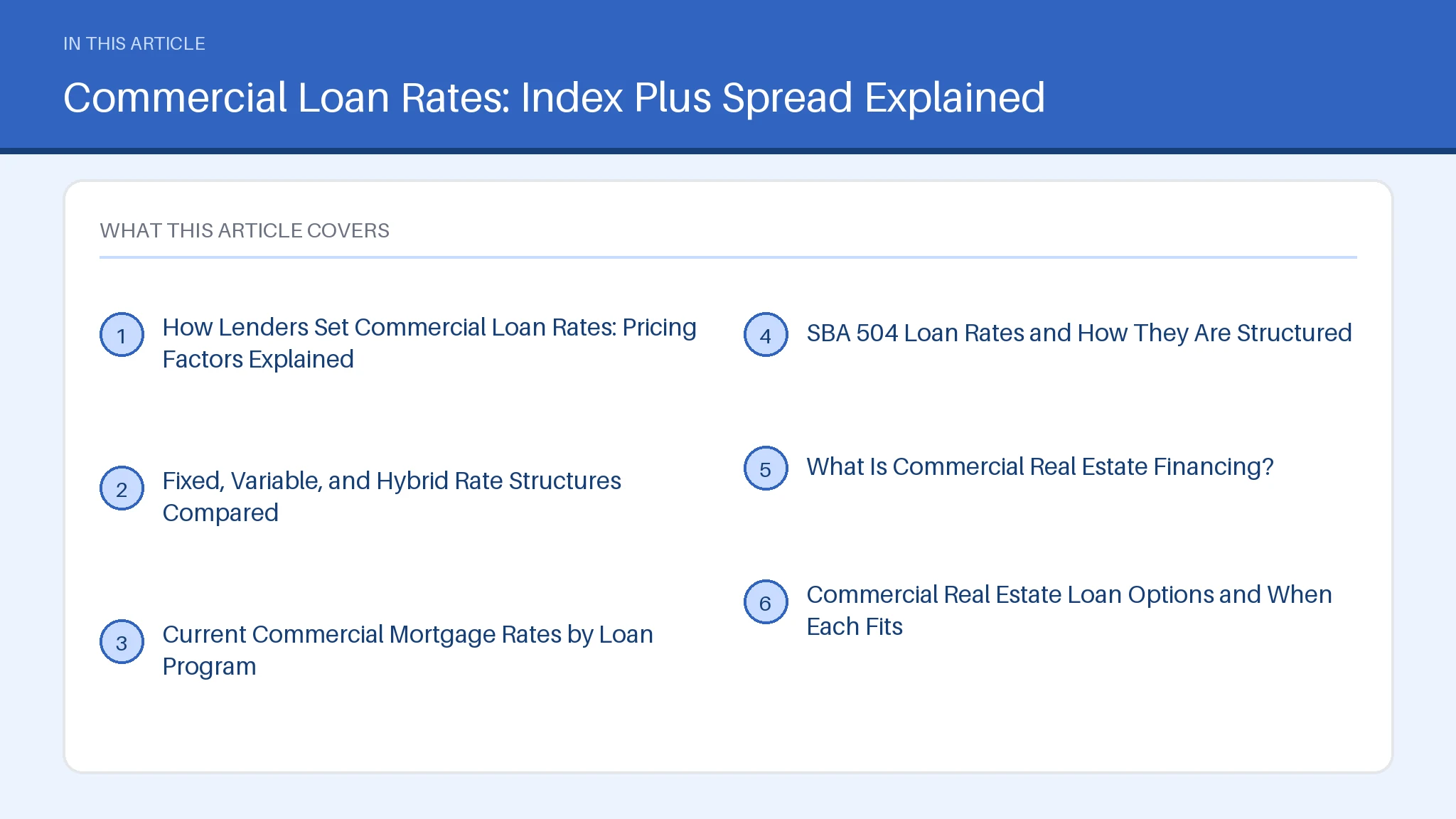
How Lenders Set Commercial Loan Rates: Pricing Factors Explained
Almost every commercial mortgage rate is built the same way: an index plus a spread. The index is a market benchmark the lender does not control, commonly a Treasury yield matched to the loan term, a swap rate, SOFR, or for some bank loans an internal cost-of-funds measure. The spread is the part the lender does control, and it represents compensation for credit risk, servicing costs, capital requirements, and profit margin. When you hear that rates "moved" this week, that is usually the index. When two lenders quote the same property very differently on the same day, that is usually the spread. Understanding which half of the number you are arguing about tells you whether to negotiate or simply to move faster.
The single largest driver of the spread is debt service coverage ratio, the property's net operating income divided by the annual debt service. A loan sized so that income comfortably exceeds the payment prices tighter than one sized to the minimum a lender will accept, because coverage is the lender's first line of defense against a vacancy or an expense surprise. Loan-to-value works alongside it. Lower leverage means the lender is further from loss if the property has to be sold, and pricing generally improves as leverage comes down. These two constraints interact: on a low-cap-rate property, coverage usually binds before LTV does, so the maximum loan is set by income rather than by value. If you want a better rate, the most reliable lever is usually asking for less money, and it helps to know before you apply which of the two tests is limiting your proceeds.
Property type and the durability of its income come next. Lenders group assets by how predictable the cash flow is and how easily the asset can be re-tenanted or resold, and pricing reflects that ordering. Stabilized multifamily and grocery-anchored retail with staggered leases sit at the conservative end; hospitality, self-storage in thin markets, special-purpose buildings, and anything with heavy operating exposure sit further out. Within a property type, the specifics matter as much as the label: a single-tenant building with four years left on the lease and no renewal option is a different credit than the same building with a fifteen-year lease and rent escalations, even at identical income today. Lease rollover concentrated in one or two years, tenant credit quality, and whether the rents are above or below market all feed the spread.
Sponsor and borrower factors carry real weight, though less than the property in most cases. Lenders look at your track record with the asset class, liquidity and net worth relative to the loan amount, credit history, and whether you have taken a deal through a difficult period without handing back keys. Recourse is a pricing variable in its own right: personal guarantees usually buy a lower rate than a non-recourse structure on comparable terms, which makes the choice a genuine trade-off rather than an obvious one. Loan size matters too, in both directions, very small loans carry fixed origination costs spread over less principal, while very large loans may exceed a lender's hold limit and require participation or a different capital source altogether.
Term structure shapes the quote in ways borrowers often overlook. A five-year fixed and a ten-year fixed price off different points on the yield curve, so which is "cheaper" depends on the curve's shape at the time you borrow, not on a general rule. Amortization schedule, interest-only periods, and whether the loan is fully amortizing or carries a balloon all affect risk and therefore price. Floating-rate loans typically start below comparable fixed rates but shift interest rate risk onto you; if a lender requires a cap or hedge, that premium is a real cost of the loan even though it does not appear in the rate. Prepayment structure is priced as well, a loan with yield maintenance or defeasance often carries a lower coupon than one with a mild step-down penalty, because the lender's return is protected either way.
To compare offers honestly, ignore the headline rate and price the whole package. Ask each lender for the index and spread separately, whether there is a rate floor, and when and how the rate locks, an unlocked quote is an estimate, and the index can move between application and closing. Then add origination points, lender legal, appraisal, environmental, engineering, processing, and any required escrows or reserves, and look at the all-in cost over the period you actually expect to hold the property. A loan with a slightly higher coupon and no exit penalty can cost less than a cheaper loan you must defease in year three. Also confirm the servicing arrangement, whether the loan is likely to be sold, and what flexibility exists for future capital expenditures, partial releases, or assumption on sale.
The practical sequence is straightforward: get a clean trailing twelve-month operating statement and rent roll together before you approach anyone, know your own coverage and leverage math, decide what term and prepayment flexibility the business plan actually requires, and then take that same package to several lender types, banks, credit unions, life companies, agency lenders, debt funds, because they price the same risk against different capital costs and regulatory constraints. Well-documented deals with a clear story get sharper pricing, and the reason is unglamorous: the lender spends less time and takes less uncertainty into underwriting, and pricing reflects that.
Fixed, Variable, and Hybrid Rate Structures Compared
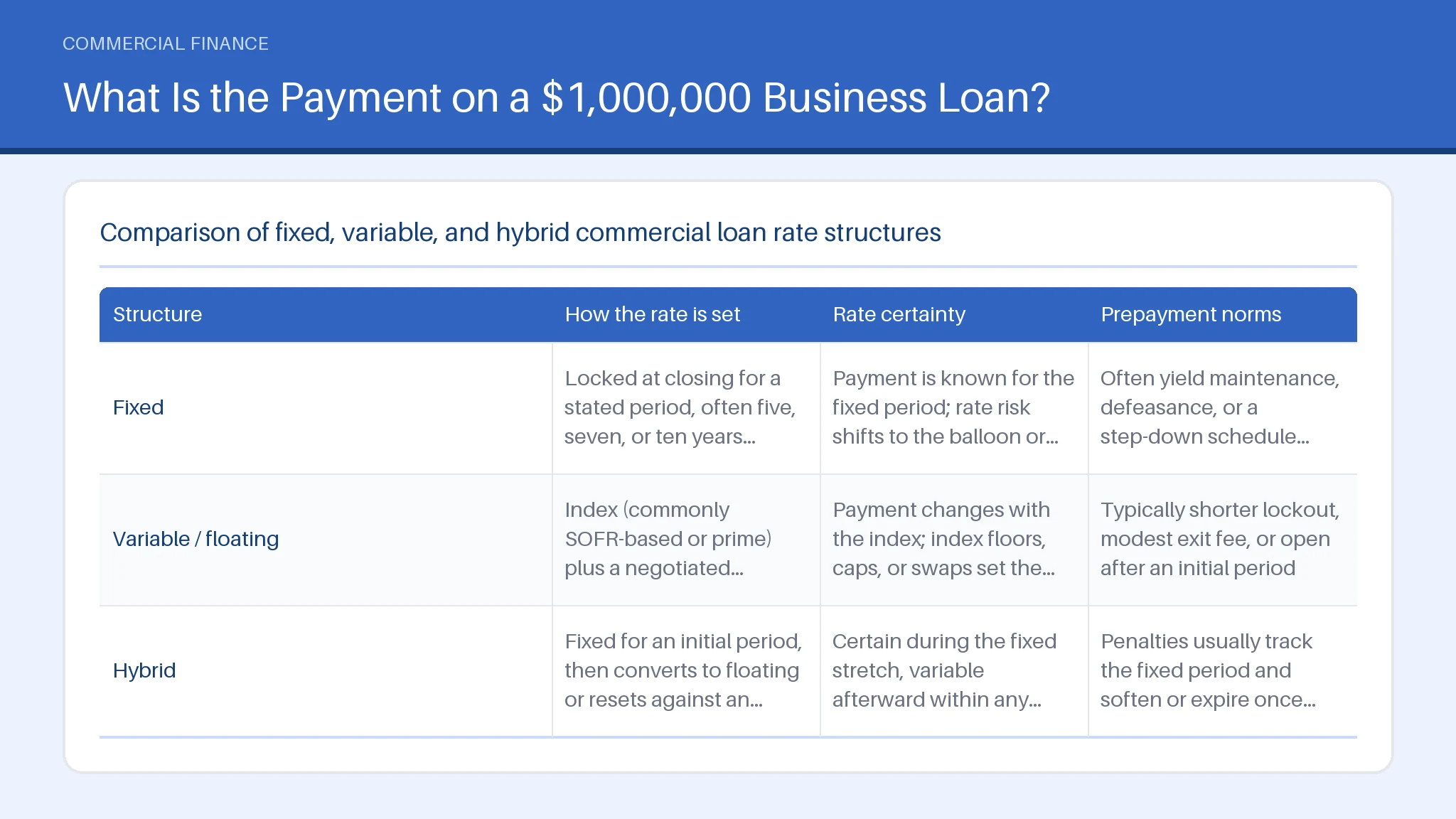
Commercial loan rates come in three basic shapes, and the differences matter more than the headline number you first see. A fixed rate is set at closing and stays put for a defined period, giving you a payment you can underwrite for years. A variable (or floating) rate is quoted as an index plus a spread, commonly a SOFR-based index or the prime rate plus a margin, and it moves when the index moves, usually monthly or quarterly. A hybrid sits between the two: the rate is fixed for an initial stretch, then converts to a floating rate or resets periodically against an index for the remainder of the term. Which one is cheaper on day one depends entirely on the shape of the yield curve when you go to market, which is why the more useful comparison is structural: how long is the rate certain, what happens when it stops being certain, and what does it cost you to leave early?
Two structural details drive most of the real-world difference. The first is term versus amortization. Many fixed-rate commercial loans fix the rate for five, seven, or ten years while amortizing on a longer schedule, which leaves a balloon balance due at maturity. Your rate risk does not disappear under a fixed structure, it gets deferred to the refinance date. The second is prepayment. Fixed-rate loans are frequently protected by yield maintenance, defeasance, or a step-down prepayment penalty, because the lender or bond investor priced the loan expecting to hold it. Floating-rate loans more often carry a short lockout, a modest exit fee, or open prepayment after an initial period, which is why they show up so frequently on value-add and bridge business plans where the exit is the whole point.
Floating structures also come with mechanics that change your effective cost. Many include an index floor, so the index is treated as no lower than a stated level regardless of where the market goes. Many bridge and construction loans require you to buy an interest rate cap or enter a swap, and that premium is a real closing cost you should carry in your model. On the sizing side, lenders underwriting a floating loan often test debt service coverage at a stressed rate rather than the current one, which can shrink proceeds compared with a fixed quote at a similar spread.
| Structure | How the rate is set | Rate certainty | Prepayment norms | Commonly used for |
|---|---|---|---|---|
| Fixed | Locked at closing for a stated period, often five, seven, or ten years, with a longer amortization schedule | Payment is known for the fixed period; rate risk shifts to the balloon or refinance date | Often yield maintenance, defeasance, or a step-down schedule, sometimes with an open window near maturity | Stabilized, cash-flowing assets held for a defined period; owner-occupants budgeting a fixed payment |
| Variable / floating | Index (commonly SOFR-based or prime) plus a negotiated spread, resetting monthly or quarterly | Payment changes with the index; index floors, caps, or swaps set the boundaries | Typically shorter lockout, modest exit fee, or open after an initial period | Value-add, bridge, and construction plans with a sale or refinance exit inside a short horizon |
| Hybrid | Fixed for an initial period, then converts to floating or resets against an index on set dates | Certain during the fixed stretch, variable afterward within any stated adjustment limits | Penalties usually track the fixed period and soften or expire once the rate begins adjusting | Holds longer than the fixed period, or borrowers wanting near-term certainty without full-term lock-in |
To compare offers honestly, hold the variables side by side rather than ranking rates. Ask each lender for the index and spread in writing, the reset frequency, any index floor, the adjustment caps on a hybrid, the amortization schedule and balloon balance, the prepayment formula, and the cost of any required cap or swap. Then run your own numbers on the hold period you actually expect. A fixed rate that carries a heavy defeasance cost can be the more expensive choice if you sell in year three, and a low floating rate can be the more expensive choice if your exit slips and the index moves against you. Match the certainty period to your business plan first, and treat the quoted rate as one input among several.
Current Commercial Mortgage Rates by Loan Program
There is no single "current commercial loan rate," and any page that publishes one number is either averaging across programs that have nothing in common or quoting a figure that was stale the day it was written. Commercial mortgage pricing is built the same way across nearly every program: a market index plus a lender spread. The index moves daily and is publicly observable. The spread is set by the lender based on the loan, the property, and the borrower, and it is where most of the variation between two quotes on the same deal comes from. If you understand which index your program follows and roughly how the spread is negotiated, you can construct a current rate picture yourself on any given morning rather than relying on a published range.
Bank and credit union balance sheet loans are the most common financing for owner-occupied and smaller investment properties. Fixed-rate structures on these loans are typically priced off a Treasury of comparable term, off an internal cost-of-funds measure, or off Federal Home Loan Bank advance rates for member institutions. Floating-rate versions are usually tied to Term SOFR or, for smaller and more relationship-driven loans, to the Wall Street Journal Prime rate. Banks rarely quote a fixed rate for the full term; the standard structure is a rate fixed for five, seven, or ten years with a longer amortization schedule, which means the rate you are quoted applies only until the reset or maturity. Ask specifically what happens at the end of the fixed period, because a five-year fixed rate on a twenty-five-year amortization is a very different exposure than a ten-year fixed rate on the same schedule.
SBA programs work differently and are worth understanding separately. The 504 program funds the second-position debenture portion through a bond sale, so that piece carries a fixed rate set at the time the debenture is sold rather than at the time you sign the loan, and the pool sale schedule determines when your rate is locked. The first-position bank portion of a 504 deal is priced conventionally by the participating lender. The 7(a) program is generally a variable-rate loan tied to a base rate with a maximum spread capped by SBA rules, which puts a ceiling on how high a lender can price the spread but leaves the base rate moving with the market. If you are comparing 504 against a conventional bank loan, compare the blended rate across both 504 pieces against the single conventional rate, not the debenture rate alone.
Agency multifamily loans through Fannie Mae and Freddie Mac are priced off Treasuries of matching term, with the spread reflecting the property's leverage, the market tier, and whether the deal qualifies for a mission-driven or affordability-related pricing incentive. Agency spreads are published to lenders and move frequently, and the same deal can price differently depending on which agency execution the lender pursues. HUD and FHA multifamily loans follow a separate process with longer timelines, a mortgage insurance premium layered on top of the note rate, and a rate set at the time the loan is placed in the market. CMBS and conduit loans are priced off a swap or Treasury benchmark plus a spread driven by what the bond market will pay for the securitized tranches, so conduit pricing can move sharply when credit spreads widen even if Treasuries are flat. Life company loans, funded from insurance company portfolios, are also Treasury-benchmarked and tend to target lower-leverage, stabilized, institutional-quality assets.
Bridge, transitional, and debt fund loans are almost always floating over Term SOFR with a stated floor on the index, and the spread is meaningfully wider than on stabilized permanent debt because the lender is underwriting a business plan rather than in-place income. Construction loans follow the same pattern, usually floating over SOFR or Prime with interest reserves built into the loan amount. On any floating-rate loan, the SOFR floor matters as much as the spread: if the index falls below the floor, you keep paying the floor, so a quote with a low spread and a high floor may cost more than the reverse.
To build a current number for your own deal, do three things. Pull today's level for the relevant index directly from the source, whether that is the Treasury yield curve, published SOFR, or the Prime rate. Ask each lender for the spread as a separate figure, along with the index it applies to and the date the spread was set. Then ask when and how the rate locks, because a spread quoted today over a floating index means your actual rate is unknown until closing. Every quote you collect should be date-stamped, or it is not comparable to the others.
Finally, the note rate is only part of the cost. Origination fees, lender legal, third-party reports, prepayment structure, and any required interest rate swap or cap all affect what the debt actually costs over your hold period. A loan with a lower rate and a defeasance or yield maintenance prepayment penalty can be more expensive than a higher-rate loan with a step-down penalty if you expect to sell or refinance before maturity. Recourse is part of the pricing too: a lender will often shave the spread in exchange for a personal guaranty, and deciding whether that trade makes sense is a judgment about your balance sheet, not about the rate sheet.
SBA 504 Loan Rates and How They Are Structured
The SBA 504 program is not a single loan with a single rate. It is a stacked structure, and understanding the stack is the only way to make sense of the rate you are quoted. A conventional 504 project splits roughly 50/40/10: a first-lien loan from a bank, credit union, or other third-party lender covers about half the project cost; a second-lien debenture funded through a Certified Development Company (CDC) and backed by the SBA covers up to 40 percent; and the borrower contributes the remaining 10 percent as equity. That equity requirement rises when the property is special-purpose (a hotel, bowling alley, gas station, or similar single-use asset) or when the business is a startup, and rises again when both conditions apply.
Each piece carries its own rate. The first-lien bank portion is priced by that lender on its own terms, the same way it would price any commercial mortgage, so it may be fixed for five or ten years with a reset, or floating over an index, and it may carry a balloon. The CDC debenture portion is different: it is fixed for the full term, and the rate is set when debentures are pooled and sold to investors, which happens on a monthly cycle. That means a 504 borrower does not lock the debenture rate at application or even at closing. The bank typically provides interim financing to fund the purchase or construction, and the debenture takes out that interim piece once it funds. The debenture rate is derived from Treasury yields at the time of the sale, plus investor spread and program fees, so the number you will actually pay is not knowable in advance.
Debenture terms run 10, 20, or 25 years, fully amortizing with no balloon. Watch the difference between the note rate and the effective rate on the debenture, because ongoing fees, CDC servicing, central servicing agent, and the SBA guaranty fee, are collected with the monthly payment and are not always included in the headline number. When you compare a 504 package against a conventional commercial mortgage, build a blended rate across both liens using the effective debenture cost, not the note rate alone. A 504 also carries a declining prepayment penalty on the debenture during roughly the first half of the term, which matters if you expect to sell or refinance early.
What is the monthly payment on a $400,000 loan at 7%? It depends entirely on the amortization period, and the difference is large. At 7 percent annual interest with monthly compounding, a fully amortizing $400,000 loan runs about $2,827 per month over 25 years, about $3,101 per month over 20 years, and about $4,644 per month over 10 years. Those are principal and interest only; taxes, insurance, and any servicing fees sit on top.
The trade-off is total interest paid. Over 25 years, that $2,827 payment adds up to roughly $848,000, meaning about $448,000 of interest on a $400,000 loan. The 20-year schedule totals roughly $744,000, or about $344,000 in interest. The 10-year schedule totals roughly $557,000, about $157,000 in interest. Stretching the amortization buys monthly cash flow and costs you cumulative interest, and there is no arithmetic that avoids the trade.
Two cautions when you apply that math to a real 504 quote. First, a $400,000 total at a flat 7 percent is a blended illustration, not how the program actually pays out: you will make two payments, one to the first-lien lender and one to the CDC servicer, at two different rates and often two different amortization schedules. Compute each separately and add them, then divide the combined payment into your net operating income or business cash flow to test coverage. Second, if the bank portion is fixed for only five years, the payment you calculate today is not the payment for the life of the loan. Run the first-lien piece at a higher assumed reset rate to see whether the deal still services, and ask the lender in writing how the reset is indexed and whether there is a cap.
To run these numbers yourself, the standard amortization formula is payment = P × r ÷ (1 − (1 + r)−n), where P is the loan amount, r is the annual rate divided by 12, and n is the number of monthly payments. It takes thirty seconds in a spreadsheet and it is worth doing before any conversation about terms, because it tells you which questions to ask about amortization, resets, and fees rather than fixating on the rate alone.
What Is Commercial Real Estate Financing?
Commercial real estate financing is debt secured by income-producing property, apartment buildings, retail centers, office suites, industrial warehouses, self-storage, hotels, mixed-use buildings, and land slated for development. The distinguishing feature is not the size of the loan but the source of repayment. A residential mortgage is underwritten primarily against the borrower's personal income. A commercial loan is underwritten primarily against the property's ability to generate cash flow and cover its own debt service. That single difference explains most of what surprises first-time commercial borrowers, including how rates are set.
Because the collateral is expected to pay for itself, the underwriting conversation centers on the rent roll, the leases behind it, operating expenses, and what's left over. Lenders look at net operating income, gross rents minus vacancy allowance and operating costs, before debt service, and compare it to the annual payment the proposed loan would require. That ratio, the debt service coverage ratio, is the number most likely to determine whether a deal gets done and at what price. A property with long-dated leases to stable tenants and expenses that are predictable will be quoted differently than a half-vacant building with month-to-month tenancies, even if the two are worth the same on paper.
The loan itself is usually structured through a single-purpose entity rather than in your personal name. Most sponsors form an LLC that owns the property and borrows against it, which keeps the asset legally separate from other holdings. That does not mean the debt is anonymous. Lenders typically require a personal guaranty from the principals, or at least from those with meaningful ownership, and they will underwrite your global cash flow, liquidity, net worth, and track record with similar assets. Some loans, particularly those funded through commercial mortgage-backed securities, are non-recourse, meaning the lender's remedy is limited to the property, subject to carve-outs for fraud, unauthorized transfers, and similar bad acts.
Terms look different from residential terms in ways that affect your total cost more than the headline rate does. Commercial loans are often written with a term shorter than the amortization schedule, so the payment is calculated as if you were paying the loan off over a long horizon while the balance actually comes due much sooner. The result is a balloon payment at maturity that you either refinance or satisfy through a sale. Rates may be fixed for the full term, fixed for an initial period and then floating, or floating from day one against an index such as SOFR or the prime rate plus a spread. Prepayment is rarely free: yield maintenance, defeasance, step-down penalties, and lockout periods are all common, and they matter enormously if you intend to sell or refinance before maturity.
Who lends depends on the asset and the story. Banks and credit unions hold loans on their own books and tend to favor borrowers with a local presence and a deposit relationship. Life insurance companies and CMBS conduits fund longer, larger, fixed-rate loans on stabilized properties. Agency lenders working through Fannie Mae, Freddie Mac, and HUD/FHA programs serve multifamily and seniors housing. SBA 504 and 7(a) programs apply when an operating business occupies most of the space. Debt funds and private bridge lenders price higher but move faster and accept transitional assets, a building being repositioned, leased up, or renovated, that a bank would decline. Rates across these channels are not interchangeable, and comparing a bridge quote to an agency quote tells you less than comparing either one to its own peer group.
When you ask what commercial loan rates are, the honest answer is that a rate is an output, not a starting point. It reflects the benchmark the lender prices against on the day of quote, plus a spread that reflects property type, location, leverage, coverage, lease quality, sponsor experience, recourse structure, and term length. Two borrowers looking at the same building on the same afternoon can be quoted differently because one is putting more equity in, one has operated the asset class for a decade, or one needs closing certainty in three weeks. Rate sheets and averages you find online are useful for orientation and nearly useless for budgeting a specific deal.
What you can do is arrive with the inputs that drive the quote. Assemble a current rent roll, trailing twelve months of operating statements, a schedule of leases with expiration dates, personal financial statements and tax returns for each guarantor, a schedule of real estate owned, and a clear statement of your business plan for the property and how long you intend to hold it. Know your intended leverage and whether you need recourse or non-recourse, fixed or floating, and flexibility to prepay. Borrowers who bring that package get priced on their actual risk profile. Borrowers who bring an address and a question get placeholder numbers that change the moment underwriting begins.
Finally, budget for the costs that surround the rate. Commercial closings typically involve an appraisal, environmental review, property condition assessment, title and survey work, legal fees on both sides, and lender origination points, with third-party report costs paid up front and often non-refundable. Lenders also commonly require escrows or reserves for taxes, insurance, capital expenditures, and tenant improvements. None of these appear in an interest rate, and all of them affect the return on the deal. Comparing offers means comparing all-in cost over your realistic hold period, including what it will cost to get out early if the plan changes.
Commercial Real Estate Loan Options and When Each Fits
The rate you are offered on a commercial mortgage is driven less by negotiation than by which financing channel your deal belongs in. Each lender type funds itself differently, is regulated differently, and tolerates a different amount of uncertainty, and those differences show up in pricing, term length, recourse, and how much flexibility you have to sell or refinance later. Before comparing rates, it is worth identifying which of the following categories your property, your business plan, and your timeline actually fit. Comparing a bridge loan quote against an agency multifamily quote tells you almost nothing, because the two are solving different problems.
Banks and credit unions (portfolio lenders) hold the loan on their own balance sheet. This is the default channel for owner-occupied buildings, smaller investment properties, borrowers with an existing depository relationship, and any asset that is stabilized but not large enough or clean enough for the capital markets. Portfolio lenders are usually the most flexible on property type and the fastest to underwrite a borrower they already know, and their prepayment terms tend to be simpler than securitized alternatives. The tradeoffs are that most bank loans are recourse, meaning you sign personally; the fixed-rate period is often shorter than the amortization schedule, which creates a balloon and refinance risk; and rate is frequently tied to your broader relationship, including deposits. Credit unions can be competitive within their membership footprint and field of membership, though they may cap loan size or lend only in defined geographies.
SBA 7(a) and 504 loans apply when your business will occupy a meaningful share of the building, the occupancy threshold differs between existing and new construction, so confirm the current requirement with a lender before you plan around it. These programs exist to let operating businesses buy their premises with less equity than a conventional bank loan requires, and the 504 structure splits the financing between a bank first mortgage and a fixed-rate debenture through a Certified Development Company. If you are a pure investor with no operating business in the building, SBA is not your channel. If you are a practice, franchise, manufacturer, or hotel operator buying real estate you will use, it usually deserves a look. Expect more documentation, longer timelines, and government-set fees.
Agency multifamily loans, financing sold to Fannie Mae or Freddie Mac, are for apartment properties, including affordable and manufactured housing communities, that are already leased up and performing. This channel generally prices tightly relative to other options, offers long fixed terms with non-recourse structures, and is the standard answer for stabilized rental housing above a modest loan size. The constraints are real: the property has to be residential rental, occupancy and operating history requirements apply, replacement reserves and escrows are typically mandated, and prepayment is governed by yield maintenance or defeasance rather than a simple fee.
CMBS or conduit loans are originated to be pooled and securitized. They suit stabilized income properties across commercial types, retail, office, industrial, self-storage, hospitality, where the borrower wants non-recourse debt and a fixed rate for a long term, and does not expect to sell or refinance before maturity. The underwriting focuses heavily on the property's cash flow rather than the sponsor's balance sheet, which helps borrowers who do not want to sign personally or who have limited net worth relative to the loan. The cost of that structure is rigidity: defeasance provisions, single-purpose entity requirements, cash management, and a servicer rather than a banker to call when you want to modify anything.
Life insurance company loans come from insurers matching long-dated liabilities with long-dated mortgages. They tend to be selective, favoring well-located, institutional-quality, low-leverage assets with strong sponsors, and in exchange they compete hard on rate and offer long fixed terms. If your deal is conservative on leverage and the asset is one an insurer wants to own if things go wrong, this channel is worth soliciting.
Bridge loans and debt funds exist for transitional situations: a partially vacant building, a value-add renovation, a lease-up, a discounted purchase that has to close quickly, or a maturing loan you cannot refinance yet on permanent terms. Pricing here sits above stabilized permanent debt because the lender is underwriting a plan rather than existing income, and terms are typically floating-rate, shorter, and often include interest reserves and future funding for capital work. Hard money sits at the far end of the same spectrum, trading the highest cost for the fewest conditions and the fastest close. Both are appropriate as a means to an end, you should be able to describe your exit, whether a sale or a takeout loan, before you sign.
Construction loans fund ground-up development or major repositioning, drawing in stages against completed work and typically requiring guarantees, a completion bond or equivalent, and a takeout plan. Mezzanine debt and preferred equity fill the gap between the senior loan and your cash equity when you want higher total leverage without writing a larger check.
Practically, work backwards from three questions. How long will you hold the asset, and is a fixed rate or floating rate the better match for that horizon? Are you willing to sign recourse in exchange for flexibility, or is non-recourse a requirement? And is the property producing stable income today, or does the income depend on work you still have to do? Those answers narrow you to one or two channels, and comparing rates within a channel, on the same leverage, term, and prepayment structure, is the only comparison that means anything.
How to Calculate Loan-to-Value and Why It Affects Pricing
Loan-to-value is the loan amount divided by the property's value, expressed as a percentage. A $3,000,000 loan against a $4,000,000 property is 75% LTV. The arithmetic is trivial; almost every disagreement between borrowers and lenders comes from the denominator, not the division.
On an acquisition, lenders generally apply their LTV limit to the lesser of the purchase price or the appraised value. If you negotiate a bargain and buy a building appraised at $4,200,000 for $4,000,000, most lenders will still size the loan off the $4,000,000 you paid. The instant equity is yours on paper, but it does not usually buy you extra proceeds at closing. On a refinance, the appraised value governs, which is why refinances of properties bought well or improved substantially can support more debt than the original purchase did. Many lenders and agency programs also apply seasoning requirements before they will lend against a newly increased value, particularly on cash-out.
Know which value the appraiser is being asked to produce. An "as-is" value reflects the property in its current condition and occupancy. An "as-stabilized" or "as-completed" value assumes the lease-up or construction is finished at projected rents. Value-add and construction deals are frequently sized against both: a lender may fund an initial advance at a percentage of as-is value and release the balance against as-stabilized value once occupancy and income tests are met. If a term sheet quotes a single LTV without specifying which value, ask.
For construction and heavy repositioning, loan-to-cost usually matters more than LTV. Loan-to-cost divides the loan by total project cost: acquisition or land basis, hard costs, soft costs, an interest reserve, and contingency. Lenders typically test LTC and as-completed LTV together and lend the lower of the two results. Understating contingency to make LTC look better tends to backfire, because a lender who thinks your budget is thin will simply require more equity up front.
LTV is also rarely the only sizing test. Most lenders run LTV, debt service coverage ratio, and debt yield in parallel, then lend the smallest of the three answers. Which test binds depends on the relationship between property yields and interest rates. When rates are low relative to cap rates, LTV is often the constraint, and borrowers hit their leverage ceiling with coverage to spare. When rates rise, coverage and debt yield usually bind first, and a borrower who qualifies for 75% LTV on paper may find the loan sizes out well below that. This is the single most common surprise in the sizing process, so it is worth calculating all three tests yourself before you assume a proceeds number.
Do not forget subordinate capital. Lenders measure combined leverage, so mezzanine debt, preferred equity with debt-like features, and seller carry-back notes generally count toward the total. A 65% senior loan with a 15% mezzanine piece is an 80% capital stack in the senior lender's eyes, and most senior loan documents restrict or prohibit additional debt outright.
The reason LTV drives pricing is loss given default. Your equity sits in front of the loan and absorbs the first losses if values fall or a sale goes poorly. At lower LTV, the lender has more cushion between the loan balance and a distressed sale price, so the credit is worth less compensation for risk. At higher LTV, the same decline in value can impair principal. Lenders price for that difference. Higher leverage also correlates with tighter coverage, meaning less room to absorb a vacancy or a spike in operating expenses before the loan stops servicing itself, and lenders price that too.
Pricing typically moves in bands rather than smoothly. Lenders commonly quote in tiers with breaks at round thresholds, so a loan sized just above a break can price meaningfully worse than one sized just below it, while a small move within a band changes nothing. That produces a practical decision point: ask the lender where their tier breaks fall, then compare the cost of the higher rate across your full hold period against the cost of contributing the additional equity needed to slide under the threshold. Sometimes the extra proceeds are clearly worth the pricing; sometimes trimming the request by a few percentage points pays for itself. You cannot run that comparison unless you know where the breaks are, and lenders will usually tell you if you ask directly.
Before an appraisal exists, estimate value the way an underwriter will. Start with underwritten net operating income, not your pro forma or the seller's trailing statements. Lenders typically adjust for market vacancy rather than actual, add a management fee even if you self-manage, deduct replacement reserves, mark rents to market where leases are rolling, and normalize taxes for a reassessment after sale. Then apply a market cap rate from recent comparable sales. That figure is often lower than a broker's opinion of value, and building your equity plan around it prevents a scramble late in diligence.
If the appraisal comes in below expectations, the options are finite: reduce the loan and contribute more equity, renegotiate price or ask for a seller credit, add subordinate capital if the senior lender permits it, or challenge the appraisal. A challenge only works when you can supply specific, better comparable sales or document a factual error in the report, such as wrong square footage or a misread rent roll. Disagreeing with the conclusion is not a basis for reconsideration. Because you generally pay for the appraisal early and the lender orders and controls it, treat the report as a real risk in your closing timeline rather than a formality.
Finally, LTV is one input among several. Property type, market, lease structure and tenant credit, sponsor experience and liquidity, recourse versus non-recourse, fixed versus floating, term length, and the lender's own cost of capital all move pricing. A well-located stabilized property with a strong sponsor at moderate leverage sits in a different pricing conversation than a transitional asset at the same LTV. Lowering leverage improves your position, but it does not by itself override the rest of the credit profile.
Commercial Mortgage Payment Calculator Using Today's Rates
A payment calculator is only as accurate as the three numbers you feed it: the interest rate, the amortization schedule, and the loan amount. Borrowers usually get the last two right and the first one wrong, because they type in a single "commercial loan rate" they saw quoted somewhere. Commercial mortgage pricing does not work like a posted residential rate. Before you calculate anything, you need to understand how the number you should be typing in is actually built.
So, what is the current interest rate on a commercial loan? There is no single answer, and any source that gives you one number without conditions is showing you an illustration rather than a price. Almost every fixed-rate commercial mortgage in the United States is quoted as an index plus a spread. The index is a market rate you can look up yourself on any given morning, commonly the 5-year or 10-year US Treasury yield for fixed-rate bank, life company, agency and CMBS loans, and term SOFR for floating-rate bank credit, bridge debt and construction facilities. The spread is the lender's margin, and that is the part that varies by deal. To find today's actual rate, pull the current index value from a public source such as the Treasury's daily yield curve or a published SOFR page, then add the spread from a real term sheet dated within the last week or two. An index from this morning plus a spread from a six-month-old conversation will produce a payment number you cannot rely on.
What moves the spread on your particular loan? Property type is the first filter, stabilized multifamily, industrial, self-storage, retail, office, hospitality and specialty assets are not priced the same way, and the gaps between them widen and narrow as lender appetite shifts. Then comes leverage, measured as loan-to-value, and coverage, measured as debt service coverage ratio. A lower-leverage loan with strong coverage prices tighter than a maximum-proceeds request on the same building. Recourse matters: full personal guarantees typically price differently than non-recourse structures. Lease profile matters, remaining weighted average lease term, tenant credit, and rollover concentration. Market and submarket liquidity matter. Sponsor experience, net worth, liquidity and track record with that asset class matter. And the lender channel matters most of all: a local bank, a national bank, a life insurance company, an agency lender for multifamily, a CMBS conduit, an SBA 504 or 7(a) structure for owner-occupied property, and a debt fund writing bridge paper will each quote the same deal differently, and each will win on different deals. That is why gathering several term sheets in parallel tells you more about your real rate than any published average.
Once you have a credible rate, the math is straightforward. Monthly payment equals P × [ i(1 + i)^n ] ÷ [ (1 + i)^n − 1 ], where P is the loan amount, i is the annual rate divided by twelve, and n is the number of months in the amortization schedule. That last word is where borrowers make their biggest error. Commercial loans routinely carry an amortization schedule that is longer than the loan term, a 25- or 30-year amortization on a five-, seven- or ten-year term is ordinary. Your payment is calculated off the amortization; your refinance or sale deadline is set by the term; and the balance still outstanding on the maturity date is the balloon you will have to retire. Any calculator that does not show you that balloon figure is hiding the most important number in the deal. If the loan is interest-only for a period, the payment during that window is simply the loan amount times the annual rate divided by twelve, and the balloon is the full principal.
Then stress the result. Run your payment at the quoted rate, then again one and two percentage points higher, and check the debt service coverage ratio at each level by dividing net operating income by annual debt service. This tells you where your deal breaks. For floating-rate debt, run the payment at the rate cap strike if you are buying a cap, and at a rate meaningfully above today's index if you are not. Also separate the coupon from the all-in cost: origination points, lender legal, appraisal, environmental and engineering reports, title, and any application deposit raise your effective cost of funds without changing the payment. And read the prepayment language, step-down penalties, yield maintenance and defeasance each change what an early exit costs you, which belongs in your model even though it never appears in the monthly payment.
Will interest rates go back to 3%? Nobody can tell you that honestly, and you should be skeptical of anyone who does. But you can reason about it with arithmetic instead of prediction. Since your rate is index plus spread, a 3% commercial mortgage requires the sum of those two components to equal 3%. Take the spread from a term sheet in front of you, subtract it from 3%, and you have the level the underlying Treasury or SOFR index would need to reach, and the spread would need to hold there, which is not guaranteed, because spreads widen and tighten with credit conditions independently of the index. That subtraction usually makes clear how large a move in the rate environment would be required. The practical consequence: do not underwrite a deal that only works if you refinance at a rate you cannot name today. Model your exit at or above your current rate, size the loan so the coverage works without a rate rally, and treat any improvement as upside rather than as the plan.
How to Estimate Your Monthly Commercial Mortgage Payment
Estimating a commercial mortgage payment takes four inputs: the loan amount, the interest rate, the amortization period, and the way interest accrues. Notice that the loan term is not on that list. On most commercial loans the term (how long before the balance comes due) and the amortization (the schedule used to calculate the payment) are two different numbers. A loan can carry a 10-year term with a 25-year amortization, which means the payment is calculated as though you had 25 years to pay it off, but the remaining balance is due in year 10. Get those two straight before you run any math, because mixing them up will throw your estimate off badly.
The standard amortizing payment formula is: Payment = P × i ÷ [1 − (1 + i)−n], where P is the loan amount, i is the periodic (monthly) interest rate, and n is the total number of monthly payments in the amortization schedule. To get i, divide the annual rate by 12. To get n, multiply the amortization years by 12. Any spreadsheet will do this for you with the PMT function: =PMT(rate/12, years*12, -loan_amount).
Here is the arithmetic on a purely illustrative set of inputs, these are round numbers chosen to show the mechanics, not a rate anyone has offered you. Take a $1,000,000 loan at 7.00% with a 25-year amortization. The monthly rate is 0.0058333 and n is 300. The payment works out to roughly $7,068 per month, or about $84,800 per year. Divide annual debt service by the loan amount and you get the mortgage constant, here about 8.48%. That single figure is a useful shortcut: once you know the constant for a given rate and amortization, you can multiply it by any loan amount to get annual debt service in your head.
Amortization length moves the payment more than borrowers expect. Stretch the same loan to 30 years and the monthly payment falls; compress it to 20 years and it rises sharply, even though the rate has not changed. When you compare offers, hold amortization constant or you are not comparing the same thing. A slightly higher rate on a 30-year schedule can produce a lower monthly payment than a lower rate on a 20-year schedule, which matters if your constraint is cash flow rather than total interest paid.
If the loan has an interest-only period, the payment during that stretch is simply the loan amount times the annual rate divided by 12. On the illustrative loan above, that is about $5,833 per month, roughly $1,235 less than the amortizing payment. Build both numbers into your model, along with the date the payment steps up, because the increase arrives all at once and your operating budget has to absorb it.
Next, calculate the balloon. Because a 10-year term paired with a 25-year amortization only retires 10 years' worth of principal, most of the balance is still outstanding at maturity. On the illustrative loan, roughly $786,000 of the original $1,000,000 remains due at the end of year 10, you have paid down under a quarter of the principal. That balloon is the number that governs your refinance or sale planning, so calculate it early. In a spreadsheet, use =FV(rate/12, months_elapsed, payment, -loan_amount).
Two accrual details separate an estimate from the actual invoice. First, many commercial lenders use an actual/360 convention, meaning interest accrues on a 360-day year but is charged for the actual days elapsed. That produces slightly more interest over a full year than a 30/360 calculation on the same stated rate, and it also makes payments vary a little month to month with the calendar. Second, ask whether payments are due monthly in arrears and whether there is an interest-only stub payment at closing covering the days between funding and the first full period.
For a floating-rate loan, the rate is an index plus a spread, commonly Term SOFR or the Prime Rate plus a stated margin. Estimate the payment at today's index level, then re-run it at several higher index values to see where your cash flow breaks. If the loan requires an interest rate cap, treat the cap purchase as a closing cost and factor any replacement cap into your budget at the renewal date. Floating-rate paper can also carry a floor, which sets a minimum you will pay regardless of where the index goes.
Finally, the debt service payment is not your full monthly obligation. Many commercial loans require monthly escrow deposits for property taxes and insurance, plus reserves for replacements, tenant improvements, and leasing commissions. Add those to the principal and interest figure to get your true monthly outflow. Then divide your net operating income by annual debt service to get your debt service coverage ratio, using the illustrative numbers, an NOI of $110,000 against $84,800 of debt service produces a DSCR of about 1.30. Lenders size loans against a minimum DSCR, so running that calculation yourself tells you whether the loan amount you have in mind is realistic before you spend money on third-party reports. Closing costs such as origination points, appraisal, environmental review, and lender legal fees do not change the monthly payment, but they do change your all-in cost of capital, so track them separately.
What Is the Prime Rate and How Does It Move?
The prime rate is a benchmark interest rate published by commercial banks and used as the starting point for pricing many floating-rate loans, including a large share of small-balance commercial mortgages, business lines of credit, and bridge facilities. It is not a government-set rate and it is not a market-traded rate. Each bank technically publishes its own prime, but in practice the large banks move together, and the figure most people mean by "the prime rate" is the consensus number reported by financial press and data services once a majority of the major banks have changed theirs.
Prime moves because the Federal Reserve moves. The Federal Open Market Committee sets a target range for the federal funds rate, and banks adjust their prime rate in step with changes to that range, keeping a customary fixed margin above the top of it. That margin has been stable for a long stretch, which is why prime tends to change by exactly the same amount as a Fed move, a quarter-point cut in the target range produces a quarter-point drop in prime, usually within a day or two of the announcement. If you want to know when prime might move next, the calendar you actually care about is the schedule of FOMC meetings, published a year in advance on the Federal Reserve's website, plus any unscheduled intermeeting action in unusual conditions.
What that means for a borrower is that prime is a step function, not a smooth curve. It sits flat for months, sometimes for more than a year, and then jumps in discrete increments. That behavior is different from index rates tied directly to trading markets, such as term SOFR or Treasury yields, which reprice continuously as expectations shift. A loan priced over SOFR can drift between reset dates; a loan priced over prime does not change until the banks change prime.
In loan documents, prime almost never appears alone. Pricing is quoted as prime plus a spread, for example, "Prime + 1.00%", where the spread reflects the lender's read on the credit, the property type, the loan-to-value, the sponsor's experience, and the loan size. Small-balance and unstabilized deals typically carry wider spreads than large, stabilized, low-leverage loans. The spread is fixed in the note for the life of the loan (or until a repricing date), so all of the movement in your interest rate comes from movement in the index.
Read the note carefully for four mechanics that determine how a prime move actually reaches your payment. First, which prime: the note should name a specific published source, such as the rate published in a named financial publication or the lender's own announced prime, and say what happens if that source stops publishing. Second, the adjustment trigger and timing: some notes adjust the day prime changes, others on the first day of the next month or the next quarter, which can delay the effect of a Fed decision by weeks. Third, an interest rate floor: many commercial notes state that the rate will never go below a stated minimum regardless of where prime goes, which caps your benefit from cuts. Fourth, caps, periodic and lifetime, which limit how far the rate can rise, though floors are far more common than caps in commercial paper.
Also check how payments recalculate. On some floating-rate loans the monthly payment resets when the rate resets, so your debt service changes with prime. On others the payment stays level and the split between interest and principal shifts, which means a rising index quietly slows your amortization rather than raising your payment. Either structure can be workable; you just need to know which one you have before you build a pro forma.
To track prime yourself, start with the Federal Reserve's published target range for the federal funds rate and the H.15 selected interest rates release, then confirm the bank prime figure your loan documents actually reference. When you are underwriting a floating-rate deal, run your debt service coverage at your current rate and at rates several increments higher, and ask the lender directly what index it uses, what the spread is, whether there is a floor, how often the rate adjusts, and whether a fixed-rate or swap option is available on the same loan. Those five questions tell you most of what you need to know about how much interest rate risk you are taking on.
Bridge Loan Rates Today and What Drives Them
The honest answer to "what are bridge loan rates today" is that there is no single number to quote, because bridge debt is almost always priced as an index plus a spread rather than as a flat rate. Most bridge lenders quote off short-term SOFR (usually 1-month Term SOFR) and add a spread; some banks and smaller private lenders still quote off the Wall Street Journal Prime rate instead. The index moves daily and is published publicly, so you can look up the current level yourself at CME Group for Term SOFR or the Federal Reserve's H.15 release for other benchmarks. The spread is what actually varies between borrowers and deals, and it is the part you can influence.
When you ask lenders for pricing, insist that the index and the spread be stated separately, along with any index floor. A floor sets a minimum level for the index component regardless of where the market goes, and a quote that looks competitive on spread can end up costing more than a wider-spread quote with no floor if short-term rates fall during your hold. Also ask whether the rate is floating for the whole term, floating with a required rate cap purchase, or fixed. Rate caps are a real out-of-pocket cost on floating bridge loans and their price changes with market volatility, so treat the cap premium as part of your financing cost rather than a closing detail.
The largest driver of your spread is leverage. Lenders look at loan-to-cost and loan-to-value on the as-is basis, and at where the loan sits relative to the stabilized value and stabilized debt yield you are underwriting. Every increment of additional proceeds pushes the lender further up the risk stack, and spread widens accordingly. If a quote comes back wider than you expected, the fastest lever available to you is usually asking for the same lender's pricing at lower leverage and comparing the blended cost of that scenario against bringing in more expensive equity or mezzanine debt to fill the gap.
Asset type and business plan risk come next. A stabilized multifamily property needing a short bridge to a permanent takeout is a different underwriting exercise than a vacant office building with a full repositioning plan, a hotel with seasonal revenue, or a construction completion loan on a stalled project. Lenders price for the complexity and duration of the value-creation plan, the amount of capital that must be spent before the property produces income, and how many things must go right before the loan can be repaid. Heavy lease-up, entitlement risk, and significant capital expenditure budgets all widen spreads relative to light-transitional deals in the same asset class.
Sponsor profile matters more in bridge lending than in stabilized permanent lending. Lenders weigh your track record with the specific property type and business plan, your liquidity and net worth relative to the loan size, whether you have completed similar renovations or lease-ups before, and the strength of your property management and general contractor. First-time sponsors in a property type should expect to pay more, be asked for recourse, or both. Offering partial or full recourse, a completion guaranty, or cross-collateralization with another asset you own can pull spread in, and it is worth asking lenders to price both a recourse and a non-recourse version so you can see what the guaranty is actually worth in basis points.
Capital source shapes pricing as much as deal quality. Banks funding from deposits, debt funds levered on repo lines or CLOs, insurance company bridge programs, and private individual lenders all have different costs of capital, different regulatory constraints, and different tolerance for construction and vacancy. This is why the same deal can come back with materially different quotes from lenders who all consider themselves bridge lenders. Loan size also plays in: small loans carry the same fixed legal, third-party report, and servicing costs as larger ones, so they often price wider or come with minimum interest requirements.
Do not compare bridge offers on the coupon alone. Origination points, exit or disposition fees, extension fees, minimum interest or yield maintenance provisions, unused line fees on future funding facilities, lender legal costs, and required interest reserves all belong in the comparison. The practical method is to build a simple cash flow of every dollar leaving your pocket from closing through payoff, using your realistic hold period rather than the stated maturity, and convert that to an all-in annualized cost. A loan with a lower spread but two points in and one point out can easily cost more than a higher-coupon loan with a single point if you expect to refinance in eighteen months. Run the same exercise for a longer hold, because bridge business plans slip and the cheapest option at your base case is not always the cheapest if you need the extension.
On that point, read the extension terms closely and ask what the conditions actually are. Extension options frequently require a fee, a purchased extension of the rate cap, and satisfaction of a performance test such as a minimum debt yield or debt service coverage at the extension date. An option you cannot exercise because the property missed its lease-up projections is not protection. Ask each lender, in writing, what tests apply, who calculates them, and what happens if the property is close but not compliant.
Finally, timing and competition affect what you are shown. Bridge spreads respond to conditions in the capital markets that lenders themselves borrow in, and quotes can move between the time a lender issues a term sheet and the time it goes to committee. Ask how long the quoted pricing is held, what triggers a re-trade, and what the deposit covers if pricing changes. Running a genuine process with several lenders whose programs actually fit the asset and the business plan, rather than accepting the first term sheet, is the most reliable way to find out what your deal is worth in the current market.
Debt Service Coverage Ratio: How to Calculate DSCR
DSCR is the single number most commercial lenders look at before they look at anything else, including the rate they will offer you. The formula is simple: divide the property's annual net operating income by its annual debt service. A result of 1.00x means the property produces exactly enough income to make its loan payments with nothing left over. Anything above 1.00x is cushion; anything below means the property does not cover its own debt out of operations.
Start with net operating income, and build it the way an underwriter will. Begin with gross potential rent, subtract vacancy and credit loss, then add other income such as parking, laundry, storage, or expense reimbursements. From that effective gross income, subtract operating expenses: property taxes, insurance, utilities the owner pays, repairs and maintenance, contract services, payroll, and property management. What does not belong in NOI is just as important. Leave out mortgage principal and interest, capital expenditures, tenant improvements and leasing commissions, depreciation, amortization, and income taxes. Those are either the debt service you are about to compare against or below-the-line items that would double-count.
Expect your NOI and the lender's NOI to differ, and know why before the term sheet arrives. Underwriters routinely substitute a market vacancy factor for your actual occupancy, add a management fee even if you self-manage, deduct annual replacement reserves per unit or per square foot, and mark real estate taxes to a reassessed value based on your purchase price. They also decide how much weight to give trailing twelve-month figures versus a pro forma that assumes lease-up or renovation. Each of those adjustments lowers NOI and therefore lowers DSCR, which is why a deal that pencils at your numbers can come back undersized at theirs. Building your model with those haircuts already in it is the fastest way to avoid a surprise.
Next, calculate annual debt service. For an amortizing loan, take the monthly principal and interest payment and multiply by twelve. Do not use interest alone; DSCR on an amortizing loan counts principal too. For an interest-only loan or interest-only period, annual debt service is simply the loan balance multiplied by the interest rate. If the property carries ground rent, a second mortgage, or any other mandatory debt payment, most lenders will include it, so include it yourself. When the loan is floating rate, ask which rate the lender underwrites to; the tested rate is often a stressed rate, an index floor, or the strike price of a required rate cap rather than today's coupon. Loans with an interest-only period are frequently tested twice, once on the interest-only payment and once on the fully amortizing payment that follows, with the lower of the two results governing.
Here is the arithmetic on a hypothetical deal. A property underwrites to $480,000 of NOI. The proposed loan carries annual debt service of $360,000. DSCR is $480,000 divided by $360,000, or 1.33x. If the lender's minimum is 1.25x, this loan clears with room. If the underwriter trims NOI to $440,000 after adding a management fee and reserves, DSCR falls to 1.22x and the loan gets resized.
Because DSCR is usually what sizes the loan, it is worth running the calculation backward. Divide underwritten NOI by the required minimum DSCR to get the maximum annual debt service the property can support. Using the same figures, $480,000 divided by 1.25 gives $384,000 of allowable annual debt service. Then divide that by the mortgage constant, which is the annual payment per dollar of loan at the quoted rate and amortization schedule. If the constant works out to 0.0800, the maximum loan is $384,000 divided by 0.08, or $4,800,000. You can pull the constant from any amortization calculator by solving the annual payment on a $1,000,000 loan at the proposed rate and term, then dividing by $1,000,000. This is also why rate and DSCR are linked: a higher rate raises the constant, which shrinks the loan the same NOI can carry, even when the loan-to-value ratio would have allowed more.
Minimum DSCR is not one number. It moves with property type, loan program, rate structure, market, and the lender's own credit policy, and stabilized multifamily is generally held to a different standard than a single-tenant industrial building or a hotel. Treat the figure in your term sheet as the operative one and ask what it is tested against at closing and annually thereafter, since many loans carry an ongoing DSCR covenant with cash management or default consequences if the ratio slips.
DSCR also does not work alone. Most lenders size to the lowest result among DSCR, loan-to-value, and debt yield, which is NOI divided by the loan amount and ignores rate and amortization entirely. In a low-rate environment LTV often binds first; when rates rise, DSCR and debt yield usually take over. Run all three and you will know which constraint is actually setting your proceeds.
If DSCR comes up short, you have a limited and fairly mechanical set of levers. Lengthening amortization lowers the annual payment and raises DSCR without changing the rate. Requesting an interest-only period does the same, if the lender will test on it. Reducing the loan amount raises coverage directly. Paying points to buy the rate down lowers debt service at the cost of upfront dollars. On the income side, correcting an understated rent roll, documenting expense reimbursements, or curing vacancy before the appraisal raises NOI. The common mistakes to avoid are subtracting debt service inside NOI, testing coverage on interest only when the loan amortizes, using actual rather than market vacancy, omitting reserves and a management fee, and mixing monthly income against annual debt service. Keep the periods consistent, keep the line items where they belong, and the ratio will tell you the same thing the underwriter's spreadsheet does.
What Is the Payment on a $1,000,000 Business Loan?
There is no single payment on a million-dollar commercial loan, and any figure offered without four specific details attached is a guess. The monthly payment comes out of four inputs: the interest rate, the amortization period used to compute the payment, whether the loan is interest-only for part or all of its life, and whether other costs, tax and insurance escrows, replacement reserves, servicing fees, are collected alongside principal and interest. Change any one of those and the payment moves, sometimes by more than a thousand dollars a month on the same loan amount.
The simplest case to calculate is interest-only. Divide the annual rate by twelve and multiply by the outstanding balance. On a million-dollar balance, each full percentage point of interest works out to roughly $833 per month, which makes rough math easy: multiply $833 by whatever rate you are being quoted. Bridge loans, construction loans, and many fixed-rate loans with a partial interest-only period use this structure. It keeps the monthly obligation low, but none of the principal comes down, so the full balance is still owed at maturity.
Amortizing loans are where the schedule does the heavy lifting. Spread the same balance and the same rate over a longer amortization and the payment falls; compress it and the payment rises. As a rough guide, shifting from a 25-year amortization to a 20-year schedule adds on the order of ten percent to the monthly payment, while stretching to 30 years reduces it by a smaller but still meaningful amount. This is why two lenders quoting nearly identical rates can hand you noticeably different payments, the difference is the amortization, not the pricing.
Do not confuse amortization with loan term. Commercial loans are frequently written with a short term and a long amortization: a 10-year term with a 30-year amortization means the payment is calculated as though you had thirty years to repay, but the remaining balance comes due as a balloon at the end of year ten. The monthly number looks manageable while a large principal balance survives to maturity, and refinancing or selling at that point becomes part of the plan rather than an afterthought. Ask for the projected balloon balance in dollars, not just the payment.
To run your own numbers, use any amortization calculator and enter the loan amount, the rate, and the amortization period in months, not the loan term. Then repeat the exercise at a rate a point or two above what you have been quoted. Rates on many commercial loans are set as an index plus a spread, and on floating-rate debt the payment moves when the index moves, so the payment you can afford at today's index is not necessarily the payment you will face later in the term. Borrowers with floating-rate loans should also ask whether a rate cap, swap, or periodic adjustment limits how far the payment can travel.
Understand, too, that the payment is often the constraint that sets the loan amount rather than the other way around. Lenders size commercial loans so that the property's net operating income covers annual debt service with a cushion the lender specifies. If the payment implied by your requested proceeds consumes too much of the income, the answer is usually a smaller loan, a longer amortization, or an interest-only period, not a lower rate. Working backward from the income statement gives you a far more realistic picture of your payment than working forward from a target loan size.
When you compare offers, insist on an apples-to-apples comparison in writing: loan amount, rate and how it is set, amortization in months, loan term and balloon date, any interest-only period, monthly escrow and reserve deposits, servicing fees, and prepayment terms. Ask each lender for a full amortization schedule showing the payment, the split between interest and principal, and the balance at maturity. That single document answers the payment question more honestly than any rate sheet, and it lets you see what the loan actually costs across the years you plan to hold the property.
Can You Still Get a 4% Mortgage Rate?
The honest answer is: only in specific situations, and almost never as a straightforward new loan on a stabilized property at market leverage. Whether a 4% rate exists at any given moment isn't a matter of shopping harder or negotiating better, it's arithmetic. Nearly every commercial loan is priced as an index plus a spread. The index is something the lender doesn't control: a Treasury yield of matching term for fixed-rate debt, or SOFR for floating-rate debt. The spread is the lender's compensation for credit risk, servicing, and profit. If the relevant index alone is at or above 4%, no lender can quote you 4% on a market-rate loan, because doing so would mean lending below its own cost of funds.
So the first thing to do is check the benchmark yourself rather than guess. Treasury yields by maturity are published daily by the U.S. Treasury, and SOFR is published by the Federal Reserve Bank of New York. Look up the yield for the term that matches the fixed period you want, five-year, seven-year, or ten-year, and treat that as the floor. Then ask lenders what spread they're quoting over that index for your property type, leverage, and loan size. Once you can see the two components separately, a quoted rate stops feeling arbitrary and you can tell whether you're being priced fairly or whether the whole market has simply moved.
It's also worth clearing up a mismatch in expectations. Many borrowers anchor on the 30-year fixed residential mortgage they remember from the last decade. Commercial mortgages don't work that way. A typical fixed-rate commercial loan fixes the rate for five, seven, or ten years while amortizing over twenty-five or thirty, leaving a balloon payment at maturity. That structural difference means commercial pricing tracks intermediate-term rates, not the 30-year residential market, and the two can move differently. Comparing a commercial quote to a remembered home loan rate rarely tells you anything useful.
Where sub-market rates do genuinely show up, it's usually through one of a handful of channels. Loan assumption is the most common: if a property carries existing agency or life company debt originated in a lower-rate period, and the loan documents permit assumption, a buyer may be able to take over that note and keep its coupon. Assumptions require lender approval, a fee, and underwriting of the new borrower, and the seller's remaining term and prepayment terms come along with it. Seller carryback financing on part of the purchase price is another route, since a motivated seller may accept a rate a bank wouldn't. Government-supported and mission-driven programs, HUD-insured multifamily and healthcare loans, USDA programs, state and local economic development or bond financing, and affordable housing programs with tax-exempt bond components, often price below conventional debt because the credit risk sits somewhere other than with the lender.
Blended cost of capital is the other place a "4%" figure legitimately appears. If you assume a low-coupon first mortgage and add a supplemental or seller note behind it, your weighted average interest cost across the stack can land well below what new senior debt alone would cost. This is a real outcome, not a trick, but be precise about which number you're using when you underwrite. A blended rate is the right input for cash-flow modeling; it is not the rate you'll be offered on a refinance once that legacy debt matures.
If none of those apply and you're financing a conventional acquisition or refinance, the productive question isn't how to reach an arbitrary rate target but which of your own inputs actually move the spread. Lower leverage and a stronger debt service coverage ratio generally improve pricing. Accepting recourse instead of insisting on non-recourse can improve it. So can a longer, more restrictive prepayment structure such as yield maintenance or a defeasance provision, since it gives the lender yield certainty. Property type matters, as does the quality of your rent roll, your track record with the asset class, and how clean and complete your loan package is when it reaches an underwriter. Lender type matters too: banks, credit unions, life insurance companies, CMBS conduits, agency lenders, and debt funds all price the same asset differently, and the gap between the best and worst fit for a specific deal can be wider than any concession you'd win from a single lender.
Finally, consider structure rather than fixating on a headline coupon. A floating-rate bridge loan may carry a higher current rate but shorter prepayment penalties, which matters if you plan to refinance after repositioning. An interest-only period can improve near-term cash flow more than a modest rate reduction would. Some borrowers use a rate buydown, paying points upfront to lower the coupon, whether that pencils depends entirely on your hold period and the breakeven math on the points paid. Run the deal on total cost over your actual expected hold, including origination fees, prepayment exposure, and the rate you'd likely face at maturity. That number tells you whether a financing works. A 4% headline, on its own, doesn't.
Can a 70 Year Old Woman Get a 30-Year Mortgage?
Yes. Age by itself is not a legitimate reason for a lender to decline a loan application or to shorten the term offered. The Equal Credit Opportunity Act and its implementing rules (Regulation B) prohibit discrimination on the basis of age in any credit transaction, and the Fair Housing Act adds protections in residential lending. A lender may not deny a 30-year mortgage to a 70-year-old applicant because of an assumption about how long she is likely to live, how long she is likely to stay in the property, or when she is likely to retire. Nor may a lender require a shorter amortization, a larger down payment, or a co-signer solely because of the applicant's age.
What a lender may do is underwrite the loan the same way it underwrites everyone else's: verify income, examine credit history, confirm assets and reserves, calculate debt-to-income and, on income-producing property, debt service coverage. Age enters the file only where it is tied to something the lender is allowed to consider, such as whether a documented source of income will continue. Retirement income generally passes that test easily. Social Security, defined-benefit pension payments, annuity income and required distributions from retirement accounts are ordinarily treated as stable and continuing, and most conventional guidelines are satisfied when income is documented as likely to continue for a reasonable period after closing rather than for the full loan term. No borrower of any age is asked to prove income for thirty years.
Practically, the paperwork looks a little different from a wage earner's file. Instead of pay stubs and a verification of employment, expect to supply award letters, 1099-Rs, recent bank statements showing the deposits, and account statements for the retirement or brokerage accounts the distributions come from. If income is drawn from investment assets rather than a fixed pension, ask lenders whether they use an asset-depletion or asset-dilution calculation, which converts a portion of liquid and retirement assets into qualifying monthly income. Not every lender offers it, and the formulas vary by program, so it is worth asking about specifically rather than assuming the answer.
On the commercial side, the question changes shape. Commercial real estate loans are rarely written as true 30-year self-amortizing notes. The common structure is a term of five, seven or ten years with amortization calculated over twenty to thirty years and a balloon payment at maturity, so the loan is refinanced or the property sold well before the amortization schedule runs out. A borrower in her seventies is not in a materially different position from a borrower in her forties under that structure, because both are being underwritten primarily on the property's net operating income and the loan-to-value ratio, not on personal longevity. Certain programs, including some agency multifamily and HUD-insured products, do offer longer fully amortizing terms.
Where age can surface legitimately in commercial underwriting is around guarantees, control and succession. If a lender is relying on a personal guarantee or on the sponsor's hands-on management of the asset, it may ask who takes over if the guarantor cannot continue, whether there is a written succession or estate plan, and whether the entity's operating agreement permits an orderly transfer of membership interests. Some lenders ask for key-person life insurance, an additional guarantor, or a management agreement with a third-party property manager. These requests should be framed around the specific credit risk in the file, not around the borrower's birth date, and it is fair to ask a lender to explain the connection.
Two housekeeping items are worth handling before you apply. First, if title is held in a revocable trust or an LLC, confirm early that the lender's program permits that vesting, since rules differ sharply between residential and commercial products. Second, read the note's provisions on death of a borrower or guarantor, along with any prepayment penalty, defeasance or yield-maintenance language, so heirs are not forced into an expensive payoff. If a lender does decline the application or offers materially different terms, you are entitled to a written statement of the specific reasons under Regulation B. Compare that reasoning against the actual numbers in your file, and if it rests on age rather than on income, credit or collateral, raise it with the lender's compliance department or with the Consumer Financial Protection Bureau.
What Is the Oldest Age to Have a Mortgage?
There is no maximum age to have a mortgage in the United States. The Equal Credit Opportunity Act and its implementing rule, Regulation B, prohibit lenders from discriminating against credit applicants on the basis of age, provided the applicant has the legal capacity to enter a contract. A lender cannot decline a loan, shorten a term, or price a loan differently simply because a borrower is 70, 80, or older. What a lender can do is evaluate the things that actually affect repayment, income, cash flow, collateral, credit history, and the strength of any guarantee, and age is sometimes indirectly relevant to those factors.
That distinction matters most on the residential side, where underwriting rests on the borrower's personal income. There, an older applicant may be asked to document that retirement income, Social Security, pension distributions, or annuity payments will continue, and the lender is permitted to consider whether that income is likely to persist. A 30-year loan closed at age 78 is not prohibited, and lenders write them.
Commercial real estate financing works differently, which is why the question comes up less often once a borrower moves from houses to income property. Commercial underwriting looks primarily at the property: net operating income, debt service coverage, occupancy, lease structure, and loan-to-value. The borrower is usually a single-purpose LLC or limited partnership rather than an individual, and an entity has no age. Commercial terms are also shorter than residential ones, five, seven, and ten-year terms with a balloon at maturity are common structures, so the arithmetic of "will this borrower outlive a 30-year amortization" rarely arises in the same form.
Where age does enter a commercial file is through the personal guarantee and what lenders call key-person risk. If a recourse loan depends on the net worth, liquidity, and management experience of one individual sponsor, the lender will want to know what happens if that person dies or becomes incapacitated mid-term. Many commercial notes include provisions that treat the death or dissolution of a guarantor as an event of default, or at minimum trigger a notice requirement and a right to demand a replacement guarantor. Older sponsors should read those clauses closely before signing, and ask directly how the lender expects them to be satisfied.
There are several practical ways to handle this in advance. Adding an adult child, partner, or successor manager as a co-guarantor gives the lender an ongoing obligor and gives the family a defined path forward. Documenting the ownership structure through a trust, and confirming that the loan documents permit transfer to that trust without triggering the due-on-sale clause, prevents a routine estate transfer from becoming a technical default. Some lenders will accept a collateral assignment of life insurance in place of a replacement guarantor. Non-recourse structures, including agency multifamily and certain CMBS conduit loans, place less weight on the individual sponsor to begin with, as do DSCR-based loans underwritten mainly to property cash flow, though non-recourse pricing and covenants come with their own tradeoffs.
The other consideration is exit strategy. Since most commercial loans mature well before they fully amortize, every borrower faces a refinance, sale, or payoff at the balloon date. If a sponsor is 75 at closing on a ten-year loan, the plan for year ten should be written down: sell, refinance under the next generation's credit, or pay off from other assets. Lenders ask about the exit anyway, and having a clear answer tends to be more useful to the file than the borrower's date of birth.
None of this changes what a borrower should ask for. Terms available at 65 or 80 are the terms the property and the guarantee support. The productive questions to raise with any lender are how the guarantee survives a death in the ownership group, what notice and substitution rights apply, whether transfers to a family trust or heirs are permitted, and what the assumption provisions look like if the next owner wants to keep the existing debt in place.
Is 55 Too Old to Buy a House?
No. Fifty-five is not too old to buy a house, and it is not too old to qualify for a mortgage. Under the federal Equal Credit Opportunity Act and Regulation B, a lender cannot deny you credit, charge you more, shorten your loan term, or demand a larger down payment because of your age. Age can only enter underwriting in narrow, defined ways — for example, confirming you have the legal capacity to contract, or applying to a program that favors older borrowers, such as a reverse mortgage with a minimum age. A loan officer who tells you a 30-year term "doesn't make sense at your age" is offering an opinion, not a credit standard.
What lenders actually underwrite is repayment: your credit history, the stability and documentation of your income, your debt-to-income ratio, your down payment and reserves, and the property itself. If those line up, the file closes the same way it would for a 35-year-old. Rates work the same way. Pricing on a residential mortgage moves with credit score, loan-to-value, occupancy, loan size, term, and where the broader rate market sits on the day you lock — not with your birth year. The same is true on the commercial side, where quoted rates track the underlying index, the property type, the debt service coverage ratio, leverage, and the lender's cost of funds.
The real work at 55 is usually income documentation rather than approval odds. If you are still employed, nothing changes. If you are partly or fully retired, expect to document each income source and show that it will continue: Social Security award letters, pension award letters or statements, 1099-Rs and recent bank deposits for annuity or retirement distributions, and account statements showing the balance behind those distributions. Many common loan programs want evidence the income will continue for at least three years from closing, which is why a pension or Social Security payment is easy to use and a temporary consulting contract may not be. If you have large retirement or brokerage balances but have not begun drawing on them, ask lenders about asset-depletion or asset-based qualification, which converts eligible liquid assets into a monthly income figure using the lender's own formula. Formulas differ meaningfully between lenders, so it is worth asking two or three how they would calculate it before you assume the number.
Term length is a choice, not a restriction. A 30-year fixed loan gives you the lowest monthly payment and the most cash-flow flexibility; a 15- or 20-year term costs less in total interest and leaves you free and clear sooner. Neither is more "appropriate" at 55. The question is which payment you can carry comfortably on the income you expect to have in ten years, not whether the amortization schedule outlives you. If a mortgage balance remains at death, it is settled from the estate or paid off by heirs who refinance or sell the property — the debt does not vanish, but it also does not create a problem that underwriting needs to solve today.
If the purchase is an investment property rather than a primary residence, the structure looks different in ways that work in your favor. Investor and commercial financing is generally sized on the property's cash flow, and many lenders offer DSCR-style programs that qualify off rents and expenses instead of your personal tax returns — useful if you show modest taxable income in retirement. Commercial mortgages also tend to run on shorter terms with a balloon, commonly amortized over a longer schedule than the term itself, so a refinance or sale event is built into the deal regardless of who signs. Ask early about the personal guarantee: whether it is full or limited, whether it survives to your estate, whether a spouse or adult child can be added or substituted as guarantor, and whether the loan is assumable if the property passes to heirs. Also check the prepayment structure — a five-year lockout or steep step-down penalty matters a great deal if your holding horizon is shorter than the lender's.
Practical steps that pay off at this stage: pull your credit and clean up anything reporting incorrectly before you shop; get income documents assembled in advance, since retirement income files stall on missing award letters more than on credit; decide how long you realistically intend to hold, because closing costs, title, and any prepayment penalty need to be spread across that horizon to see whether buying beats renting or leasing; and hold the conversation about title and entity structure with your attorney and CPA before closing, not after, since moving a property into an LLC or trust later can trigger transfer taxes or a due-on-sale clause.
Whether buying makes sense for you specifically depends on numbers only you have — your monthly income after retirement, your reserves, the purchase price and carrying costs in your market, and what the same money would earn elsewhere. Age is not the constraint. Documented cash flow and a clear plan for how the property is eventually sold, refinanced, or passed on is what actually decides the deal.
What Is the Best Home Loan for Seniors?
There is no single "best" home loan for seniors, and any lender who names one before asking questions is selling a product rather than solving a problem. The right structure depends on four things: how your income is documented now that you may no longer draw a paycheck, how long you realistically intend to hold the property, whether the property is a residence or produces rental income, and what you want to happen to the property and its debt after you're gone. Change any one of those inputs and the sensible answer changes with it.
Start with the qualifying method, because that is where most senior borrowers hit friction. Federal fair lending rules prohibit denying credit on the basis of age, but lenders may consider whether the income you're using to qualify is likely to continue. Retirement income is documentable: Social Security award letters, pension statements, annuity contracts, 1099-Rs, and IRA or 401(k) distribution histories all work, and some programs will "gross up" nontaxable portions of Social Security when calculating your debt-to-income ratio. If you have substantial retirement assets but take little or no monthly distribution, ask lenders about asset depletion or asset-based qualifying, which converts a portion of your liquid and retirement accounts into a hypothetical monthly income stream for underwriting purposes. Borrowers with strong balance sheets and thin monthly income are often turned down by the first lender they call and approved by the third, purely because the third one runs a program that reads assets as income.
For an owner-occupied home, the realistic menu is a conventional fixed-rate mortgage, an adjustable-rate mortgage, a government-backed loan such as FHA or VA if you qualify, a home equity line of credit, or a reverse mortgage (the FHA-insured version is the Home Equity Conversion Mortgage, available at 62 and older, including a purchase variant). A reverse mortgage does not require monthly principal and interest payments, but the loan balance grows over time, you remain responsible for property taxes, insurance, and maintenance, and the loan becomes due when the last borrower permanently leaves the home. That mechanism suits someone who intends to stay put indefinitely and is comfortable with heirs inheriting less equity or selling to repay. It suits almost no one who plans to move in a few years or who wants the property to pass debt-free. Counseling through a HUD-approved agency is required before you can proceed, and that session is the right place to press on the details.
Match the loan term to your planning horizon rather than defaulting to 30 years. A shorter fixed term costs more per month but retires the debt sooner; a longer term keeps payments manageable and preserves cash flow, which often matters more on a fixed income than the total interest paid over a period you may not live to see. An adjustable-rate loan with a five- or seven-year fixed period can be reasonable if you have a firm exit date, and a poor fit if you don't. Ask each lender to show you the payment, the total cost through your expected holding period, and the prepayment terms side by side, quoted on the same day, since rates move and comparisons across different weeks tell you nothing.
If the property is an investment rather than a residence, the analysis shifts onto commercial ground and personal retirement income may become largely irrelevant. Debt service coverage ratio loans qualify off the property's rental cash flow, which is why many retired investors find them easier to obtain than a consumer mortgage. In exchange, expect commercial loan structures: five-, seven-, or ten-year terms amortized over 25 or 30 years with a balloon at maturity, title held in an LLC, a personal guaranty in most cases, and refinance risk at the end of the term. That balloon deserves hard thought at 70 that it may not have deserved at 45. Ask whether the lender offers a longer fixed term, whether the guaranty can be limited, whether the loan is assumable, and how the note would be handled by your estate or successor trustee.
Practically, the sequence that works is this: write down your monthly income sources and the documents that prove them, decide your holding horizon and what you want heirs to receive, then take that packet to three lenders whose programs differ from one another, including at least one that qualifies on assets or property cash flow. Compare structures, not just rates. Bring your tax advisor and your estate attorney into the decision before you sign, particularly if a reverse mortgage, a cash-out refinance, or entity vesting is on the table.
Should Seniors Pay Off Their Mortgage Early?
There is no single right answer, and anyone who gives you one without looking at your note and your balance sheet is guessing. Paying off a mortgage early is a trade: you convert liquid dollars into illiquid equity in exchange for eliminating a monthly payment and the interest that comes with it. Whether that trade is good depends on the rate on the debt, how long it has left, what the money would otherwise do, and how much cash you need to keep on hand. For readers who own income property as well as a home, the calculation is different for each, and the two should be evaluated separately rather than lumped together as "the mortgage."
Start by pulling the actual loan documents rather than working from memory. You need four things: the current interest rate, the remaining balance, the maturity date, and the prepayment language. On a residential mortgage, prepayment is usually free and the maturity is the amortization date, so the question really is just about rate versus opportunity cost. On a commercial mortgage, none of that is safe to assume. Commercial notes commonly carry a fixed rate for a term shorter than the amortization schedule, which means a balloon payment comes due long before the loan is paid down. They also frequently carry prepayment protection: a step-down penalty that declines by year, yield maintenance that makes the lender whole for lost interest, or defeasance on securitized loans, which requires buying a portfolio of substitute securities and is expensive and administratively involved. Paying off a loan early inside a lockout or defeasance period can cost enough to erase the interest savings entirely.
Once you know the terms, compare the after-tax cost of the debt with what the same dollars can reasonably earn somewhere safe. Interest on a loan secured by income-producing property is generally a deductible business expense, and personal mortgage interest may or may not benefit you depending on whether you itemize. That means the headline rate on the note overstates what the debt actually costs you. Ask your CPA to tell you the effective after-tax rate before you compare anything. Then be honest about the alternative: the fair comparison is not the return you hope to earn on equities, it is the return on a low-risk instrument, because retiring debt is itself a low-risk act. If the after-tax cost of the loan is higher than that, paying it down looks better on the math alone. If it is lower, the case for holding the debt is stronger, and the decision comes down to cash flow and temperament rather than arithmetic.
Liquidity usually deserves more weight than the interest rate. Home equity and property equity are not spendable. A retiree who pays off a mortgage and then faces a roof replacement, a health event, a vacancy, or a capital call has to borrow against the asset again, and borrowing terms in your seventies or eighties depend on being able to document income or, in the case of a commercial refinance, on the property's cash flow covering debt service under whatever underwriting standards apply at that moment. If depleting your reserves to retire a loan would leave you without a cushion measured in months of expenses, the payoff is premature regardless of what the rate says. A partial paydown, or simply keeping the payment and holding the reserves, is often the more durable choice.
The maturity question deserves separate attention for anyone holding leveraged investment property. If your note balloons in a few years, the real decision is not "should I pay it off early" but "do I want to be refinancing this asset at whatever commercial loan rates prevail on that date, at whatever age I will be, under whatever debt service coverage requirement lenders are applying." Some owners in their seventies conclude that eliminating refinance risk is worth giving up leverage, particularly on a single property they intend to hold through their lifetime. Others conclude that the property should be sold, exchanged, or transferred into an entity structure that outlives them so the refinance obligation does not fall on a spouse or heirs unprepared for it. Either of those is a legitimate answer; drifting toward a balloon date without a plan is not.
Finally, think about what happens to the asset after you. Debt is not automatically bad for an estate, and heirs generally receive a stepped-up basis on inherited property whether or not it carries a loan. But a mortgaged property demands active management: payments must be made, insurance and taxes escrowed or paid, and loan covenants observed. If your heirs are not in a position to handle that, or if the asset would need to be sold quickly, an unencumbered property is easier to hand off. Work through this with your accountant and your estate attorney together, because the tax answer and the practical answer sometimes point in different directions, and both matter more than the interest rate on the note.
How Retired Borrowers Qualify for Loans Without Employment Income
Retired people borrow against commercial property the same way anyone else does: the loan is underwritten primarily on the property, not on a paycheck. In commercial real estate lending, the first question an underwriter asks is whether the building's net operating income covers the proposed debt payments with room to spare, the debt service coverage ratio. A W-2 is not part of that calculation. What the borrower brings to the file is credit history, liquidity, net worth, real estate experience, and a documented ability to fund the down payment, carry the property through a vacancy, and cover capital repairs. Retirement income and investment assets satisfy those tests, provided they are documented in the form underwriters expect.
That said, absence of employment income does change the paperwork. Lenders build a "global cash flow" picture of the guarantor, all income from all sources, against all debt obligations, personal and business. For a retiree, that picture is assembled from Social Security award letters and benefit statements, pension award letters, 1099-Rs, annuity contracts, required minimum distribution schedules, brokerage and retirement account statements, K-1s from partnerships or S corporations, and rent rolls and operating statements from other properties already owned. Two years of personal tax returns with all schedules is a standard request, along with a personal financial statement listing assets, liabilities, and contingent liabilities such as guarantees on other loans.
Retirees often run into a specific mismatch: their taxable income looks small relative to their actual spending power. Portions of Social Security may be untaxed, Roth distributions are untaxed, depreciation on existing rentals suppresses reported real estate income, and a borrower living off principal may show very little adjusted gross income at all. Experienced commercial underwriters expect this and adjust for it, adding depreciation, amortization, and other non-cash deductions back into cash flow, and treating documented non-taxable income as income. It is worth flagging these adjustments in a short cover memo with the application rather than waiting for someone to notice, because a file that appears thin on income gets slower, more skeptical handling.
Where recurring income genuinely is limited, ask whether the lender will underwrite on assets instead. Some portfolio lenders and many debt funds will accept an asset-depletion or asset-based approach, converting liquid and retirement holdings into an imputed monthly income stream over a set period, or simply testing whether post-closing liquidity clears a required threshold. DSCR-focused programs go further and largely set aside guarantor income altogether, sizing the loan off the property's rents and requiring the sponsor to meet minimum credit score, net worth, and reserve tests. These programs price differently from bank loans, and the trade-off is usually cost and prepayment structure rather than approval odds alone.
Liquidity is where retired borrowers are most often tested. Lenders want cash or marketable securities available after closing, separate from the down payment, commonly expressed as a number of months of principal and interest payments or as a percentage of the loan amount. Retirement accounts are frequently counted at a discount, since withdrawing from them may trigger taxes and penalties. If the bulk of your liquidity sits inside an IRA or 401(k), say so early and ask how that lender haircuts it. Selling positions to move money into a taxable account weeks before closing, purely to satisfy a reserve test, can be an expensive way to solve a problem a different lender would not have raised.
Two structural issues come up more often with older borrowers than younger ones. The first is management succession. On a loan with a balloon maturity years out, a lender may ask who will operate the property if the sponsor cannot, a property manager under contract, an adult child already involved in the entity, a co-guarantor, or a trust with a named successor trustee. Having a written answer helps. The second is the guarantee itself. Non-recourse loans exist across much of the commercial market, particularly with CMBS, life company, and agency lenders on stabilized assets, and they eliminate the personal guarantee in exchange for tighter property quality and leverage requirements. If limiting personal exposure matters more than squeezing the last dollar of proceeds, that trade is available.
Borrowers using a self-directed IRA to buy commercial property face a hard rule: the loan must be non-recourse to the account holder, because a personal guarantee on IRA debt is a prohibited transaction. A relatively small group of lenders writes these loans, terms are more conservative, and leveraged income inside the IRA can trigger unrelated business income tax. Run that structure past a CPA and a qualified custodian before making an offer, not after.
On pricing, retirement status by itself is not a rate factor. Commercial loan rates follow the index and spread, the asset type and location, occupancy and lease quality, leverage, term and amortization, recourse, and the guarantor's credit and liquidity. Federal credit law bars discrimination on the basis of age against an applicant old enough to contract, and lenders may not deny a business-purpose loan simply because a borrower has stopped working. If you are told otherwise, that is a reason to place the loan elsewhere and to ask for the denial reasons in writing.
The $1,000 a Month Retirement Rule Explained With Examples
The $1,000 a month rule is a back-of-the-envelope shortcut for turning a desired retirement income into a savings target. In its most common form, it says that for every thousand dollars of monthly income you want your investments to produce, you should plan on having roughly a quarter of a million dollars set aside. It is a sizing tool, not a financial plan, and it exists mainly to make an abstract question, "how much do I need?", concrete enough to argue about.
The arithmetic behind it is simple. Take the monthly income you want, multiply by twelve to get an annual figure, then divide by the annual withdrawal rate you are willing to assume. The popular version of the rule bakes in a five percent withdrawal assumption, which produces the $250,000-per-thousand figure. Assume a more conservative four percent instead and the target per thousand dollars of monthly income rises to $300,000. Nothing about the rule is fixed; the withdrawal assumption you choose drives the entire answer, which is exactly why it is worth stating out loud rather than leaving buried in a spreadsheet.
A worked example: a retiree who wants $3,000 a month from savings, on top of Social Security, multiplies the per-thousand target by three. Under the five percent version, that is a portfolio target in the neighborhood of three-quarters of a million dollars. Under the four percent version, it is closer to nine hundred thousand. Same goal, different assumption, and a gap large enough to change when someone retires.
Commercial real estate investors often run the rule in reverse. Instead of asking what portfolio balance throws off a thousand dollars a month, they ask what property, at what price, with what loan, produces a thousand dollars a month of cash flow after the mortgage payment, property taxes, insurance, management, vacancy allowance, and reserves for capital items. The answer is not a single number. It depends on the property's net operating income, the purchase price, how much equity goes in, and the terms of the debt.
This is where commercial loan rates enter the picture, and they enter hard. Debt service is usually the largest single line item standing between net operating income and the cash the owner actually keeps. Two identical buildings bought at the same price can produce very different monthly cash flow if one is financed at a materially higher rate than the other. When rates rise, an investor holding the target cash flow constant has only a few levers: put in more equity, negotiate a lower price, buy a property with stronger income, or accept a longer path to the goal.
Loan structure matters alongside the rate. Amortization schedule affects the payment independently of the rate, a shorter amortization raises the monthly obligation even when the interest rate is unchanged. Interest-only periods flatter early cash flow and then step it down when principal payments begin. And most commercial loans mature well before they fully amortize, so cash flow calculated at today's rate holds only until the balloon date. An investor who builds a retirement income plan on a five- or ten-year loan should think through what happens at refinance, because the rate available then is unknowable today.
The rule leaves out several things worth naming. It ignores inflation, so a thousand dollars a month twenty years from now buys less than it does today. It ignores taxes, which differ sharply between withdrawals from a retirement account and cash flow from real estate. It assumes income arrives smoothly, which portfolio withdrawals roughly do and rental income does not, a roof replacement or a tenant rollover can erase a year of distributions. And it says nothing about sequence risk, the possibility that poor early results permanently shrink what the asset can support.
Used honestly, the rule is a starting point for a conversation. Write down the monthly number you actually need. State the withdrawal rate or the cash-on-cash return you are assuming, and be willing to defend it. If real estate is part of the plan, check your assumptions against how lenders will size the deal, debt service coverage minimums and loan-to-value caps often constrain the loan before the interest rate does, and price the debt against current market rates rather than the rate that was available when you first ran the numbers.
Is There an Upper Age Limit on Loan Approval?
No. There is no maximum age at which you stop being eligible for a commercial real estate loan in the United States. The Equal Credit Opportunity Act prohibits creditors from discriminating against an applicant on the basis of age, and it applies to business-purpose credit as well as consumer credit. A lender cannot decline a well-underwritten deal, shorten the term, or reprice it because the guarantor is 68, 78, or 88. If a lender tells you that you are "too old" for the loan, that is a compliance problem for the lender, not an underwriting standard you need to accept.
What does have an upper limit is the structure around the loan, and that is where age genuinely comes into the conversation. Commercial mortgages are usually written to an entity, an LLC or limited partnership that holds title, and the individuals behind that entity typically sign a personal guaranty. The entity does not age out of anything. But a guaranty is only as durable as the guarantor, so underwriters look at what happens to the collateral, the cash flow, and the guaranty if the sponsor dies or becomes incapacitated during the loan term. On a loan with a long amortization schedule, that is a reasonable question to ask about any borrower, and it is the practical issue hiding behind the age question.
So the productive way to approach a lender is to answer that question before it is asked. Bring a succession plan in writing: who takes over management of the property, who inherits or already holds the equity, who is authorized to sign, and where the reserves sit. If your children, a family trust, or a business partner will step in, put them in the documents now rather than leaving it to the estate. Adding a younger co-guarantor with real net worth and real management experience often resolves the underwriter's concern completely, because the credit no longer depends on one person's continued involvement.
Loan term is your other lever. A shorter fixed period with a balloon, or a term that matures around a planned sale or a lease rollover, keeps the horizon inside the window you actually intend to hold the asset. Many sponsors in their seventies and eighties deliberately choose shorter terms because the exit is a sale or a transfer to heirs, not a full payoff of a thirty-year schedule. That is a planning decision, not a concession, and lenders generally read it as evidence that the sponsor has thought the deal through.
Expect a few structural requests that are more common when the sponsor is the operating brains of the deal. Lenders may ask for key-person life insurance with a collateral assignment, so the loan can be paid down if the sponsor dies. They may want a management agreement with a third-party property manager already in place, or the right to require one. Loans in the SBA programs require a personal guaranty from owners at or above a 20 percent stake, and the lender has discretion on life insurance when the business depends heavily on one individual. None of these requirements is triggered by a birthday; they are triggered by concentration of control, and they can appear for a forty-year-old sole sponsor too.
Read the transfer and default provisions carefully, because this is where an older borrower can get hurt. Standard loan documents often make any transfer of ownership interests an event of default, which technically includes a transfer at death to a trust or to heirs. Ask counsel to negotiate an estate-transfer carve-out that permits transfers to a revocable trust, a surviving spouse, or lineal descendants without lender consent, subject to notice and to a replacement guarantor or a qualified manager. Also ask whether the loan is assumable and on what terms, since an assumable loan is worth considerably more to your heirs than one that must be paid off or refinanced on short notice.
As for pricing, your age is not an input. Commercial loan rates are driven by the index the lender prices off, the credit spread for the asset type and market, leverage, debt service coverage, occupancy and lease quality, recourse versus non-recourse, and the fixed-rate period you select. Sponsor strength matters, but it is measured in liquidity, net worth, credit history, and track record with the property type. Show a lender strong coverage, real reserves, a clean rent roll, and a documented plan for who runs the asset after you, and the quoted terms will look like the terms on any comparable deal.