
A ground-up building project rarely fails because the numbers looked wrong on paper. It fails because the money arrived later than the concrete truck. That is the practical reality behind commercial construction loans: they are short-term, milestone-driven facilities that release funds only after someone verifies that the work you are billing for actually exists.
If you are a business owner planning a new headquarters, an investor building flex industrial space, or a developer converting a tired retail box into medical suites, you are looking at a different animal from a standard commercial mortgage. There is no finished, income-producing building to secure the debt at closing. There is a plan, a budget, a contractor, and a sponsor. The lender is underwriting all four at once, plus the risk that lumber prices, permit timelines, or a subcontractor bankruptcy blows a hole in your schedule.
That difference shapes everything else. Interest accrues only on the amount drawn, so your carrying cost climbs as the building rises. Payments during construction are typically interest only, which protects cash flow but does nothing to reduce principal. And because the loan matures near completion, the question every borrower should answer before signing is not just how the build gets funded but how the debt gets repaid or refinanced once the building opens.
This guide explains how these facilities are structured, how draw schedules and disbursements work in practice, where SBA 504 and 7(a) programs fit for owner-occupied projects, what documentation underwriters actually read, and which risks deserve a contingency line rather than optimism. It also covers the trade-offs that most published overviews skip, including interest reserve sizing, retainage, and the timing gap between completion and stabilized occupancy. Independent third-party finance providers set all terms and make all credit decisions, so treat the ranges here as context for your own conversations, not as pricing.
Key takeaways
- Commercial construction loans fund a project in stages against verified work completed, not as a single lump sum at closing, so cash flow planning matters as much as the headline loan amount.
- Most structures run interest-only during the build, then either mature at certificate of occupancy or convert to permanent debt, which means an exit plan is part of the underwriting from day one.
- Qualifying usually turns on four things: sponsor credit and liquidity, documented construction experience, a hard-cost budget supported by real bids, and projected income or business cash flow that covers permanent debt service.
- SBA 504 and 7(a) structures can suit owner-occupied buildings with lower equity, while conventional and private options move faster on investment property but ask for more sponsor equity.
- Cost overruns, interest-reserve exhaustion, and lien or inspection delays cause more distress than interest rates do, so contingency sizing deserves close attention.
What Are Commercial Construction Loans and How Are They Used?
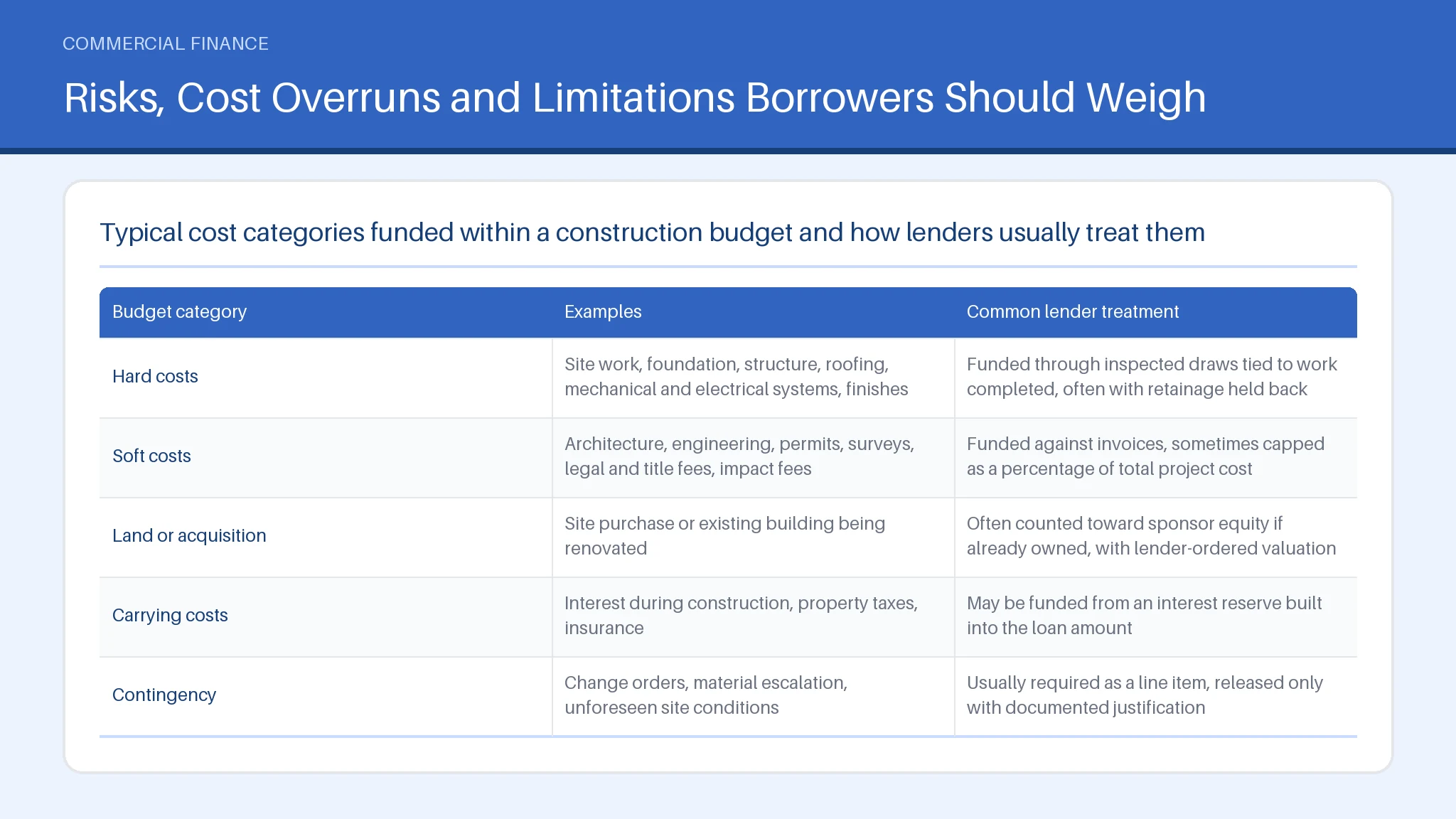
Commercial construction loans pay for the creation or substantial improvement of income-producing or owner-occupied property. Eligible costs generally fall into hard costs, soft costs, and carrying costs, and lenders treat each category differently when sizing the facility.
| Budget category | Examples | Common lender treatment |
|---|---|---|
| Hard costs | Site work, foundation, structure, roofing, mechanical and electrical systems, finishes | Funded through inspected draws tied to work completed, often with retainage held back |
| Soft costs | Architecture, engineering, permits, surveys, legal and title fees, impact fees | Funded against invoices, sometimes capped as a percentage of total project cost |
| Land or acquisition | Site purchase or existing building being renovated | Often counted toward sponsor equity if already owned, with lender-ordered valuation |
| Carrying costs | Interest during construction, property taxes, insurance | May be funded from an interest reserve built into the loan amount |
| Contingency | Change orders, material escalation, unforeseen site conditions | Usually required as a line item, released only with documented justification |
Common uses include ground-up offices, warehouses and light industrial buildings, retail and restaurant shells, self-storage, multifamily, and gut renovation of an existing structure. What these facilities do not typically fund is working capital, equipment unrelated to the building, or speculative land banking with no permitted plan.
Loan Programs for Building Projects, Including SBA 504 and 7(a)
Program choice usually comes down to occupancy. If your business will occupy the majority of the finished square footage, SBA-backed structures come into play. The 504 program pairs a conventional first mortgage from a bank with a debenture funded through a Certified Development Company, which historically allows lower sponsor equity than a straight conventional deal and offers long amortization on the CDC portion. The 7(a) program is more flexible on use of proceeds and can bundle construction with other business needs, though it is generally variable rate and carries guaranty fees.
For investment property that you will lease to third parties, SBA programs are off the table and conventional bank, credit union, debt fund, or bridge structures take over. These price and size on projected stabilized income, sponsor strength, and market fundamentals. Commercial construction loans from private capital sources tend to close faster and tolerate more complex sites, with higher cost and lower leverage as the trade-off.
SBA guidance on occupancy thresholds and eligible costs is published by the U.S. Small Business Administration and worth reading directly before you assume a project qualifies.
How Draw Schedules, Disbursements and Repayment Actually Work
Funds move on a draw schedule, not at closing. You or your general contractor submits a draw request listing completed line items, supported by invoices, a sworn contractor statement, and lien waivers from subcontractors paid in the prior cycle. A third-party inspector or fund control agent visits the site and confirms the percentage complete. Title is usually updated before each disbursement so the lender knows no mechanic's liens have been filed.
Two mechanics catch borrowers by surprise. The first is retainage, commonly around 10 percent of each draw, held until the work is accepted and final lien waivers are in. That holdback sits between your contractor and their cash flow, so your subcontract terms need to match it. The second is the interest reserve. Interest accrues only on drawn balances, but if the schedule slips, the reserve depletes before the building is finished and interest starts coming out of pocket.
Repayment during the build is interest only. At maturity, the balance is either refinanced into permanent debt or retired through a sale, which is why the exit is underwritten alongside the construction budget.
Advantages of Financing a Ground-Up Building Project
Building rather than buying gives you control over layout, ceiling heights, power capacity, loading, and energy systems that an existing property rarely delivers without expensive retrofitting. For an operating business, that can mean lower long-run occupancy cost per unit of output, not just a nicer building.
The financial advantages are more specific than "you get a new building." Because interest accrues only on drawn funds, the carrying cost of commercial construction loans is materially lower in the early months than it would be on a fully funded term loan of the same size. Sponsor equity can often be satisfied in part by land already owned at its appraised value, which preserves cash. And where the completed building appraises above total project cost, that spread becomes equity you did not have to write a check for, which improves refinance leverage at the exit.
Owner-occupied borrowers also gain control over their own rent. Instead of facing renewal negotiations every few years, the payment schedule is fixed by the lending agreement and amortization. Investors gain a product with no deferred maintenance, warranty coverage on major systems, and a tenant appeal that older stock in the same submarket may not match. Those factors show up in both achievable rents and eventual valuation.
Risks, Cost Overruns and Limitations Borrowers Should Weigh
The dominant risk is not the interest rate. It is the gap between your budget and what the project actually costs. Material escalation, unforeseen site conditions, redesign after plan review, and change orders all consume contingency, and once contingency is gone the shortfall becomes a capital call on the sponsor. Many lending agreements include a balancing requirement, meaning you must deposit cash to keep the loan in balance before the next draw is released.
Timing risk compounds it. Permit delays, utility connection queues, and inspection backlogs push completion past the maturity date, which can trigger extension fees or a default even when the building itself is sound. If the interest reserve was sized to the original schedule, it runs dry at the worst possible moment.
Then there is the lease-up gap. A certificate of occupancy is not stabilized income. Permanent debt is usually sized on actual or credibly projected net operating income, so a building that finishes on budget but leases slowly can still fail to support the refinance you modeled. Commercial construction loans also carry personal guarantees in most cases, recourse that survives the entity structure. Weigh that against the project's downside, not just its base case.
Construction Financing vs Traditional Commercial Mortgages: Key Differences
A commercial construction loan is short-term, staged debt used to build a new commercial building or substantially renovate an existing one. It funds land or site costs, permits and surveys, architecture and engineering, labor and materials, and often the interest that accrues while the building goes up. A traditional commercial mortgage does something narrower: it finances a standing property that already produces income or already houses your business, and it funds in full at closing.
The underwriting logic differs at the root. On a standing asset, the lender will look at historical net operating income, in-place leases, and a stabilized appraisal. On a construction deal, none of that exists yet, so the analysis shifts to the plans and specs, the general contractor's balance sheet and bonding capacity, the line-item budget, an as-completed appraisal, and the sponsor's track record delivering comparable square footage.
Several practical differences follow from that underwriting logic, and each one affects how you plan cash flow.
- Disbursement: staged draws with inspections versus a single funding.
- Term: commonly 12 to 36 months versus five to thirty years.
- Payments: interest only on drawn balances versus amortizing principal and interest.
- Equity: measured against total project cost, not just purchase price.
- Exit: a required refinance or sale versus a scheduled payoff at maturity.
What can you use construction financing for that a mortgage cannot cover? Vertical construction itself, tenant improvement allowances on a new shell, site infrastructure, and the soft costs that precede a single shovel. What it cannot do is act as long-term debt. Once the building is complete and occupied, the goal is to move into permanent financing, whether that is a bank term loan, an SBA structure, an agency loan on multifamily, or a securitized option such as CMBS.
Qualification Requirements: Credit, Financials, Experience and Project Plans
Qualification rests on the sponsor and the project together. On the sponsor side, expect a review of personal and business credit, two to three years of tax returns and financial statements, a personal financial statement showing liquidity beyond the equity injection, and a schedule of real estate owned. Liquidity matters more here than on a standing-asset loan because someone must fund overruns.
Experience is a genuine screen. A first-time developer proposing a 60,000-square-foot industrial building will face harder questions than a sponsor with three comparable completions, and the lender will often require a stronger general contractor, a payment and performance bond, or a lower loan-to-cost to compensate.
On the project side, documentation typically includes stamped plans and specifications, a detailed line-item budget with contractor bids rather than estimates, the executed construction contract, the construction schedule, zoning and permit status, environmental and geotechnical reports, an as-completed appraisal, and a pro forma with supporting market data. Owner-occupied applicants add business projections showing coverage of post-completion debt service; investors add lease letters of intent or comparable rent evidence. Metrics such as cap rate and NOI drive the as-completed value that sets your leverage.
The Application and Approval Process From Prep to Funding
The sequence is fairly consistent, even though the parties differ. Preparation comes first: assemble the budget, bids, plans, permits, entity documents, and sponsor financials into one package. Incomplete packages are the single largest cause of delay, because each missing item restarts a review cycle.
Next comes preliminary sizing, where a lender assesses loan-to-cost, as-completed loan-to-value, projected debt service coverage, and sponsor strength. If that clears, third-party reports are ordered: appraisal, environmental, plan and cost review, and sometimes a feasibility study. A plan and cost reviewer will confirm that your budget and schedule are realistic, and their findings can change the required contingency or equity.
Formal credit approval follows, then a term sheet, then closing, which involves title, survey, builder's risk and liability insurance, and the construction loan agreement setting out draw procedures and covenants. Our guide to how CRE loan matching works outlines where a matching service sits in that sequence. Realistically, budget 45 to 120 days from complete package to first draw, longer for SBA and for projects still awaiting entitlements.
Choosing Among Commercial Construction Loans and SBA-Backed Alternatives
Once you understand the mechanics, choosing between structures becomes a question of four variables: occupancy, equity available, speed required, and exit certainty.
Commercial construction loans work by advancing money in inspected stages against a fixed budget, charging interest only on what has been drawn, and maturing at or shortly after completion. That mechanism is the same whether the capital comes from a community bank, a credit union, a debt fund, or an SBA-backed structure. What changes is leverage, cost, closing speed, and how much documentation the process demands.
Use these trade-offs as a decision frame:
- Owner-occupied with limited cash: SBA 504 or 7(a) generally allows the lowest equity injection, at the price of a longer approval timeline and program-specific occupancy rules.
- Owner-occupied with strong cash and a banking relationship: a conventional construction-to-permanent facility avoids guaranty fees and reduces the number of parties at closing.
- Investment property, conventional profile: bank or credit union construction debt sized on as-completed value and stabilized coverage, typically with recourse.
- Complex site, tight timeline, or heavy value-add: private or bridge construction capital, faster and more flexible, with higher rates, fees, and lower loan-to-cost.
Two questions separate a good structure from a bad one. Does the maturity date give you enough runway past completion to reach stabilized occupancy, and is the interest reserve sized to a realistic schedule rather than an optimistic one? A facility that funds the build but matures before lease-up creates refinancing pressure exactly when your income statement is weakest. Compare the total cost of capital across the full term, including origination, inspection, extension, and prepayment provisions, rather than the nominal rate alone. Broader background on structures and metrics sits in our commercial real estate finance guides.
Summary
Commercial construction loans are staged, short-term facilities underwritten on plans, budgets, contractors, and sponsor strength rather than existing income. The details that decide outcomes are usually procedural: draw documentation, retainage, contingency sizing, interest reserve adequacy, and whether the maturity date allows time to reach stabilized occupancy before a refinance. Program fit follows occupancy, available equity, and how fast you need to close. A practical next step is to assemble a complete package of stamped plans, contractor bids, permits, sponsor financials, and a pro forma, then compare structures on total cost and timing. CRE Loans USA matches US borrowers with independent third-party finance providers, who make all credit and pricing decisions. continue with the qualification form below.
Frequently asked questions
How hard is it to get a commercial construction loan?
Harder than a mortgage on a standing building, and for a straightforward reason: there is no completed asset and no operating history to underwrite. Providers compensate by asking for more sponsor equity, more documentation, and evidence of relevant construction experience. First-time sponsors, unusual property types, and projects without permits in hand face the most friction. Deals that move smoothly tend to share three traits: a line-item budget backed by real contractor bids rather than estimates, liquidity beyond the equity injection to absorb overruns, and a credible exit into permanent debt or a sale. Weak spots are usually fixable, but they are best addressed before submission rather than during underwriting.
What's the monthly payment on a $200,000 construction loan?
It depends entirely on the rate, the term, and how much of the $200,000 has actually been drawn, and no honest answer can be given without those inputs. What is useful to understand is the structure. During construction you typically pay interest only on the outstanding balance, so a project that has drawn $60,000 accrues interest on $60,000, not on the full commitment. That payment rises with each draw. After conversion to permanent debt, the payment becomes principal and interest amortized over the remaining term, which is a substantially larger number than the construction-phase payment. Model both phases. Only a third-party finance provider can quote actual terms for your project.
How hard is it to get a $1,000,000 business loan?
Loan size alone is not the hurdle; the coverage and collateral behind it are. At the seven-figure level, providers look closely at debt service coverage from documented cash flow, the quality and value of the collateral, sponsor liquidity and net worth relative to the request, and industry risk. Owner-occupied real estate requests are often easier to support than unsecured working capital at the same amount because the building itself secures the debt. Expect full financial statements, tax returns, a debt schedule, and personal guarantees from principals holding meaningful ownership. Clean, current, reconciled financials matter more than most applicants expect.
How do you qualify for a commercial construction loan?
Qualification comes down to four pillars assessed together. First, sponsor credit and character, including personal and business credit history. Second, capital, meaning an equity injection measured against total project cost plus reserves left over afterward. Third, capacity, shown through business cash flow for owner-occupied projects or projected net operating income for investment property, tested against post-completion debt service. Fourth, the project itself: stamped plans, permits or a clear path to them, a bid-supported budget with contingency, a qualified and ideally bonded general contractor, and an as-completed appraisal supporting the requested leverage. Documented construction experience strengthens every one of those pillars.
Should you take out a commercial construction loan?
Take one when the completed building serves a purpose you can measure, and when you can absorb a schedule slip without distress. Good candidates include a business outgrowing leased space where ownership lowers long-run occupancy cost, and an investor with a site, entitlements, and demonstrated demand in the submarket. Poor candidates include projects with thin contingency, no reserves after closing, unresolved zoning, or an exit that depends on rents above current comparables. Ask what happens if construction runs three months long and 15 percent over. If that scenario is survivable, the project is financeable. If it is not, redesign the capital stack first.
Can I get a construction loan with my LLC?
Yes, and in most transactions the LLC is the borrower of record while title sits in the same entity. Lenders commonly prefer a single-asset entity for construction because it isolates project liabilities, keeps insurance and title clean, and simplifies a later refinance or sale. Practical points to plan for: the operating agreement must permit borrowing and pledging property, all members above the lender's ownership threshold will likely sign guarantees, and any capital contributions funding the equity injection should be documented and seasoned. Also confirm that builder's risk and liability coverage names the entity correctly, since property insurance requirements are a closing condition rather than an afterthought.