
Commercial property insurance is coverage that helps protect the physical assets a business owns or leases, including the building, inventory, equipment, furniture, and fixtures, against sudden and unexpected losses. When a fire, storm, burst pipe, theft, or act of vandalism damages the space where you operate, this coverage is designed to pay to repair or replace what was lost, up to the limits and terms written into your policy. For property investors and business owners alike, it is one of the foundational protections that keeps a single bad event from turning into a permanent setback.
If you are researching this topic, you are probably weighing one of two decisions: how much protection your assets actually need, or how coverage fits into a larger financing plan for a commercial property you are buying or improving. Both are legitimate reasons to understand the details, because insurers, lenders, and landlords all look at coverage differently. A lender arranging a mortgage on a retail strip center cares about the replacement value of the structure. A tenant fitting out a leased space cares about protecting inventory and business personal property that the landlord's policy will not touch.
This guide explains what commercial property insurance covers, how needs shift by industry, what drives the cost, and how insurers value your property so you can read a policy critically instead of taking a number at face value. We also look at endorsements that strengthen a basic policy and the practical role that a risk advisor plays in tailoring coverage. Throughout, the goal is plain-English clarity rather than sales pressure. Insurance is not the same product as financing, but the two intersect constantly for anyone acquiring, holding, or developing commercial real estate, and understanding one helps you plan the other more confidently.
Key takeaways
- Commercial property insurance helps cover the physical assets a business depends on, including buildings, inventory, furniture, and equipment, against events like fire, storms, theft, and vandalism.
- Coverage needs differ sharply by industry, so a restaurant, a warehouse operator, and an office tenant will each structure a policy around different risks and asset values.
- Premiums depend on factors such as location, construction type, occupancy, claims history, and whether the property is valued at replacement cost or actual cash value.
- Endorsements like business interruption, equipment breakdown, and flood coverage close gaps that a standard policy leaves open.
- For property investors financing an acquisition, lenders typically require proof of adequate coverage before closing, which makes insurance a practical part of the deal timeline.
What Is Commercial Property Insurance and What Does It Cover?
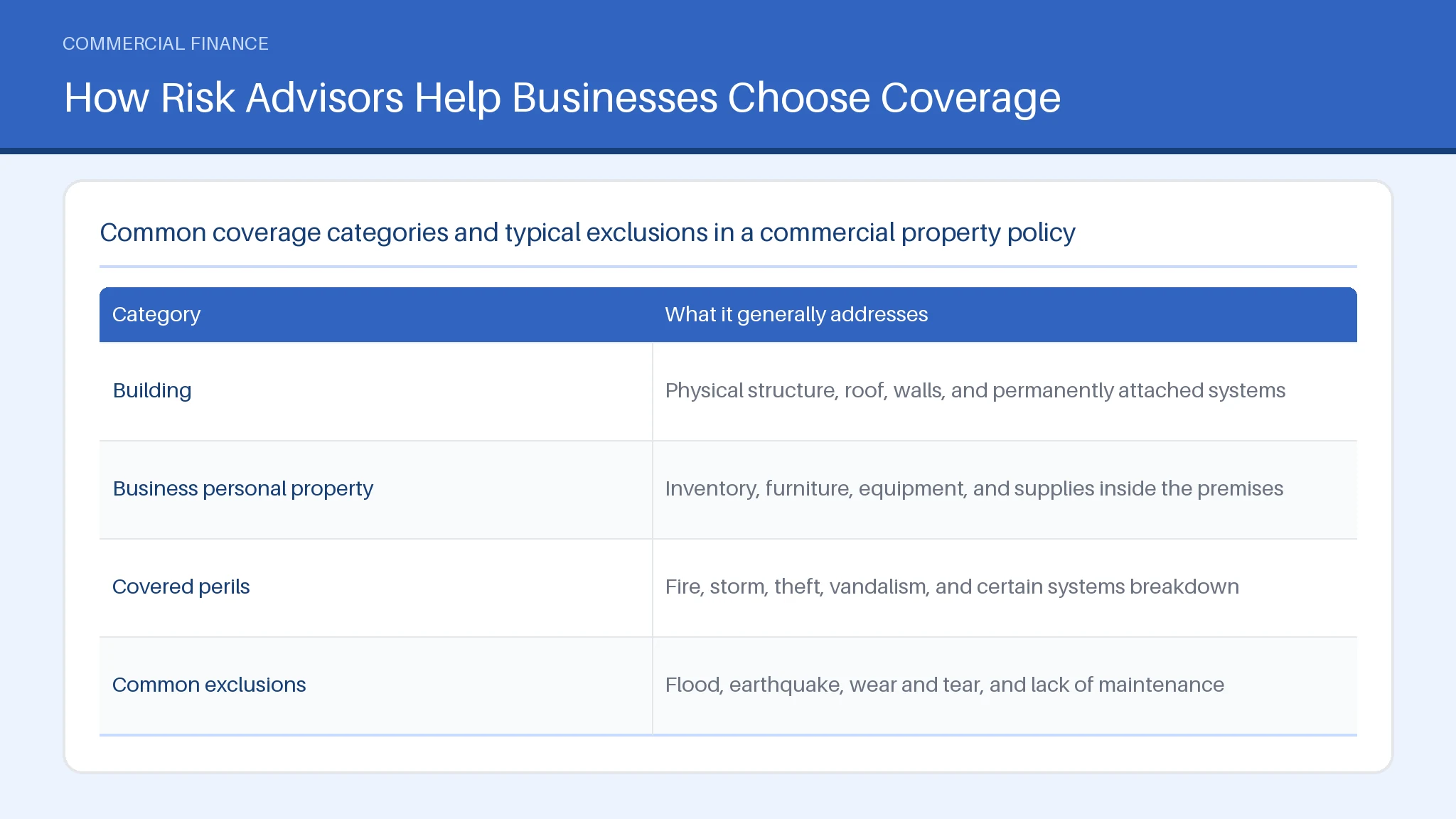
Commercial property insurance covers the tangible things a business relies on to operate. That generally includes the building or structure, permanently installed fixtures, furniture, machinery, computers, inventory, and supplies. Most policies respond to a list of covered perils such as fire, explosions, windstorms, hail, theft, vandalism, and certain kinds of equipment or systems breakdown. What a policy does not cover matters just as much: flood and earthquake are typically excluded and require separate coverage, and ordinary wear, corrosion, and neglected maintenance are almost always outside the policy.
The table below outlines common categories so you can see where a typical policy focuses and where the usual gaps sit.
| Category | What it generally addresses |
|---|---|
| Building | Physical structure, roof, walls, and permanently attached systems |
| Business personal property | Inventory, furniture, equipment, and supplies inside the premises |
| Covered perils | Fire, storm, theft, vandalism, and certain systems breakdown |
| Common exclusions | Flood, earthquake, wear and tear, and lack of maintenance |
Reading these categories against your own operation is the fastest way to spot exposure. A business with high-value stock needs generous inventory limits, while a light office may care more about protecting computers and furniture.
How Coverage Needs Vary by Business Type and Industry
Coverage needs differ sharply by business type because commercial property insurance is priced around each operation's specific risks. No two businesses carry the same risk profile. A restaurant faces grease fires, refrigeration breakdown, and spoilage, so equipment breakdown and spoilage endorsements often matter more than raw square footage. A warehouse or distribution operation concentrates enormous value in inventory that can be wiped out by a single sprinkler malfunction or roof leak, which pushes limits and water-damage terms to the front of the conversation.
Retailers worry about theft and seasonal inventory swings, so their limits may need to flex with the calendar. Manufacturers depend on specialized machinery that is expensive and slow to replace, making equipment valuation and business interruption central. Professional offices usually have lower physical asset values but still need to protect furniture, technology, and any tenant improvements they paid to install in a leased space.
Location layers on top of industry. A property in a coastal wind zone, a wildfire region, or a high-crime area will be underwritten and priced differently than the same building elsewhere. Lease structure matters too, because a landlord's policy typically covers the shell while the tenant insures everything inside. Mapping your specific assets, perils, and lease obligations before you shop is the difference between a policy that pays and one that leaves a surprising gap.
How Commercial Property Insurance Works and What It Protects
At a mechanical level, commercial property insurance works on a simple exchange: you pay a premium, and in return the insurer agrees to help pay for covered losses up to stated limits, after you satisfy a deductible. When a covered event damages your property, you file a claim, document the loss, and the insurer values it against the terms in your policy. How the loss is valued, whether at replacement cost or actual cash value, determines how much of the repair or replacement you actually recover.
What the coverage protects extends beyond the building itself. A well-structured policy protects the income-producing capacity of the property. If a fire forces you to close for repairs, business interruption coverage can help replace lost income and cover continuing expenses like rent and payroll during the shutdown. That protection is often more valuable than the physical repair, because a long closure can end a business even after the building is fixed.
Limits and deductibles are the two dials you control. A higher deductible lowers the premium but shifts more of each loss onto you. Underinsuring the building to save money can trigger a coinsurance penalty, where the insurer reduces a claim payment because your limit fell short of the required percentage of value. Understanding those trade-offs is central to buying coverage that performs when you need it.
Tips to Reduce the Risk of Property Damage
Insurers price risk, and reducing risk can lower both the odds of a loss and, over time, your premium. The most effective steps are unglamorous but proven. Install and maintain a monitored fire alarm and a working sprinkler system, since active suppression sharply limits fire spread and is one of the factors underwriters reward. Keep electrical systems, HVAC, and roofing on a documented maintenance schedule, because slow leaks and deferred repairs cause many losses that policies then exclude as neglect.
Address security directly. Alarm systems, exterior lighting, and controlled access reduce theft and vandalism, which are among the more common commercial property insurance claims. For water damage, one of the costliest and most frequent perils, add leak detection near plumbing and water heaters and shut off supply lines to unused areas.
Manage inventory and equipment placement thoughtfully. Storing stock off the floor protects against minor flooding, and separating high-value equipment from high-heat processes limits how much a single incident can destroy. Finally, keep an updated inventory list with photos and receipts. Good documentation speeds claims, supports accurate valuation, and helps you prove replacement cost when it matters most. These habits protect the business first and reward you on renewal second.
How Risk Advisors Help Businesses Choose Coverage
A risk advisor or licensed insurance broker helps translate the way a business actually operates into the way a commercial property insurance policy is written. Their first job is discovery: walking through your assets, lease obligations, revenue model, and the specific perils your location and industry face. That review often surfaces exposures owners miss, such as tenant improvements they paid for but never insured, or inventory values that have grown well past an old policy limit.
From there, an advisor compares how different carriers define covered perils, set exclusions, and value losses. Two policies with the same headline limit can pay very differently after a claim because one uses replacement cost and the other uses actual cash value, or because one bundles equipment breakdown while the other charges for it separately. A good advisor makes those differences visible instead of letting price alone drive the decision.
Advisors also right-size limits to avoid coinsurance penalties, recommend deductibles that match your cash reserves, and flag when a separate flood or earthquake policy is worth carrying. During a claim, they can advocate for a fair valuation and keep the process moving. The value is not just placing coverage; it is building a program that holds up under the stress of an actual loss.
What Affects the Cost of Commercial Property Insurance?
The cost of business insurance for property reflects how much the insurer expects to pay in claims, so nearly every pricing factor traces back to risk. Location leads the list. A building in a wind, wildfire, flood, or high-crime area costs more to insure than an identical structure in a low-risk zone. Construction type matters too: fire-resistive masonry generally prices better than wood frame, and older buildings with dated wiring or plumbing carry higher premiums.
The amount and value of what you insure drives the base cost. Higher building limits, larger inventory values, and expensive specialized equipment all raise the premium. So does occupancy, because a woodworking shop or restaurant presents more fire exposure than a quiet office. Safety features push the other direction; sprinklers, monitored alarms, and updated systems can earn credits.
Your choices shape the number as well. A higher deductible lowers the premium in exchange for more out-of-pocket cost per claim, while replacement cost valuation costs more than actual cash value but pays more after a loss. Claims history counts, since a record of frequent losses signals future risk. Finally, endorsements such as business interruption or equipment breakdown add coverage and cost. Understanding these levers helps you compare quotes on substance rather than headline price alone.
How Insurers Value Your Property for Coverage
Insurers value your property to set how much you collect after a loss, and the valuation method is one of the most misunderstood parts of business insurance. There are two main methods. Replacement cost pays to repair or rebuild with materials of like kind and quality at today's prices, without deducting for age or wear. Actual cash value pays replacement cost minus depreciation, so a ten-year-old roof is reimbursed as a ten-year-old roof, not a new one. Replacement cost costs more in premium but protects you far better after a serious loss.
Insurers estimate building value using construction cost data based on square footage, materials, finishes, and local building costs, not the market or purchase price of the real estate. That distinction surprises many owners, because a property can sell for far more or less than it costs to rebuild.
Coinsurance ties valuation to your limit. Policies often require you to insure to a set percentage of full value, commonly 80 percent or more. If you insure below that threshold to save money, the insurer can reduce even a partial claim payment proportionally. Reviewing your insured value at each renewal, especially after renovations or rising construction costs, keeps your coverage aligned with what a rebuild would actually cost.
Which Business Owners Need Commercial Property Coverage?
Almost any business that owns or occupies physical space benefits from commercial property coverage, but a few groups need it most directly. Owners of the building itself carry the clearest exposure, since a fire or storm can destroy an asset worth hundreds of thousands or millions of dollars. Property investors and developers fall squarely in this group, and lenders almost always require proof of adequate commercial property coverage before a loan closes, which makes it a practical step in any financing timeline.
Tenants need it too, even when a landlord insures the shell. A lease commonly makes the tenant responsible for business personal property and for any improvements they installed, so a restaurant that spent heavily on a kitchen build-out cannot rely on the landlord's policy to replace it. Retailers, manufacturers, warehouse operators, and professional offices all hold enough inventory, equipment, or fixtures to justify property coverage.
The clearest way to know whether you need it is to ask a simple question: if the space and everything in it were destroyed tomorrow, could the business absorb the cost and keep operating? For most owners the honest answer is no, and that is precisely the exposure this coverage is built to address. If you are financing an acquisition and want to understand where insurance fits alongside qualifying factors, you can continue with the qualification form below and review how CRE loan matching works.
Endorsements and Add-Ons That Strengthen Your Policy
A base property policy leaves predictable gaps, and endorsements are how you close them. Business interruption coverage is often the most important add-on, because it replaces lost income and covers continuing expenses like rent and payroll while you rebuild after a covered loss. Without it, a business can survive the fire but not the months of closure that follow.
Equipment breakdown coverage handles losses from mechanical or electrical failure, such as a compressor, boiler, or electrical panel that fails on its own rather than from a covered peril. Flood and earthquake are excluded from standard policies and require separate coverage, which is essential in exposed regions and frequently required by lenders. Ordinance or law coverage pays the extra cost of rebuilding to current codes after a loss, a real expense in older buildings.
Other useful add-ons include spoilage for perishable inventory, extra expense to keep operating from a temporary location, and higher sub-limits for signs, outdoor property, or accounts receivable records. The right combination depends on your assets and risks, so it pays to review endorsements against a concrete list of what a serious loss would actually cost you rather than accepting a stock package.
Summary
Commercial property insurance protects the physical assets a business depends on, from the building itself to inventory, equipment, and improvements, against fire, storm, theft, vandalism, and breakdown. The details decide everything: covered perils, exclusions like flood and earthquake, replacement cost versus actual cash value, coinsurance rules, and endorsements such as business interruption all shape how a policy performs after a loss. Costs track risk, and smart risk reduction plus right-sized limits keep coverage effective without overpaying. For investors and developers, adequate coverage is often a lender requirement, so it belongs in your acquisition planning. If financing a commercial property is your next step, CRE Loans USA can help match you with independent lenders. continue with the qualification form below.
Frequently asked questions
Who offers the best commercial property insurance?
There is no single best commercial property insurance for every business, because the right policy depends on your assets, industry, location, and lease. The strongest choice is the carrier and policy that cover your specific perils, use replacement cost valuation where it matters, set limits high enough to avoid a coinsurance penalty, and offer the endorsements your operation needs. Comparing how policies define coverage and value losses matters more than comparing headline premiums, and a licensed broker can help you weigh those trade-offs against your real exposure.
How much is commercial property insurance per month?
Monthly cost varies widely because pricing reflects risk. Small businesses in low-risk locations with modest property values often pay a few dozen to a few hundred dollars a month, while operations with large buildings, high inventory values, or hazardous occupancies pay considerably more. Location, construction type, claims history, chosen limits, deductible, and endorsements all move the number, so the only reliable figure is one built from your specific property and coverage choices.
How much is a $1,000,000 general liability policy?
General liability is a different coverage than property insurance, protecting against third-party bodily injury and property damage claims rather than damage to your own assets. Cost for a policy with a $1,000,000 limit depends on industry, revenue, location, and claims history, and it is commonly bundled with property coverage in a business owner's policy. Because pricing is individual, treat any single figure as an estimate and confirm it against your own operation.
Do I need an LLC to get commercial insurance?
You do not need an LLC to buy commercial insurance. Sole proprietors, partnerships, and other structures can all obtain a policy, and insurers care about the business activity, assets, and risk rather than the legal entity type. That said, forming an LLC or corporation can offer liability separation between business and personal assets, which is a legal and tax decision worth discussing with an attorney or accountant. If your next step is financing rather than insurance, you can explore our commercial real estate finance guides and common loan questions.