Self storage loans are commercial real estate debt products used to buy, build, expand, or refinance storage facilities, and they are underwritten on the facility's cash flow, occupancy history, and local competitive supply rather than on the sponsor's income alone. That makes storage a distinctive lending category: operating margins are high, leases are month to month, and revenue can be repriced quickly, which lenders view as both an advantage and a volatility risk.
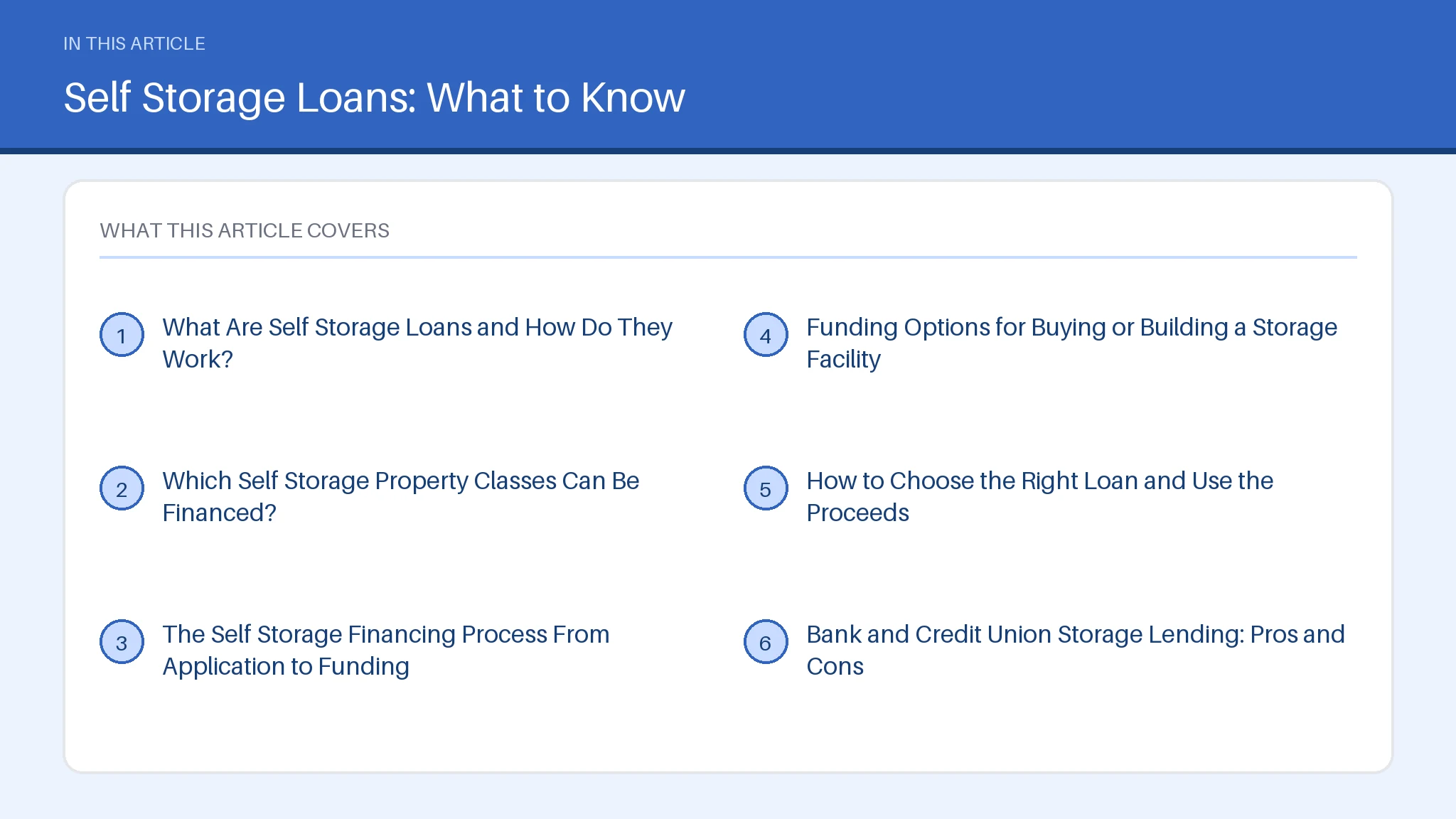
Borrowers usually choose between SBA-backed debt for owner-operated facilities, conventional bank or credit union mortgages, and short-term bridge or construction financing for lease-up and repositioning plays. Each path carries different leverage, amortization, and reporting expectations. The sections below break down how self storage loans work, which property classes qualify, and how to compare structures before committing to one. For broader context, the Commercial Real Estate Finance Guides library covers adjacent structures in more depth.
Key takeaways
- Self storage loans cover acquisition, construction, expansion, and refinance of climate-controlled, drive-up, and mixed-use storage properties.
- Owner-occupied deals may fit SBA structures, while passive investment deals usually route to conventional commercial mortgages, bridge debt, or CMBS.
- Underwriters weigh trailing occupancy, rent roll churn, unit mix, and local supply pipeline more heavily than they do for most other asset classes.
- Leverage generally falls as execution risk rises: stabilized permanent debt sits at the top of the LTV range, ground-up construction at the bottom.
- Prepayment terms, reserve requirements, and recourse often move the true cost of a deal more than the headline rate does.
What Are Self Storage Loans and How Do They Work?
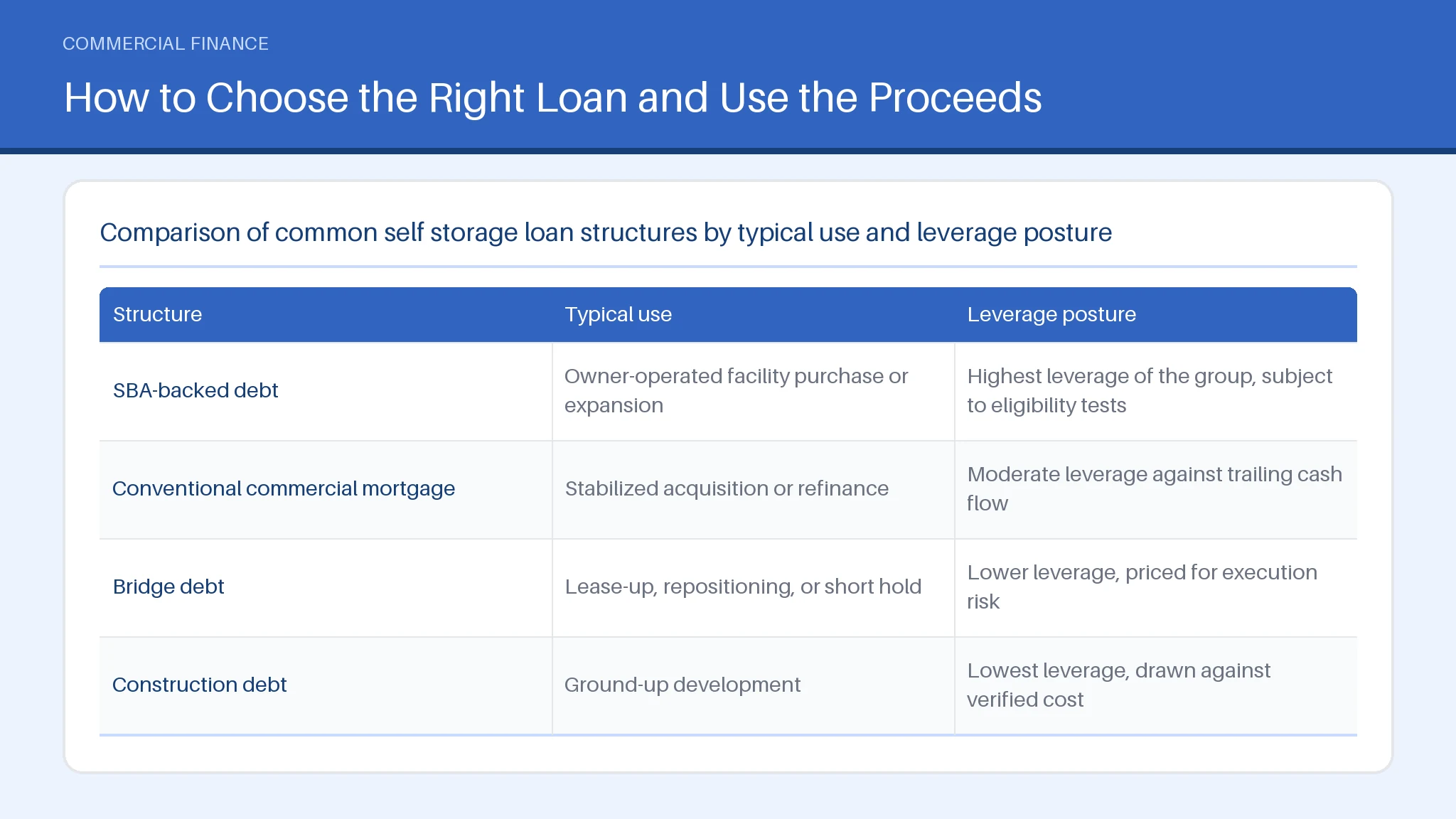
Self storage loans work like other income-property debt: a lender sizes the loan against net operating income, a debt service coverage floor, and a maximum LTV, then secures it with a first mortgage on the real estate. What differs is the revenue test. Because leases run month to month, underwriters lean on trailing twelve-month collections, concession levels, and delinquency data before they credit a proforma. An SBA loan path adds a business-use test on top of the real estate analysis, while a conventional financing option focuses purely on the asset. The table below helps you compare how the main structures treat a loan storage request, whether you plan to refinance or acquire a self storage facility. Treat a lender logo on a term sheet as a starting point, not a final answer.
| Structure | Typical use | Leverage posture |
|---|---|---|
| SBA-backed debt | Owner-operated facility purchase or expansion | Highest leverage of the group, subject to eligibility tests |
| Conventional commercial mortgage | Stabilized acquisition or refinance | Moderate leverage against trailing cash flow |
| Bridge debt | Lease-up, repositioning, or short hold | Lower leverage, priced for execution risk |
| Construction debt | Ground-up development | Lowest leverage, drawn against verified cost |
Which Self Storage Property Classes Can Be Financed?
Most storage formats can be financed, but the class of property changes the terms. Fully climate-controlled multi-story facilities in dense metros attract the widest lender interest and the strongest LTV. Single-story drive-up sites, rural facilities, RV and boat storage, and conversion projects still get funded, though appraisers apply more caution on exit value. Self storage construction loans serve ground-up development, while an SBA 504 loan self storage structure suits an operator who will run the site. Repositioning a self storage property, by adding units, upgrading security, installing climate control, or replacing below-market rents, usually starts with short-term debt and ends with a refinance into permanent debt once the asset stabilizes. When you compare options, ask each lender how they treat non-storage income. A standard SBA loan and a bank facility may score truck rental or tenant insurance revenue very differently, which affects how much you can finance self.
The Self Storage Financing Process From Application to Funding
The self storage financing process moves in four stages: package, underwrite, third-party reports, and close. The package stage is where most deals stall, so assemble a trailing twelve-month operating statement, current rent roll with unit mix and square footage, occupancy by unit type, real estate tax bills, and a summary of competing facilities within a three-mile radius. Storage financing underwriters then test debt service coverage against in-place income, not projections.
Third-party work follows: appraisal, environmental screening, and often a feasibility study on new supply. Self Storage Permanent Financing typically closes after a facility holds stable occupancy for several consecutive months, which is why many sponsors sequence bridge storage financing first and permanent self storage financing second. Self storage loans close faster when the sponsor answers supply questions before they are asked. The how it works page outlines how a financing request becomes a lender-ready enquiry.
Funding Options for Buying or Building a Storage Facility
Funding a purchase and funding construction call for different capital. Acquisitions of stabilized sites suit permanent debt with a longer loan term and steady amortization. Ground-up projects need self storage construction loans that fund in draws against verified cost, then refinance once lease-up hits target. SBA self storage loans can work for owner-operators who will manage the site themselves. Compare the total expense of each route, including origination, third-party reports, legal fees, and interest carried during lease-up, because carry cost often exceeds the rate difference between lenders. Storage demand held up better than many property types in the last recession, but that history does not guarantee lease-up speed in an oversupplied submarket. Ask every lender how they underwrite new competing square footage before you finance self storage projects on thin margins.
How to Choose the Right Loan and Use the Proceeds
Choose the structure that matches your hold period first, then negotiate price. A ten-year hold argues for a longer loan term with fixed-rate protection. A two-year reposition argues for flexible prepayment, even at a higher coupon. Match proceeds to use as well: real estate and long-lived improvements belong in mortgage debt, while signage, software, gate systems, and marketing fit self storage business loans or equipment finance where the amortization tracks the useful life. SBA loans for self storage facilities carry an owner-occupancy requirement, so a passive investor will not qualify on that path. Model each expense line against proceeds before signing, and treat a marketing logo refresh or brand change as an operating cost rather than loan collateral. A borrower who documents the use of funds clearly gives a lender less reason to trim the amount on a self storage facility deal.
Bank and Credit Union Storage Lending: Pros and Cons
Local banks and credit unions remain the largest source of storage debt, and their advantage is relationship depth. A local credit committee that already knows the submarket can move quickly, hold the loan on balance sheet, and revisit terms later. The trade-offs are real: recourse is usually personal, deposit relationships are often expected, and concentration limits can close a lending window without warning once a bank's commercial real estate portfolio hits internal caps. Banks also tend to require stronger trailing occupancy than debt funds do before they will finance self storage at full leverage. SBA loans for self storage facilities are frequently delivered through these same institutions. If you plan self storage business loans for a multi-site operator, expect global cash flow analysis across every self storage facility you own, not just the subject property. Ask early whether their lending appetite covers your format, because a familiar logo does not guarantee a fit.
Financing a Storage Facility With a Conventional Commercial Mortgage
A conventional commercial mortgage is the default route for a stabilized self storage facility that no longer needs bridge pricing. This form of storage financing is sized on in-place net operating income, carries a fixed or floating coupon, and usually amortizes over twenty to twenty-five years with a balloon well before full payoff. A bank loan of this type puts the real estate first and the operating business second, which suits investors who hire third-party management.
SBA 7(a) loans for self-storage financing work differently: the structure supports owner-operators, blends real estate and working capital in a single facility, and can fund soft costs that pure mortgage financing will not. Trade-offs include SBA fees, personal guarantees, and closer reporting. Conventional storage financing avoids those program rules but typically caps proceeds lower. Prepayment language decides which storage financing option actually costs less over your hold, so read it before comparing coupons. See how prepayment penalties are calculated before locking a term.
Comparing Self Storage Loans by Term, Cost and Leverage
Rank the structures by execution risk and the pricing logic becomes clear. SBA 504 loans for self-storage businesses split the deal between a bank first mortgage and a debenture second, delivering long fixed-rate debt at high leverage for owner-operators who occupy the site. SBA 7(a) covers a wider set of uses but at a shorter term and a floating rate. Both SBA paths require personal guarantees, and an SBA loan carries guaranty fees that a conventional facility does not.
A bridge loan funds lease-up or a turnaround on a storage property at lower leverage with interest-only payments, then exits into permanent debt or a refinance. Construction loans for self-storage fund in draws against verified cost and carry the lowest proceeds of any structure. Mezzanine loans for self-storage sit behind the senior mortgage, fill a gap in the capital stack, and price accordingly, as covered in this guide to how junior capital works. Working capital loans for self-storage cover payroll, marketing, and short-term shortfalls rather than the real estate. Self Storage Property Loans priced by any lender ultimately turn on trailing coverage at the self storage facility, not on projections.
Using a Business Line of Credit for Storage Operations
Summary
Self storage loans reward sponsors who document trailing occupancy, unit mix, and local supply before shopping terms. Match structure to hold period, then compare prepayment and reserves alongside pricing. CRE Loans USA matches borrowers with independent third-party finance providers who make all lending decisions.
Frequently asked questions
Is there a self-storage ETF?
Yes, publicly traded exchange-traded funds and real estate investment trusts hold self-storage assets, giving investors exposure to the sector without owning property or arranging debt. That is an equity route, not a financing route, and it does not help an operator fund a facility.
What credit score do you need to get a $30,000 loan?
Most conventional lenders look for a personal credit score in the high 600s or better on a $30,000 business loan, though thin-file or lower-score applicants may still qualify with strong collateral, a personal guarantee, or a shorter term at higher cost.
Will the SBA give me a loan for a storage unit?
The SBA does not lend directly; participating banks and credit unions originate SBA-guaranteed debt, and self-storage facilities are eligible when the borrower operates the business and occupies the required share of the property. Passive landlord deals are steered toward conventional loans instead.
What disqualifies you from an SBA loan?
Common disqualifiers include a passive real estate investment model, delinquency on existing federal debt, prior government loan charge-offs, businesses in ineligible categories, size above SBA standards, and insufficient historical cash flow to service the requested amount.
What is the easiest SBA loan to qualify for?
Program-wise, smaller 7(a) and microloan products generally have the lightest documentation, but qualification still depends on credit, collateral, and cash flow. No SBA program is guaranteed to approve any applicant.
How many years do you have to pay back an SBA loan?
Terms vary by use: working capital typically runs up to ten years, while real estate secured debt commonly extends to twenty-five years. Bank loans outside the SBA often amortize similarly but balloon sooner.
What is the monthly payment on a $50,000 business loan?
Payment depends entirely on rate and term. A $50,000 loan amortized over five years costs far more per month than the same balance over ten, so ask each lender for a full amortization schedule rather than a single figure.