

Mezzanine financing is a layer of junior capital that funds the space between the senior loan and the cash an owner is willing to put in. A senior lender may size a first mortgage at 60 to 65 percent of value on a stabilized commercial property, while the sponsor wants to limit the check written from its own balance sheet. That shortfall is the classic use case: a subordinated position that takes more risk than the bank, prices accordingly, and gets repaid after the senior debt but before equity sees a dollar of profit.
Most articles stop at the textbook definition. The decisions that actually make or break a deal are narrower. Whether the senior lender permits a junior layer at all, how the intercreditor agreement handles cure rights and standstill periods, whether combined coverage still clears the tests after the junior coupon, and what the total blended cost does to projected returns all matter more than the label. Those questions apply just as much to an operating company buyout as to a stabilized apartment portfolio.
This guide explains where mezzanine financing sits in the capital stack, how the paperwork and collateral actually work, how it compares with preferred equity, and what underwriters look at before committing. It also walks through two worked examples with real arithmetic so you can see how a junior layer changes leverage, cost, and residual ownership. If you want to understand the structure before you price it, start with mechanics rather than headline rates.
Key takeaways
- Mezzanine financing is junior capital that sits between senior debt and equity in the capital stack, ranking behind the first mortgage but ahead of the owners.
- It is normally secured by a pledge of the ownership interests in the borrowing entity rather than by a recorded mortgage on the property itself, which is why many summaries loosely call it unsecured.
- Borrowers use it to close a funding gap on an acquisition, buyout, or expansion without selling additional common equity and diluting control.
- Pricing is higher than senior debt because the junior position absorbs losses first, and lenders often add exit fees, warrants, or conversion rights.
- Senior lender consent, an intercreditor agreement, and realistic combined leverage and coverage tests usually decide whether a mezzanine layer is workable at all.
What Is Mezzanine Financing and Where It Sits in the Capital Stack
Mezzanine financing is a hybrid layer of capital that ranks below senior secured debt and above equity, combining a fixed coupon with features that give the holder an equity-like upside or conversion right if the deal underperforms. In the capital stack, mezzanine debt sits third from the bottom in terms of risk: the senior mortgage is repaid first, mezzanine debt second, preferred equity third, and common equity last. That ranking drives everything else about the instrument, including price, documentation, and control rights.
Position matters because it dictates what happens in a downturn. A senior loan is secured by a recorded mortgage on the real property. Mezzanine debt is typically secured by a pledge of the equity interests in the entity that owns the asset, so it is often described as unsecured at the property level even though the lender holds enforceable collateral one level up. If the borrower fails to meet a payment obligation, the mezzanine holder can foreclose on those pledged interests and step into ownership rather than taking the building through a mortgage foreclosure.
Repayment is usually interest-only during the term with a balloon at maturity, funded by a refinance or a sale. Whether the deal is mezzanine financing commercial real estate sponsors use for a value-add office repositioning or multifamily mezzanine financing behind an agency first mortgage, the borrower must repay the senior loan and the junior layer out of the same asset. Mezzanine financing lenders and each equity investor therefore care about the same question: how much room is left between total debt and realistic exit value. A conservative investor will test that cushion at a higher exit cap rate than the base case assumes.
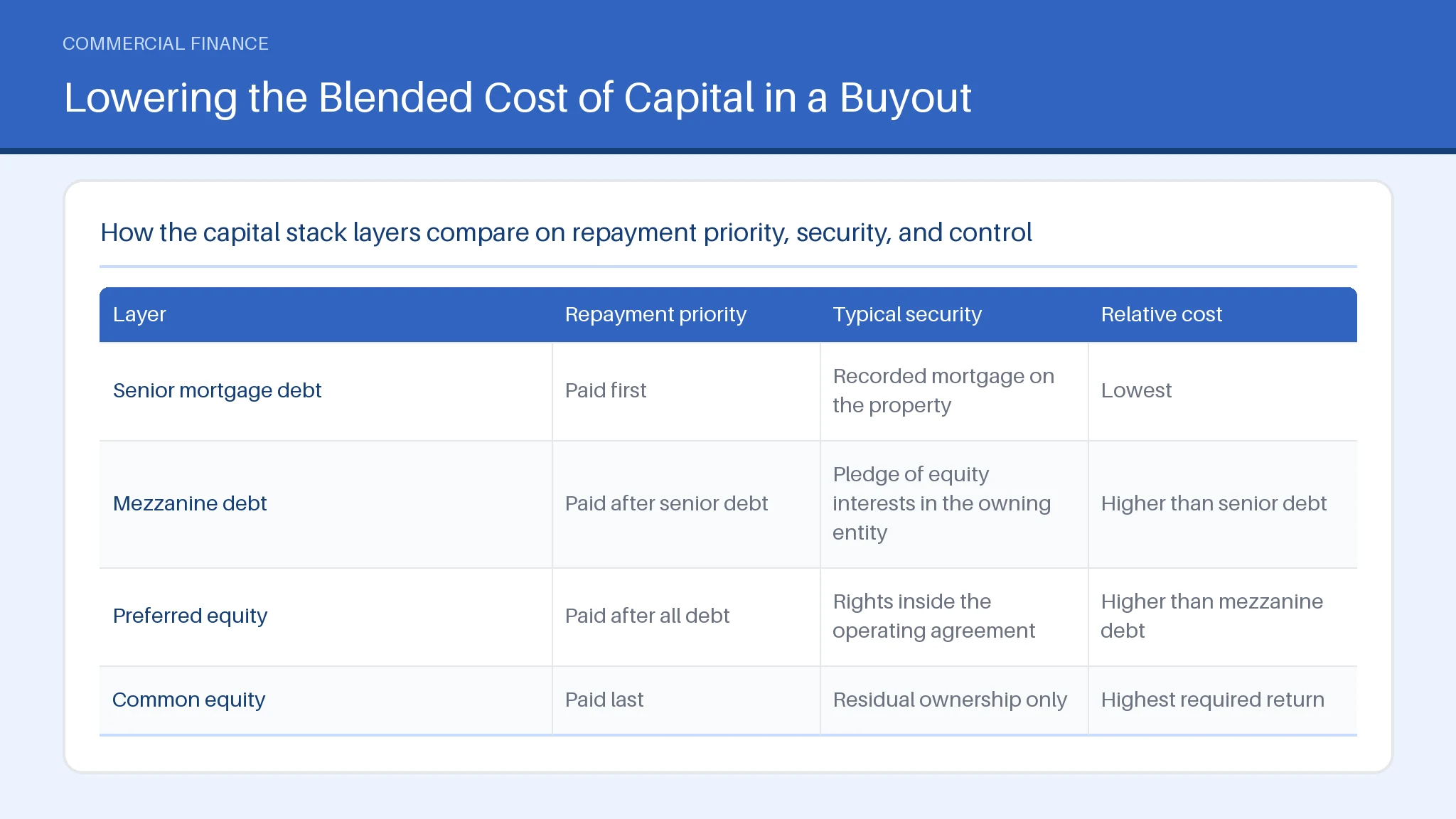
| Layer | Repayment priority | Typical security | Relative cost |
|---|---|---|---|
| Senior mortgage debt | Paid first | Recorded mortgage on the property | Lowest |
| Mezzanine debt | Paid after senior debt | Pledge of equity interests in the owning entity | Higher than senior debt |
| Preferred equity | Paid after all debt | Rights inside the operating agreement | Higher than mezzanine debt |
| Common equity | Paid last | Residual ownership only | Highest required return |
Why Borrowers Use Junior Capital Without Diluting Ownership
A junior layer lets a sponsor raise more capital while keeping the existing ownership split intact. Selling additional common equity to close a shortfall permanently transfers a share of every future dollar of profit and usually brings governance rights with it. A subordinated loan is finite: the borrower pays the coupon, retires the principal, and the ownership table looks the same afterward.
The arithmetic is straightforward. If a sponsor needs 5 million dollars beyond what the senior lender will advance and the deal is projected to produce a strong residual, giving away the ownership percentage a new partner would demand can cost far more over a five-year hold than paying a double-digit coupon for the same period. Mezzanine financing converts an open-ended claim on ownership into a defined repayment schedule.
There are trade-offs a borrower should price honestly. The junior coupon is a hard obligation, so cash flow tightens immediately, and a borrower with thin coverage may find the fixed payment more dangerous than dilution. The senior lender has to approve the structure, which can mean tighter covenants across the whole stack. Each lender will also negotiate cure rights and transfer restrictions, and most mezzanine documents include a conversion or equity-kicker feature that can dilute ownership anyway if the deal defaults. Understanding the structure of a lender introduction before you commit helps you compare offers on total cost rather than headline rate.
How a Mezzanine Loan Is Arranged, Funded and Repaid
A mezzanine loan is arranged after the senior debt is sized, because the junior amount is whatever gap remains between the first mortgage proceeds and total capital required. The sequence usually runs: senior term sheet, then a junior proposal, then an intercreditor agreement that the two lenders negotiate directly with each other. The borrower signs a separate note and a pledge of the equity interests in the property-owning entity, and often a special purpose entity is inserted so the pledged interests are clean.
Funding is normally a single draw at closing for an acquisition, or staged draws where proceeds are tied to construction or lease-up milestones. During the term the borrower pays a current coupon, sometimes with a portion accrued as payment-in-kind so cash flow is preserved while the asset stabilizes. Mezzanine financing lenders underwrite the same items as the senior bank plus one extra: the realistic value cushion above combined debt.
Repayment comes at maturity from a refinance or sale. Terms are typically shorter than the senior loan and often coterminous by agreement. A mezzanine loan on a value-add deal is expected to repay once net operating income supports a larger permanent first mortgage. Among the mezzanine financing benefits advantages sponsors weigh most highly is that an investor group can invest less cash up front, though each investor should stress-test the exit. Multifamily mezzanine financing behind agency debt often carries the tightest prepayment mechanics, so any mezzanine loan should be modeled against the senior loan's own prepayment terms.
Is Mezzanine Debt Risky Compared With Senior Lending?
Mezzanine debt carries materially more risk than senior debt for the lender and adds risk for the borrower too. The junior position absorbs losses first after equity, so if an asset sells for less than the combined debt balance, the senior lender is made whole before the mezzanine holder receives anything. That loss-severity profile is the reason pricing sits well above first-mortgage pricing, and why documentation focuses on enforcement mechanics rather than covenants alone.
For the borrower, the added risk is layered leverage. Total debt at 80 to 85 percent of value leaves a thin cushion, and a modest decline in net operating income or a 50 basis point move in exit cap rate can wipe out the equity entirely. The interest on the junior layer is a fixed charge that does not flex with performance, so real estate mezzanine financing works best where cash flow is contractual and predictable, such as a property with long-dated leases or an apartment asset with a proven rent roll.
Two offsets make the trade acceptable to many sponsors. Interest is generally tax deductible for the borrower, unlike an equity distribution, which lowers the effective cost. And the structure closes a funding gap without a permanent claim on profits. A disciplined investor tests the combined coverage at a stressed rate before signing, and a second investor view on exit assumptions is worth the time. Sponsors who follow mezzanine financing news today should treat market commentary as context rather than a substitute for underwriting a specific asset.
Lowering the Blended Cost of Capital in a Buyout
A junior layer can reduce the weighted average cost of capital in a buyout because it prices below the return a new equity partner requires. If a sponsor's common equity targets a high-teens return and the senior lender is priced in the mid single digits, inserting a layer priced in between pulls the blended number down compared with funding the whole gap with equity. The saving is real only if the asset performs, since the coupon is owed regardless.
The effect compounds because interest is tax deductible while equity distributions are not. A borrower paying 12 percent on a nominally unsecured junior note carries a lower after-tax cost than the headline suggests, whereas a preferred return paid to an equity investor is an after-tax cost in full.
Two practical constraints limit how far this can go. First, the senior lender sets the ceiling: if the bank caps combined leverage, debt mezzanine capacity shrinks regardless of appetite from the junior lender. Second, every additional dollar of leverage raises the required return on the remaining equity, so the apparent saving can reverse if the exit disappoints. Sponsors using real estate mezzanine financing in a buyout should model the blended cost against the asset's unlevered yield and stop adding leverage where the spread compresses. Recent mezzanine financing news today consistently points to lenders sizing on coverage, not just value. Understanding how index plus spread pricing works on the senior layer makes the blended math easier to check.
Subordinated Debt vs Preferred Equity as Junior Capital
Subordinated debt and preferred equity solve the same funding problem with different legal machinery. Subordinated debt is a loan with a note, a maturity date, and a pledge of equity interests as collateral, so the holder can foreclose on those interests and take over the ownership entity. Preferred equity is an equity interest inside the same entity, documented in the operating agreement, with a stated return and a priority ahead of common equity but behind all debt.
The practical differences show up in three places. Enforcement is faster and cleaner for a mezzanine lender holding a pledge than for a preferred equity holder relying on member removal provisions. Senior lenders sometimes prohibit additional debt outright but will permit preferred equity, which is why sponsors restructure the same dollars as equity rather than as a subordinate note. And accounting treatment differs: interest on subordinated debt is an expense, while a preferred equity return is a distribution.
Priority is otherwise similar in spirit. Both sit above common equity and both are subordinate to the first mortgage. Both may include conversion features that increase the holder's equity stake if targets are missed. A borrower comparing the two should look past the coupon and read the remedies: the ability to replace the sponsor, block a sale, or force a capital call often matters more to an equity holder than 100 basis points of return. Our common financing questions page covers related structuring basics.
Worked Example: Funding a Business Acquisition With Junior Debt
Consider an owner-operator buying a light industrial business and its building for 20 million dollars. The senior lender advances 12 million dollars against the real property and equipment, secured by first-lien collateral, leaving an 8 million dollar shortfall. The buyer has 4 million dollars of cash available and does not want to sell half the company to fund the rest, so the acquisition is completed with a 4 million dollar junior note that is structurally unsecured at the asset level but supported by a pledge of the equity interests.
The capital stack is therefore 60 percent senior debt, 20 percent junior debt, and 20 percent sponsor cash. The junior note is interest-only for five years with a balloon at maturity, and the repayment plan is a refinance once trailing earnings support a larger senior facility. Total borrowing costs rise, but the buyer retains full ownership of the upside.
The mezzanine lender underwrites this differently from the bank. It asks whether combined fixed charges are covered by normalized cash flow with a margin for a soft year, whether the earnings are customer-concentrated, and whether the sponsor can run the business without the seller. Blending debt and equity this way lets the buyer bridge the gap between bank proceeds and price, and a co-investor brought in later as a minority investor faces a smaller entry price than if that investor had funded the shortfall at closing. Each lender in the stack signs an intercreditor agreement first.
Worked Example: Financing an Expansion When Senior Debt Falls Short
A multifamily owner planning a 9 million dollar renovation across a 200-unit portfolio shows how a junior layer fills an expansion shortfall. The senior lender sizes new proceeds using in-place net operating income, not projected post-renovation income, and the resulting advance covers only 6 million dollars. The 3 million dollar shortfall exists because the appraisal reflects today's rents while the business plan depends on tomorrow's.
A 3 million dollar junior facility, drawn in stages against completed unit turns, closes that distance. The facility is unsecured against the real estate and instead relies on a pledge of interests, with repayment scheduled at a supplemental refinance once the stabilized rent roll supports higher senior proceeds. The mezzanine lender prices the risk of the renovation schedule slipping, so draw conditions reference completed units rather than spending.
Approval hinges on the senior lender consenting to the junior layer and to the intercreditor terms, including whether the junior lender may cure a senior default before acceleration. Among the financing benefits advantages in this scenario, the sponsor preserves its position as the sole equity holder and does not bring in an outside investor at a pre-renovation valuation. This is a common pattern in financing commercial real estate work, where staged capital helps bridge the gap between current value and completed value. Compare the mechanics with apartment building loan terms before choosing.
Cost, Security and Control Across Senior, Junior and Equity Layers
Cost, security, and control move together as you climb the capital stack, and understanding that relationship is how a sponsor decides which layer to add. The senior lender holds the strongest security, a recorded first mortgage, and therefore charges the least and demands the fewest governance concessions beyond standard covenants. A debt mezzanine layer holds weaker security, a pledge of equity interests instead of the asset, and prices higher while negotiating specific consent rights over sales, refinancings, and major leases.
Equity sits at the opposite end. Common equity has no security at all, so its required return is the highest in the stack, and in exchange it holds day-to-day control until a default shifts leverage elsewhere. Preferred equity gives up some of that control in return for payment priority, which is why its cost falls between junior debt and common equity.
The control question is where sponsors are most often surprised. A junior holder with an equity pledge can, on default, take the ownership entity and leave the former equity owners with nothing while the first mortgage stays in place. Preferred equity remedies typically involve removing the managing member, which also transfers operational control of the equity position. Before adding any layer, list which decisions you are prepared to share, then price the equity you are effectively putting at risk. continue with the qualification form below for a structure review, and browse more financing guides for context on each equity and debt layer.
Summary
Financing closes the distance between senior loan proceeds and total capital needed, priced above the bank and secured by a pledge of ownership interests rather than the property. It preserves the ownership table but adds a fixed payment and a thinner cushion at exit. Test combined coverage and a stressed exit value first. CRE Loans USA is a lead-generation and lender-matching site that introduces borrowers to independent finance providers, who make all lending and pricing decisions.
Frequently asked questions
What is mezzanine financing in simple terms?
Mezzanine finance is borrowed money that ranks behind the main mortgage but ahead of the owners. A lender advances the amount the senior loan will not cover, charges a higher rate for taking the weaker position, and is repaid after the senior debt at a refinance or sale. Structurally, most debt mezzanine loans are documented as a note plus a pledge of the equity interests in the entity that owns the asset, usually interest-only with a balloon, and sometimes with part of the interest accrued rather than paid in cash. It suits situations where value is likely to rise, such as an acquisition, a buyout, or a renovation.
What are the risks of mezzanine financing?
The main risks are layered leverage and a fixed charge that does not flex with performance. Combined debt often reaches 80 to 85 percent of value, so a modest fall in income or a rise in exit cap rate can erase the sponsor's remaining equity. The junior holder can also foreclose on the pledged interests and take ownership of the entity, and any conversion or warrant feature dilutes the sponsor if targets are missed. Prepayment restrictions and senior lender consent requirements add friction if plans change.
Who typically uses it?
It is used mainly by property sponsors funding value-add or transitional assets, private equity buyers funding acquisitions and management buyouts, and established operating companies financing expansion. The common thread is a business with predictable cash flow, a credible exit, and owners who prefer a repayable layer to permanent dilution.
Can you give me an example of it?
A typical example is a 20 million dollar purchase funded with a 12 million dollar first mortgage, a 4 million dollar junior note, and 4 million dollars of sponsor cash. The junior note carries a higher coupon, is interest-only for five years, and is repaid at a refinance once earnings support larger senior proceeds.
What is the typical interest rate for mezzanine loans?
Pricing is set by each independent lender based on the asset, the sponsor, combined leverage, and coverage, and it sits above senior mortgage pricing because the junior position absorbs losses first. Published rate ranges are not a substitute for a lender's own sizing on a specific deal.
Who funds mezzanine debt?
Providers include private credit funds, specialty finance companies, insurance company debt platforms, business development companies, and some bank affiliates. These are independent third parties that make their own lending and pricing decisions.
What are the disadvantages of a mezzanine?
The main disadvantages are higher cost than senior debt, a hard payment obligation, negotiated consent rights that limit the sponsor's freedom to sell or refinance, longer documentation because of the intercreditor agreement, and the risk of losing the ownership entity on default.