
Multifamily construction financing is short-term, milestone-funded debt that pays for the vertical and horizontal work of building an apartment property, then either matures at certificate of occupancy or converts into permanent debt once the asset stabilizes. It behaves almost nothing like a mortgage on a finished building. There is no in-place income to underwrite, the collateral gains value only as the contractor performs, and the lender releases money in stages against inspected progress rather than in one advance at closing.
That structural difference is where most first-time developers lose time. They compare quoted rates across capital sources and assume the cheapest coupon is the cheapest capital. In practice the total cost of a ground up apartment build is driven by the interest reserve, the recourse position of the guarantors, the length of the construction period, the number of closings, and whether the exit is committed before the first shovel hits the ground. A deal that carries twelve months of unplanned extension because the draw process stalled can cost far more than a fifty basis point spread difference.
The market context matters too. Construction costs and insurance escalation have compressed development margins, so lenders have tightened leverage and leaned harder on sponsor balance sheets and contractor track records. Capital is available, but it rewards developers who arrive with a complete story: hard cost budget with contingency, a guaranteed maximum price contract, entitlements in hand, an equity source identified, and a realistic absorption schedule.
This guide explains how multifamily construction financing is structured, who provides it, what underwriting actually tests, how draws and timelines work in practice, and which trade-offs determine your real cost of capital. It is educational context rather than a product offer. Lending and pricing decisions belong to independent third-party finance providers. For related structures on completed assets, the guides on apartment building loans cover the stabilized side of the same asset class.
Key takeaways
- Multifamily construction financing is funded in draws against verified work in place, not as a single lump sum at closing, so interest accrues only on the balance actually advanced.
- The two structural questions that shape pricing are recourse and term: a recourse bank facility usually prices tighter than a non recourse alternative, and a construction to permanent structure removes a second closing and a second round of fees.
- Agency-insured programs for new apartment development are long, fully amortizing and non recourse, but they carry longer processing timelines and prevailing wage obligations that a bank construction loan does not.
- Most ground up apartment deals are underwritten on the sponsor as much as the site: completed schedule of real estate owned, net worth close to the loan amount, liquidity of roughly ten percent, and a general contractor with comparable finished projects.
- A single purpose LLC is the normal borrowing entity, but the entity does not carry the credit; the guarantors behind it do.
HUD and FHA Loan Programs for New Apartment Development
HUD and FHA mortgage insurance programs support new apartment development through Section 221(d)(4), which combines the construction period and the permanent period into one insured, fully amortizing, non recourse loan. The headline attraction is duration: a 40-year amortizing permanent term following the construction period, with fixed pricing locked at initial endorsement. For a developer planning to hold the asset for decades, that eliminates refinance risk entirely.
The trade-offs are real and they are mostly about time and compliance. Applications move through a two-stage review, Davis-Bacon prevailing wage rules apply to construction labor, and mortgage insurance premiums plus third-party reports add cost that a bank deal does not carry. Sponsors who need to break ground in ninety days rarely choose this route. Sponsors who can absorb a longer processing runway in exchange for permanent non recourse leverage often find nothing else competes.
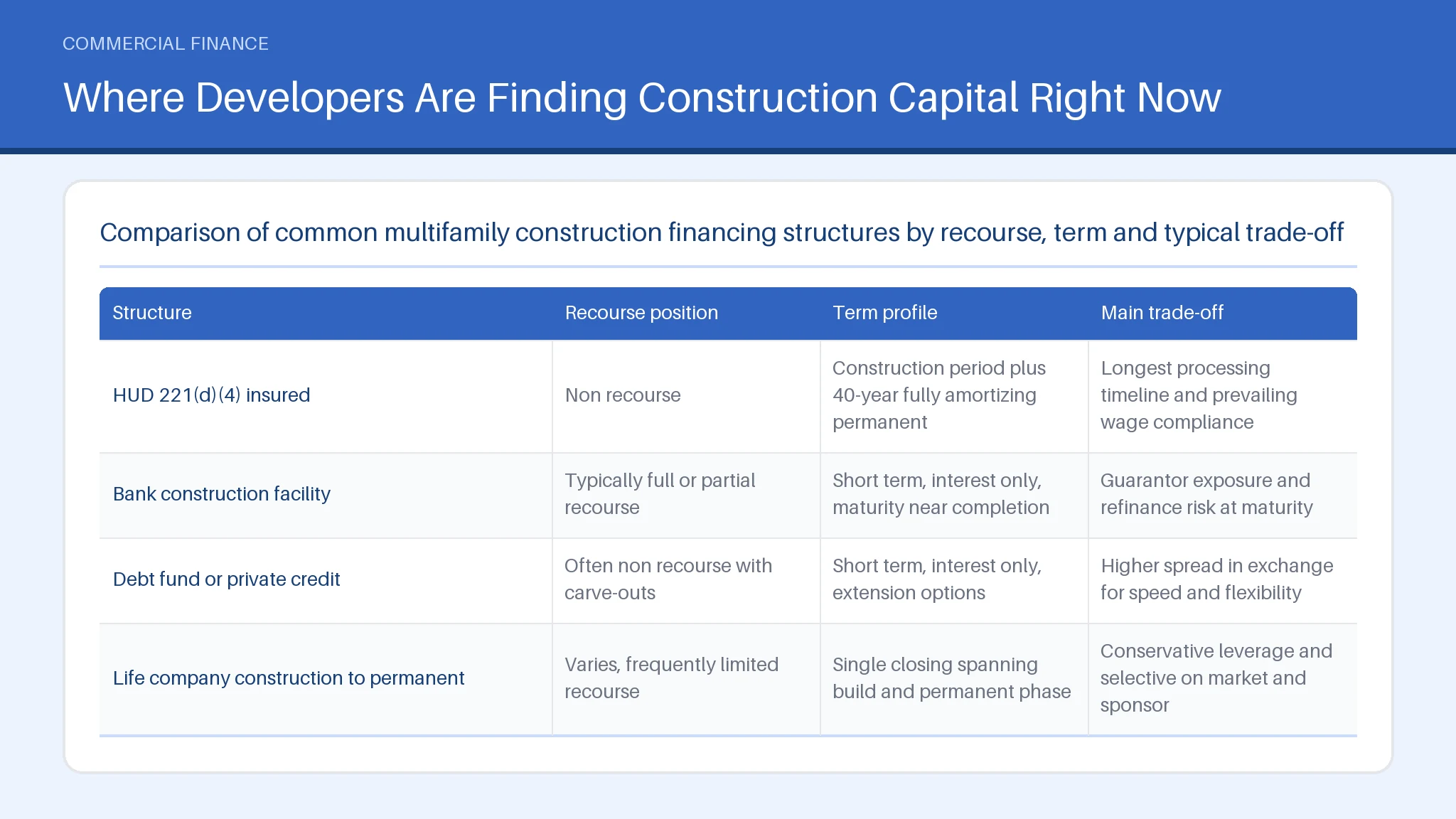
| Structure | Recourse position | Term profile | Main trade-off |
|---|---|---|---|
| HUD 221(d)(4) insured | Non recourse | Construction period plus 40-year fully amortizing permanent | Longest processing timeline and prevailing wage compliance |
| Bank construction facility | Typically full or partial recourse | Short term, interest only, maturity near completion | Guarantor exposure and refinance risk at maturity |
| Debt fund or private credit | Often non recourse with carve-outs | Short term, interest only, extension options | Higher spread in exchange for speed and flexibility |
| Life company construction to permanent | Varies, frequently limited recourse | Single closing spanning build and permanent phase | Conservative leverage and selective on market and sponsor |
How Multifamily Construction Financing Works From Draw to Payoff
Construction financing funds in sequence rather than in a single advance. At closing the lender typically requires the sponsor equity to go in first or to fund pari passu alongside debt, so the borrower's money is at risk before the lender's is. From there, the contractor submits a monthly pay application tied to the schedule of values, a third-party inspector verifies work in place, title is updated to confirm no intervening mechanic's liens, and the lender funds the approved amount less retainage, commonly five to ten percent held back until substantial completion.
Interest during the build is usually paid from an interest reserve sized into the loan amount. That reserve is calculated on an assumed draw curve, so if construction runs slow or the index rises above the assumption, the reserve can exhaust before completion and the sponsor must fund debt service out of pocket. Testing the reserve against a delayed-draw and higher-index scenario is one of the most useful sensitivity checks a developer can run.
Payoff happens one of three ways: conversion to a permanent loan under a combination structure, refinance into agency or fixed-rate debt once the property hits a stabilization threshold such as ninety percent occupancy for ninety days, or sale of the completed asset. Multifamily construction financing is priced and structured around which of those exits is committed, which is why lenders ask about the takeout before they discuss the construction loan itself.
Construction to Permanent Loans With a Single Closing
A construction to permanent loan closes once and covers both phases, so the borrower signs one set of documents, pays one set of legal and title fees, and locks the permanent terms before the first draw funds. During the build it behaves as an interest-only facility. At completion and stabilization it converts on pre-agreed terms into an amortizing permanent loan without a second underwriting cycle.
The value is risk transfer. In a two-loan approach the developer carries takeout risk: rates can move, lending appetite can tighten, and lease-up can underperform between groundbreaking and refinance. A single closing removes that gap. The cost of removing it is usually conservative leverage, a rate locked early in a market that might improve, and firm conversion conditions such as a minimum debt service coverage ratio or occupancy test that must be met by a stated date.
Read the conversion trigger carefully. If the property misses the test, some structures extend the construction period at a higher rate, others require a principal paydown to resize the permanent loan. Modeling that paydown against your equity reserve is a practical step before committing to multifamily construction financing on a single-close basis.
Current Multifamily Construction Loan Rates and Regional Pricing Spreads
Construction pricing is quoted as a floating index plus a spread, most often tied to a short-term benchmark rather than a fixed coupon, because the lender is funding unpredictable draws over an unpredictable schedule. That means two developers can hold the same nominal spread and pay very different amounts depending on when their draws land and where the index sits. The mechanics of that structure are covered in the guide on index plus spread pricing.
Regional spread differences track risk rather than geography for its own sake. Markets with heavy new supply in the delivery pipeline, long entitlement timelines, or sharp insurance escalation draw wider spreads and lower leverage than markets with constrained supply and fast permitting. Lenders also price the labor market: a metro where subcontractor capacity is thin gets underwritten with a longer schedule and a bigger contingency, both of which raise the all-in cost.
An LLC can absolutely borrow for a ground up apartment project, and in practice a single purpose entity is the preferred borrower because it isolates the asset and simplifies collateral. The entity itself carries no credit history, so underwriting looks through it to the members who sign personal guarantees and completion guarantees.
Qualifying for ground up apartment debt comes down to a repeatable checklist: demonstrated experience delivering comparable projects, combined guarantor net worth at or near the loan amount, post-closing liquidity of roughly ten percent of the loan, a general contractor with a bonded or otherwise credit-supported track record, a guaranteed maximum price contract, full entitlements and permits, and a pro forma that clears the lender's stabilized debt service and debt yield tests with room to spare.
Where Developers Are Finding Construction Capital Right Now
Regional and community banks remain the volume providers for apartment construction, particularly for sponsors with a deposit relationship and a local track record. Their pricing is usually the tightest available, but they ask for recourse, they cap concentration by market and by borrower, and their appetite swings with their own balance sheet and regulatory capital position.
Debt funds and private credit have taken share where banks pulled back. They underwrite faster, tolerate more complexity, and frequently offer non recourse structures with bad-boy carve-outs, but the spread is wider and extension options often carry fees tied to performance milestones. Life insurance companies write selectively, favoring strong markets and experienced developers, and are the most common source of a true single-close construction to permanent facility. Agency-insured programs sit at the patient end of the spectrum.
A practical sourcing approach is to run two tracks at once: one bank quote to establish the tightest realistic pricing, and one alternative quote to test structure, leverage and certainty of execution. Comparing those side by side tells you what you are actually paying for flexibility. That comparison is the real work in arranging multifamily construction financing, and our matching process exists to shorten the first step of it.
Qualifying Requirements for Ground Up Apartment Construction Loans
Underwriting for a ground up apartment construction loan tests four things in order: the sponsor, the budget, the site, and the exit. Sponsor review covers a completed schedule of real estate owned, evidence of at least one comparable delivered project, credit history of each guarantor, and the strength of the completion guarantee. Lenders would rather see a modest balance sheet attached to three finished buildings than a large balance sheet with no vertical experience.
Budget review focuses on whether the hard cost number is defensible. Expect the lender to commission a plan and cost review, compare your line items against regional cost data, and require contingency of roughly five to ten percent of hard costs plus a separate soft cost contingency. A guaranteed maximum price contract with a creditworthy general contractor significantly improves terms.
Site review confirms entitlements, zoning, utility availability, environmental reports and geotechnical conditions before any commitment is issued. Exit review models stabilized net operating income against a takeout loan sized on debt service coverage and debt yield, because a project that cannot support permanent multifamily financing at conservative assumptions will not get built with borrowed money. The math behind those tests is set out in the guide on debt service coverage ratio minimums.
Draw Schedules, Terms, and Timelines Developers Should Expect
Draw schedules follow the schedule of values agreed at closing, with most facilities funding monthly on a fixed cycle. A realistic timeline runs ten to fifteen business days from pay application submission to funding: inspector site visit, review of lien waivers from the general contractor and major subcontractors, title endorsement, then wire. Developers who submit incomplete waiver packages are the single most common cause of delay, and the delay compounds because subcontractors slow down when payment slips.
Terms on the construction period are typically interest only for eighteen to thirty-six months depending on unit count and construction type, with one or two extension options that require payment of an extension fee and evidence that the project is on budget and lien free. Retainage is released at substantial completion, sometimes in two stages, with final release tied to the certificate of occupancy and closeout documentation.
Build the schedule with float. Lenders underwrite to a completion date, and blowing through it triggers extension fees, an exhausted interest reserve and, in the worst case, a technical default. Adding ninety days of contingency to the construction timeline at the outset is cheaper than negotiating an extension later, and it protects the permanent multifamily financing conversion window.
Planning Your Next Ground Up Multifamily Project
Developers working on a ground up apartment project should assemble the lender package before approaching capital, not after. The package that moves fastest contains six items: a unit mix and rent comparables study, a line-item development budget with contingency, a guaranteed maximum price contract or a contractor bid with a schedule, proof of entitlements and permits, a sources and uses statement showing committed equity, and a sponsor resume with the schedule of real estate owned attached.
Sequence matters as much as content. Locking land under a contract with an entitlement contingency preserves optionality, and running the plan and cost review early surfaces budget gaps while there is still time to value engineer. Order the environmental and geotechnical reports before the loan application rather than during underwriting, because a surprise finding at week six restarts the clock.
Test the deal against a stress case before you commit: costs up ten percent, lease-up three months slower, and exit cap rate fifty basis points wider. If the project still services debt under those conditions, the capital conversation becomes straightforward. You can continue with the qualification form below to be matched with independent lenders active in ground up apartment development.
Rate Outlook and Cost of Capital for Apartment Builds
Cost of capital on an apartment build is not one number. It is the blended cost of the construction coupon, the interest reserve, lender fees, third-party reports, the equity return you owe your investors, and any mezzanine or preferred layer sitting between them. Developers who focus only on the construction spread routinely understate their true cost by several hundred basis points once the equity stack is included.
Floating-rate exposure is the variable to manage most actively. Because construction debt is indexed, a rise in short-term rates during the build raises carry at exactly the point when the asset produces no income. Rate caps are commonly required by lenders and should be budgeted as a real line item, since cap pricing moves with volatility and can cost materially more at renewal than at purchase.
On the permanent side, the decision is between locking early through a combination structure and staying flexible for a possibly better market at stabilization. Neither is automatically correct. The choice depends on your hold period, your investors' tolerance for refinance risk, and how much of your return depends on the exit rather than on operations. Further structural context is available across the finance guides.
Summary
Multifamily construction financing rewards preparation more than negotiation. The structures differ mainly on recourse, term length and number of closings, and each trade-off has a price: agency-insured debt buys non recourse permanence at the cost of timeline and compliance, bank facilities buy tighter pricing at the cost of guarantor exposure, and private credit buys speed at the cost of spread. Underwriting consistently comes back to sponsor experience, a defensible budget with real contingency, entitled land, and a credible takeout. Developers who model an exhausted interest reserve, a slower lease-up and a wider exit cap before applying enter the conversation with a stronger case. CRE Loans USA matches borrowers with independent third-party lenders that consider multifamily construction financing requests; those lenders make all lending and pricing decisions.
Frequently asked questions
Do I have to put 20% down on a construction loan?
A twenty percent down payment is not the standard benchmark for apartment construction debt, because these loans are sized on loan to cost rather than loan to value. Most ground up apartment facilities fund sixty to seventy-five percent of total development cost, which means the sponsor contributes twenty-five to forty percent as equity, and land contributed at appraised value can often count toward that contribution. Agency-insured programs can reach higher leverage on cost, while private credit typically funds less and prices wider.
What is the monthly payment on a $300,000 construction loan?
The monthly payment on a $300,000 construction loan depends on how much of that facility has actually been drawn, because construction debt accrues interest only on the outstanding balance rather than the full commitment. If the full $300,000 were drawn and the loan were interest only, each one percentage point of rate would equal $250 per month, so an eight percent rate would produce $2,000 per month while the balance stayed fully outstanding. Early in a build, when only a fraction is advanced, the payment is a fraction of that figure. Most construction facilities also fund this interest from a reserve inside the loan rather than from the borrower's operating cash.
How can I get money to buy a multifamily building?
Buying an existing multifamily building uses acquisition debt rather than construction debt, and the common sources are agency loans, bank mortgages, life company loans, CMBS and private lenders. Underwriting turns on the property's in-place net operating income measured against the proposed debt service, plus your credit, liquidity and experience. Structures for completed assets are covered in the guide on multifamily loans.
Can I use my LLC to get a construction loan?
An LLC can borrow for a construction project, and lenders generally prefer it. A single purpose LLC that owns only the project isolates the asset, simplifies the collateral package and makes title and insurance cleaner. What the LLC does not do is carry credit on its own. Lenders underwrite the members behind it, require personal guarantees and a completion guarantee from the principals, and review each guarantor's net worth, liquidity and credit history.
What is the payment on a $1,000,000 business loan?
Payments on a $1,000,000 business loan vary with rate, term and amortization. Amortized over twenty-five years at seven percent, monthly principal and interest is roughly $7,070; over ten years at the same rate it is roughly $11,610. On an interest-only basis at seven percent, the monthly figure is about $5,833. Commercial facilities frequently amortize over twenty-five or thirty years while maturing in five to ten, which leaves a balloon balance due at maturity.
What credit score does a new LLC start with?
A newly formed LLC has no credit score at all. Business credit files build over time through trade lines, vendor reporting and a registered business identifier, and until that history exists lenders rely entirely on the owners' personal credit and financial statements. Expect to sign personally on a first project regardless of how the entity is structured.
What is the biggest disadvantage of an LLC?
The most commonly cited disadvantage of an LLC for real estate owners is that it does not shield the principals from the obligations they personally guarantee, so the liability protection stops where the guarantee begins. Add self-employment tax treatment on active income, state franchise fees and annual filing requirements, and separate books and insurance for each entity, and the administrative load grows quickly across a portfolio of single purpose entities.