
A commercial loan application is the formal package a business owner or property investor submits so a lender can size, price and underwrite debt against an income-producing asset. It is not a single form. In practice it is a bundle: an intake form covering the entity and the request, financial statements for the business and the guarantors, property-level records such as a rent roll and operating history, and a description of how the debt will be repaid.
The distinction matters because residential lending leads with personal income and credit, while commercial underwriting leads with the asset. A lender wants to see whether net operating income covers debt service, whether the sponsor has managed similar property, and whether the exit at maturity is credible. Understanding that order of review tells you which documents to prepare first and where weak files usually fail. The sections below walk through the loan types on the table, what the paperwork actually asks, and how long each stage tends to take.
Key takeaways
- A complete application package, not a perfect credit score, is what usually moves a commercial file forward: lenders read the property's cash flow first and the sponsor second.
- Most commercial requests ask for three years of business and personal tax returns, year-to-date financials, a rent roll, a personal financial statement and a schedule of real estate owned.
- Equity expectations commonly land near 20 percent to 35 percent of cost, though owner-occupied and government-backed structures can require less.
- Timelines run roughly two to eight weeks from signed term sheet to closing, and third-party reports such as appraisal and environmental work are the most common cause of delay.
- Independent third-party finance providers make all lending, pricing and approval decisions, so preparing documents early is the part a borrower can actually control.
Business Loan Types Available to Commercial Borrowers
A commercial business loan is debt extended to an entity rather than an individual, secured by business assets or by commercial real estate, and repaid from the revenue those assets produce. There is no single best structure. The right one depends on the hold period, whether the property is stabilized, and how much flexibility a borrower needs at maturity.
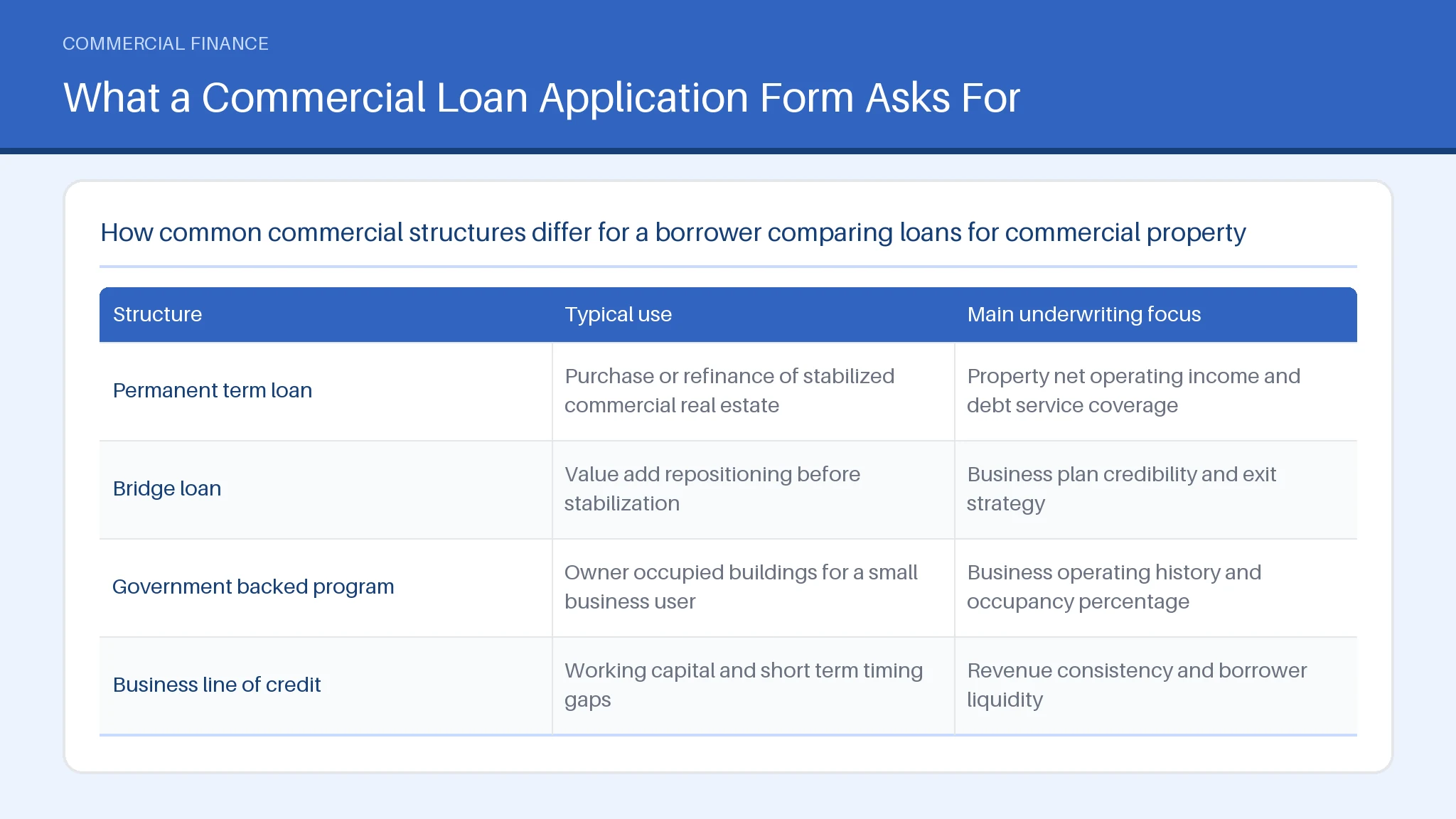
A permanent term loan suits stabilized buildings with predictable rent. Bridge debt suits repositioning, and a line of credit suits working capital swings rather than property purchases. Owner-occupied purchases often route to government-backed programs such as SBA 504 and 7(a), while rental investors frequently qualify on property cash flow under DSCR loan requirements. Ground-up work belongs to commercial construction loans, which draw funds in stages rather than at one closing.
| Structure | Typical use | Main underwriting focus |
|---|---|---|
| Permanent term loan | Purchase or refinance of stabilized commercial real estate | Property net operating income and debt service coverage |
| Bridge loan | Value-add repositioning before stabilization | Business plan credibility and exit strategy |
| Government-backed program | Owner-occupied buildings for a small business user | Business operating history and occupancy percentage |
| Business line of credit | Working capital and short-term timing gaps | Revenue consistency and borrower liquidity |
A commercial loan application template or checklist helps a borrower gather the same core documents once, then reuse them, which is more productive than repeating intake from scratch with each lender.
What a Commercial Loan Application Form Asks For
A commercial loan application form asks for four blocks of information: the borrowing entity, the sponsors behind it, the property, and the request itself. Entity items include formation documents, operating agreement, EIN and ownership percentages. Sponsor items include three years of personal returns, a personal financial statement and a schedule of real estate owned. Property items include the rent roll, trailing twelve-month operating statements, leases, and any capital expenditure history.
The request block is where borrowers lose time. Name the loan amount, the purpose, the term loan structure you want, and the repayment source. For a small business user, add interim financials and a debt schedule. Reading how commercial financing is priced before you submit helps you evaluate the terms that come back on commercial real estate debt.
Commercial Loan Application Timeline From Request to Closing
Most commercial files take roughly two to eight weeks from signed term sheet to closing, and the clock is set by third-party reports rather than by the lender's review. Week one covers intake and preliminary sizing. Weeks two and three cover appraisal ordering, environmental screening and title. Underwriting and credit committee typically follow, then closing conditions and funding.
You do not always have to put 20 percent down on a commercial loan, though something near that range is common. Investor purchases frequently need 20 percent to 35 percent of cost, while owner-occupied and government-backed structures for a small business can require materially less because part of the debt sits in a second lien position. Loan sizing is driven by whichever constraint binds first: loan to value, debt service coverage, or debt yield.
An application PDF assembled in advance shortens every stage. Keep a single indexed application PDF and an application template for entity documents, then refresh only the property exhibits when you pursue new loans for commercial real estate. Confirm term loan amortization, the repayment schedule and prepayment terms before you commit to financing.
Summary
Strong commercial files win on preparation: documented cash flow, clean entity records, realistic equity and a credible exit. CRE Loans USA is a lender-matching service that connects US borrowers and investors with independent third-party finance providers, who make all lending and pricing decisions. Review how the matching process works, then continue with the qualification form below.
Frequently asked questions
Can I get a business loan with a 400 credit score?
A 400 credit score makes most commercial approvals unlikely, because lenders generally look for mid-600s or higher on sponsor credit. Some asset-based and short-term structures weigh property equity and cash flow more heavily than the score, but they usually carry higher pricing, lower leverage and shorter terms. Repairing credit and adding a stronger co-guarantor are the practical routes.
What are commercial business loans used for?
Commercial business loans fund property purchases, refinances, ground-up development, tenant improvements, equipment, business acquisitions and working capital. The common thread is that the borrowing entity expects the funded asset or activity to generate the revenue that repays the debt.
How much income do you need for a $150,000 loan?
A $150,000 loan at roughly 8 percent over 10 years runs near $1,800 per month. Lenders typically want income that covers debt service by 1.25 times, so about $2,250 per month, or near $27,000 per year, of free cash flow after operating expenses.
What should you know about navigating the commercial loan process?
Navigating the commercial loan process means moving through intake, preliminary sizing, term sheet, third-party reports, underwriting, credit approval and closing, and a well-organized commercial loan application keeps each stage on schedule. Understanding the loan terms is a distinct step: check the index and spread, amortization period, any balloon maturity, recourse, reserve requirements and prepayment structure before signing.
What should you know about Small Business Administration loans (SBA loans)?
SBA loans support owner-occupied property where the business uses a majority of the space, and they offer longer amortization and lower equity than many conventional options. See the SBA 504 requirements guide for program detail.
How do you get a line of credit with a new LLC?
A new LLC can obtain a line of credit by pledging collateral, adding a personal guarantee from an owner with established credit, and showing business bank activity. Most lenders want operating history, so expect smaller initial limits.
What should you know about a business line of credit?
A business line of credit is revolving, interest accrues only on the drawn balance, and limits are reviewed periodically. It suits timing gaps, not long-term property ownership. Browse the financing guides or the questions page for more.