A DSCR loan is investment property financing that is underwritten on the cash flow of the asset instead of the personal income of the borrower. The lender takes the rental income the property produces, compares it to the monthly debt obligation on the proposed mortgage, and uses that ratio to decide whether the deal supports the requested loan amount. Pay stubs, employment history, and personal debt-to-income calculations move to the background. The rent roll or market rent analysis moves to the front.
That shift matters for a specific kind of borrower. If you are self-employed, write off aggressively, hold property in an LLC, or already have several mortgages reported on your credit, a conventional loan file can stall for reasons that have nothing to do with the quality of the building. Cash flow underwriting sidesteps most of that. It also introduces different constraints: lower leverage than owner-occupied lending, higher pricing, reserve requirements, and prepayment penalty terms that can materially change your exit math if you plan to sell or refinance within a few years.
The confusion in this market is rarely about the formula. It is about everything around the formula. Two lenders can quote the same ratio threshold and still reach different conclusions on the same duplex because one uses in-place rent, another uses an appraiser's market rent estimate, one deducts vacancy and management, and another does not. One counts short term rental revenue from a booking platform statement; another refuses it entirely. Those underwriting details, plus the structure of the prepayment schedule, usually determine whether a deal works.
This guide covers what the ratio actually measures, how the calculation is performed in practice, which property types typically qualify, what documentation you should expect to produce, and how rental income qualifying compares with a conventional investment property mortgage. It also sets out the practical trade-offs that thinner articles skip: reserve math, interest-only versus amortizing structures, and how to read a term sheet before you commit to an appraisal fee. For broader context on how income-based underwriting works across asset classes, our Commercial Real Estate Finance Guides cover the related metrics in more depth.
Key takeaways
- A DSCR loan qualifies a borrower on the property's rental income against its debt obligation, not on W-2s, tax returns, or personal debt-to-income ratios.
- The core math is simple: divide net rental income by the total mortgage payment including principal, interest, taxes, insurance, and any HOA dues.
- Most programs sit in the non QM loan category, which means underwriting guidelines, reserve rules, and prepayment penalty structures vary widely between lenders.
- Property type matters as much as the ratio. Single family rentals, small multifamily, and short term rental units are all common, but each is treated differently in underwriting.
- The biggest cost trade-offs are usually pricing and prepayment terms, not the down payment, so compare the full structure rather than the headline rate.
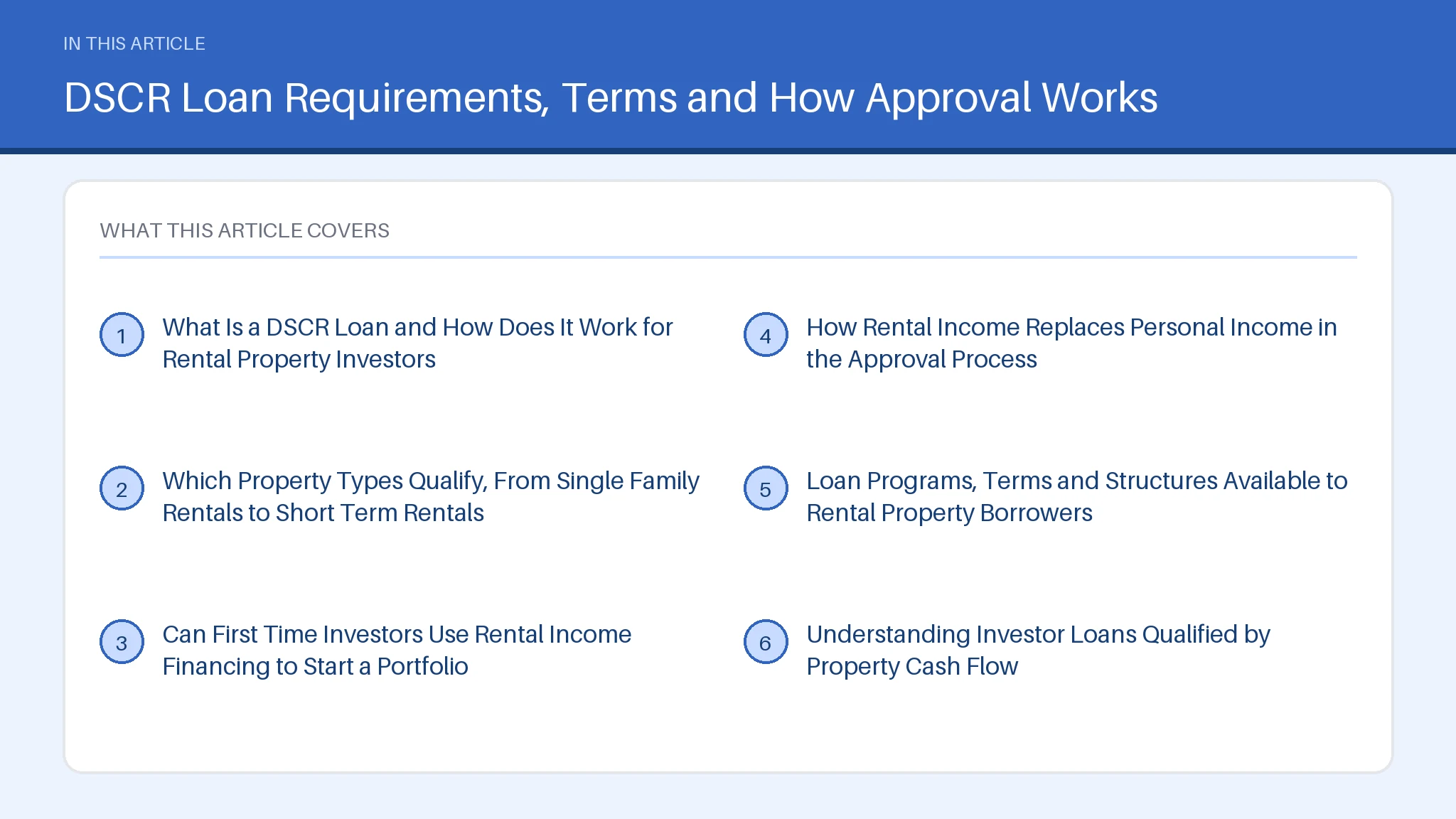
What Is a DSCR Loan and How Does It Work for Rental Property Investors
Debt service coverage ratio measures how comfortably a property's income covers its scheduled debt payments. The residential investor version of the calculation divides monthly rental income by the monthly mortgage payment, where the payment includes principal, interest, property taxes, insurance, and HOA dues where they apply. A property renting for $2,400 a month with a $2,000 all-in payment produces a ratio of 1.20. The same property with a $2,600 payment produces 0.92, which means the rent no longer covers the obligation.
Understanding how a DSCR loan work in practice means understanding the inputs, because the divisor and the dividend are both negotiable in underwriting. Lenders typically use the lower of the executed lease amount or the appraiser's market rent opinion, which is delivered on a rent schedule form alongside the appraisal. Vacant units are usually underwritten at market rent, sometimes with a haircut. Short term rental income is often supported by twelve months of platform statements or a third-party market data report, and some lenders average seasonal revenue while others discount it.
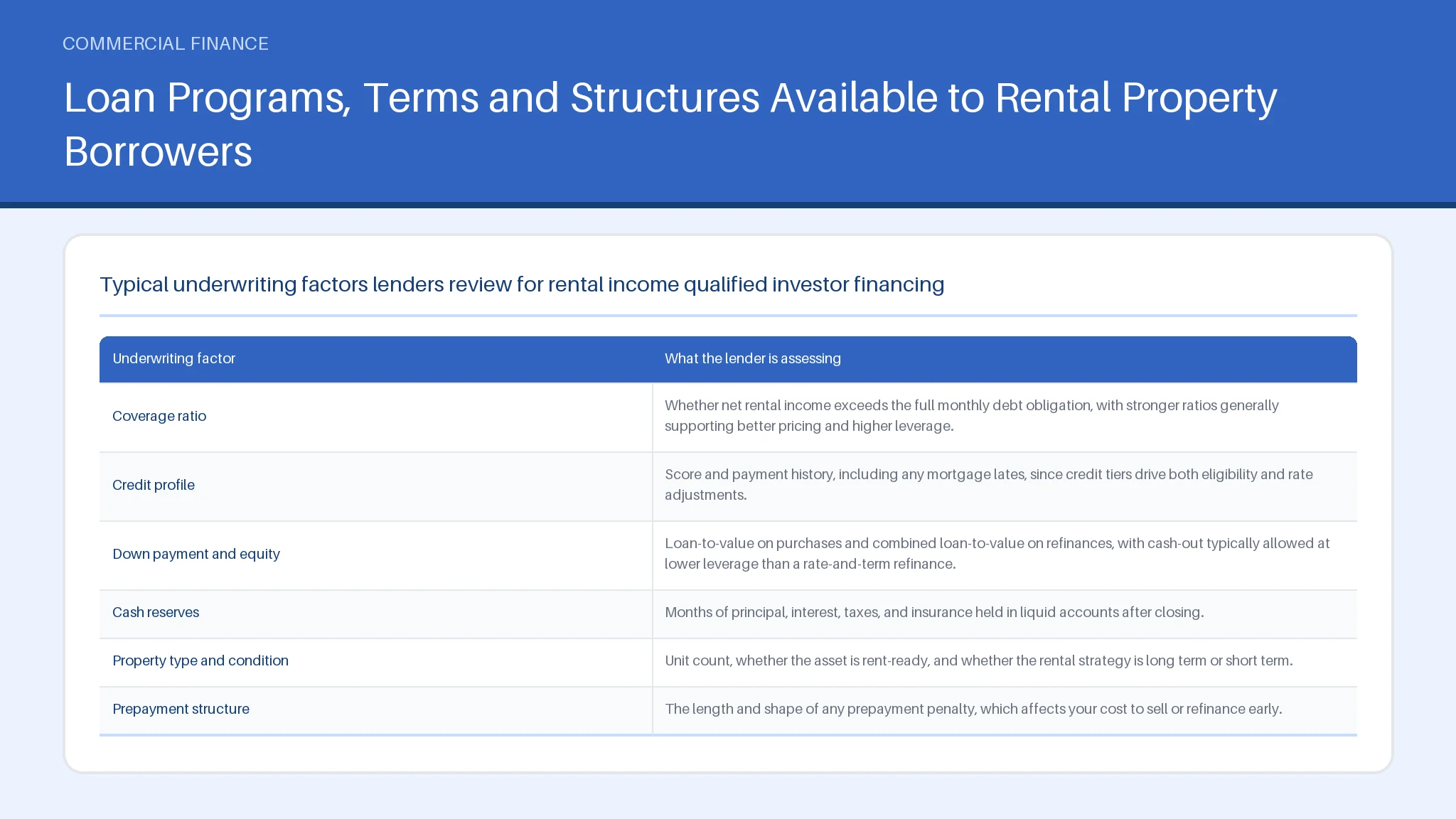
Common DSCR loan requirements across the market cluster around a handful of factors, though every lender sets its own thresholds and none of the values below is an offer or a promise of terms.
| Underwriting factor | What the lender is assessing |
|---|---|
| Coverage ratio | Whether net rental income exceeds the full monthly debt obligation, with stronger ratios generally supporting better pricing and higher leverage. |
| Credit profile | Score and payment history, including any mortgage lates, since credit tiers drive both eligibility and rate adjustments. |
| Down payment and equity | Loan-to-value on purchases and combined loan-to-value on refinances, with cash-out typically allowed at lower leverage than a rate-and-term refinance. |
| Cash reserves | Months of principal, interest, taxes, and insurance held in liquid accounts after closing. |
| Property type and condition | Unit count, whether the asset is rent-ready, and whether the rental strategy is long term or short term. |
| Prepayment structure | The length and shape of any prepayment penalty, which affects your cost to sell or refinance early. |
The mechanics of how a DSCR loan work on the file itself are lighter than most borrowers expect. There is no employment verification and no tax return review. Instead the lender orders an appraisal with a rent schedule, verifies reserves through bank statements, confirms entity documents if you are borrowing through an LLC, and checks title and insurance. The appraisal becomes the pivotal document, because it sets both the value and the rent figure the entire ratio depends on.
Which Property Types Qualify, From Single Family Rentals to Short Term Rentals
One to four unit residential rental property makes up the core of this market, and single family rentals are the cleanest file to underwrite because comparable sales and market rents are easy to support. Duplexes, triplexes, and fourplexes are widely accepted, usually with the rent schedule covering each unit separately. Condominiums qualify when the project itself passes review, which typically means checking owner-occupancy levels, litigation, and reserve funding at the association.
Short term rental units sit in a different underwriting lane. Some lenders will underwrite documented platform revenue, some use a market data report, and some insist on the long term market rent even when the property earns more nightly. Local licensing rules matter too, because a jurisdiction that restricts nightly rentals can undermine the income the ratio relies on. Rural properties, unique construction, and properties needing significant repair are frequently excluded or require additional equity.
Larger residential portfolios of five or more doors typically move into commercial style underwriting, where net operating income and cap rate analysis replace the simpler residential ratio. If you are evaluating that transition, our guide to cap rate, NOI, and valuation math explains the metrics lenders use on those files. Confirming property type eligibility before ordering an appraisal on a DSCR loan avoids the most common wasted expense in this market.
Can First Time Investors Use Rental Income Financing to Start a Portfolio
Yes, first time investors qualify for cash flow qualified financing, though the terms are usually tighter than those offered to experienced operators. Many lenders apply a first-time-investor overlay: a lower maximum loan-to-value, a higher minimum coverage ratio, additional months of reserves, or a requirement that a licensed property manager handles the asset. Some programs require prior homeownership rather than prior investment experience, which is a distinction worth confirming early because it changes which lenders are even worth approaching.
The practical constraint for a first purchase is rarely the ratio itself. It is liquidity. You need the down payment, closing costs, an appraisal fee paid upfront, and post-closing reserves in the same window. Investors who plan for reserves as an afterthought are the ones who fail underwriting late in the process, after the appraisal has already been paid for.
Portfolio building is where this structure earns its reputation. Because qualification rests on each property's own income, adding a second and third asset does not compound a personal debt-to-income problem the way conventional financing can. That said, most lenders still track aggregate exposure to a single borrower, so growth is not unlimited. Starting with a straightforward, rent-ready single family asset gives a first DSCR loan the best chance of clean underwriting.
How Rental Income Replaces Personal Income in the Approval Process
Rental income replaces personal income by becoming the sole repayment source the underwriter tests. In a conventional file, the underwriter builds a picture of you: income documents, employment verification, and a debt-to-income ratio that counts every mortgage, car payment, and student loan you carry. In cash flow underwriting, the underwriter builds a picture of the asset instead. The property's rental income is measured against the property's own debt obligation, and your outside liabilities generally stay out of the calculation.
That does not mean the borrower disappears from the file. Credit score still drives pricing tiers and minimum eligibility. Reserves are verified through bank statements. Entity documents, operating agreements, and personal guarantees are reviewed when you borrow through an LLC. Background checks on prior foreclosures, short sales, or bankruptcies still apply, usually with seasoning periods. What changes is that a self-employed investor with strong properties and modest reported taxable income is no longer penalized for legitimate write-offs.
The practical implication is where you should spend your preparation time. Chasing extra income documentation adds nothing. Verifying leases, confirming that rents are at or above market, cleaning up deferred maintenance before the appraisal, and consolidating reserves into a single documented account all move the needle. On a DSCR loan, the appraisal and the lease file carry the weight that pay stubs carry elsewhere.
Loan Programs, Terms and Structures Available to Rental Property Borrowers
Rental property borrowers can choose from several structures, not just the thirty-year fixed most assume is the only option. Common options include thirty-year fixed fully amortizing loans, interest-only periods of five to ten years followed by amortization over the remaining term, forty-year products with an interest-only front end, and adjustable rate hybrids fixed for five, seven, or ten years. Interest-only lowers the monthly payment, which raises the coverage ratio and can make a marginal deal qualify, but it builds no principal and resets to a higher payment later.
The term that most often surprises borrowers is the prepayment penalty. Declining structures such as five-four-three-two-one, or flat multi-year step-downs, are standard on investor programs. If your plan is to renovate, stabilize rents, and refinance in eighteen months, a five-year prepayment schedule can consume much of the gain. Some lenders will shorten or buy out the penalty in exchange for a higher rate, which is a legitimate trade to price out rather than avoid.
Ground-up and heavy renovation projects generally use separate short-term products and then refinance into permanent cash flow qualified debt once the asset is leased. Our overview of commercial construction loans explains that sequence. Choosing between structures on a DSCR loan comes down to your holding period, not the lowest advertised payment.
Understanding Investor Loans Qualified by Property Cash Flow
Cash flow qualified investor lending exists because the asset, not the individual, is the primary source of repayment. That principle shapes every guideline in the category. Leverage is capped lower than owner-occupied lending because the lender's protection is equity plus income rather than a homeowner's incentive to stay put. Reserves are required because a vacancy interrupts the very income the underwriting relies on. Pricing sits above agency levels because these loans are held on balance sheets or sold into private securitizations rather than to government sponsored enterprises.
Read any DSCR loan offer as a package rather than a rate. The variables that change your real cost are the coverage ratio calculation method, whether vacancy and management expense are deducted, the loan-to-value tier, points charged at closing, the prepayment schedule, and whether the lender allows title to be held in an entity without a personal guarantee. Two term sheets with identical rates can differ by thousands of dollars over a three-year hold because of points and prepayment terms alone.
It also helps to stress test the deal yourself. Recalculate the ratio using a rent 10 percent below your assumption and a payment based on the current tax assessment rather than the seller's historic bill. Deals that still clear coverage under those conditions are the ones that survive real operating conditions.
How to Find and Evaluate Lenders That Offer Investor Financing
Finding a suitable lender means comparing guidelines rather than advertised rates, because this market is fragmented. Portfolio lenders, private credit funds, mortgage bankers, and correspondent brokers all participate, and guidelines differ enough that one declined file can be a straightforward approval elsewhere. Rather than shopping on advertised rates, compare the specific mechanics: which rent figure the lender uses, whether the ratio is calculated before or after vacancy and management deductions, minimum coverage by loan-to-value tier, reserve months required, entity vesting rules, and state licensing coverage for the property's location.
Ask for a written term sheet before paying appraisal fees, and read the prepayment section first. Confirm whether the quoted rate is locked or indicative, what triggers a repricing, and how long the lender's typical timeline runs from appraisal order to funding. Confirm the appraisal will include a rent schedule, because a report without one will need to be supplemented.
A DSCR loan offer should be evaluated on total cost across your expected holding period, including points, third-party fees, and the cost of exiting early. Matching services can shorten the search by routing a single set of property and borrower details to multiple independent finance providers who then decide their own terms. Our page on how CRE loan matching works explains that process. continue with the qualification form below before committing to any single path.
Rental Income Qualifying Versus Conventional Investment Property Mortgages
A conventional loan on an investment property follows agency guidelines. You document personal income, the underwriter calculates debt-to-income including all your existing mortgages, and the file is subject to limits on the number of financed properties. In exchange you generally get better pricing, no prepayment penalty, and long fixed terms. For a salaried investor with one or two rentals and clean tax returns, conventional financing is frequently the cheaper answer, and it deserves an honest comparison rather than dismissal.
Cash flow qualifying is a non QM loan approach, meaning it sits outside the qualified mortgage rules that govern documented-income consumer lending. That is why guidelines are set by each lender rather than by an agency rulebook, and why terms vary so much across the market. The advantages are speed, entity vesting, no cap on the number of properties in most programs, and no personal income documentation. The costs are higher rates, lower leverage, reserve requirements, and prepayment penalties.
The honest decision rule is arithmetic. If you can document income, hold few mortgages, and plan a long hold in your personal name, conventional financing usually wins on cost. If write-offs suppress your reported income, you hold property in an LLC, or you are past agency property count limits, cash flow underwriting is what keeps acquisitions moving.
Is This Financing Right for Your Investment Goals and Finances
Start with your holding period, because it determines whether the prepayment structure is a minor detail or the dominant cost. A ten-year hold on a stabilized rental absorbs a declining penalty easily. A twelve-month value-add flip does not, and a short-term bridge product may fit better until the asset is leased and stabilized.
Next, test the coverage math honestly. Use the lower of in-place rent and market rent, add the reassessed property tax rather than the seller's number, include realistic insurance in your market, and add HOA dues where they apply. Then add a vacancy allowance and a management fee even if you self-manage, because a deal that only clears coverage when you work for free is thin. Finally, confirm you will still hold the required reserves after closing, not before.
A non QM loan structure is a tool, not an upgrade. It works well for investors with strong assets and complicated tax returns, for entity ownership, and for portfolios beyond agency limits. It works poorly for borrowers stretching on a property that barely covers its payment. If the numbers only work under optimistic rent assumptions, the more useful next step is a different property rather than a different lender.
Summary
Cash flow qualified investor financing measures rental income against the full monthly debt obligation, which lets self-employed borrowers, entity owners, and investors past agency property limits keep acquiring. The formula is straightforward. The variables that decide your outcome are the rent figure the lender uses, whether vacancy and management are deducted, leverage tier, reserves, and the prepayment schedule. Compare offers as complete structures across your expected holding period rather than by headline rate, and stress test coverage with reassessed taxes and conservative rent. CRE Loans USA is a lender matching service that connects borrower details with independent third-party finance providers, who set their own terms and make all lending decisions.
Frequently asked questions
How does a DSCR loan work?
The lender divides the property's rental income by its monthly debt obligation, which includes principal, interest, taxes, insurance, and HOA dues. If that ratio meets the lender's minimum for the requested leverage, the file can proceed without personal income documentation. Rent comes from the executed lease or the appraiser's market rent schedule, usually whichever is lower, and some lenders deduct a vacancy factor or management fee before calculating. The appraisal therefore carries unusual weight, because it sets both the value and the rent used in the ratio. Underwriting still verifies credit, reserves, title, insurance, and entity documents where the property is held in an LLC.
Do DSCR loans require 20% down?
Twenty percent down is a common market convention on purchases rather than a universal rule. Requirements vary by lender, credit tier, property type, coverage ratio, and whether the transaction is a purchase, a rate-and-term refinance, or a cash-out refinance. Cash-out is typically allowed at lower leverage than a purchase. Stronger credit and stronger coverage ratios generally support higher leverage, while first-time investors, short term rental strategies, and properties with four units often face additional equity requirements. Plan for down payment, closing costs, upfront appraisal fees, and post-closing reserves together, since reserves are the requirement borrowers most often overlook.
Is a DSCR loan hard to get?
A DSCR loan is usually less document intensive than conventional financing but not automatically easier to qualify for. There are no pay stubs, W-2s, or tax returns and no personal debt-to-income calculation, which removes the obstacles that stall many self-employed files. The difficulty shifts to the property. If rent does not cover the payment at the leverage you want, no amount of personal financial strength fixes the file. Credit minimums, reserve requirements, seasoning after a foreclosure or bankruptcy, and property condition standards all still apply. The most common decline reasons are a coverage ratio below threshold, an appraised market rent lower than assumed, and insufficient verified reserves.