
A DSCR loan is investment property financing that is underwritten on the cash flow of the asset instead of the borrower's personal income. A lender takes the property's expected rent, subtracts the operating costs it recognizes, and compares the result against the annual mortgage payment. If the rent covers the debt at the threshold the program requires, the deal can move forward without W2s, pay stubs, or tax returns. That structure is why a DSCR loan in Florida usually suits an investor who is self-employed, already carries several financed properties, or writes off enough income that conventional qualification has become awkward.
Florida is where this product gets tested hardest. The state combines strong in-migration, no personal income tax, a deep long-term rental base in metros like Tampa, Jacksonville, and Orlando, and a vacation rental economy that runs from the Panhandle to the Keys. It also carries insurance costs and condo regulations that can turn a promising rent roll into a marginal coverage ratio. An investor who understands only the formula, and not the Florida-specific inputs that feed it, tends to be surprised late in the process.
This guide works through what actually drives a DSCR loan decision in Florida: how the ratio is calculated and where lenders disagree on inputs, what coverage thresholds are typical, how condo and short-term rental properties are treated differently, what reserves and documentation are expected, and where the trade-offs against conventional financing genuinely favor one route over the other. The goal is to give you enough detail to model a deal before you spend money on an appraisal, and to help you spot the two or three line items most likely to move your number in the wrong direction.
Independent third-party finance providers set every rate, term, and credit decision described here. Nothing below is a rate sheet or an eligibility determination, and program specifics vary widely between capital sources.
Key takeaways
- A DSCR loan qualifies an investment property on the rent it produces rather than on the borrower's personal income, tax returns, or employment history.
- The core math is simple: divide the property's net operating income by its annual debt service. Most programs look for a result at or above 1.00 to 1.25, with pricing improving as the number rises.
- Florida adds specific friction points that generic guides skip, including condo project reviews, wind and flood insurance premiums that shrink net operating income, and city-level short-term rental registration rules.
- Vesting title in an LLC is normally allowed and often expected, which is one reason investors scaling a portfolio use these programs instead of conventional financing with agency loan caps.
- Insurance and property tax reassessment after purchase are the two most common reasons a Florida deal that pencils on paper falls short at underwriting.
What Is a DSCR Loan Florida Investors Use for Rentals?
The debt service coverage ratio expresses one relationship: how many dollars of qualifying income the property generates for every dollar of debt payment. A result of 1.20 means the rent covers the payment with twenty percent to spare. A result of 0.90 means the property runs a monthly shortfall that the investor funds from elsewhere.
Where programs diverge is the definition of both halves of the fraction. Some use gross scheduled rent against principal, interest, taxes, insurance, and any association dues. Others deduct vacancy and management before dividing. Understanding which convention a program applies matters more than chasing a headline threshold, because the same building can produce meaningfully different ratios under each method.
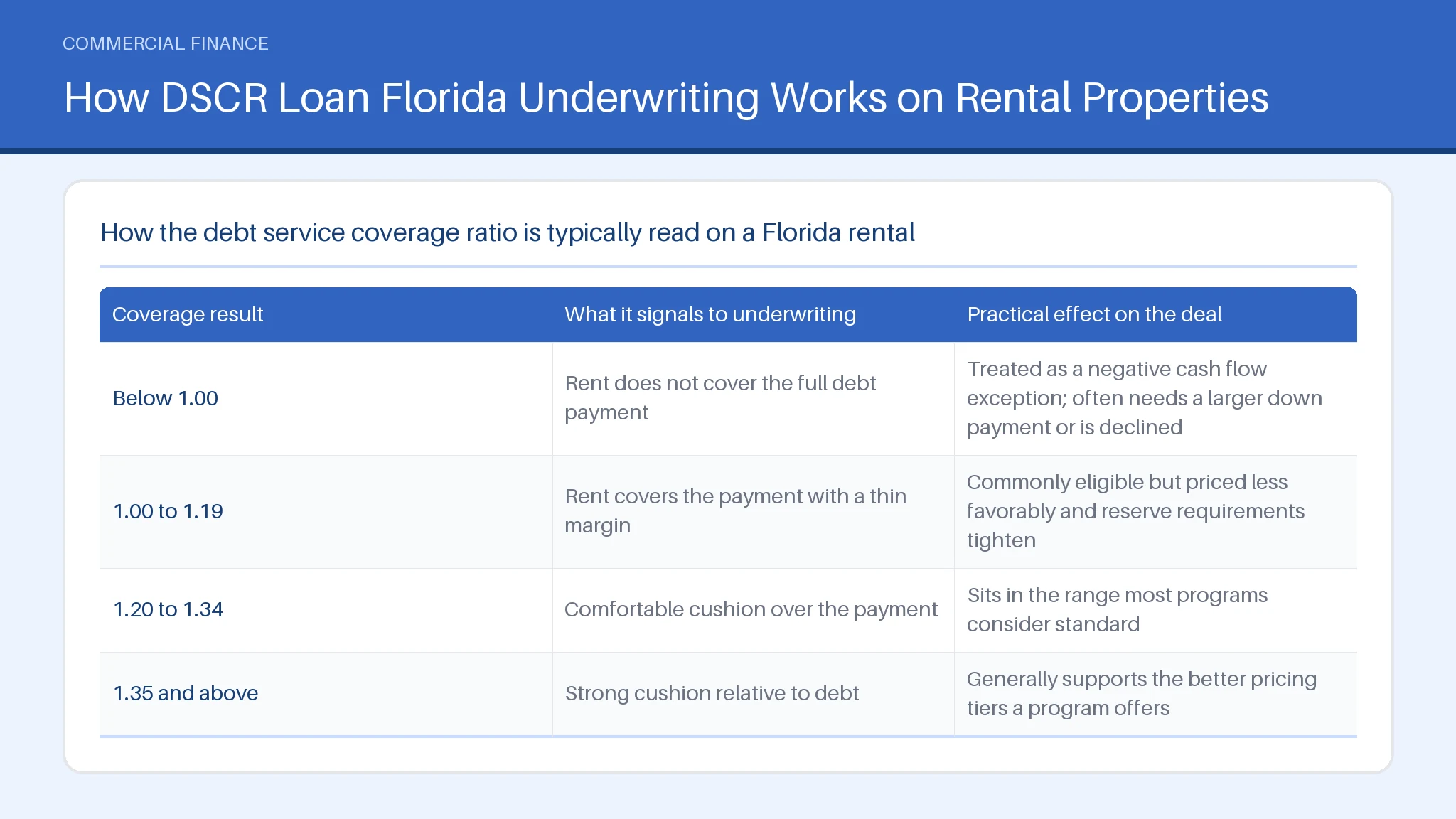
| Coverage result | What it signals to underwriting | Practical effect on the deal |
|---|---|---|
| Below 1.00 | Rent does not cover the full debt payment | Treated as a negative cash flow exception; often needs a larger down payment or is declined |
| 1.00 to 1.19 | Rent covers the payment with a thin margin | Commonly eligible but priced less favorably and reserve requirements tighten |
| 1.20 to 1.34 | Comfortable cushion over the payment | Sits in the range most programs consider standard |
| 1.35 and above | Strong cushion relative to debt | Generally supports the better pricing tiers a program offers |
A DSCR loan application in Florida is scored against these bands, but the bands themselves are program conventions rather than regulation, so confirm the calculation method a specific capital source uses before you build a model around it.
Why Florida Investors Choose DSCR Loans Over Conventional Mortgages
Florida is a top market for these programs for structural reasons, not marketing ones. The state has led the country in net domestic in-migration for several years, which sustains rental demand across price points. There is no state personal income tax, which draws high earners whose W2 income does not reflect their actual buying power, along with self-employed owners whose Schedule C looks thin after depreciation and expenses. Tourism supports a vacation rental sector that produces seasonal income patterns a conventional mortgage underwriter is not built to evaluate.
The practical driver is portfolio scale. A conventional mortgage counts against agency financed-property limits and requires the borrower to carry every payment on a personal debt-to-income calculation. An investor buying a fifth or eighth rental hits a ceiling that has nothing to do with whether the properties perform. Cash flow underwriting removes that ceiling because each asset stands on its own rent.
The second driver is speed and paperwork. Skipping tax return analysis removes the back and forth that stalls self-employed files, which matters when competing for a listing in an active submarket.
The trade-off is honest and worth stating: cash flow underwriting typically carries higher pricing and larger down payments than agency financing, because the capital sources behind it hold different risk. Investors choose it for access and flexibility, not for the cheapest cost of funds. A DSCR loan strategy in Florida makes most sense when the property genuinely cash flows and the borrower values scale over the lowest available rate.
How to Apply for a DSCR Loan in Florida Step by Step
The sequence for a DSCR loan application in Florida is predictable, and running it in order saves money on dead deals.
- Model the ratio first. Take realistic market rent, subtract expected taxes at the reassessed value rather than the seller's current bill, add a current insurance quote, then compare that total against the payment at today's rates.
- Confirm the property type is eligible. Single family, two to four unit, and many condos work. Condotels, rural acreage, and properties under major renovation frequently do not.
- Decide on vesting. If you intend to hold in an LLC, form it and gather the operating agreement and articles before the file opens.
- Assemble the document set. Expect a credit pull, two to three months of bank statements showing reserves and down payment, entity documents, a lease or market rent estimate, and evidence of insurance.
- Order the appraisal. Most programs use a form that includes a market rent schedule, since the appraiser's rent opinion often governs the ratio rather than your lease.
- Clear conditions. Condo questionnaires, association insurance certificates, and short-term rental registrations are the items that most often extend a Florida closing timeline.
If you want to test whether your scenario fits typical matching criteria before assembling paperwork, continue with the qualification form below.
DSCR Loans vs Conventional Financing: Key Trade-Offs to Weigh
Choosing between the two routes is a question of what constraint is binding. If your documented income is strong, you own fewer than four financed properties, and the asset is a straightforward long-term rental, agency financing usually wins on cost. If any of those conditions fail, cash flow underwriting is often the only route that closes.
The real trade-offs cluster in four places. Cost: cash flow programs price above agency financing and typically require twenty to twenty-five percent down or more. Prepayment: many carry a prepayment penalty structure that agency loans do not, which matters if you plan to refinance or sell within a few years. Recourse and vesting: entity ownership is generally permitted, though a personal guarantee is still common. Flexibility: property count is not capped the way agency guidelines cap it.
Run the comparison on total cost over your actual hold period rather than on rate alone. A DSCR loan structure with a three year prepayment penalty can be the cheaper choice for a ten year hold and the more expensive one for an eighteen month flip. Our Commercial Real Estate Finance Guides cover the underlying valuation math in more depth.
How DSCR Loan Florida Underwriting Works on Rental Properties
A Florida DSCR loan is simply a cash flow underwritten investment property loan applied to Florida collateral. The file moves through three parallel reviews: the property, the ratio, and the borrower's credit and liquidity profile. The borrower's employment and tax returns are not part of it.
Qualification turns on a short list. Credit score usually needs to clear a program floor. Down payment normally starts around twenty to twenty-five percent for a purchase. Reserves covering several months of the payment must be verifiable. The property must appraise and produce a coverage ratio at or above the program minimum. Meeting all four is not difficult for a well-chosen rental with realistic rent assumptions; it becomes difficult when the purchase price outruns achievable rent, which is the single most common reason a Florida file stalls.
Condos are eligible in principle but receive extra scrutiny. Underwriting reviews the association's budget, reserve funding, owner-occupancy mix, litigation status, and master insurance. Following the structural reforms Florida enacted after the 2021 Surfside collapse, milestone inspection status and structural integrity reserve studies have become live underwriting questions on older coastal buildings. A unit that appraises well can still be declined on project-level findings.
Holding title in an LLC is normally permitted and is one of the format's advantages, though members typically sign a personal guarantee and the entity documents are reviewed for authority to borrow.
Short-term and vacation rentals are financeable under many programs, but the income analysis differs. Some accept documented twelve-month platform revenue history; others insist on long-term market rent from the appraiser even when the unit operates nightly, which can materially lower the qualifying ratio.
Pricing improves in three reliable ways: a larger down payment, a higher coverage ratio, and a stronger credit score. Reducing the loan amount enough to lift the ratio into the next band often costs less over a full hold period than accepting a thinner margin at a higher rate.
Minimum Coverage Ratio Thresholds Lenders Expect in Florida
Most programs set a floor at 1.00, meaning the property must at least break even against its own debt payment. A meaningful number of capital sources hold the line higher, at 1.15 or 1.25, especially on condos, short-term rentals, and higher-leverage requests. A smaller set will consider ratios below 1.00 with compensating factors such as a larger down payment, stronger reserves, or a credit profile well above the minimum.
Thresholds are not fixed points; they are tiers. A DSCR calculation that lands at 1.05 and one that lands at 1.30 may both be eligible with the same lender, but the second typically earns better terms and a lower reserve requirement. Investors who treat the minimum as the target leave money on the table across the life of the hold.
Florida-specific pressure comes from the expense side. Property insurance in coastal counties has risen sharply in recent years, and windstorm and flood coverage can add thousands of dollars annually to a single family rental. Because insurance sits in the denominator of the payment calculation, a premium increase between contract and closing can push a deal from comfortable to marginal. Get a bindable insurance figure early rather than relying on the seller's expiring policy, and treat any lender estimate as provisional until the quote is in the file.
Reserves, Documentation, and Property Standards for Qualification
Reserves are the requirement investors underestimate most. Programs commonly ask for three to six months of principal, interest, taxes, insurance, and association dues held in a verifiable account after closing, with more required on short-term rentals or when the DSCR result sits near the floor. Retirement accounts are often counted at a discount, and recently deposited funds need a documented source.
The documentation set is short but strict: government identification, a credit authorization, two to three months of asset statements, entity formation documents where title is vested in an LLC, the current lease or the appraiser's market rent schedule, and an insurance binder naming the correct insured party.
Property condition standards matter as much as paperwork. The appraisal must come back with no major deferred maintenance, a roof with remaining useful life, and functioning systems. In Florida, roof age is a frequent sticking point because insurers may decline coverage on older roofs, and no insurance means no closing. Verify roof age and permit history before you go under contract rather than after the appraisal report lands.
Short-Term and Vacation Rental Rules Across Florida Cities
Florida preempts much vacation rental regulation to the state, and the Department of Business and Professional Regulation licenses transient public lodging establishments. Local governments retain authority in specific areas, and cities that had rental ordinances in place before the 2011 state preemption were allowed to keep them. The result is a patchwork that underwriting reads carefully.
Practically, this means registration requirements, minimum stay rules, occupancy caps, inspection regimes, and tourist development tax collection vary from one municipality and county to the next, and some communities restrict nightly rentals in defined residential zones. Condo and homeowner association documents impose a separate layer that can prohibit short stays even where the city permits them.
Before assuming vacation rental income will support a deal, confirm three things in writing: the state license category the property qualifies for, the local registration status and any minimum stay ordinance, and the association's recorded leasing restrictions. A file that relies on nightly revenue while the governing documents require a six month minimum lease will not survive review, regardless of how strong the booking history looks.
Urban, Suburban, and Coastal Rental Strategies in Florida
The three broad Florida rental strategies produce different coverage profiles, and matching the strategy to the financing structure avoids wasted effort.
Urban core assets in Miami, Tampa, and Orlando tend to carry higher purchase prices relative to rent, which compresses the ratio. Condos dominate the inventory, so association review and dues become central to whether the deal works at all. Suburban single family rentals in markets such as Lakeland, Ocala, and the Jacksonville periphery usually produce the cleanest files: predictable long-term leases, standard appraisal comparables, lower insurance than coastal collateral, and ratios that clear thresholds without creative assumptions.
Coastal and vacation markets offer the highest gross revenue and the most volatility. Seasonal income, higher management costs, wind and flood premiums, and stricter local rules all reduce the income a program will recognize. Investors in these markets often need larger down payments to reach an acceptable ratio.
Whichever strategy you pursue, model taxes at the post-sale assessed value. Florida reassesses on transfer, and a seller's homestead-capped bill can understate your real cost significantly.
Summary
Cash flow underwriting lets a Florida rental qualify on its own performance, which suits self-employed investors and anyone scaling past agency property limits. The math is straightforward, but the inputs are where Florida deals succeed or fail: reassessed property taxes, current wind and flood premiums, condo project condition, roof age, and local vacation rental rules all move the coverage ratio before a lender ever prices the file. Model those items honestly, target a ratio above the minimum rather than at it, and confirm reserves early. CRE Loans USA is a lender-matching service that connects investors with independent third-party finance providers who make all lending and pricing decisions. How CRE Loan Matching Works explains the process.
Frequently asked questions
How do you qualify for a DSCR loan in Florida?
Qualification rests on the property first and the borrower second. The rental must generate a coverage ratio at or above the program floor, typically 1.00 to 1.25 depending on the capital source and property type. Beyond that, expect a minimum credit score, a down payment usually starting near twenty to twenty-five percent, verifiable post-closing reserves of roughly three to six months of the full payment, and an appraisal supporting both value and market rent. Personal income documents, tax returns, and employment verification are generally not required. The practical work is making sure your rent assumption is defensible and your expense estimates reflect reassessed taxes and current Florida insurance pricing.
What is the downside of a DSCR loan?
The main downsides are cost and rigidity. Pricing sits above conventional investment property financing, down payment requirements are larger, and many programs include a prepayment penalty that reduces flexibility if you sell or refinance within the first few years. Because qualification depends on the property, a soft rental market or an insurance premium spike can undermine an otherwise sound deal. There is also no personal income cushion in the analysis, so a property that stops performing puts pressure directly on the borrower's reserves.
Can my LLC get a DSCR loan?
Yes. Vesting title in a limited liability company is normally permitted and is one of the reasons investors choose this structure over agency financing. Underwriting will review the articles of organization, the operating agreement, and evidence of good standing with the state, and members with meaningful ownership typically provide a personal guarantee. Set the entity up before the file opens, since forming or amending it mid-process delays closing.
What are the interest rates on a DSCR loan?
Rates on cash flow underwritten investment loans are set by each independent finance provider and move with bond markets, credit spreads, and program-level risk pricing. They generally sit above owner-occupied and agency investment property rates. Your specific pricing depends on the coverage ratio, loan-to-value, credit score, property type, occupancy strategy, and prepayment structure you choose. No published figure should be treated as an offer, and quotes are only meaningful once a provider has reviewed the actual file.
What is the minimum credit score for a DSCR loan in Florida?
Most programs set a floor somewhere in the low to mid 600s, with 620 to 680 being common starting points, and the strongest pricing tiers usually beginning around 720 and above. Floors vary by capital source, property type, and leverage. A higher score can also reduce reserve requirements and expand the loan-to-value available, so improving a score before applying often changes more than one term at once.
Can I buy multiple properties with DSCR loans?
Yes, and that is a primary reason investors use the structure. Because each property is underwritten on its own income rather than against a personal debt-to-income calculation, there is no agency-style cap on the number of financed properties. Individual providers may set their own exposure limits per borrower or per market, and some offer portfolio structures that cover several assets under one facility.
Part of DSCR Loan Requirements, Terms and How Approval Works