
A DSCR loan in Texas is an investment property mortgage underwritten on the property's cash flow instead of the borrower's personal income. The lender divides the property's net operating income by its annual debt obligation, checks whether the resulting debt service coverage ratio clears their floor, and prices the loan from there. No pay stub. No W-2. No employment verification letter. That single design choice is why self-employed operators, retirees, partnership members, and full-time investors gravitate toward the structure.
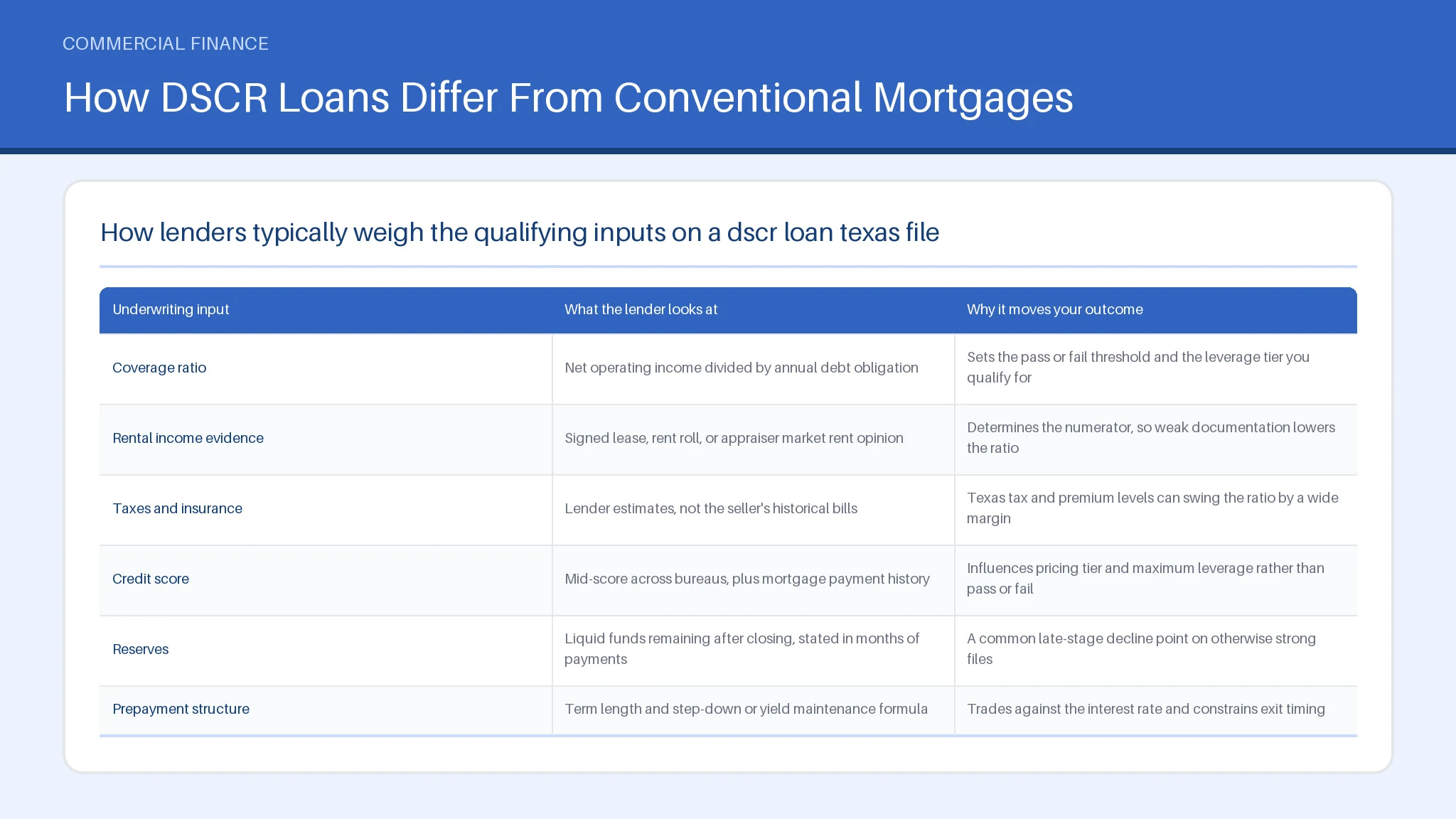
The practical problem most borrowers hit is not the definition. It is discovering, three weeks into a file, that the numbers behind the definition move constantly. A Dallas duplex that pencils at 1.28 with a 30-year amortization schedule can fall under 1.05 once the lender substitutes their own tax and insurance estimates, applies a vacancy factor to the rent roll, or requires a shorter amortization. Texas property tax rates are high relative to much of the country, and rising insurance premiums in coastal and hail-exposed counties have moved coverage ratios more than interest rates have in some files. Two properties with identical rents and identical purchase prices can produce very different outcomes purely because of the escrow line.
This guide works through what a DSCR loan borrower in Texas actually gets evaluated on: how the rental math is built, which documentation replaces income proof, where leverage limits land, and how prepayment terms shape your exit. Programs vary, and every eligibility and pricing decision belongs to the independent finance provider reviewing the file. If you want to test fit before gathering documents, continue with the qualification form below.
Key takeaways
- A DSCR loan qualifies the property, not the person: lenders compare the rental income a Texas property produces against the annual debt obligation it must cover, rather than reading pay stubs or tax returns.
- Most lenders require a coverage ratio at or above 1.00 to 1.25, and a stronger ratio usually unlocks higher leverage, wider property eligibility, and better pricing tiers.
- Leverage is typically capped well below owner-occupied levels, so plan for a meaningful down payment plus closing costs and reserves held after funding.
- Prepayment penalty structures matter as much as the rate. A step-down or yield maintenance clause can cost more than a slightly higher coupon if you plan to refinance or sell inside three years.
- Short-term and vacation rental underwriting is possible in parts of Texas but depends on documented booking history and local ordinances, which vary city by city.
What Is a DSCR Loan Texas Investors Can Use?
A Texas DSCR loan is a business-purpose, non-agency investment property loan approved on one arithmetic test: whether the property's income covers its debt. Underwriting divides net operating income by the annual obligation for principal, interest, taxes, insurance, and HOA dues, then compares the result to a program floor between roughly 1.00 and 1.25. Because that ratio is the qualifying test, lease documentation replaces income verification. Practically, it means the asset you select determines your terms, the collateral must be non-owner-occupied, and improving cash flow is the most direct route to better leverage and pricing. Further context sits in the frequently asked questions.
How to Calculate DSCR on a Texas Rental Property
The formula to calculate coverage on a Texas rental property is net operating income divided by annual debt service. Start with gross annual rental income from the lease or the appraiser's market rental opinion, subtract the operating expenses the program counts, then divide by twelve months of principal, interest, taxes, insurance, and HOA dues on the proposed mortgage.
Work an example. A Fort Worth single-family rental leases for 2,400 dollars a month, or 28,800 dollars a year. Debt service is 1,450 dollars a month, taxes run 500 dollars, and insurance is 190 dollars. Total monthly obligation is 2,140 dollars, or 25,680 dollars annually. That produces 28,800 divided by 25,680, which equals 1.12. It clears a 1.10 floor with almost no cushion.
Now apply what most lenders actually do on a DSCR loan file in Texas. Deduct a five percent vacancy factor from the rental income and the numerator falls to 27,360, dropping the ratio to roughly 1.07. If the appraiser's market rental figure comes in at 2,300 rather than 2,400, it slips again. The rental property rarely fails on rent alone; it fails on the assumptions layered over the rent.
Build your model with conservative rental numbers, the lender's tax estimate rather than the seller's bill, and a current insurance quote. The full DSCR loan requirements, terms and how approval works guide walks through each input a borrower should verify before ordering an appraisal on any rental property.
Benefits of a DSCR Loan Texas Investors Should Know
A DSCR loan in Texas comes down to a single substitution: the property's documented cash flow replaces your personal income file. That substitution creates the benefits investors actually care about, and they go well beyond convenience.
The first benefit is that aggressive tax planning stops working against you. Self-employed operators who depreciate heavily and deduct legitimate expenses often show modest net income on paper, which sinks a conventional debt-to-income test while the underlying rental cash flow is healthy. Cash flow underwriting ignores that distortion entirely.
The second is entity flexibility. These loans are routinely written to an LLC, which supports liability separation and cleaner portfolio accounting. Agency lending generally requires an individual borrower and caps how many financed properties one person may hold, so portfolio builders hit a wall that cash flow programs usually do not impose.
The third is speed. Removing income verification removes the slowest part of the document chase, which matters when a seller is weighing your offer against cash.
The fourth is structural choice. Interest-only periods lower the annual payment and lift the ratio, which can raise available leverage on a marginal file. Prepayment terms are also negotiable in ways agency debt is not: accepting a longer prepayment window often buys a lower coupon, while a shorter prepayment penalty costs rate but preserves your exit.
Timing matters too. Use the structure when the property already produces stabilized income, when you need to close quickly, or when you have passed agency property limits. It fits poorly when the asset needs renovation before it cash flows, or when you plan to sell inside the penalty window.
What a DSCR loan in Texas is worth in practice depends on the local math. Texas has no state income tax, but effective property tax burdens are high, and that expense sits directly in the denominator. The pros and cons for rental investors comparison sets those trade-offs side by side.
How DSCR Loans Work in Texas This Year
A DSCR loan file in Texas moves through four stages, and each one has a decision point where deals commonly break. Stage one is the scenario review: a lender takes the property address, estimated value, projected rent, and credit band, then returns indicative terms. Stage two is documentation, which covers entity papers, bank statements for the down payment and reserves, a lease or rent roll, and an insurance binder. Stage three is the appraisal with a market rent addendum. Stage four is underwriting, where the coverage math is rebuilt with the lender's own tax and insurance figures.
The pattern worth knowing is that eligibility is usually settled at stage one, while pricing is settled at stage four. Two conditions have tightened in Texas recently. Insurance binders now carry more weight because premium increases in hail-prone and Gulf Coast counties push the debt obligation higher than a seller's historical bill suggests. Reserve requirements have also firmed, with many programs wanting three to twelve months of payments still liquid after funding.
Loans fund purchases, rate-and-term refinances that retire bridge or maturing debt, cash-out refinances that release equity for the next acquisition, and transfers of title into an entity. Cash-out generally carries lower leverage and a higher ratio floor.
The drawbacks are real. Pricing runs above agency investment debt, maximum leverage is lower, a prepayment penalty usually applies, and a property with thin cash flow can fail even when your personal balance sheet is strong. The structure suits self-employed borrowers, entity buyers, partnership members, and investors past agency caps. It suits poorly anyone who needs maximum leverage or plans a fast exit. Where to get a DSCR loan is a question of matching the property profile to programs that underwrite it, which is what the CRE loan matching process is built around.
Can You Use Rental Cash Flow Financing for Short Term Rentals
Short term rental properties can be financed with cash flow underwriting in Texas, but the evidence standard is higher than it is for annual leases. A long term rental qualifies on a signed lease or a market rent addendum. A short term rental usually requires twelve months of platform statements or operator records for the subject property itself, and many programs discount gross bookings to cover cleaning, management fees, supplies, and seasonal vacancy.
That discount changes outcomes. A Galveston or Fredericksburg property with strong summer revenue can still underwrite below its long term rental equivalent once those deductions apply. Financing terms also tighten: leverage on short term rental collateral is often capped a few points lower, and some financing programs require proof of a current municipal permit at closing.
Regulatory risk is the factor most comparisons skip. Texas cities set their own ordinances, and permit rules have been litigated and revised repeatedly, so a lender may treat the same property differently in Austin than in San Antonio. Model both income scenarios before you commit, because the financing structure available may decide the strategy for you. A Texas DSCR loan file on a nightly-rental asset also behaves differently at refinance, since the mortgage is repriced on updated booking history rather than a renewed lease, which is a real financing consideration when you plan to refinance. Comparable Florida rental cash flow financing rules show how much state and city context shifts these financing decisions.
DSCR Formula and Example Math for a Houston Duplex
A Houston duplex shows how the formula behaves on a two-unit rental property. Assume both sides lease at 1,650 dollars a month, giving 3,300 dollars monthly and 39,600 dollars annually. The proposed mortgage payment is 2,050 dollars, county taxes add 690 dollars, and insurance adds 260 dollars. The annual debt obligation totals 36,000 dollars, so 39,600 divided by 36,000 equals 1.10.
That result sits exactly on a common eligibility floor, which is a fragile place to be. If underwriting applies a five percent vacancy deduction, the ratio drops to about 1.04. If the appraiser sets market rent at 1,600 per side, it falls near 1.07 before vacancy. Either adjustment can move the file into a lower leverage tier or trigger a higher pricing tier.
Three levers fix a thin ratio. Increase the down payment to shrink the payment. Select an interest-only structure, which reduces the annual obligation. Or accept a longer prepayment penalty term, which some lenders trade for a lower coupon that improves the math.
Where you can get a DSCR loan on a marginal duplex depends on which lenders underwrite gross rather than adjusted rents, since that one policy difference decides borderline files. Comparing programs on that assumption, not only on headline rate, is the most useful screen available to a DSCR loan borrower in Texas.
LTV Caps, Equity and Down Payment Requirements Explained
Leverage on these loans is set by a grid rather than a single cap. Maximum loan-to-value typically sits in the seventy to eighty percent range for a purchase, steps down for a cash-out refinance, and steps down again for nightly-rental collateral, small multifamily, or files with a thin DSCR result. A borrower at 1.35 coverage with a 760 credit score sees the top of the grid. The same property at 1.02 may be capped ten to fifteen points lower.
Plan the down payment as a range. Budget the equity contribution plus closing costs, title, appraisal, an escrow impound for high Texas property taxes, and post-closing reserves. Reserves are the most underestimated line: programs commonly want three to twelve months of principal, interest, taxes, and insurance still liquid after funding, and a file that clears the coverage test can still fail there.
What DSCR loan documentation does not include is a pay stub or an employment stub, so your liquidity evidence and the property's expense profile carry more weight than usual. One practical lever: a larger down payment lowers the payment, raises coverage, and can move you into a better pricing tier. Whether you can get a DSCR loan at top-of-grid leverage usually depends on that ratio, plus a longer prepayment penalty term.
Market Data and Tools for Texas Rental Property Investors
Reliable rental data changes underwriting outcomes more than any spreadsheet technique. Census Bureau American Community Survey tables publish median gross rental figures by county and metro, and HUD Fair Market Rent schedules give bedroom-level rental benchmarks updated annually. County appraisal district records give the actual assessed value and tax rate for the subject parcel, which is the number a lender uses instead of the seller's older bill. Together those three sources let a borrower reconstruct the DSCR math before paying for an appraisal.
Two tools are worth building. The first is a rental comparison sheet holding asking rents for four nearby units of the same bedroom count, since an appraiser's market rental opinion tends to track those. The second is an insurance worksheet with a current binder quote, because premium changes in hail and coastal counties move the mortgage escrow sharply.
When you refinance later, keep a clean rent roll and twelve months of deposits for each rental property, since documented collections usually support a stronger rental figure than a market opinion alone. A rental property held two years with verifiable rental income is simply easier to underwrite. More rental modeling walkthroughs sit in the commercial real estate finance guides.
Texas DSCR Qualification Mechanics From Application to Closing
Qualification runs on a predictable sequence, and a prepared borrower can compress it. After indicative terms, the file needs entity formation documents and an operating agreement if you close in an LLC, two to three months of bank statements evidencing equity and reserves, the lease or booking history, a current insurance binder, and a completed property questionnaire. Title work and the appraisal with market rent addendum run in parallel.
The lender requirements that most often surprise borrowers at this stage are not income related. They are the reserve verification, the insurance figure, and a payoff or subordination detail on a refinance. Confirm all three in writing before the appraisal is ordered.
What DSCR loan closings hinge on is consistency between the rental market evidence you submitted and what the appraiser finds. If your projected rent exceeds the appraised market rent, the lower figure generally controls. For a vacation rental, submit platform statements covering a full year so seasonality is visible rather than inferred.
Where to get a DSCR loan with terms that match your exit plan is a comparison exercise across programs, since each sets its own prepayment schedule, reserve level, and ratio floor. Treating that as a single financing option rather than a shopping decision is how borrowers end up mispriced.
Qualifying Without Tax Returns or Personal Income Documents
Qualifying without tax returns works because the debt service coverage ratio test measures the asset, not the applicant. Instead of returns, W-2s, or an employment check, underwriting reads a lease or rent roll, an appraisal with a market rent addendum, bank statements proving equity and reserves, a credit report, and an insurance binder. The mortgage still gets fully documented; the documentation simply points at the property.
Credit history remains applicable. Most lenders review the mid-score across bureaus and look closely at prior mortgage lates, foreclosures, and bankruptcy seasoning, because payment behavior is the only direct read on the borrower they keep. Liquidity also matters more than income: months of reserves after closing is frequently the final condition cleared.
What the absence of income documents does not remove is exposure. If the rental market softens and the unit sits vacant, there is no personal income test standing behind the file, so your own reserves absorb the gap. Build that scenario into the model before treating cash flow underwriting as the cheaper financing option. Rate, leverage, and prepayment terms all shift with the coverage tier, so improving the ratio is usually the highest-value preparation work available.
Summary
Cash flow underwriting trades personal income documents for a coverage test, which suits self-employed operators, entity buyers, and investors past agency limits. Outcomes turn on details: the tax and insurance figures used, gross versus adjusted rents, reserves left liquid after closing, and how the prepayment schedule meets your exit. Model conservatively before ordering an appraisal. CRE Loans USA is a lender-matching service connecting investors with independent finance providers, who set all eligibility, pricing, and terms.
You may also find this related guide helpful: Cap Rate Real Estate: Formula, Examples and NOI.
Frequently asked questions
How do you qualify for a DSCR loan in Texas?
Qualifying centers on the property. Lenders compute the coverage ratio from documented rental income against the full annual debt obligation, and most require a result at or above a floor between 1.00 and 1.25. Expect a credit review, verification of down payment funds and post-closing reserves, an appraisal with a market rent addendum, and confirmation that the property is non-owner-occupied and held for business purposes. Entity documents apply if you close in an LLC. Personal tax returns and pay stubs are generally not part of the file.
What is the downside to a DSCR loan?
Four drawbacks recur. Pricing and origination costs typically run above agency investment loans. Maximum leverage is lower, so you commit more equity. Most programs carry a prepayment penalty that limits flexibility on an early sale or refinance. And the loan lives or dies on coverage, so high Texas property taxes or a rising insurance premium can sink a file even when your personal finances are strong. Properties needing renovation before they produce income are usually ineligible.
Who is eligible for a DSCR loan?
Eligible borrowers include self-employed business owners, investors with several financed properties, partnership members, retirees living on assets, and in some programs non-resident investors. The collateral must be an investment property. Common eligible types are single-family rentals, condos, townhomes, two to four unit buildings, small multifamily, and permitted short-term or vacation properties. Rural acreage, manufactured housing, condotels, and heavily commercial mixed-use buildings narrow the lender pool considerably.
Can I live in a house with a DSCR loan?
No. These are business-purpose loans secured by non-owner-occupied collateral, so occupying the property breaches the occupancy certification you sign at closing. Investors who later want to live in a property generally refinance into a conventional owner-occupied mortgage first.
Do DSCR loans require 20% down?
Not always, though twenty percent is close to the practical minimum. Purchase leverage commonly tops out between seventy and eighty percent, so plan for twenty to thirty percent equity depending on your coverage ratio, credit band, and property type, plus closing costs and reserves.
How can you avoid a 20% down payment on an investment property?
Avoiding twenty percent on an investment purchase is difficult. Realistic paths include a cash-out refinance on an existing rental property to fund the equity, seller financing for part of the purchase price, a partnership that splits the equity contribution, or a renovation strategy that creates value and is then refinanced once the rental income stabilizes.
Part of DSCR Loan Requirements, Terms and How Approval Works