
A DSCR loan is an investment property mortgage underwritten on the income the property produces, not on your pay stubs, W-2s, or tax returns. The lender divides the property's net operating income by its annual debt service and lends against that ratio. That single design choice drives every one of the DSCR loan pros and cons that follow: you gain speed and privacy on income documentation, and you accept pricing, structure, and reserve requirements that a conventional loan would not impose.
Most articles stop at that summary. The harder question for a working investor is where the structure actually costs you money. It usually shows up in three places: the rate premium built into a loan the secondary market treats as non-QM, the prepayment penalty that follows the loan for the first few years, and the vacancy exposure you carry when no personal income backstops the mortgage payment. Those are the real DSCR loan pros and cons, and they are decided property by property rather than borrower by borrower.
This guide walks through the ratio math, the underwriting logic, the prepay structures you will encounter, and the practical questions worth asking before you commit a property to cash-flow-based financing. It is written for investors comparing this route against a conventional mortgage or a bank portfolio product.
Key takeaways
- A DSCR loan qualifies on the property's rental cash flow rather than a personal debt-to-income calculation, which is the single biggest reason investors weigh DSCR loan pros and cons in the first place.
- The trade for lighter income verification is usually a higher rate, a larger down payment, and a prepayment penalty structure that limits how soon you can sell or refinance without a fee.
- Debt service coverage ratio is annual net operating income divided by annual debt service, and most programs look for a result at or above 1.20, with reserves and credit score still reviewed.
- Vacancy, tax and insurance escalations, and expiring leases hit a cash-flow-qualified loan harder because the property, not your salary, carries the payment.
- Terms vary widely between lenders, so comparing coverage thresholds, prepay structures, and reserve rules matters more than chasing the headline rate.
DSCR Loan Pros and Cons at a Glance
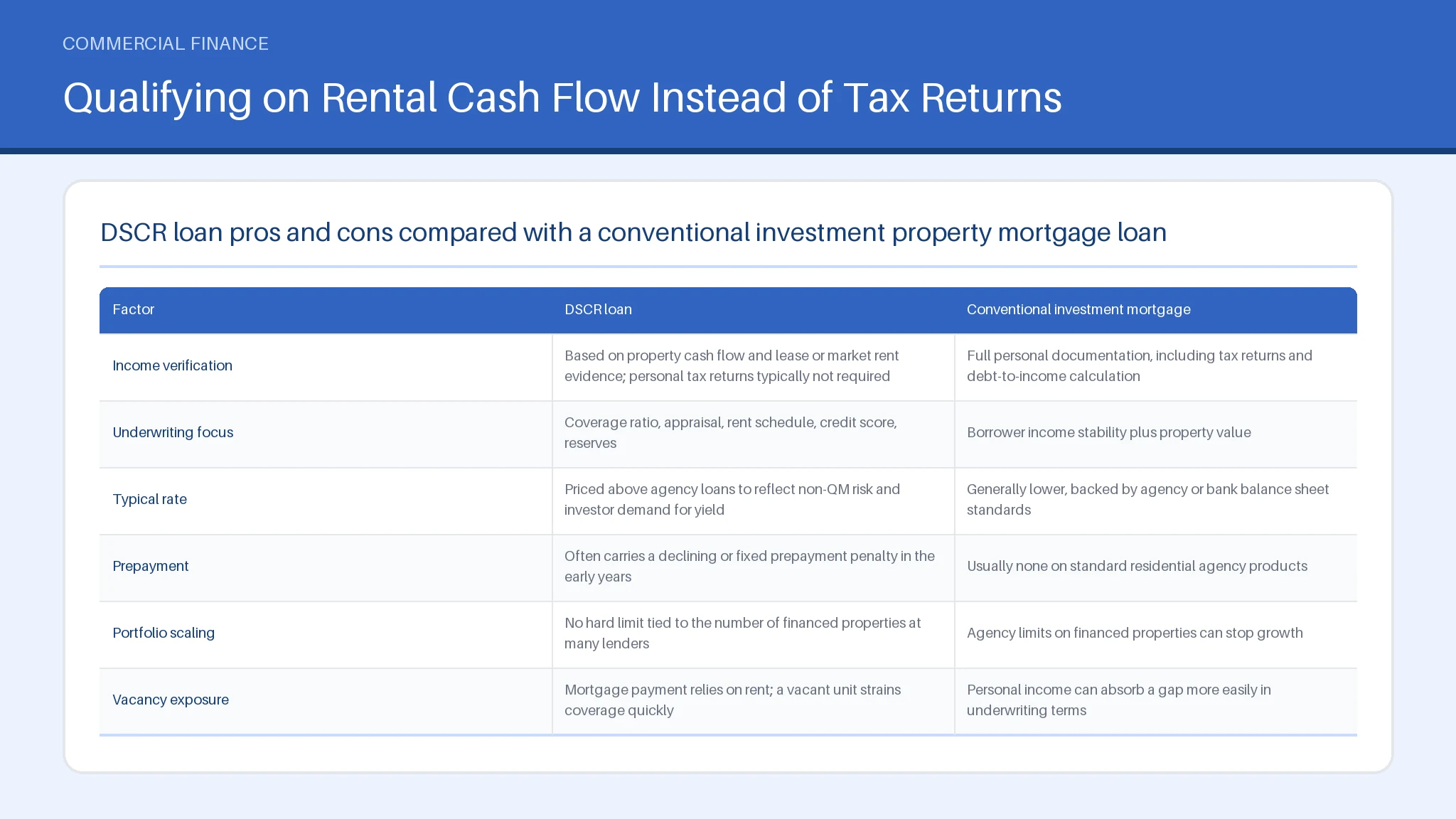
The clearest way to see the trade-offs is to line them up. A DSCR product sits inside the broader non-QM category, which means it is not written to the qualified mortgage rulebook and is priced accordingly. The upside of non-QM is that documentation flexibility exists at all. The downside is that pricing, reserves, and exit terms are set by private capital rather than agency guidelines, so two lenders can quote materially different structures on the same property.
| Factor | DSCR loan | Conventional investment mortgage |
|---|---|---|
| Income verification | Based on property cash flow and lease or market rent evidence; personal tax returns typically not required | Full personal documentation, including tax returns and debt-to-income calculation |
| Underwriting focus | Coverage ratio, appraisal, rent schedule, credit score, reserves | Borrower income stability plus property value |
| Typical rate | Priced above agency loans to reflect non-QM risk and investor demand for yield | Generally lower, backed by agency or bank balance sheet standards |
| Prepayment | Often carries a declining or fixed prepayment penalty in the early years | Usually none on standard residential agency products |
| Portfolio scaling | No hard limit tied to the number of financed properties at many lenders | Agency limits on financed properties can stop growth |
| Vacancy exposure | Mortgage payment relies on rent; a vacant unit strains coverage quickly | Personal income can absorb a gap more easily in underwriting terms |
Read the table as a decision map rather than a verdict. An investor with strong documented W-2 income and one rental will often do better on a conventional path. An investor with several entities, heavy depreciation, and a plan to refinance into a portfolio will usually find the flexibility worth the premium. A lender may also apply overlays that shift these columns, so confirm specifics before you assume a category rule applies to your file.
How to Begin a DSCR Loan Application
Start with the property file, not the loan file. Pull the current lease or a signed rent roll, twelve months of operating statements if you have them, the tax bill, the insurance declaration page, and any HOA statement. Underwriting will rebuild your numbers from those documents, so the closer your figures track the paperwork, the fewer conditions land later.
Next, run your own coverage estimate at a rate slightly above what you expect. If the deal only works at the best available pricing, it is fragile. A real estate investor who tests the ratio at a stressed rate learns quickly whether the property is an ideal candidate or a marginal one.
Then confirm the ownership structure. Many programs prefer or require title in an LLC, which affects eligibility, insurance, and closing timelines. Have your entity documents, EIN letter, and operating agreement ready.
Finally, decide the exit before you sign. If you plan to sell or refinance inside three years, the prepay term matters more than a quarter point of rate. An investor buying to hold for a decade will value the mortgage loan's fixed period instead. Working through how lender matching works first helps a borrower see which questions a lender will ask before documents are requested. Weighing the DSCR loan pros and cons at this stage is cheaper than discovering them at closing.
How Risky Is DSCR Financing for Rental Investors?
The risk is concentrated, not hidden. Because the property carries the loan, anything that interrupts rental income hits the borrower directly. A single-tenant house that goes vacant for two months has produced zero coverage for that period while taxes, insurance, and interest keep accruing. An investor with a four-unit building spreads that exposure across tenants; an investor with one door does not.
Three specific pressures deserve attention. Property tax reassessment after purchase can raise the payment materially in states that reset assessed value on sale. Insurance premiums in coastal and wildfire regions have moved faster than rents in recent years. And rental turnover costs, including make-ready work and leasing commissions, rarely appear in a pro forma but always appear in the bank account.
Structure adds a second layer. A Prepayment penalty means a distressed investor cannot always sell or refinance out cheaply, which turns a temporary cash-flow problem into a locked position. That is one of the DSCR loan pros and cons that only shows up under stress.
The practical mitigation is reserves. An investor holding six months of debt service per property absorbs vacancy without touching the asset. Financing built on rental cash flow works well when the cash flow has depth, and this financing punishes thin margins. Treat reserves as part of the financing cost, not as optional savings, because financing decisions made without them tend to unwind first.
Prepayment Penalties on DSCR Loans: What to Expect
Prepayment terms are where two apparently similar offers diverge most. The common structures are a step-down, often quoted as 5-4-3-2-1, where the fee falls by one percentage point of the outstanding balance each year, and a flat percentage that applies for a fixed period regardless of when you exit. Some programs offer a shorter three-year step-down or no prepay at all in exchange for a higher rate.
Read the fine print on what triggers the charge. Many agreements allow partial curtailment of up to twenty percent of principal per year without a fee, and some waive the penalty on a genuine arm's length sale while still charging it on a refinance. Others charge on both. A borrower who plans a value-add hold and a cash-out refinance in month thirty should price that exit explicitly rather than assume the sale carve-out applies.
The math is straightforward. Multiply the expected balance at exit by the applicable prepayment percentage, then compare that dollar figure against the rate savings you would gain from a no-prepay option over the same holding period. For a real estate investor planning a quick reposition, the fee often outweighs the rate difference. For a long-term holder, accepting the penalty is usually the cheaper choice. Lending terms on prepayment vary by program, so treat the property DSCR result and the prepay schedule as a single package when you evaluate an investor financing offer.
Qualifying on Rental Cash Flow Instead of Tax Returns
The appeal is concrete. Investors who take aggressive depreciation, run cost segregation studies, or carry several entities often show low adjusted gross income on paper even while their portfolios perform well. Conventional underwriting reads that as weak capacity. Cash-flow qualification reads the rental property's own numbers instead, which is why a real estate investor with strong assets and a thin tax return can keep buying.
What the lender actually reviews is the lease, a market rent schedule from the appraiser, and the fixed obligations on the property. Where a signed lease is below market, most programs use the lower of the two figures. Where the unit is vacant, the appraiser's market rent estimate usually governs, sometimes with a haircut. Short-term rental income is treated differently again, with many lenders requiring a documented booking history rather than a projection.
Credit score remains a real criterion even though personal income is not. It drives pricing tiers, minimum down payment, and in some cases the prepayment penalty options offered. Reserve requirements, typically stated in months of principal, interest, taxes, insurance, and association dues, are also checked.
Lending built on rental cash flow is not documentation-free. It simply moves the paperwork from your tax return to the rental asset itself, and the borrower who prepares that file well moves fastest.
How to Calculate Debt Service Coverage Ratio on a Rental
The formula is net operating income divided by annual debt service. NOI is gross rental income minus operating expenses such as property taxes, insurance, management, maintenance, and vacancy allowance, but before mortgage principal and interest. Annual debt service is twelve months of principal and interest, and many programs add taxes, insurance, and HOA dues to that denominator.
Work an example. A duplex collects $4,000 a month, or $48,000 a year. Subtract $6,000 in taxes, $2,400 in insurance, $3,840 in management at eight percent, and $4,800 for maintenance and vacancy, and NOI is $30,960. If annual principal and interest total $24,000, the debt service coverage ratio is 1.29. Most programs want at least 1.20, so this rental clears with modest room.
Two details matter for a borrower. First, confirm whether the lender uses gross rent or NOI in the numerator, because some residential-style programs use a simplified rent-to-payment calculation that produces a very different number. Second, ask whether taxes and insurance sit in the denominator. That choice can swing the result by fifteen points or more.
An investor comparing lending options should run both versions. A real estate investor who understands the underlying valuation math, including how cap rate and NOI relate, will spot an inflated pro forma faster than one relying on a conventional loan mindset.
Weighing DSCR Loan Advantages Against the Drawbacks
Put the two columns against your actual plan. The advantages cluster around access and speed: lighter income verification, faster closings because there is no employment or tax transcript chase, entity ownership as a norm rather than an exception, and no agency cap on the number of financed properties. For a growing portfolio, that removes the qualification ceiling that stops many buyers at their fourth or fifth deal.
The drawbacks cluster around cost and rigidity. Rates sit above a conventional loan. Down payments commonly run twenty to twenty-five percent or more. Prepay terms constrain your exit. And the entire structure rests on rental income holding up, because the debt obligation does not shrink when a tenant leaves.
A useful test is the delta test. Calculate the annual dollar cost of the rate premium, add the amortized cost of any exit fee you expect to pay, and compare that total against the value of the deals you could not otherwise close. If the premium buys you two extra acquisitions a year, the arithmetic usually favors the cash-flow route.
Some lenders also allow a rate-and-term refinance later once the rental property has a seasoned operating history and stronger NOI, which can recover part of the premium. That option deserves weight for a borrower buying below market rents and an investor planning improvements.
How to Find and Vet Lenders Offering DSCR Loans
Cash-flow programs are offered by private capital groups, non-bank mortgage companies, credit unions, and some community banks holding loans on balance sheet. Each source prices differently, so the first task is coverage: see several structures rather than one. A single lender quote gives you no reference point.
Vet on structure, not headline rate. Ask each lender the same questions in writing. What minimum coverage ratio applies at this property type and loan size? Is NOI or gross rent used in the calculation? Are taxes and insurance in the denominator? What prepay options exist and what do they cost in rate? How many months of reserves are required, and are they verified before or after closing? Is the loan held or sold, and does servicing transfer?
Then check execution history. A lender may quote attractively and then reprice after appraisal, so ask how often files close at the terms originally issued. Request references from investors who closed similar deals.
Finally, understand the intermediary's role. A broker or matching service does not set terms; underwriting and pricing sit with the funding source. If you are unsure how your file compares with what a lender expects on a conventional loan versus a cash-flow program, continue with the qualification form below is a reasonable starting point before you order appraisals.
Why DSCR Loan Rates Run Higher Than Conventional Mortgages
Price follows risk and liquidity. A conventional investment mortgage can be sold to Fannie Mae or Freddie Mac, which gives the originating lender a deep, standardized buyer and a predictable exit. A cash-flow loan cannot. It is packaged and sold to private securitization buyers or held by a lender on balance sheet, and those buyers demand a yield premium for the reduced documentation and thinner historical performance data. That premium reaches the borrower as a higher rate.
Three further factors widen the gap. The loans are almost always for non-owner-occupied property, and investment property mortgage pricing carries an add-on regardless of program because investors default at higher rates than owner-occupants during downturns. There is no personal income backstop in the file, so severity assumptions in loss modeling are higher. And loan sizes are often smaller relative to origination cost, which pushes fixed expenses into the rate.
This also answers what beats a cash-flow loan for some investors. If you can document income and stay within agency limits, a conventional mortgage is usually cheaper. A bank portfolio mortgage, an SBA 504 for owner-occupied commercial space, or a longer fixed-rate commercial mortgage can each undercut it depending on the asset. For larger stabilized commercial assets, fixed-rate CMBS structures often price better than a small-balance cash-flow mortgage.
Requirements are consistent across most lenders even though pricing is not: a coverage ratio typically at or above 1.20, a credit score usually starting in the high 600s, twenty percent or more down, several months of reserves, an appraisal with a rent schedule, and property insurance meeting the lender's limits. Reviewing the wider commercial finance guides before you approach a lender helps you match the property to the right mortgage category rather than defaulting to the first one offered.
Summary
Cash-flow underwriting buys access and speed, and charges for it through rate, down payment, and exit terms. The deciding factors are your coverage ratio at a stressed rate, your reserve depth, and your holding period against the prepay schedule. CRE Loans USA is a lender-matching service, not a lender, so it connects investors with independent third-party finance providers who set their own terms and make all credit decisions.
Frequently asked questions
Can you pay off a DSCR loan early?
Usually yes, but often at a cost. Most of these loans carry a prepayment penalty for the first three to five years, commonly structured as a step-down. Many agreements permit annual partial paydowns of up to twenty percent of the balance without a charge, and a few waive the fee on a sale while still applying it to a refinance. Check the note language before you plan an early exit.
What's better than a DSCR loan?
It depends on your documentation. If you can verify personal income and remain under agency financed-property limits, a conventional investment mortgage is usually cheaper. Owner-occupied commercial users may do better with an SBA 504 or 7(a) structure. Bank portfolio loans and, for larger stabilized assets, fixed-rate commercial products can also beat it. There is no universally better option, only a better fit for a given property and plan.
Can I live in a home bought with a DSCR loan?
No. These loans are written for non-owner-occupied investment property, and occupancy affidavits at closing confirm that. Moving into the property generally breaches the loan agreement. If you intend to occupy a unit in a small multifamily building, an owner-occupied program is the appropriate route.
What is DSCR in real estate?
In real estate, DSCR is the debt service coverage ratio: net operating income divided by annual debt service. A result of 1.00 means the property produces exactly enough income to cover its debt payments. Above 1.00 indicates surplus cash flow; below 1.00 means the income falls short.
Why does DSCR matter in investment financing?
The ratio tells you and the lender how much cushion exists between income and the debt obligation. Lenders commonly look for at least 1.20, giving roughly twenty percent headroom for vacancy, repairs, or rising insurance costs. For the owner, it is an early warning signal: a falling ratio flags a deal drifting toward negative cash flow well before the account balance shows it.
Part of DSCR Loan Requirements, Terms and How Approval Works