
Debt yield is the annual net operating income of a property divided by the total loan amount, shown as a percentage. If a lender writes a $10,000,000 loan against a property producing $850,000 of net operating income, the ratio is 8.5 percent. Read plainly, that number tells the lender what cash return it would earn on the loan balance if it took the keys back tomorrow and operated the asset at current income. It is a recovery metric first and a sizing metric second.
That framing matters because most borrowers arrive at the underwriting conversation thinking in terms of loan to value and debt service coverage. Both of those tests move with market conditions. An appraisal can rise on falling cap rates. Coverage can improve on a lower interest rate or a longer amortization schedule. Neither change means the underlying income got any stronger. The debt yield calculation strips out interest rate, amortization and valuation entirely, leaving only income against dollars lent, which is why credit committees and rating agencies lean on it when values and pricing are moving fast.
The practical consequence is that a deal can clear coverage and leverage and still be cut back. When the income based floor binds, it becomes the constraint that sets maximum proceeds, and the borrower either brings more equity or accepts a smaller loan. Understanding the debt yield calc before you submit a request tells you roughly what loan size the property can carry on its own merits, and it tells you which line items in your operating statement a lender is most likely to challenge.
This guide covers the formula and a worked comparison, the minimum thresholds securitized lenders apply, how loan sizing logic sets the floor, how the test behaves on multifamily and apartment deals, and the questions borrowers ask most often.
Key takeaways
- Debt yield measures annual net operating income as a percentage of the total loan amount, so it answers one question for a lender: how much income the property produces per dollar lent.
- The formula is NOI divided by loan amount, expressed as a percentage. A property with $800,000 of NOI and a $10,000,000 loan carries an 8 percent debt yield.
- Unlike DSCR and LTV, the metric ignores interest rate, amortization and appraised value, which makes it a consistent risk gauge when rates fall or valuations run hot.
- Securitized and balance-sheet lenders commonly apply a minimum floor, and when that floor binds it caps proceeds no matter how comfortable coverage or leverage looks.
- Borrowers can improve the number two ways: raise defensible, verifiable NOI or reduce the loan request with more equity.
How to Calculate Debt Yield: NOI Divided by Loan Amount
The debt yield calculation commercial real estate underwriters use is simple arithmetic: divide annual net operating income by the proposed loan amount, then express the result as a percentage. Nothing else enters the formula. Two inputs, one division, no assumptions about pricing or term.
The debt yield definition is easy. The discipline sits in the numerator. Lenders rarely accept a borrower's stated NOI at face value. They typically underwrite in place contractual rent rather than pro forma rent, apply a vacancy and credit loss factor even in a fully leased building, add a market management fee whether or not the owner pays one, and deduct replacement reserves per unit or per square foot. Each of those adjustments lowers NOI, and because the loan amount stays fixed, each one lowers the result. Borrowers who model their own yield calc off a broker's proforma are usually working from a number one to two percentage points higher than the lender's.
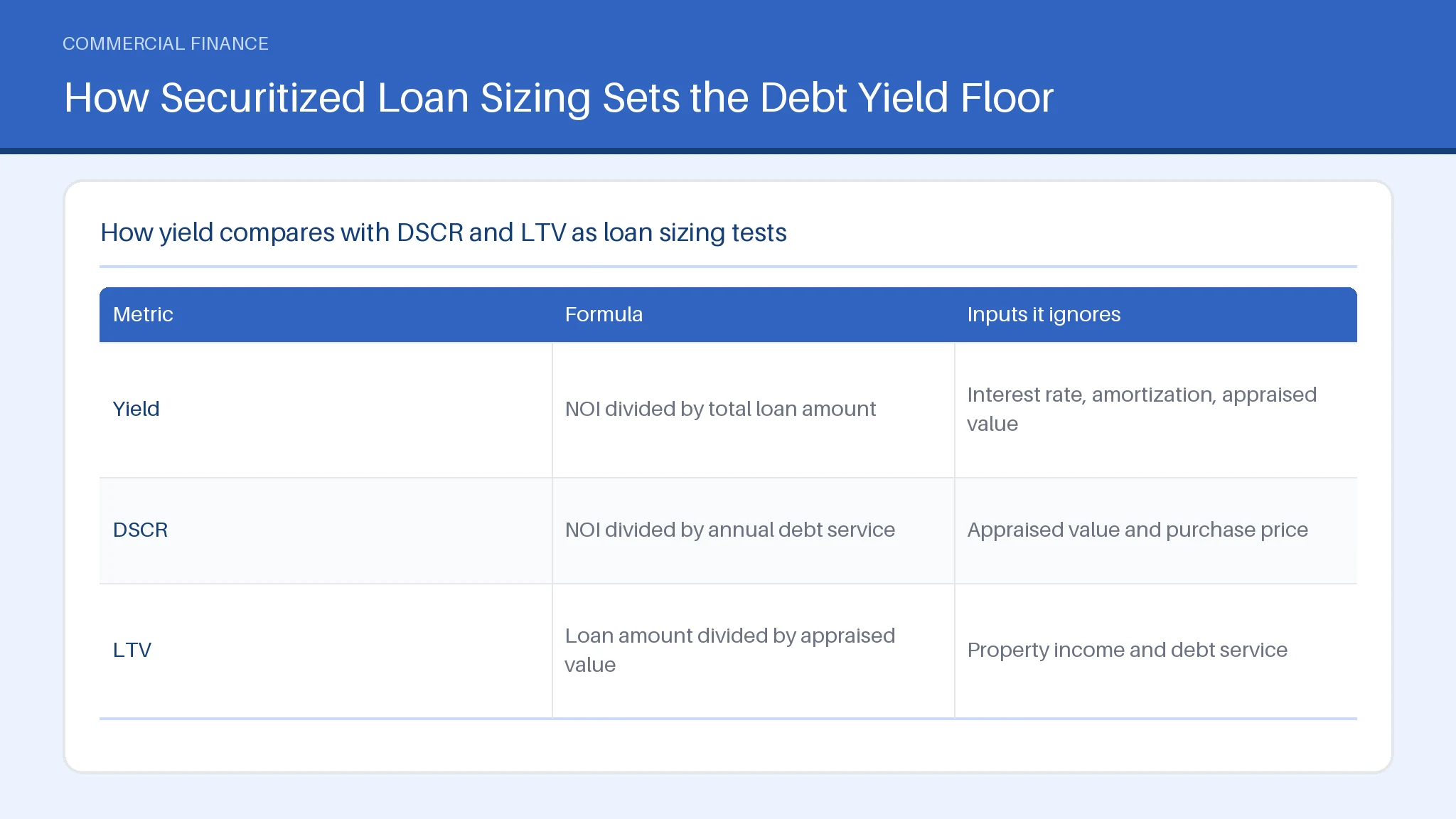
| Metric | Formula | Inputs it ignores |
|---|---|---|
| Yield | NOI divided by total loan amount | Interest rate, amortization, appraised value |
| DSCR | NOI divided by annual debt service | Appraised value and purchase price |
| LTV | Loan amount divided by appraised value | Property income and debt service |
Because the three tests use different denominators, they rarely bind at the same time. Run all three and take the lowest resulting loan amount, which is exactly what a lender does.
Minimum Debt Yield Thresholds CMBS Lenders Require in Underwriting
A yield is the lender's cash on cash return on the loan if the property were taken over at its current income, and it functions as a floor on how large that loan can be. The yield ratio is the same figure stated as a relationship rather than a single number: income over principal, so higher means more income supporting every dollar of debt, and lower means thinner recovery cushion if the borrower defaults.
A good yield depends on asset type and market, but the working convention across the US market is that stabilized institutional lenders look for a number in the high single digits, with roughly 10 percent treated as a common baseline in securitized underwriting and 8 to 9 percent more typical for stronger, well located multifamily and industrial assets. Thresholds move up for property types with volatile income or short lease terms, such as hospitality and self storage, and down for assets with long credit leases and predictable cash flow. Anything in the low to mid single digits signals that the loan request is large relative to what the building actually earns.
The difference from DSCR is the point of the metric. DSCR divides NOI by annual debt service, so it answers whether current income covers current payments. It flatters a deal when interest rates are low or when the loan carries a 30 year amortization or an interest only period. The yield calculation removes both levers, so the same property produces the same percentage regardless of how the loan is priced or structured. That consistency is why the ratio became standard after the 2008 downturn, when loans that passed coverage tests on aggressive rates and long amortization schedules still failed once income softened.
In practice lenders use both. Coverage governs whether the loan can be paid, while the income floor governs whether the loan can be recovered. Our companion explainer on the debt service coverage ratio works through the coverage side of that math in detail.
How Securitized Loan Sizing Sets the Debt Yield Floor
Securitized loan sizing works backward from the minimum threshold. Divide underwritten NOI by the required percentage and the result is the maximum loan the property supports under that test. Using $850,000 of NOI, a 10 percent floor produces $8,500,000 of proceeds, while a 9 percent floor produces about $9,444,000. A single percentage point of threshold moves proceeds by roughly a million dollars on a mid sized deal, which is why the floor is negotiated as hard as pricing.
The reason the floor exists in securitization is that loans are pooled, rated and sold. Rating agencies and bond investors need a measure that does not flatter itself when rates compress or appraised values climb, because the certificates outlive the market conditions at closing. Yield real estate underwriting gives them that fixed reference point. The yield calculation is also easy to reproduce from a servicer's income statement years after closing, which supports ongoing surveillance.
For borrowers, the operational lesson is that yield real estate proceeds are set by the trailing twelve months of income a lender can verify, not by the stabilized number you expect in month eighteen. If the plan depends on future rent growth or lease up, the income based floor will cut the loan today. That is where structures such as earnout provisions, holdbacks or mezzanine financing get discussed, and where CMBS loans differ from bank execution.
Multifamily and Apartment Loan Financing Made Straightforward
Multifamily is where the yield test is most predictable, because apartment income is granular, leases are short and comparable data is deep. Underwriters can verify rent from a rent roll, trend it against a trailing twelve month operating statement, and apply market vacancy with confidence. The yield calc on a stabilized apartment building therefore tends to land close to the borrower's own number once management fees and per unit replacement reserves are added.
Three adjustments move the figure most on apartment deals. First, loss to lease: if in place rents sit below market, the lender uses in place, which lowers NOI and proceeds. Second, non recurring income such as one time fees or short term corporate rentals, which is usually excluded. Third, real estate taxes, which many lenders reassess at the post sale value rather than the seller's historic bill. A reassessment alone can cut the yield definition inputs by half a point on a heavily appreciated asset.
Agency lenders, banks and securitized programs weigh these items differently, and the same rent roll can produce a meaningfully different yield calculation commercial real estate outcome across executions. That is why comparing structures matters more than chasing a single rate. Our guides to multifamily loans and apartment building loans walk through those differences.
Summary
Yield turns net operating income and loan amount into one percentage that tells a lender how much income backs every dollar of debt. It ignores rate, amortization and appraised value, which makes it the steadiest of the three sizing tests and often the binding one. Borrowers who underwrite their own income conservatively, expect management fees, reserves and tax reassessment, and then run coverage, leverage and the income floor together will know their realistic loan size before they talk to anyone. CRE Loans USA is a lender matching service that passes your property details to independent finance providers who make all lending decisions. continue with the qualification form below or read more in the guides.
Frequently asked questions
What is a good debt yield ratio?
A good yield ratio for stabilized commercial property generally sits in the high single digits, with around 10 percent used as a common baseline in securitized underwriting and 8 to 9 percent accepted on stronger multifamily and industrial assets. The threshold is not universal. Property types with short leases or volatile income, such as hotels and self storage, usually face higher floors, while long term credit leased assets can clear at lower numbers. Judge your figure against the requirement for your asset type and market, not against a single national rule of thumb.
What is debt yield vs dscr?
Yield and DSCR answer different questions from the same NOI. Yield divides income by the loan amount, so it measures recovery: how much the property earns per dollar lent. DSCR divides income by annual debt service, so it measures affordability: whether current cash flow covers the payment. Because DSCR includes rate and amortization, a low rate or a 30 year schedule can lift it without any improvement in the building's income. The income based test cannot be moved that way, which is why lenders run both and size to whichever is more restrictive.
What does 8% it mean?
An 8 percent figure means the property generates $8 of annual net operating income for every $100 of loan principal, so the lender would recover the loan balance from current income in roughly 12.5 years if it took over the asset. On a $10,000,000 loan, 8 percent implies $800,000 of underwritten NOI. For most stabilized deals that sits at the acceptable end of the range rather than comfortably above it.
Is higher it better?
Higher is better from the lender's perspective, because more income supports each dollar of debt and the recovery cushion is larger. From the borrower's side the picture is different. A high figure usually means the loan is small relative to what the property earns, which limits leverage and ties up more equity. The useful target is the lowest number that still clears the lender's floor with margin, because that produces maximum proceeds without leaving the deal vulnerable if income softens before closing.
What does one tell you?
The figure tells you how quickly a lender could recoup its principal from existing income and, by extension, how much loan the property can carry on its own. It does not tell you whether the price is fair, what the return on equity will be, or how the loan will be priced. It also says nothing about capital expenditure needs or lease rollover risk, so read it alongside cap rate analysis, coverage math, and a rent roll review rather than in isolation.
Is 1.7 a good debt-to-equity ratio?
A 1.7 debt to equity ratio means a company or entity carries $1.70 of debt for every $1.00 of equity. Whether that is reasonable depends entirely on the sector, and it is a corporate balance sheet measure rather than a property level test. It is often viewed as moderately leveraged for capital intensive businesses and high for asset light ones. Commercial mortgage underwriting looks at the property's income and the loan against it, so a sponsor's debt to equity ratio is context for creditworthiness, not a substitute for income based sizing.
What is Coca-Cola's debt-to-equity ratio?
Published debt to equity figures for large listed beverage companies vary by reporting period and by how analysts treat leases and short term borrowings, so any single number goes stale quickly. Read it directly from the most recent audited balance sheet filed with the Securities and Exchange Commission rather than relying on a secondhand figure. The same caution applies to property underwriting: use verified, current financial statements, because lenders will.