
A commercial mortgage broker is a licensed or registered intermediary who arranges debt for income-producing and owner-occupied property. The broker does not lend money. Instead, the broker builds a credit package around your property, your operating history, and your business plan, then places that package with banks, credit unions, debt funds, life insurance companies, agency lenders, and other capital sources that fit the deal. When the loan funds, the broker is paid a fee, typically calculated as a percentage of the loan amount.
That definition sounds simple, but it hides the part that actually decides whether a borrower gets a workable result. Commercial lending is not a single market with one set of rules. A twelve-unit apartment building, a single-tenant industrial box, a ground-up self-storage project, and a hotel refinance are underwritten by different desks with different appetites, different leverage ceilings, and different tolerance for construction risk or lease-up risk. A borrower who walks into one bank sees exactly one credit box. A commercial mortgage broker who works the market regularly sees which desks are actively quoting this quarter and which have quietly stopped.
The problem most sponsors face is not a lack of lenders. It is a lack of visibility. Rate sheets are not published for a commercial loan the way they are for a thirty-year residential mortgage. Terms move with deposit pressure, regulatory capital rules, and the lender's existing concentration in your asset class and your metro. Two institutions on the same street can differ by several hundred basis points and twenty points of leverage on the same file, for reasons that have nothing to do with your credit quality.
This guide covers what brokers actually do, how they are licensed and paid, how their economics compare with other real estate careers, how to evaluate one before signing an exclusive agreement, and where a real estate loan intermediary adds value versus where going direct is simply cheaper. It also covers the structures brokers are asked about most: single close construction facilities, bridge debt, and recasting.
Key takeaways
- A commercial mortgage broker is an intermediary who packages a borrower's property and financial story, then presents it to multiple capital sources rather than a single bank credit box.
- Broker compensation in commercial real estate is usually a percentage of the funded loan amount, most often paid at closing by the borrower, the lender, or a split of both, and it should be disclosed in writing before you sign an engagement.
- Licensing is set state by state, not federally, so the credentials that matter depend on where the property sits and whether the deal touches residential collateral.
- The strongest reason to use a broker is coverage of lender categories you cannot easily reach, including credit unions, debt funds, life companies, and agency lenders, not simply a faster application.
- Twenty percent down is a rough starting point rather than a rule; leverage in commercial real estate is driven by debt service coverage, cap rate, and property type as much as by a fixed down payment percentage.
How to Become a Commercial Mortgage Broker in the US
There is no single federal license for arranging commercial property debt. The Secure and Fair Enforcement for Mortgage Licensing Act, administered through the Nationwide Multistate Licensing System, governs loan originators who work on residential mortgages secured by one to four family dwellings. Commercial-only origination generally falls outside that federal regime, which is why requirements vary so sharply by state.
The practical path looks like this. First, confirm the rules in every state where you intend to place loans, because the obligation usually attaches to the location of the property and sometimes to the location of the borrower. Some states require a finance lender or broker license administered by the state financial regulator. Others require a real estate broker license, since arranging a loan secured by real property is treated as a real estate activity. A handful impose no commercial-specific licensing at all, and several require registration only above certain thresholds or when the collateral includes residential units.
Second, build underwriting fluency before building a client list. A broker who cannot construct a rent roll, a trailing twelve, a debt service coverage calculation, and a sources and uses statement will waste lender time and lose credibility quickly. Third, form the business entity, secure errors and omissions coverage, and establish written fee agreements. Fourth, build lender relationships deliberately by asset class rather than collecting business cards.
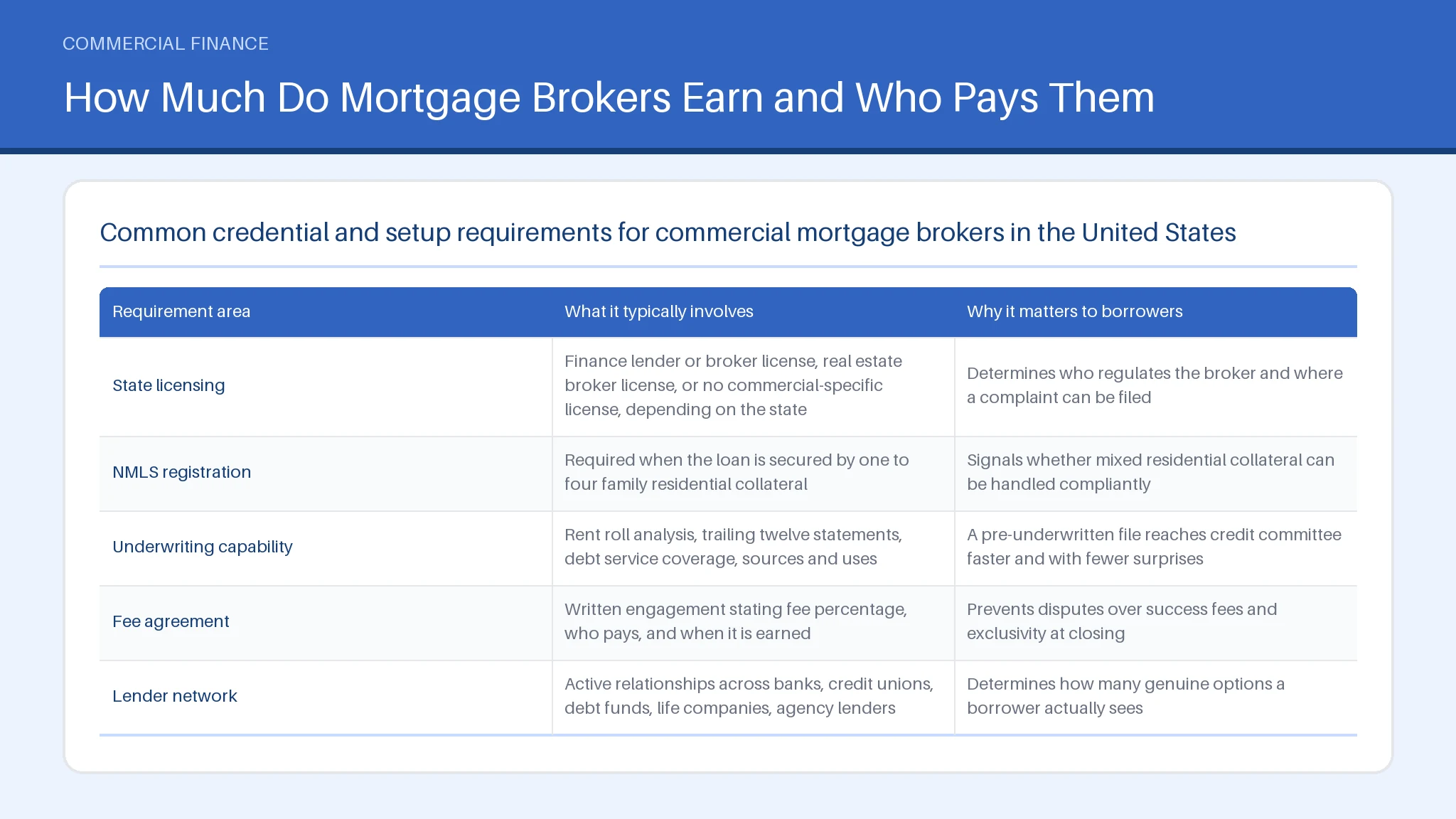
| Requirement area | What it typically involves | Why it matters to borrowers |
|---|---|---|
| State licensing | Finance lender or broker license, real estate broker license, or no commercial-specific license, depending on the state | Determines who regulates the broker and where a complaint can be filed |
| NMLS registration | Required when the loan is secured by one to four family residential collateral | Signals whether mixed residential collateral can be handled compliantly |
| Underwriting capability | Rent roll analysis, trailing twelve statements, debt service coverage, sources and uses | A pre-underwritten file reaches credit committee faster and with fewer surprises |
| Fee agreement | Written engagement stating fee percentage, who pays, and when it is earned | Prevents disputes over success fees and exclusivity at closing |
| Lender network | Active relationships across banks, credit unions, debt funds, life companies, agency lenders | Determines how many genuine options a borrower actually sees |
Why use a broker at all? Because the same file priced across eight desks rarely comes back with eight similar answers. Choosing the right broker comes down to four checks: verifiable closings in your asset class, a written fee disclosure, a named list of the lender categories they will approach, and a willingness to explain why a deal was declined rather than only forwarding good news. Ask how many of their last ten submitted files closed, and with which category of capital source.
Why Borrowers Work With a Local Commercial Loan Broker
Local knowledge is not sentiment. It is underwriting input. Appraisers, credit officers, and third-party report vendors all price local risk differently, and a broker who works one metro repeatedly knows which submarkets a given bank has flagged as concentrated, which appraisal firms that bank accepts, and how long municipal approvals typically take in a specific county. That intelligence shortens the timeline on a commercial loan more reliably than any promise about speed.
Local brokers also carry relationships with community banks and credit unions that never appear in national searches. These institutions frequently hold loans on balance sheet, which gives them room to structure around a lease that is slightly short or a borrower whose tax returns understate real cash flow. Their footprint is limited by geography, so they rarely market outside their lending area.
The trade-off is real. A purely local commercial mortgage broker may not have standing relationships with agency lenders, life companies, or national debt funds, which matters on larger multifamily and stabilized assets where those sources price most aggressively. The strongest arrangement is usually a broker with genuine local depth plus documented access to national capital, so the deal is tested against both. Ask directly which national desks they have closed with in the past year and request the asset types, not just the count.
How a Single Close Construction Loan Works Step by Step
A single close construction facility combines the construction period and the permanent loan into one legal closing with one set of documents and one title policy. The borrower closes once, draws during construction, and then converts to amortizing permanent debt without a second underwriting and a second round of closing costs.
The sequence generally runs as follows. The lender underwrites both the construction budget and the stabilized property, since it is committing to the exit up front. Plans, permits, the general contractor's qualifications, and a fixed or guaranteed maximum price contract are reviewed. At closing, the borrower funds the equity portion first in most structures. Draws are then released against inspections and lien waivers, usually monthly, with interest charged only on funds advanced. Interest is frequently reserved within the loan amount. Once the certificate of occupancy is issued and any debt service coverage or occupancy test is met, the facility converts to permanent terms already fixed at closing.
The trade-off is pricing and rigidity. Locking the permanent terms early can cost more than shopping the takeout later, and the conversion tests are strict. A commercial mortgage broker earns the fee here by modeling both paths before you commit. For deeper mechanics, see Commercial Construction Loans: How They Work and Qualify.
Mortgage Broker vs Real Estate Agent: Which Career Pays Better
The two roles are paid on the same underlying event, a real estate transaction, but the economics behave very differently. A residential sales agent typically earns a percentage of the sale price, split with a brokerage and often with a cooperating agent, so the net share of the headline commission can be roughly a quarter to a half of the gross. Volume depends on inventory and buyer demand.
Loan origination pays on debt rather than on price. That changes the cycle. When sales volume falls, refinancing and loan maturities still generate work, and in commercial real estate the maturity calendar is a reliable source of business regardless of transaction volume. A commercial mortgage broker also serves repeat institutional and sponsor clients who refinance every few years, which produces a more predictable pipeline than one-time homebuyers.
The offsetting factor is deal length and fallout. Commercial files can run sixty to one hundred twenty days or longer, and a meaningful share die at appraisal, environmental review, or credit committee. Nobody is paid on a dead file. Agents close more transactions per year at smaller average fees; commercial brokers close fewer at larger fees with higher variance. Neither is universally better paid. Income tracks specialization, market access, and the ability to survive long stretches without a closing.
How Much Do Mortgage Brokers Earn and Who Pays Them
Commercial broker compensation is almost always a success fee expressed as a percentage of the funded loan amount. Fees commonly sit around one percent on mid-size transactions, trend lower as loan size increases, and trend higher on small, complex, or heavily structured deals where the work per dollar is greatest. Many engagements include a minimum fee so that a small transaction remains worth underwriting.
Who pays varies. On many commercial transactions the borrower pays the fee directly at closing, itemized on the settlement statement. On others the lender pays the broker from its own economics, particularly with debt funds and some agency programs. Occasionally the fee is split. All three arrangements are legitimate, but the borrower should know which one applies before signing, because lender-paid compensation can be priced into the rate rather than removed from the deal.
Some brokers also charge an upfront retainer or a due diligence deposit to cover third-party reports and analyst time. That is not automatically a red flag on complex files, but it should be credited against the success fee and the terms should be written down. A written engagement letter naming the fee percentage, the payer, the minimum, the exclusivity period, and any tail provision protects both sides and prevents the most common closing table dispute.
Finding Commercial Loan Brokerage Services in Your Town
Start with verifiable public records rather than advertising. State financial regulator and real estate commission databases let you confirm that a license is active and check for disciplinary history. County recorder records show recorded deeds of trust and mortgages, which is the closest thing to public proof that a broker's stated closings actually happened in your market and asset class.
From there, the useful screening questions are narrow. Which capital sources have you closed a commercial loan with in this county in the past twelve months? What was the smallest and largest transaction? How many of your submitted files reached funding? What is your fee, who pays it, and is there a tail period after our agreement ends? A broker who answers these plainly is treating commercial lending as a documented process rather than a sales pitch.
Also check the boring operational details. Does the broker maintain errors and omissions coverage? Will they name the specific lenders receiving your package before it goes out, so your file is not shotgunned across the market and stale by the time a serious desk sees it? Overshopping a deal is a genuine risk, because credit officers talk and a widely circulated file starts to look distressed. Background reading in the Commercial Real Estate Finance Guides library helps you frame those conversations.
What Does a Commercial Mortgage Broker Do Locally
Day to day, the work is document assembly and market translation. The broker collects the rent roll, trailing twelve month operating statements, personal and entity tax returns, a personal financial statement, a schedule of real estate owned, the purchase contract or existing debt payoff, entity documents, and the business plan for the asset. Then the broker normalizes those numbers into the format credit officers expect, adjusting for owner add-backs, management fees, replacement reserves, and vacancy assumptions that a lender will insist on regardless of actual occupancy.
Next comes placement. The broker matches the normalized file to the lenders whose current appetite fits the property type, the leverage requested, the sponsor's experience, and the loan size. In commercial lending, this is where deals are won or lost, because sending a lease-up multifamily file to a bank that only funds stabilized assets simply burns two weeks.
After term sheets arrive, the broker manages the third-party process: appraisal, environmental site assessment, property condition report, survey, and title. They also negotiate the items borrowers often ignore, including prepayment structure, recourse carve-outs, reserve requirements, and covenant tests. Valuation assumptions drive most of these terms, which is why sponsors benefit from understanding the cap rate formula and NOI mechanics before the appraisal lands.
Mortgage Recasting: A Low Cost Way to Cut Monthly Payments
Recasting means applying a lump sum to principal and then having the lender re-amortize the remaining balance over the remaining term. The interest rate does not change and the maturity date does not move. Only the payment drops. Because there is no new note, no new appraisal, and no new title work, the cost is usually a modest administrative fee rather than full closing costs.
This matters when a borrower is holding a below-market fixed rate. Refinancing would surrender that rate; recasting keeps it while improving cash flow and debt service coverage. Improved coverage can also help with covenant tests on an existing real estate loan or strengthen the sponsor's global cash flow when applying for the next acquisition.
The limits are important. Recasting is not a right. It is a contractual option, and many commercial notes are silent on it or prohibit it outright, particularly securitized loans where the servicer has no authority to modify amortization. Loans with defeasance or yield maintenance provisions typically treat large principal paydowns as prepayments subject to penalty. Before assuming a recast is available, read the note's prepayment and amortization sections, then confirm in writing with the servicer rather than the original relationship officer.
Construction Loan or Bridge Loan: Which Fits Your Project
The distinction is what the money pays for. A construction facility funds vertical work through inspected draws against a budget, and interest accrues only on advanced funds. A bridge loan funds acquisition or repositioning of an existing structure, usually advancing most of the proceeds at closing with a holdback for capital expenditures and interest carry.
Choose construction financing when you are building from the ground up or performing structural work that requires permits, a general contractor, and a draw schedule. Choose bridge debt when the building already stands and the gap is occupancy, lease quality, or deferred maintenance rather than construction itself. A property at sixty percent occupancy that needs eighteen months of leasing is a bridge candidate. A vacant lot is not.
Cost and covenant differences follow from risk. Construction lenders require completion guarantees, budget contingency, and often a signed guaranteed maximum price contract. Bridge lenders focus on the business plan, the exit, and whether projected stabilized value supports a takeout real estate loan at maturity. Both are floating rate in most cases, both carry exit or extension fees, and both punish schedule slippage. Model the carry cost of a six month delay before choosing, because that single assumption changes which structure is actually cheaper.
Summary
Choosing an intermediary comes down to evidence rather than reputation: confirmed licensing in the state where the property sits, recorded closings in your asset class, a written fee agreement naming the payer and any tail period, and a named list of the capital sources that will actually see your file. Structure choices follow the same discipline. Single close construction facilities, bridge debt, and recasting each solve a specific problem and each carry contractual limits worth reading before you commit. CRE Loans USA is a lender-matching service that connects US borrowers with independent third-party finance providers, who make all lending and pricing decisions. continue with the qualification form below or review How CRE Loan Matching Works.
Frequently asked questions
What is a commercial mortgage broker?
A commercial mortgage broker is an intermediary who arranges debt secured by income-producing or owner-occupied commercial property. The broker does not lend, underwrite for its own balance sheet, or set the interest rate. Instead it gathers the borrower's financial and property documentation, normalizes it into the format credit officers expect, identifies which lenders are currently active in that property type and market, and manages the transaction from term sheet through appraisal, third-party reports, and closing. Compensation is usually a success fee tied to the funded loan amount, so the broker is paid when the deal actually closes.
How much does a mortgage broker make on a $500,000 loan?
On a $500,000 commercial transaction, a fee of one percent produces $5,000, and one and a half percent produces $7,500. In practice, many brokers apply a minimum fee on smaller loans because the underwriting and third-party coordination workload does not shrink proportionally with loan size, so a $500,000 file may be quoted at a flat minimum rather than a pure percentage. Residential origination works differently, with lender-paid compensation typically expressed as a percentage of the loan and constrained by federal rules that do not apply to commercial-only transactions. Always confirm the fee, the payer, and any minimum in writing before signing an engagement.
Why use a commercial mortgage broker?
The main reason is access. Commercial pricing and leverage are not published, and appetite shifts quarter to quarter based on a lender's deposit position, regulatory capital, and existing concentration in your asset class and metro. A broker who places loans continuously knows which desks are quoting today. The second reason is file quality: a package that arrives pre-underwritten, with normalized operating statements and a defensible debt service coverage calculation, moves through credit committee faster and attracts better terms than a folder of raw documents. The third reason is negotiation on terms borrowers often overlook, including prepayment structure, recourse carve-outs, and reserve requirements.
Do commercial loans require 20% down?
Not necessarily. Twenty percent down is a useful mental starting point, but commercial leverage is driven primarily by debt service coverage and the property's net operating income rather than by a fixed equity percentage. Stabilized multifamily with strong coverage can reach higher leverage, while hospitality, special purpose assets, and ground-up development typically require considerably more equity. Owner-occupied business property financed through certain Small Business Administration programs can require less down than conventional bank debt. The honest answer is that the required equity is an output of the underwriting, not an input, and it varies by asset type, sponsor experience, and market conditions.
How do mortgage brokers make money, and why does it matter?
Brokers are paid on funded volume, which shapes behavior in ways borrowers should understand. A success fee aligns the broker with closing the deal, but it does not automatically align them with closing the best available deal, since a fee on a higher loan amount is larger. Lender-paid compensation can be embedded in the rate rather than shown on the settlement statement, which makes the cost less visible without making it cheaper. The practical protection is to ask for the fee in writing, ask whether the broker receives compensation from the lender in addition to any borrower-paid fee, and compare term sheets on all-in cost over your expected hold period rather than on headline rate alone.