
Multifamily due diligence is the contractual period after a purchase agreement is signed when a buyer verifies the physical condition, income, expenses, title and legal standing of an apartment property before the deposit becomes nonrefundable. It exists because the seller's marketing package is a sales document, not audited evidence. The work splits into three tracks that run at the same time: a property inspection of buildings and systems, a financial audit of leases and operating statements, and a legal review of title, zoning and litigation history.
Most deals do not fall apart over a surprise nobody could find. They fall apart over findings that arrived too late to renegotiate. Effective multifamily due diligence is therefore a scheduling problem as much as an analytical one, and the sections below map the sequence, the documents and the judgment calls that decide whether you close, reprice or walk. Broader context sits in our commercial real estate finance guides.
Key takeaways
- Multifamily due diligence is a fixed-length verification window, not an open-ended study period, so order third-party reports in the first few days rather than the last week.
- Unit-by-unit walks matter more than a sampled inspection: a 10 percent sample can miss the exact units carrying deferred maintenance and unreported water damage.
- Lease files are the real source of truth. A rent roll shows what the seller claims, while signed leases, ledgers and deposit records show what is collectible.
- Deferred capital items usually reprice a deal faster than market rent misses, because roofs, sewer lines and electrical panels hit cash in year one.
- Lender-ordered reports run on a separate track from buyer reports, so budget time and cost for both instead of assuming one replaces the other.
What a Property Condition Inspection Covers in Apartment Deals
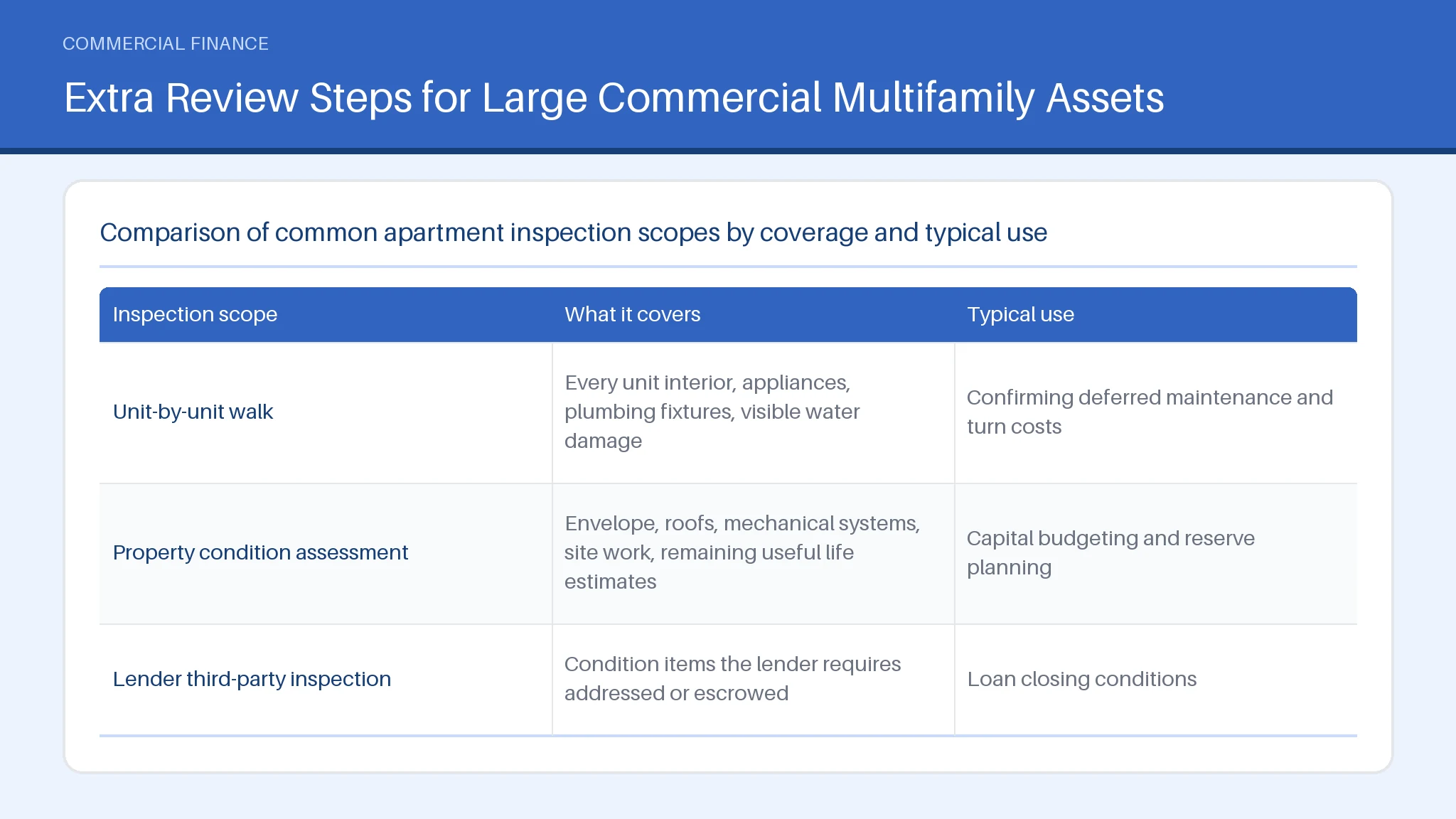
A property condition inspection in an apartment deal documents the physical state of the site, building envelope, mechanical systems and unit interiors, then assigns replacement costs and remaining useful life to each component. Scope is where buyers lose money. A limited walkthrough inspection prices differently from a full property condition assessment, and a lender's third-party inspection answers a different question again, as covered in our guide to a lender inspection for an apartment. Multifamily due diligence works best when you decide the inspection depth before ordering, because expanding scope mid-period rarely fits the calendar or the financing timeline.
| Inspection scope | What it covers | Typical use |
|---|---|---|
| Unit-by-unit walk | Every unit interior, appliances, plumbing fixtures, visible water damage | Confirming deferred maintenance and turn costs |
| Property condition assessment | Envelope, roofs, mechanical systems, site work, remaining useful life estimates | Capital budgeting and reserve planning |
| Lender third-party inspection | Condition items the lender requires addressed or escrowed | Loan closing conditions |
Apartment Acquisition Checklist: What to Verify Before Closing
An apartment acquisition checklist should be organized by who controls the deadline, not by topic. Title commitments, survey, zoning letters and municipal code violation searches depend on third parties, so they go first. A practical closing checklist covers title exceptions and easements, certificates of occupancy, open permits, code violations, utility transfer requirements, insurance loss runs, real estate tax reassessment exposure after sale, and any rent regulation or affordability restriction recorded against the property. Multifamily due diligence also requires you to verify service contracts that survive closing, including laundry leases, cable agreements and pest control terms. Build the checklist as a live document with owner, due date and status on every line, and treat any unresolved checklist item as an open pricing question rather than a formality.
Buyer Responsibilities at Each Stage of the Review Period
The buyer carries the burden of proof during the review period, and the obligations shift week by week. In the first days, order reports, issue the document request and schedule unit access notices that satisfy state lease notice rules. Mid-period, reconcile lease files against the rent roll, price repair findings and confirm expense assumptions against actual invoices rather than pro forma figures. In the final stretch, deliver written objections, negotiate credits or escrows, and confirm loan conditions are achievable. A buyer who waits until the last week has only one lever left, which is walking away. Coordinating a lender's timeline early is covered in how CRE loan matching works.
Documents and Records to Request From the Seller
Request the document package on day one and treat late delivery as a schedule risk. Ask the seller for three years of operating statements, general ledgers, current and trailing rent rolls, every executed lease with amendments, tenant ledgers and deposit records, utility bills by meter, tax bills, insurance loss runs, payroll detail, service contracts, warranties, permits, environmental reports and any prior property condition assessment. A prior assessment is useful evidence but not a substitute for your own inspector, since conditions change and the earlier scope may have excluded units. Where the seller cannot produce a document, note the gap in writing. Missing deposit records and unsigned lease renewals are among the most common findings that move price at the end of multifamily due diligence.
Extra Review Steps for Large Commercial Multifamily Assets
Larger assets add review steps that smaller deals skip. A comprehensive scope on a 150-unit or larger property usually includes a Phase I environmental site assessment, seismic or wind exposure modeling where applicable, elevator and boiler certifications, ADA accessibility review, utility submetering audits and a structural engineer's opinion on any settlement or facade cracking found during the property inspection. Expense verification also gets harder at scale, because payroll, on-site management and turnover costs are real line items that a small pro forma often understates. An institutional investor will additionally stress test insurance renewal pricing and property tax reassessment, both of which can reshape valuation. Our cap rate and NOI guide shows how those inputs flow through.
Planning Your Next Apartment Investment With Expert Input
Expert input pays for itself when it changes a number in your model. A general contractor pricing exterior siding and parking lot work will usually produce a tighter capital estimate than a report allowance, and a local property manager can tell you whether achievable rental rates match the ones underwritten. Build a standing bench of an engineer, a contractor, a title attorney and a manager in each market you buy, so a multifamily property under contract does not wait for introductions. Every property inspection finding should map to a line in the operating budget or the capital plan, with each expense assigned to year one, year two or reserves. An investor who does this consistently negotiates from evidence instead of instinct. continue with the qualification form below.
Inspecting Roofs, HVAC, Plumbing and Electrical Systems
Roofs, HVAC, plumbing and electrical systems drive the largest single-item repair costs in apartment deals, so inspect them by age and remaining life rather than by whether they currently function. Record roof installation dates and membrane type, HVAC unit ages and refrigerant type, supply and waste line material, panel amperage and any aluminum branch wiring. Cast iron waste lines and original panels in a 1970s multifamily property are budget events, not maintenance items. Ask which systems the tenant pays for, because a master-metered building shifts utility expense onto ownership. The most useful insight often comes from work order history, which shows the recurring failures a single visit misses, and from any lease that promises services the equipment cannot reliably deliver.
How to Audit Leases, Rent Roll and Occupancy Files
A lease audit compares every executed lease against the rent roll line by line, and the standard is one hundred percent of files, not a sample. For each lease, confirm the tenant name, term dates, stated rent, concessions, deposit held, pet and parking fees, and signatures on every amendment. Flag any lease that is month to month, expired, unsigned, or priced below the rent roll figure. Then reconcile deposits to the bank ledger, because deposit shortfalls transfer to the buyer at closing. Occupancy files should also show income certifications where a program requires them. Lenders repeat this work during underwriting, and a clean lease file speeds financing review on any multifamily property. Document every lease variance in your objection letter with a dollar figure attached.
Multifamily Due Diligence Checklist for First Time Apartment Buyers
A due diligence checklist is a written, dated list of every item a buyer must verify before the contingency period expires, with an owner and a source document assigned to each line. First-time apartment buyers should build one acquisition checklist with four sections. Financial due diligence reconciles rent rolls, ledgers, bank deposits, tax bills and utility invoices to the trailing twelve months of income and expenses, and tests whether the seller's numbers survive contact with actual receipts. Legal due diligence covers title exceptions, survey encroachments, zoning compliance, open permits, litigation and any recorded restriction. Physical diligence prices condition findings. Loan diligence confirms that appraisal, third-party reports and borrower documents can clear in time.
Commercial real estate due diligence differs from a residential purchase mainly in evidence standard: value rests on verified income, so an unsupported line item is treated as zero until proven. That is why a diligence checklist for multifamily investments should require a document reference beside each cleared item. Keep the diligence checklist and the objection log in one file, and the negotiation at the end writes itself.
Summary
Strong multifamily due diligence sequences third-party reports early, audits every lease file rather than a sample, and converts each finding into a dated dollar figure. Multifamily due diligence ends in a priced objection letter, not a summary memo. CRE Loans USA is a lender-matching service that introduces borrowers to independent finance providers. About CRE Loans USA
You may also find these related guides helpful: ARV Real Estate: How to Calculate After-Repair Value, Commercial Property Insurance: What It Covers and Costs, and CMBS Loans: How Fixed-Rate CRE Financing Works.
Frequently asked questions
What is the 2% rule for properties?
The 2 percent rule suggests a property should generate monthly rent equal to 2 percent of purchase price. It is a crude screen that rarely holds in current US apartment markets and ignores expenses, capital needs and debt terms.
What are the three types of due diligence?
The three types are financial, legal and physical. Financial tests income and expenses, legal tests title, zoning and contracts, and physical tests condition. The purpose across all three is to replace assumptions with evidence before the money is committed.
What are red flags in due diligence?
Red flags include missing deposit records, unsigned or expired leases, concessions absent from the rent roll, deferred roof and plumbing work, open code violations and a seller who restricts unit access. Each one signals reporting the documents do not support.