
Industrial property loans are mortgages secured by buildings used for warehousing, manufacturing, assembly, cold storage, flex space and last-mile distribution. Lenders size them on the property's net operating income, the strength of the lease or leases in place, and the physical characteristics that decide whether another occupant could use the space if the current tenant leaves. That last point is what separates industrial underwriting from most other asset classes. A 32-foot clear-height distribution box with ample dock doors and three-phase power has a deep tenant pool. A purpose-built plant with pits in the slab, overhead cranes and a single occupant has a narrow one, and the loan terms reflect it.
Borrowers usually arrive at industrial property loans in one of three situations. An owner-operator wants to stop renting and buy the building the business already occupies. An investor is acquiring a leased warehouse and needs permanent debt at closing. Or an existing owner wants to refinance maturing debt, pull out trapped equity, or fund a roof, sprinkler upgrade or dock expansion before re-leasing. Each path leads to a different lender type, a different appraisal emphasis and a different timeline.
Pricing on industrial property financing is not a single number. It is an index plus a spread, and the spread moves with leverage, lease term, tenant credit and recourse. Two owners buying identical buildings on the same street can get materially different quotes because one has a ten-year lease to a national logistics operator and the other has month-to-month occupancy from a local fabricator.
This guide explains how each lender category approaches an industrial property loan, what documentation actually moves a file forward, where the hidden costs sit in environmental and structural review, and how to compare offers on total cost rather than headline rate. For a broader view of how pricing is built, the explainer on commercial loan rates and index plus spread covers the mechanics in detail.
Key takeaways
- Industrial property loans are underwritten mainly on the building's cash flow, clear height, power supply and tenant credit, not on the borrower's personal income alone.
- Permanent bank debt, insurance company debt, SBA programs and bridge debt all finance industrial buildings, and each one trades price against speed, flexibility and prepayment freedom.
- Most stabilized industrial purchases are sized around 65 to 75 percent of value, so a 25 to 35 percent equity contribution is a realistic planning assumption.
- Single-tenant manufacturing space with heavy specialized improvements usually prices wider than multi-tenant warehouse or distribution space because re-tenanting risk is higher.
- Negotiating leverage comes from a complete, well-organized package: rent roll, leases, environmental history, deferred maintenance list and three years of operating statements.
How Industrial Property Loans Work for Purchases and Refinances
An industrial property loan on a purchase is sized by the lower of three tests: a percentage of appraised value, a minimum debt service coverage ratio, and a minimum debt yield. Whichever test produces the smallest number sets the loan amount, which is why a building appraising well can still support less debt than the buyer expected when in-place rent is below market. On a refinance, the same three tests apply, but the lender also looks at how much of the existing loan balance is being paid down and whether any proceeds are leaving the deal. Taking cash out generally means lower leverage, a wider spread, or both, and the mechanics are set out in the guide to how a commercial cash out refinance converts equity into cash.
Owner-occupied deals follow a different logic. When the business using the warehouse is also the borrower, lenders underwrite business cash flow alongside property income, and government-guaranteed programs become available. Investors holding leased industrial property loans are judged almost entirely on the rent roll and the coverage it produces.
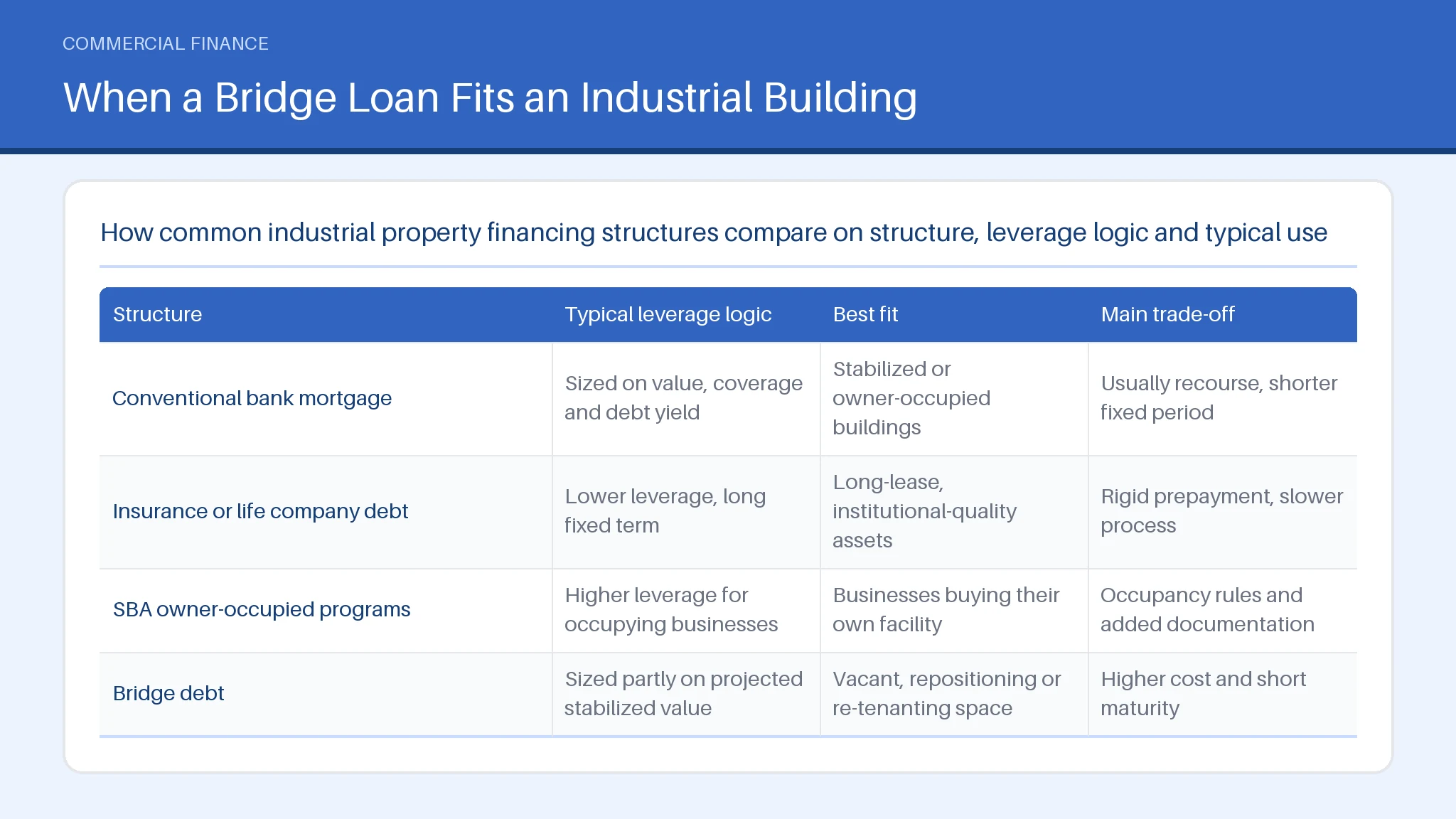
| Structure | Typical leverage logic | Best fit | Main trade-off |
|---|---|---|---|
| Conventional bank mortgage | Sized on value, coverage and debt yield | Stabilized or owner-occupied buildings | Usually recourse, shorter fixed period |
| Insurance or life company debt | Lower leverage, long fixed term | Long-lease, institutional-quality assets | Rigid prepayment, slower process |
| SBA owner-occupied programs | Higher leverage for occupying businesses | Businesses buying their own facility | Occupancy rules and added documentation |
| Bridge debt | Sized partly on projected stabilized value | Vacant, repositioning or re-tenanting space | Higher cost and short maturity |
Warehouses, Manufacturing Plants and Distribution Centers Lenders Finance
Lenders finance a wide band of industrial buildings, and the physical specification drives the terms more than the label on the property type. General-purpose warehouse and distribution space attracts the broadest appetite because clear height, dock-high loading, truck court depth and column spacing are readable by any future tenant. Light manufacturing and assembly space sits in the middle, with power capacity, floor load and ceiling-mounted service becoming the questions underwriters ask. Cold storage, food processing and heavy manufacturing are financeable but specialized, since refrigeration systems, drains, wastewater permits and tenant-specific fit-out limit the replacement tenant pool.
Flex and incubator buildings with a high office finish ratio are often treated as a hybrid, and some lenders apply office assumptions to the finished portion. Truck terminals, outdoor storage yards and industrial service facilities with minimal building coverage get judged mostly on land value and zoning permanence.
Across all of these, industrial property loans hinge on one practical question: if the occupant vacated next quarter, how long and how expensive would re-leasing be? Buildings with functional obsolescence, such as 16-foot clear height or inadequate truck maneuvering, draw lower leverage and shorter terms even when current income looks healthy. Reviewing how triple net lease structures work helps explain why single-tenant industrial leases are priced the way they are.
See if You Qualify for Industrial Property Loans
Qualifying for industrial property loans comes down to four measurable items plus one judgment call. The measurable items are coverage, leverage, liquidity and credit. Coverage means the property's net operating income divided by annual debt service, and most stabilized industrial deals need a comfortable cushion above break-even. Leverage means the equity you are contributing, commonly 25 to 35 percent on a purchase. Liquidity means cash reserves left after closing, since lenders want to see funds available for a roof, a tenant improvement allowance or a vacancy gap. Credit means both the sponsor's score and the payment history on existing commercial debt.
The judgment call is sponsor experience with the asset type. A borrower who has operated warehouse space before gets read differently than a first-time buyer of a manufacturing facility, particularly on a non-stabilized industrial property loan.
Before approaching lenders, assemble three years of operating statements, a current rent roll with lease expirations, a personal financial statement, business tax returns if the deal is owner-occupied, and any prior environmental report. The commercial loan application documents and timeline guide lists what underwriters request and when. To be matched with lenders active in this asset class, continue with the qualification form below.
When a Bridge Loan Fits an Industrial Building
A bridge loan fits an industrial building when the property cannot yet support permanent debt. The common triggers are a vacant box that needs a tenant, a short-dated lease that permanent lenders will not underwrite, deferred capital work such as roof replacement or sprinkler upgrades, a partial-interest buyout, or a purchase closing faster than conventional processing allows. Bridge industrial loans are sized partly on where the lender believes value and income will land after the business plan is executed, which is why a credible, costed plan matters more than historical statements.
The trade-offs are real. Bridge debt typically carries a floating rate, an origination fee, an exit fee in some cases, interest reserves funded at closing, and a maturity measured in months rather than decades. Extension options usually require performance tests and a fee. The honest way to evaluate bridge industrial property loans is to model total cost from closing through refinance, including the permanent loan's own costs, rather than comparing rates alone.
Bridge debt also works when a building is being repositioned from single-tenant to multi-tenant use, since demolition, demising walls and new dock doors all precede stabilized income. Borrowers planning ground-up work should instead review how commercial construction loans are drawn and qualified.
How Insurance and Life Company Lenders Fund Industrial Assets
Insurance and life company lenders fund industrial assets by holding the loan on their own balance sheet to match long-dated liabilities. That mandate shapes everything about their terms. They favor stabilized buildings with long remaining lease term, creditworthy tenants, strong locations near highway or port infrastructure, and modern specifications. In exchange they offer long fixed-rate periods, often non-recourse treatment, and a quiet servicing relationship with no annual renewal risk.
The cost of that stability is flexibility. Life company industrial loans usually come at lower leverage than bank debt, commonly in the low-to-mid 60 percent range of value, and prepayment is restricted through yield maintenance or defeasance rather than a simple declining fee. Selling or refinancing early can be expensive, so the structure suits owners with a genuine long hold horizon.
Underwriting is thorough rather than fast. Expect detailed lease abstraction, a full third-party appraisal, property condition assessment, environmental review, and scrutiny of tenant financial statements. Loan committee cycles are slower than a bank's, so timelines need to be built into the purchase contract. Borrowers comparing non-recourse treatment across lender types will find the detail in the guide to Non Recourse Commercial Loan: Limits and Carve-Outs, which matters because industrial property loans from balance-sheet lenders still carry standard carve-outs.
What Conventional Bank Financing on an Industrial Building Involves
Conventional bank financing on an industrial building involves a mortgage from a commercial bank or credit union, underwritten on property cash flow with a personal or corporate guarantee attached. Banks are typically the most competitive source for owner-occupied warehouse and light manufacturing purchases, and they are the only category that routinely combines a deposit relationship with the credit decision. A meaningful operating account balance can influence the spread offered.
Structurally, bank industrial property financing often pairs a 20 to 25 year amortization schedule with a shorter fixed-rate period of five to ten years, followed by a reset or maturity. That mismatch creates refinance risk the borrower owns, so the maturity date deserves as much attention as the rate. Banks also impose ongoing covenants: minimum coverage tested annually, limits on additional debt, and sometimes a required minimum liquidity.
Third-party costs on a bank deal commonly include appraisal, Phase I environmental assessment, property condition report, survey, title and legal review. On industrial sites with historical manufacturing use, a Phase II investigation can be triggered, which adds both cost and weeks. Owner-occupiers comparing bank debt against government-guaranteed options should read the comparison of SBA 504 and 7(a) structures.
How to Negotiate Better Rates and Terms With Lenders
Better terms come from reducing the lender's uncertainty, not from arguing about rate. The single most effective step is submitting a complete package up front: three years of operating statements, a rent roll with lease expiration dates, abstracts of each lease, a capital expenditure history, the prior environmental report, a current survey if one exists, and a short written summary of the business plan for the building. Files that arrive complete get priced on their merits, while files that dribble in get priced for risk.
Beyond documentation, four levers genuinely move industrial property financing terms. Lower requested leverage almost always buys a tighter spread. Extending lease term with the existing tenant before closing improves coverage and tenant-credit scoring. Accepting a longer prepayment lockout can reduce pricing when a long hold is planned anyway. And running a parallel process with more than one lender category creates a real reference point.
Ask for term sheets that spell out prepayment mechanics, reserve requirements, covenant tests and the recourse carve-outs, since those clauses decide cost over the hold period. An independent commercial mortgage broker's role is largely translating those differences, and further background sits in the commercial real estate finance guides.
Summary
Industrial property loans are priced on the building's physical specification, the credit and term of its leases, and the coverage its income produces. Bank debt suits owner-occupiers and stabilized assets, insurance company debt rewards long holds with long fixed terms and tight prepayment, and bridge debt buys time to lease or repair a building at a higher carrying cost. Across every structure, leverage sits mainly in the 65 to 75 percent band, and environmental history on industrial sites can reshape a timeline. CRE Loans USA is a lender-matching service that connects borrowers with independent third-party finance providers, who make all lending and pricing decisions. Learn more about how CRE loan matching works or read about the platform.
You may also find these related guides helpful: Commercial Property Insurance: What It Covers and Costs.
Frequently asked questions
How to Finance Industrial Real Estate Property?
Financing industrial real estate starts with deciding whether the building will be owner-occupied or held as an investment, because that choice determines which lender categories will look at the file. Owner-occupiers can access government-guaranteed programs and bank debt underwritten partly on business cash flow. Investors go to banks, insurance companies and debt funds that underwrite the rent roll. From there, the sequence is practical: get the property under contract with enough time for third-party reports, order an appraisal, Phase I environmental assessment and property condition report, assemble three years of operating statements plus leases, and compare term sheets on total cost including fees, reserves and prepayment terms. Industrial property loans move faster when environmental history is addressed early rather than discovered in week six.
What is industrial real estate?
Industrial real estate is property used for producing, storing, assembling, processing or distributing physical goods rather than for retail sales, offices or housing. The category covers bulk warehouses, last-mile distribution centers, manufacturing plants, cold storage and food processing facilities, flex and research buildings, truck terminals, and industrial outdoor storage yards. Buildings are described by clear height, dock-high and grade-level door counts, truck court depth, column spacing, floor load capacity, electrical service and office finish ratio. Those specifications, more than the street address alone, determine how broad the tenant pool is and therefore how industrial property loans are sized and priced.
What credit score do you need for a commercial mortgage loan?
Commercial mortgage lenders generally look for a personal credit score in the high 600s or above on recourse loans, with many banks treating 680 to 700 as a working threshold and stronger pricing appearing above 720. Credit score is only one input. Lenders weigh the property's debt service coverage ratio, the loan-to-value ratio, sponsor liquidity and net worth, prior commercial payment history, and experience with the asset type. A borrower with a 660 score and a well-leased building plus strong reserves can clear underwriting where a 760 score with thin coverage will not. Non-recourse balance sheet lenders place less weight on personal scores and more on the asset.
What is a typical down payment for commercial property financing?
A typical down payment for commercial property financing is 20 to 35 percent of purchase price, which corresponds to loan-to-value ratios of roughly 65 to 80 percent. Stabilized multi-tenant industrial buildings with solid leases commonly land at 70 to 75 percent leverage. Insurance company and life company debt often sits lower, around 60 to 65 percent. Owner-occupied purchases using government-guaranteed structures can require as little as 10 to 15 percent equity. Remember that closing costs, third-party reports, lender legal fees and funded reserves sit on top of the down payment, so budget beyond the equity figure alone.
What is the payment on a $1,000,000 business loan?
The payment on a $1,000,000 business loan depends entirely on the interest rate and amortization schedule. At 7 percent over a 25 year amortization, the monthly principal and interest payment is approximately $7,068, which is about $84,800 a year. Shorten the amortization to 20 years at the same rate and the payment rises to roughly $7,753 a month. On an interest-only basis at 7 percent, the monthly cost would be about $5,833. This is why amortization length matters as much as rate when sizing industrial debt: a shorter schedule builds equity faster but consumes more of the property's net operating income, which in turn lowers the coverage ratio the lender calculates.
What is the monthly payment on a $50,000 business loan?
The monthly payment on a $50,000 business loan over a 10 year term at 9 percent interest is approximately $633. Compress that to a 5 year term at the same rate and the payment rises to about $1,038 a month. Shorter-term working capital and equipment facilities are usually quoted over three to seven years, so payments are considerably higher per dollar borrowed than on real estate debt amortized over 20 or 25 years. Owners financing a warehouse purchase alongside equipment should model the two payments together, because lenders will include both in the coverage test applied to the property.