
Triple net lease real estate NNN property investment means buying a commercial building where the occupying business pays rent plus the three main property costs: real estate taxes, building insurance and maintenance. The owner collects a base rent that is closer to net income than gross rent, because the largest recurring expense categories sit with the occupant rather than with the title holder.
That structure attracts buyers who want predictable cash flow without day to day operations. It also creates a different risk profile. When one business occupies the whole building, the income depends on that single company's ability to keep paying. Vacancy is not a partial event in a single tenant building; it is total. Pricing follows credit and lease term as much as bricks and location.
This guide works through what triple net lease real estate NNN property investment actually transfers, where the categories differ, how roof and structure clauses get negotiated, and what lenders look at when the lease term and loan term do not line up. If you are still building the financial vocabulary behind these deals, the explainer on cap rates and net operating income pairs directly with the concepts below.
Key takeaways
- A triple net structure shifts property taxes, building insurance and maintenance from the owner to the occupant, leaving the owner with a rent stream that moves less than gross lease income.
- Net lease categories run on a spectrum: single net covers taxes, double net adds insurance, and triple net adds maintenance and most operating costs.
- Credit quality of the occupying business, remaining lease term and rent escalations usually drive pricing more than the building itself.
- Roof, structure and parking lot obligations are negotiated line items, not automatic transfers, so the signed document decides who funds a capital replacement.
- Lenders underwrite these deals around lease term against loan term, so a lease that expires before the loan matures changes the financing conversation.
What Is Triple Net Lease Real Estate NNN Property Investment?
Triple net lease real estate NNN property investment is a single tenant or multi tenant structure in which the occupant reimburses or pays directly the three net categories. The landlord keeps ownership, debt service and, in most documents, some responsibility for structural elements. A triple net ground lease goes further by leasing the land itself for a long term while the occupant owns or builds the improvements. Any triple net lease sample you review should define each expense category by name rather than by abbreviation, because the letters alone carry no legal meaning.
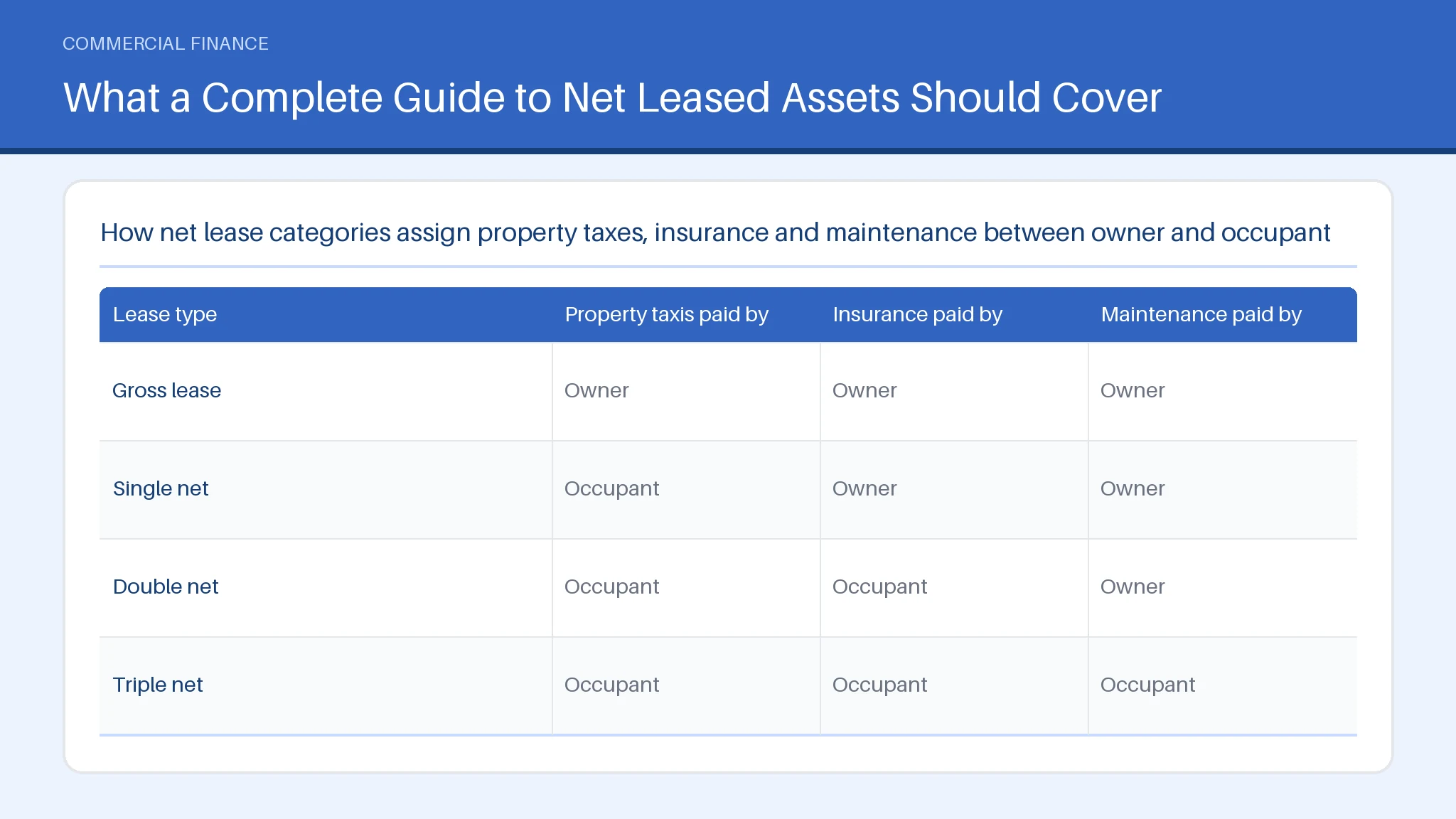
| Lease type | Property taxis paid by | Insurance paid by | Maintenance paid by |
|---|---|---|---|
| Gross lease | Owner | Owner | Owner |
| Single net | Occupant | Owner | Owner |
| Double net | Occupant | Occupant | Owner |
| Triple net | Occupant | Occupant | Occupant |
Investors who invest across several taxis jurisdictions should confirm reassessment rules on sale, since a jump in assessed value changes the occupant's total cost.
Net Lease Categories Used in Commercial Property Deals
Net lease categories exist on a spectrum, and brokers use the labels loosely. The only reliable method when buying triple net lease properties is to read the expense exhibit and map each line to a payer. Two buildings marketed identically can allocate roof replacement, parking lot resurfacing and HVAC capital work in opposite directions.
A practical way to sort deals when buying triple net properties is by how much residual obligation stays with the landlord:
- Absolute net: the occupant carries every expense including structure and roof, and the landlord has almost no operating role.
- Standard triple net: taxis, insurance and routine maintenance transfer, while the landlord retains roof and structural items.
- Modified net: specific costs such as property taxis over a base year are shared on a stated formula.
Triple net lease real estate NNN property investment rewards this level of reading, because the residual items are exactly the ones that arrive as large, irregular bills.
Why Investors Choose NNN Properties for Passive Income
Investors choose net leased assets because the income line is unusually clean. When the occupant pays taxis, insurance, utility bills and routine repair costs directly, the gap between gross rent and net cash flow narrows, and forecasting gets simpler for anyone who wants to invest without hiring property management.
Three practical advantages show up repeatedly when buying triple net lease properties:
- Long initial terms, often ten to twenty years, with scheduled rent increases written into the document.
- Low landlord staffing needs, since the occupant handles vendor contracts and day to day building issues.
- Clear expense visibility, which makes lender underwriting straightforward when the rent roll is a single reliable payer.
The trade off is concentration. One vacancy removes all income, and re-tenanting a purpose built store can take longer than an investor's reserve assumptions allow. Triple net lease real estate NNN property investment works best for buyers who hold reserves and can wait out a re-lease period. The commercial real estate finance guides cover reserve planning in more depth.
Triple Net Lease Real Estate NNN Property Investment Explained
A triple net lease in real estate investing is a contract where the occupying business pays base rent plus real estate taxis, building insurance and maintenance, so the landlord receives income with fewer deductions. The occupant pays the property tax bill, either directly to the assessor or as a reimbursement to the landlord, and the document names which method applies. When the occupant pays directly, the landlord should still require proof of payment each cycle, because unpaid taxes attach to the title, not to the occupant.
Whether it is a good investment depends on three variables rather than the label. First, the credit strength of the business paying rent, since an investment grade corporate guarantee behaves very differently from a franchisee guarantee. Second, the remaining term against your hold period and loan maturity. Third, whether contract rent sits above or below market, because an above market rent inflates today's yield and depresses tomorrow's re-leasing outcome.
The benefits are real: reduced management burden, predictable escalations, a defensible expense structure and financing that lenders understand well. The limits are equally real. A landlord with a below market rent cannot capture upside for a decade or more, and inflation erodes a flat rent quickly. Structural and roof repair exposure often stays with the landlord in standard forms. Triple net lease real estate NNN property investment should be judged on those specifics, alongside the utility metering arrangement, not on the three letters.
What a Complete Guide to Net Leased Assets Should Cover
A complete guide to net leased assets should move past definitions and into the documents that decide outcomes. Triple net lease NNN property investment real estate deals turn on estoppel certificates, subordination clauses, casualty and condemnation language, and the exact wording that caps a landlord's expense exposure.
The items worth checking before a landlord signs:
- Whether the occupant carries a corporate guarantee or only a single entity guarantee.
- How utility accounts are metered and transferred at lease commencement.
- Whether real estate taxis reimbursements are capped, and what happens after a sale triggers reassessment.
- Renewal option rent: fixed, indexed, or set at fair market value.
- Which capital expense items revert to the landlord in the final years of the term.
Triple net lease real estate NNN property investment analysis should also model the insurance line, since deductible sharing varies. The overview of what commercial property insurance covers explains where those gaps usually appear.
Single Net Lease: Tenant Pays the Property Taxes
A single net lease requires the tenant to pay real estate taxes on top of base rent, while the owner keeps insurance and maintenance. It is the lightest of the net structures and the least common in modern single tenant retail, but it still appears in office suites, medical buildings and older industrial stock where one tenant occupies a defined footprint.
The mechanics matter more than the label. In most single net documents the tenant either pays the assessor directly or reimburses the owner within a stated number of days of receiving the bill. If several occupants share a building, each tenant pays a pro rata share based on rentable square footage, and the owner must issue a reconciliation statement. A tenant who disputes an assessment usually needs the owner's cooperation to file an appeal, so the lease should say whether the tenant holds that right.
Risk sits with the owner in a single net deal. Insurance premiums and repair costs rise regardless of what the tenant pays, and a tenant with thin margins may resist any rent increase that follows. An owner evaluating a single net building should underwrite insurance and maintenance growth independently, then compare the result to what the same tenant credit would support under a heavier net structure. A tenant, for its part, gains cost certainty everywhere except the tax line.
Double Net Lease: Taxes and Insurance Split With the Owner
A double net lease moves property taxis and building insurance to the occupant while the landlord keeps maintenance, most often roof, structure and common areas. It is a frequent structure in multi tenant industrial parks and in ground up build to suit deals where the landlord wants control over how the building is maintained.
For a landlord, the double net form isolates the two most volatile line items. Insurance premiums in coastal and wildfire exposed markets have moved sharply, and passing that expense through protects the rent stream. The landlord still funds capital maintenance, so reserve funding should be written into the underwriting rather than assumed away. A lease agreement should state the reserve mechanism plainly, including whether unspent amounts roll forward.
Buyers comparing double net stock with triple net lease NNN property investment real estate should price the retained maintenance exposure. When buying triple net properties the landlord sheds that work, and the yield usually reflects it. Utility metering is separate again: confirm each unit has its own utility service before closing. The guide to refinancing commercial property covers how retained expenses affect later loan sizing.
Triple Net Lease: Taxes, Insurance and Maintenance on the Tenant
In a triple net lease the tenant pays base rent plus real estate taxes, building insurance and maintenance, and the owner's remaining duties are usually limited to structure, roof and sometimes the parking lot. That split is the answer to who pays for what: the tenant funds everything tied to occupying and operating the building, and the owner funds the shell unless an absolute net form transfers that too.
Maintenance in an NNN lease is the tenant's responsibility in practice as well as in theory. The tenant contracts the HVAC service provider, handles landscaping and snow removal, manages janitorial work and repairs interior systems. Many documents require the tenant to carry a service agreement on rooftop units and to deliver the equipment in good condition at expiration. Where the building sits in a park with shared areas, the tenant pays a proportionate share of common area costs.
Roof replacement is the line most often disputed. A standard NNN lease frequently leaves full roof replacement with the owner while the tenant handles patching and routine care. An absolute net form puts replacement on the tenant. Neither outcome is automatic, so read the capital expense clause before assuming.
The benefit for a tenant is control over building operations and vendor selection. The benefit for an owner is a rent stream insulated from cost inflation. The cost for the tenant is exposure to tax reassessment and premium increases, which is why a sophisticated tenant negotiates caps on controllable expenses and audit rights over reconciliations.
Does a Triple Net Strategy Match Your Investment Goals?
A triple net strategy suits buyers who want durable income and can accept concentrated credit risk. It suits less well anyone who needs to invest for near term value creation, because the lease agreement removes most levers a landlord would normally pull to raise net income.
Test the fit against four questions:
- Does the remaining term extend past your loan maturity, or will you be re-leasing and refinancing at the same moment?
- Is contract rent at, above or below market, and what does a market reset do to value?
- What residual expense exposure stays with the landlord, and have you funded it?
- Do escalations keep pace with your expense assumptions over the hold period?
A triple net ground lease answers some of these differently, since the landlord holds land with no building expense at all but also no depreciation benefit on improvements. Compare a triple net lease sample against your own model before committing. Understanding how index plus spread pricing works helps when taxis and other pass throughs shift the debt coverage picture. continue with the qualification form below.
Summary
Net lease structures differ by who funds taxes, insurance and maintenance, and the signed document, not the abbreviation, decides the outcome. Judge each deal on occupant credit, remaining term, rent versus market and retained capital exposure. CRE Loans USA is a lender-matching service that connects US borrowers with independent finance providers; how the matching process works is set out separately, alongside background on the network.
You may also find these related guides helpful: ARV Real Estate: How to Calculate After-Repair Value, Debt Yield: Formula, Minimums and Loan Sizing, DSCR Loans in Texas: How Cash Flow Underwriting Works, CMBS Loans: How Fixed-Rate CRE Financing Works, Commercial Construction Loans: How They Work and Qualify, and Hotel Financing Lenders: Loan Types, Terms and Approval.
Frequently asked questions
Is a triple net lease a good investment?
A triple net lease can be a sound investment when the occupying business has verifiable credit, the remaining term covers your hold period and the contract rent sits at or below market. It is a weaker investment when rent is above market, the guarantee is thin, or the building is purpose built for one use and hard to backfill.
Are NNN properties good investments?
NNN properties are good investments for buyers who prioritize predictable income over active value creation. The management burden is low and the expense pass throughs are clear, but the income depends on one payer, so vacancy is total rather than partial. Reserves and a realistic re-leasing timeline matter more than headline yield.
Is NNN a good long-term investment?
NNN assets can hold up well over a long horizon when escalations keep pace with inflation and the location retains demand for alternative uses. Flat rent over a twenty year term erodes real income, so the escalation schedule is the single most important long term variable. Location quality determines what happens at expiration far more than the current occupant does.
Which triple net lease REIT is the best to buy?
No single net lease REIT can be identified as the best purchase, and no responsible guide should rank one. Publicly traded net lease vehicles differ by portfolio credit mix, lease duration, geographic spread and balance sheet leverage, and those factors change constantly. Evaluate published filings and consult a licensed adviser before buying securities.
Who pays for what in a triple net lease?
In a triple net lease the occupant pays base rent plus real estate taxes, insurance and maintenance, and the owner typically retains roof, structure and parking lot. Absolute net forms move even those items to the occupant.
Who pays property tax on a triple net lease?
The tenant pays property tax under a triple net lease, either directly to the assessor or as a reimbursement. Unpaid taxes still attach to the title, so owners should require proof of payment.
What are the cons of an NNN lease?
The main drawbacks are concentration risk, limited ability to raise income mid term, exposure to reassessment for the tenant, and slow re-leasing of specialized buildings. Owners also face residual capital expense on the shell. The commercial financing questions page covers related lending points.