
Hotel financing lenders are the banks, SBA-approved institutions, debt funds, conduit desks and specialty capital providers that underwrite lodging assets as operating businesses with real estate attached. That single distinction explains most of what frustrates first-time hospitality borrowers. A retail strip or apartment building is underwritten on leases. A hotel is underwritten on last night's occupancy, this month's average daily rate, the franchise agreement, the property improvement plan sitting in the pipeline, and the depth of the operator running the front desk.
Most articles on this topic simply list companies. That is the least useful part of the exercise, because the category of capital you need is decided by your asset's condition and your own track record, not by a brand name. A stabilized, flagged select-service hotel with three years of clean financials sits in a completely different market than a tired independent motel with deferred maintenance and a broken revenue management strategy.
This guide explains how hotel financing lenders group themselves, how they size a loan, which metrics decide leverage, and what genuinely changes an outcome when you take a deal to market. It covers program types, process sequencing, structural terms, distressed situations and the pricing benchmarks that govern hospitality debt, so you can tell in advance which lane your deal belongs in.
Key takeaways
- Hotel financing lenders underwrite hospitality as an operating business, not just real estate, so room revenue, brand affiliation and management quality carry as much weight as the building itself.
- Four debt families cover most deals: SBA programs for owner-operators, conventional bank debt, short-term bridge capital, and fixed-rate conduit loans for stabilized assets.
- Leverage is usually capped by coverage and debt yield tests before it is capped by LTV, which is why a request priced off purchase price alone often gets resized.
- Hotel construction and heavy repositioning deals rely on interest reserves, draw schedules and a credible takeout plan rather than day-one cash flow.
- Distressed motels, flagged conversions and single-asset sponsors are financeable, but they trade at lower leverage, shorter terms and tighter reporting.
What Is Hotel Financing and Who Funds Hospitality Properties?
Hotel financing is debt secured by a lodging property and repaid from the income the hotel generates through room nights, food and beverage, meeting space and ancillary revenue. Because that income can reprice daily, hotel financing is treated as one of the more volatile parts of commercial real estate, and capital providers price it accordingly.
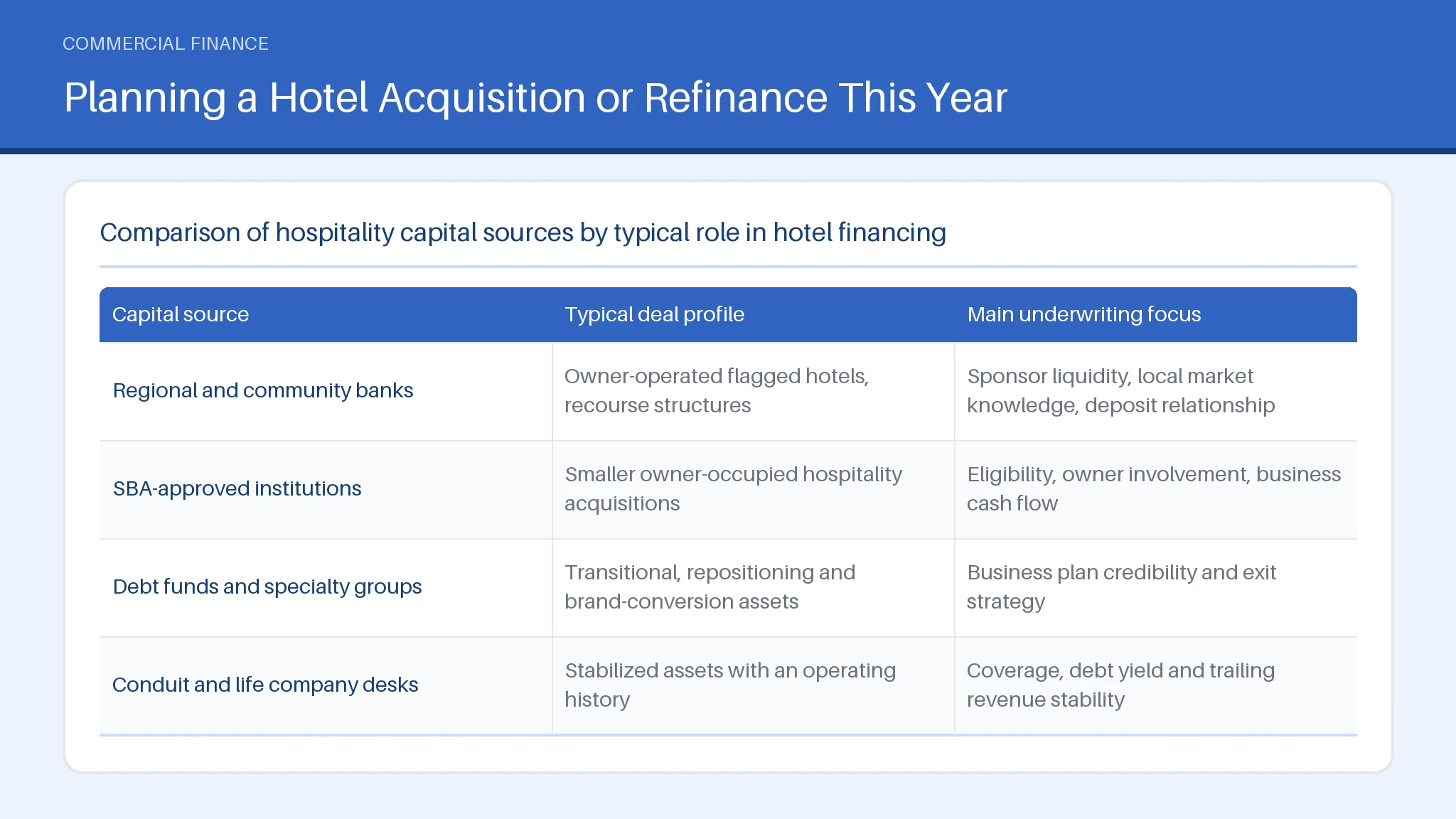
Funding comes from several distinct sources. Regional and community banks handle much of the owner-operator market. SBA-approved institutions serve smaller flagged deals with longer amortization. Debt funds and specialty hospitality groups take transitional risk. Conduit desks aggregate stabilized loans and sell them as bonds. Life companies take the lowest-leverage, highest-quality assets. Each pool has a different tolerance for construction risk, brand quality and sponsor experience, and hotel financing lenders rarely cross into a neighboring lane without repricing the deal.
| Capital source | Typical deal profile | Main underwriting focus |
|---|---|---|
| Regional and community banks | Owner-operated flagged hotels, recourse structures | Sponsor liquidity, local market knowledge, deposit relationship |
| SBA-approved institutions | Smaller owner-occupied hospitality acquisitions | Eligibility, owner involvement, business cash flow |
| Debt funds and specialty groups | Transitional, repositioning and brand-conversion assets | Business plan credibility and exit strategy |
| Conduit and life company desks | Stabilized assets with an operating history | Coverage, debt yield and trailing revenue stability |
Hotel Loan Programs: SBA, Conventional, Bridge and CMBS Debt
Four program families cover nearly every hospitality deal. An SBA loan suits owner-operators buying a flagged property they will actively run, offering long amortization and modest equity in exchange for eligibility rules and personal guarantees. Conventional bank debt typically runs a five to ten year term with a twenty to twenty-five year amortization schedule, recourse, and covenant testing through the life of the mortgage.
Bridge capital from a debt fund or other hotel lender carries the transitional deals: brand conversions, property improvement plans, and assets with trailing performance too weak for permanent lending. Pricing is higher and terms are shorter, but the structure tolerates interest-only repayment while revenue recovers. Fixed-rate conduit debt is the stabilized endgame, and readers comparing that structure against bank execution can review how CMBS loans work for fixed-rate CRE financing.
Choosing a hotel loan means choosing constraints. A lender like a conduit desk offers non-recourse and rate certainty but almost no flexibility later. A bank offers flexibility and relationship value but keeps you on the hook. Hotel financing lenders will also cap LTV well below what a residential mortgage borrower would expect, and every financing option in this group is sized on cash flow first.
How the Hotel Loan Process Works From Application to Funding
The hotel loan process moves through five stages: preliminary sizing, term sheet, third-party reports, formal credit approval, and closing. Preliminary sizing happens fast, often within days, because it relies on documents a hotel owner already has: trailing twelve-month operating statements, monthly STR-style performance data, the franchise agreement, a rent roll equivalent in the form of segmentation reports, and a personal financial statement.
Once a term sheet is signed, underwriting shifts to verification. Third-party work includes an appraisal with a going-concern component, a property condition assessment, environmental review, and often a seismic or flood analysis. The lender inspection stage on a commercial asset follows a similar logic to what to expect from a lender inspection for an apartment, though hospitality adds a review of furniture, fixtures and equipment reserves.
Timelines separate the programs. A bridge mortgage can close in three to six weeks. A conventional mortgage usually takes forty-five to seventy-five days. An SBA loan often runs sixty to ninety days because of eligibility documentation. Working with CRE lenders specializing in hotel financing shortens the questions, but every borrower still controls the calendar through document quality. Hotel financing lenders resize LTV when a borrower delivers incomplete financials late in diligence.
How Hotel Loans Are Structured: Amounts, Terms and Amortization
Hotel loans work by matching the term of the debt to the stage of the asset's income. Stabilized properties support longer fixed-rate terms with scheduled amortization, while properties still building revenue take shorter floating-rate paper with interest-only periods and reserves. Loan amounts are sized by the lower of three tests: a percentage of value or cost, a minimum debt service coverage ratio, and a minimum debt yield. Whichever test binds first sets the proceeds.
Bank terms for a stabilized hospitality asset commonly pair a five to ten year term with twenty to twenty-five year amortization, so the loan carries a balloon balance at maturity. That balloon is the single most important date in the structure, because it forces either a sale or a refinance at whatever rates exist then. Prepayment mechanics matter just as much.
A hotel construction loan funds through draws against a budget, holds an interest reserve to cover carry until the property opens, and requires completion guarantees plus a fixed-price or guaranteed maximum price contract. Hotel construction lending also expects real sponsor equity in first, usually well ahead of any draw. Because a construction loan matures shortly after stabilization, the takeout plan is underwritten on day one alongside the hotel construction budget itself.
A bridge loan serves the middle ground: acquisition of an underperforming asset, a franchise-mandated renovation, or a partnership buyout. A bridge loan is priced off a floating index, runs twelve to thirty-six months with extension options, and is often interest-only throughout. The discipline a bridge loan demands is an honest exit date, and CRE lenders specializing in hotel financing will test that exit before they test the coupon. Hotel financing lenders read an unrealistic stabilization curve as the primary risk in the file.
Planning a Hotel Acquisition or Refinance This Year
Planning a hotel acquisition or refinance starts twelve months before you need the money, because the trailing financials that will be underwritten are being created right now. A borrower who cleans up expense classification, documents non-recurring items and keeps franchise compliance current gives the underwriter a defensible income statement instead of an argument.
For a refinance, model the outcome against today's coverage requirements rather than the terms you signed years ago. Many owners discover that a refinance sized on current cash flow returns less proceeds than the existing balance, which means a paydown, a mezzanine piece, or a longer hold. The general mechanics of a commercial refinance, including cash-out constraints and closing costs, are set out in our guide to refinancing commercial property.
Acquisition borrowers should confirm three things early: the franchisor's approval process for a change of ownership, the cost of any property improvement plan, and whether an SBA loan or a conventional business loan fits the ownership structure. A hotel loan can also be sized differently once a reserve for furniture and equipment is funded. Hotel financing lenders may quote a workable LTV and still require a second borrower guarantee, so a business loan request should include every sponsor's financials upfront.
Moving From Hard Money to Permanent Hotel Debt
Moving from hard money to permanent debt is the most common failure point in hospitality capital stacks. Short-term paper from a private lender solves an immediate problem, closing fast on a distressed purchase or funding a renovation, but it rarely accommodates the twelve to twenty-four months a hotel business needs to prove stabilized revenue. The mortgage that replaces it is underwritten on demonstrated performance, not projections.
A practical transition plan sets a trailing-performance trigger. Once the property produces three consecutive months of operating results that annualize above the permanent lender's coverage floor, the file becomes credible. At six to nine months of clean trailing data, most conventional lending desks will engage seriously. A hotel loan can be refinanced earlier only if the sponsor accepts a cash-in structure or a partial guarantee.
Watch the cost of waiting. Extension fees, higher floating carry and deferred capital expenditure compound quickly in the hospitality industry, so a hotel owner should compare the cost of holding bridge debt for another quarter against the proceeds gained from stronger financials. An SBA loan program can occasionally serve as the takeout for an owner-operated asset, and a specialty hotel lender may bridge the gap to a permanent mortgage when brand approvals are still pending.
Financing Distressed Hotels and Motels Banks Decline
Distressed hotels and motels are financeable, but almost never by the bank that just declined the file. A bank declines for specific reasons: negative net operating income, a lapsed franchise agreement, deferred maintenance that fails a property condition assessment, litigation, or delinquent property taxes. Each of those is a fixable condition, and specialty capital exists to fund the repair period while conventional financing stays out of reach.
A motel with an independent flag and weekly-stay revenue is underwritten differently from a branded hotel. Lenders discount extended-stay income, scrutinize whether the motel operates as lodging or as quasi-residential housing, and test the local room demand base. Financing for a distressed motel typically arrives as a low-leverage loan with an interest reserve, a capital expenditure holdback and monthly reporting.
A hotel owner has three realistic paths. First, asset-based financing sized on value rather than trailing cash flow. Second, conversion financing, which behaves more like construction financing when a motel is being repositioned or demolished. Third, recapitalization, where new equity reduces the debt requirement. An SBA loan can occasionally fund an acquisition of a distressed property when the buyer will operate it, though a business loan for a property with no income history is unusual. Honest financing math beats an optimistic pro forma every time.
Comparing Hospitality Debt Options Across Loan Sizes and Sponsors
Hotel loan options sort themselves by deal size and sponsor depth more than by property quality. Below roughly two million dollars, the market is dominated by community banks and government-guaranteed programs, because the fixed cost of third-party reports and legal work makes institutional execution uneconomic. In that range a business loan structure with personal guarantees is normal, and pricing reflects the relationship as much as the asset.
Between two and ten million dollars, the field widens. Regional banks, credit unions and smaller debt funds compete, and a hospitality borrower with two or three assets can negotiate on recourse, covenants and repayment flexibility. Above ten million dollars, conduit desks, life companies and institutional hospitality lenders enter, offering non-recourse mortgage debt in exchange for stricter reporting and defeasance provisions.
Sponsor profile shifts the outcome as much as size. A first-time hotel owner usually needs a third-party management company approved by the lender. An experienced operator can self-manage and often earns better leverage on the same asset. Each financing option carries a different reporting burden, and a hospitality mortgage with quarterly covenant testing demands accounting discipline that a smaller hotel business may not yet have in place. Compare total cost over the hold period, not just the headline rate.
Hotel Financing Lenders: Pricing Benchmarks, DSCR and Debt Yield
Hotel financing is the use of debt secured by a lodging asset and serviced from its operating income, and its pricing reflects that the income is re-sold every single night. That volatility is why hospitality debt is generally priced above stabilized multifamily or industrial debt of the same vintage and leverage, and why lenders hold back proceeds through coverage and debt yield tests rather than relying on loan-to-value alone.
Getting hotel financing for a property comes down to assembling four items before you approach the market: three years of operating statements plus a trailing twelve-month statement, the franchise agreement and any property improvement plan, a sponsor schedule of real estate owned with liquidity evidence, and a written business plan for the hold period. Deals stall on missing documents far more often than on weak assets.
SBA hotel programs sit apart from the rest of the market. SBA hotel financing requires the borrower to operate the property, caps loan size by statute, and rewards owner-operators with longer amortization than a bank would offer. The strongest hotel financing lenders in any category are the ones that underwrite lodging regularly, understand brand standards, and will lend against a repositioning plan they can verify. Types of hotel financing therefore include SBA debt, conventional bank debt, bridge and transitional capital, conduit fixed-rate debt, and construction facilities, and most owners will use more than one over a single hold.
Summary
Hotel financing lenders group into SBA, bank, bridge, conduit and construction lanes, and coverage plus debt yield usually cap proceeds before LTV does. Prepare trailing financials, franchise documents and sponsor liquidity early, then match the debt term to the asset's income stage. CRE Loans USA is a lender-matching service that passes your property details to independent finance providers. continue with the qualification form below or read more in the guides library.
Frequently asked questions
How do you get financing for a hotel?
Getting financing for a hotel starts with assembling trailing twelve-month operating statements, three years of tax returns, the franchise agreement, a property condition summary and a sponsor financial statement. Those documents let a lender size the loan against coverage and debt yield tests, and they determine whether your deal fits SBA, bank, bridge or conduit capital. Exploring types of hotel loans is far easier once the numbers are verified, because each category answers a different question about the asset's stage. You can read more about hotel business loans and adjacent structures in our commercial finance guides, and see how matching works on the process page.
Who is the easiest lender to get a loan from?
No lender is universally easiest, and any source promising automatic approval is worth avoiding. Asset-based and short-term lenders generally have the lightest documentation requirements because they rely on collateral value, while government-guaranteed programs ask the most questions but offer the longest terms. Credit decisions always rest with the individual finance provider.
What disqualifies you from getting a business loan?
Common disqualifiers include recent bankruptcy, unresolved tax liens, delinquent federal debt, insufficient operating history, coverage below the lender's minimum, and collateral that fails environmental or condition review. Thin documentation disqualifies as many files as weak credit does.