
A commercial cash out refinance is a new loan, larger than the balance it retires, secured by an income producing property, with the surplus paid to the ownership entity at closing. The equity stays invested in the building on paper, but a portion of it becomes usable cash for a renovation, a down payment on the next acquisition, a partner buyout or simply reserves.
The mechanics sound simple. The constraints are where deals succeed or fail. A lender does not decide your proceeds by asking how much cash you want. It sizes the loan to the lower of a loan to value ceiling, a debt coverage floor and a debt yield minimum, then subtracts the existing payoff, transaction costs and any reserve requirements. Two owners with identical properties can walk away with very different checks because one has three years of clean occupancy and the other has a lease rolling in six months.
This guide explains how proceeds are calculated, what a commercial cash out refinance costs, which loan structures allow the most cash out, and when the exit terms on your current debt make waiting the better decision. For the wider view of the process, see the pillar guide on how to refinance commercial property including cash out, costs and terms.
Key takeaways
- A commercial cash out refinance replaces an existing loan with a larger one and releases the difference as cash, after the prior payoff, fees and any escrow holdbacks are settled.
- Loan size is usually capped by whichever comes first: the LTV ceiling, the minimum debt coverage a lender underwrites to, or a minimum debt yield test.
- Prepayment terms on the loan being retired often decide the timing, because defeasance or yield maintenance can cost more than the interest saved.
- Appraised value, trailing 12 month income and occupancy history drive proceeds far more than the owner's estimate of what the property is worth.
- Entities such as LLCs are the normal borrowing vehicle in commercial lending, though guarantors and their liquidity are still reviewed.
CMBS Loans for a Commercial Cash Out Refinance: Key Perks
Securitized conduit debt is popular for cash out because it rarely restricts the use of proceeds. The practical limit is the LTV ceiling rather than a rule about what the money funds, which is why a stabilized asset with strong trailing income can release meaningful cash. The trade-off is rigidity: fixed terms, a servicer instead of a relationship officer, and a rigid prepayment penalty regime. Loans of this type are covered in more depth in the guide to fixed rate conduit financing.
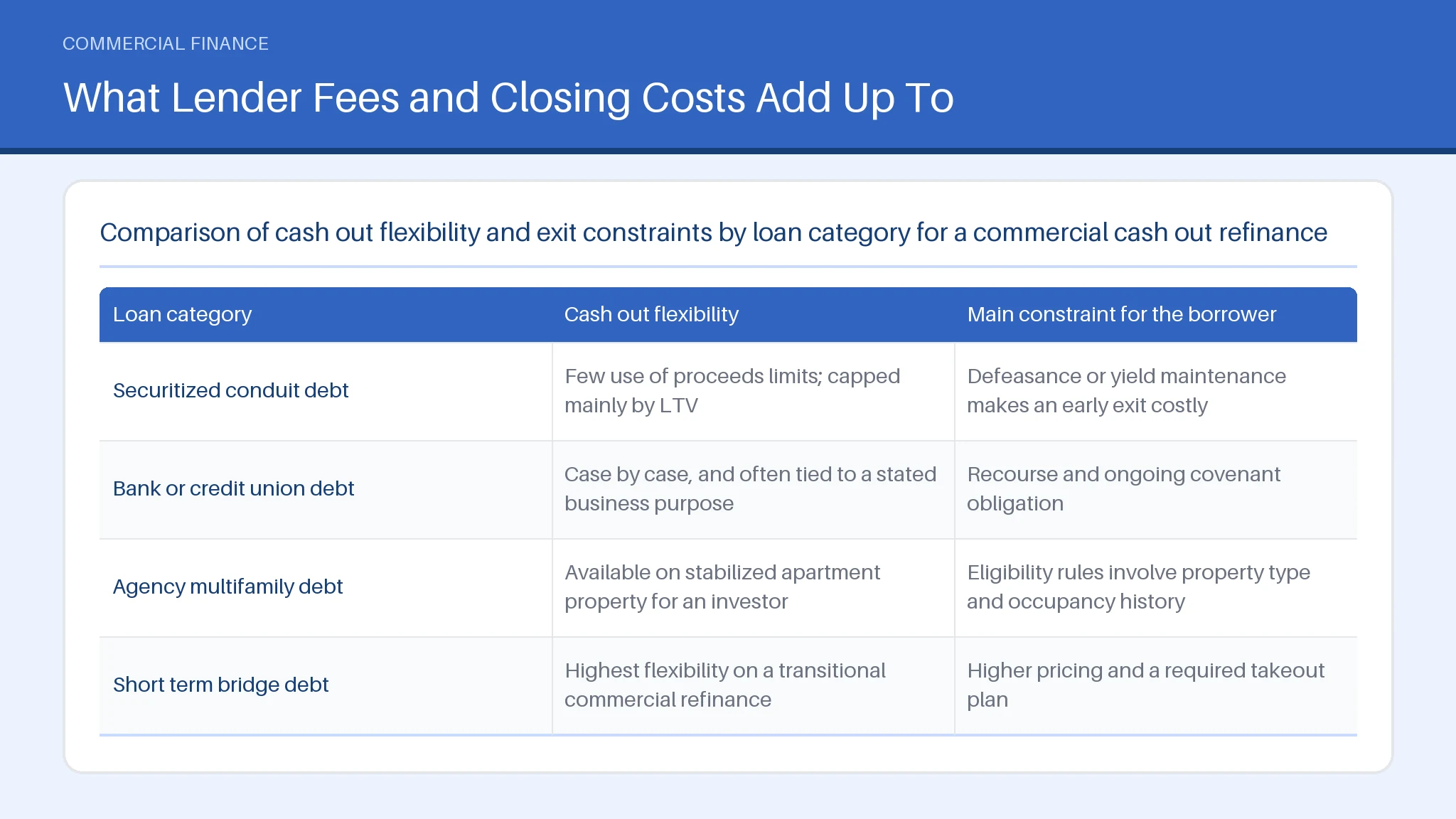
| Loan category | Cash out flexibility | Main constraint for the borrower |
|---|---|---|
| Securitized conduit debt | Few use of proceeds limits; capped mainly by LTV | Defeasance or yield maintenance makes an early exit costly |
| Bank or credit union debt | Case by case, and often tied to a stated business purpose | Recourse and ongoing covenant obligation |
| Agency multifamily debt | Available on stabilized apartment property for an investor | Eligibility rules involve property type and occupancy history |
| Short term bridge debt | Highest flexibility on a transitional commercial refinance | Higher pricing and a required takeout plan |
A cash out refinance commercial deal therefore starts with a question about the exit, not the entry.
Why Owners Tap Commercial Equity to Fund Growth
Owners pull equity out of stabilized property because trapped equity earns nothing. A building bought at 6.5 million and now appraising at 9 million holds roughly 2.5 million of new equity that produces no return until it is either sold or borrowed against. A commercial cash out refinance converts part of that paper gain into deployable capital without triggering a sale, which is the reason a cash out refinance commercial strategy often beats disposition for long hold investors.
The discipline is in the comparison. Released equity should fund something that earns more than the new blended cost of debt, whether that is a value add unit turn program, a partner buyout or reserves that let you bid without a financing contingency. Two costs get underestimated: the prepayment penalty on the debt being retired, and the tighter underwriting that a larger loan invites. Higher leverage means less cushion if occupancy dips, so run the downside case on the equity you keep, not just the equity you extract.
How a Commercial Cash Out Refinance Converts Equity Into Cash
A commercial cash out refinance works in five steps: value the property, size the new loan against that value and its income, pay off the existing debt, settle costs and escrows, then distribute the remainder to the ownership entity. Nothing is released until the title company disburses at closing.
Work a concrete example. A retail strip center appraises at 4,000,000 with net operating income of 300,000. The existing loan balance is 1,900,000. At a 70 percent LTV ceiling, the new loan sizes to 2,800,000. Coverage is checked next: if annual debt service on that amount is 205,000, coverage sits near 1.46, comfortably above a typical 1.25 floor, so the LTV test governs. Subtract the 1,900,000 payoff, roughly 70,000 in transaction costs and a 25,000 replacement reserve, and the borrower nets about 805,000.
The benefits of refinancing commercial property extend past the check. Refinancing can extend the amortization schedule, replace maturing debt before a hard deadline, remove a partner from the loan or convert floating exposure to fixed. Commercial real estate refinancing requirements are consistent across most programs: a current appraisal, trailing 12 month operating statements, a rent roll with lease abstracts, entity documents, personal financial statements for guarantors, title and survey, and often an environmental report. A requirement for a property condition report is common on older assets, and a requirement for reserves follows the same inspection. Refinancing without those items assembled simply stalls, and refinancing timelines usually run 45 to 75 days once a lender issues terms. Refinancing before a lease rolls protects the income the sizing relies on.
Loan Programs and Structures for Taking Cash Out
Program choice sets the ceiling on a commercial cash out refinance more than any negotiation does. Stabilized apartment property routes toward agency or conduit debt, owner occupied commercial buildings often route toward bank debt, and a transitional asset with lease up risk usually needs short term bridge debt first. How much cash a structure releases will depend on whether the income is already in place or still projected.
A cash out refi commercial property scenario differs from a cash out refinance construction loan situation, where the new permanent loan retires the construction facility and any surplus reflects the value created during the build; the mechanics of that original facility are covered in the guide to commercial construction loans. Investor borrowing appetite also matters to underwriting, because a lender reviewing a growing portfolio looks at aggregate exposure, not just this building. A single investor with five cross defaulted loans faces different terms than one with standalone debt.
What Lender Fees and Closing Costs Add Up To
Transaction costs on a commercial cash out refinance typically run 2 to 5 percent of the loan amount, and they come out of proceeds rather than out of pocket. The recurring line items are an origination fee, an appraisal, environmental and property condition reports, title insurance and endorsements, a survey, lender legal review, recording taxes and escrow funding. Each lender allocates these differently, which is why a cash out refi commercial property comparison should be made on net proceeds and total cost, not on the rate alone.
Two items surprise borrowers most. Lender legal fees on securitized debt are paid by the borrower regardless of whether the loan closes, and mortgage recording tax varies sharply by state and county. On a cash out refinance construction loan payoff, expect a second round of title work. Closing on a 3,000,000 loan with 4 percent in costs consumes 120,000, so a lender quoting slightly higher pricing with lower fees can leave more cash at closing. The commercial loan application guide lists what each lender will request.
Turning Released Equity Into Expansion Capital and Working Cash
Released equity funds four common uses: acquisitions, capital improvements, partner buyouts and operating reserves. A cash out refinance commercial property strategy works best when the proceeds have a defined job before the loan application is submitted, because underwriters increasingly ask the question directly and a vague answer slows the file.
Acquisition capital is the dominant use. An investor who extracts 800,000 of equity can control another 2,600,000 of property at 70 percent leverage, which is why a portfolio investor treats each stabilized mortgage as a funding source rather than a finished chapter. Capital improvements are the second use, and they compound: renovated units support higher rents, higher rents lift net operating income, and the next valuation reflects it. A borrower buying out a passive partner should price the buyout against the new debt service rather than the original basis. A hard money cash out refinance sometimes bridges a fast acquisition, though the short term pricing makes it a tool for timing, not for holding equity long term.
Securitized Loan Terms, Prepayment Rules and Cash Out Proceeds
Securitized debt trades pricing for rigidity, and the prepayment structure is where that shows up. Fixed rate conduit loans usually carry defeasance or yield maintenance rather than a declining percentage fee, which means an early payoff can cost a borrower a substantial sum when rates have fallen. Prepayment mechanics deserve a careful read before signing; the detail sits in the guide to prepayment penalty costs on commercial loans.
Proceeds are also affected by holdbacks. A servicer may escrow funds for a deferred improvement identified in the property condition report, which reduces the cash a cash out refinance commercial property deal delivers on day one. An origination fee, ongoing servicing costs and rate lock deposits all reduce net liquidity as well. Interest only periods can raise sizing under a coverage test, but they leave a larger balance at maturity. A hard money cash out refinance avoids most of this rigidity and costs more for the privilege. Match the mortgage term to your realistic hold period, because the exit terms cost more to break than they do to plan around.
Appraisal, Payoff and Net Proceeds: The Cash Out Math
Net proceeds equal the new loan amount minus the existing payoff, minus transaction costs, minus escrow funding, minus any prepayment charge. The appraisal sets the first number, and on income property the appraiser capitalizes stabilized net operating income rather than counting recent sales alone, so an expense line that looks inflated on your operating statement directly reduces value. Owners who scrub management fees, non recurring repairs and one time legal costs before ordering the report protect the sizing on a commercial refinance.
Watch the payoff statement closely. It includes accrued interest through the funding date, any penalty owed on early retirement, and unreleased escrow balances that may be returned weeks later rather than credited at settlement. A capital improvement completed but not yet reflected in rents will depend on documented leases to count. An investor modeling this math should build two cases, one at the appraised value they expect and one 8 percent lower, because a borrower who has already committed the proceeds to a purchase has no room when the mortgage sizes smaller than the investor assumed.
DSCR, LTV and Occupancy Thresholds Lenders Expect
Three tests decide loan size. Most lenders cap cash out LTV between 65 and 75 percent depending on property type, hold coverage at or above roughly 1.25 times debt service, and apply a debt yield floor near 9 to 10 percent. The binding constraint is whichever produces the smallest loan, and on low cap rate property the LTV test is often not the one that binds. The coverage calculation is explained in the guide to debt service coverage minimums and the sizing floor in the guide to debt yield.
Occupancy history matters as much as the snapshot. A lender generally wants 90 percent physical occupancy sustained for 90 days, with economic occupancy that matches after concessions. Expect an underwritten expense load based on market norms rather than your actuals if yours run low. Investors using cash flow based programs can review DSCR loan requirements, and every lender will also price a penalty structure into the term sheet alongside the LTV it offers. continue with the qualification form below.
Summary
A commercial cash out refinance releases trapped equity when value, income and occupancy support a larger loan, and the binding limit is usually coverage or debt yield rather than LTV. Price the exit terms on existing debt before modeling proceeds. CRE Loans USA is a lender matching service that connects US borrowers with independent third party finance providers who make all lending decisions; read how the matching process works or browse the commercial real estate finance guides.
Frequently asked questions
What does Dave Ramsey say about cash-out refinance?
Commentary from consumer personal finance educators generally treats cash out refinancing on a primary residence with caution, on the grounds that it converts home equity into debt against the family home. Commercial property sits in a different category, because the asset produces income and the loan is underwritten against that income. The relevant test for an investment property is whether the returns on the released capital exceed the new cost of debt, not whether debt is philosophically undesirable.
Can an LLC do a cash-out refinance?
An LLC can complete a cash out refinance, and in commercial lending a single purpose entity is the standard borrowing vehicle rather than an exception. The entity holds title and signs the note, while members typically provide guarantees, personal financial statements and liquidity verification. A lender will request the operating agreement, a certificate of good standing and resolutions authorizing the loan.
How to pull equity out of a commercial property?
Equity comes out of a commercial property through a new larger first mortgage, a supplemental loan behind existing agency debt, or junior capital such as mezzanine financing. The first mortgage route is the most common and the cheapest per dollar.
Are refinance rates going to go down in 2026?
Nobody can responsibly forecast 2026 refinance rates. Commercial pricing moves with the underlying index plus a credit spread, and both components shift with market conditions, as explained in the guide to index plus spread pricing.
What is the current interest rate for a 30-year fixed rate refinance?
Thirty year fixed rate quotes describe residential lending. Commercial loans more often carry 5, 7 or 10 year fixed terms with 25 or 30 year amortization and a balloon at maturity, priced individually by each lender.
At what point is it not worth it to refinance?
Refinancing stops making sense when the prepayment charge plus transaction costs exceed the benefit over your remaining hold period, or when a lower appraisal or weaker occupancy would shrink the loan below the current balance.
Are cash out refinances a bad idea?
Cash out refinancing becomes a poor decision when proceeds fund consumption rather than a return generating use, or when higher debt service erases the cushion that protects the property through a vacancy.
Part of Refinance Commercial Property: Cash Out, Costs, Terms