
Gas station loans are commercial facilities used to buy, build, refinance, or improve a fueling site and the convenience store attached to it. They differ from a standard commercial mortgage in one important way: the lender is not only financing a building and a parcel of land. It is financing an operating business with fuel inventory, underground storage tanks, canopy and dispenser equipment, a branded supply agreement, and an inside sales operation that often produces most of the profit. That combination changes who will lend, what documents get requested, and how long the file takes to close.
Most borrowers searching for a loan for gas station acquisitions fall into one of three groups. The first is an operator who already runs one or more stores and wants to add a site. The second is a buyer coming from another industry who sees steady cash flow and wants in. The third is an owner who holds the real estate, leases it to a dealer, and wants to refinance or pull equity out. Each profile is priced and structured differently, because the lender's security and repayment source are different in each case.
The practical problem is that fuel retail sits in an awkward spot. Conventional lenders see environmental liability and specialized equipment, so many of them pass or demand low leverage. Business lenders understand the cash flow but will not write a 25 year term on real estate. SBA-backed programs bridge that gap for owner-operators, which is why so much of the discussion around gas station loans circles back to the 7(a) program. This guide walks through the structures available, how underwriters test a fuel site, what environmental diligence actually involves, and where a deal usually slows down. If you want to see how a property-first request is packaged and introduced to lenders, the CRE loan matching process explains the sequence.
Key takeaways
- Gas station loans are usually underwritten as a business plus real estate transaction, so lenders review fuel volume, inside sales margin, and environmental condition alongside the property value.
- SBA 7(a) credit is common for owner-operators because it allows goodwill and business assets in the same facility as the real estate, which conventional mortgage lending often will not.
- Environmental review drives the timeline. A Phase I assessment, tank testing records, and compliance history can add weeks and can change loan sizing or terms.
- Lenders look at the split between fuel and in-store revenue. Convenience store margin is usually what carries debt service, not gallons alone.
- Leased sites, branded fuel supply agreements, and dealer contracts need to survive the loan term, or the lender will shorten amortization to match.
Financing Options Available to Fuel Retail Businesses
Fuel retail capital falls into four broad categories, and the right one depends on whether you occupy the site, how much of the purchase price is goodwill, and how fast you need to close. Owner-operators who will run the store themselves have the widest menu. Passive owners who lease the site to a dealer are generally limited to conventional or investment-property structures, because government-guaranteed small business programs require occupancy by the operating business.
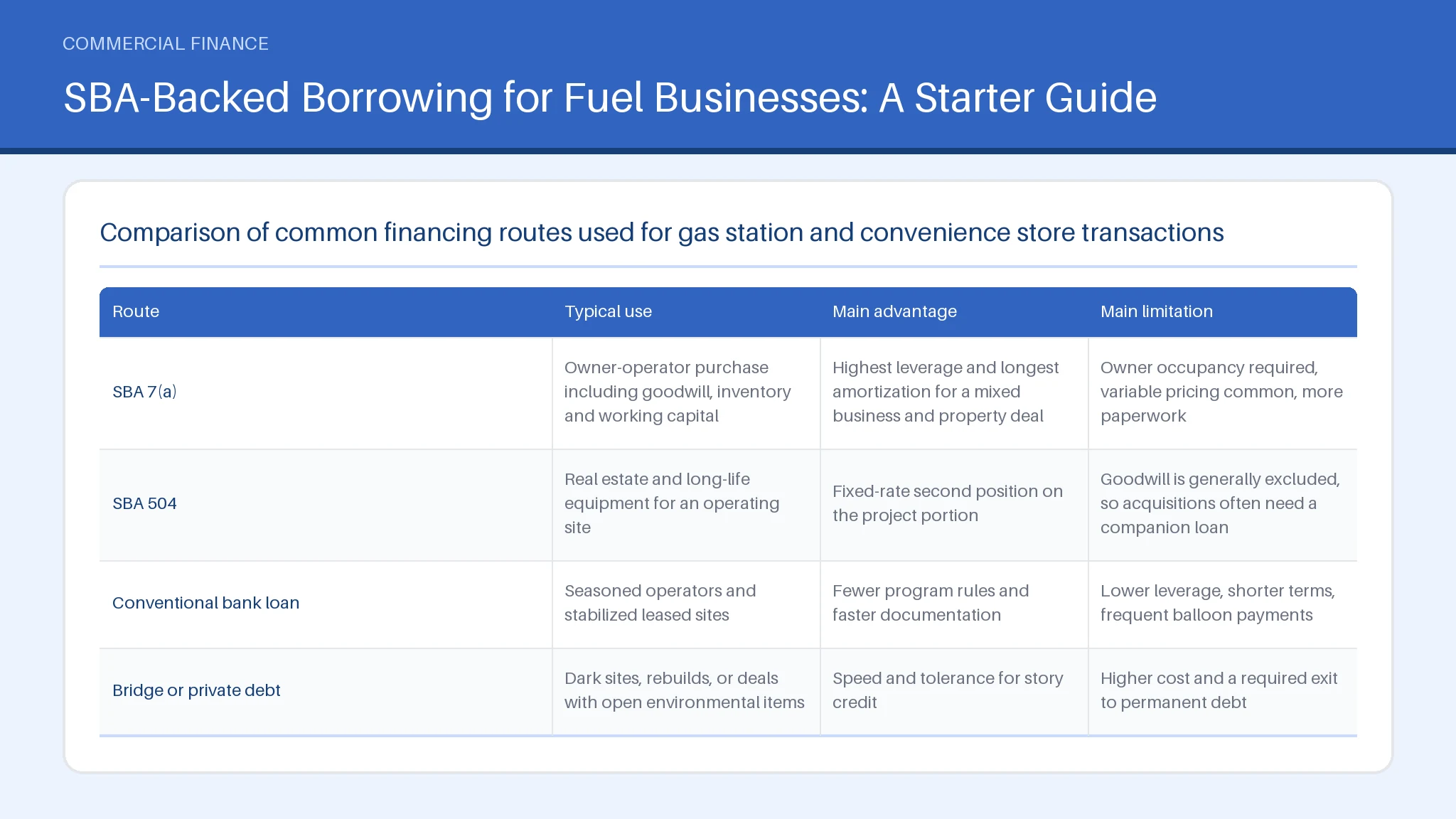
The table below compares the common routes on the factors that actually decide the outcome.
| Route | Typical use | Main advantage | Main limitation |
|---|---|---|---|
| SBA 7(a) | Owner-operator purchase including goodwill, inventory and working capital | Highest leverage and longest amortization for a mixed business and property deal | Owner occupancy required, variable pricing common, more paperwork |
| SBA 504 | Real estate and long-life equipment for an operating site | Fixed-rate second position on the project portion | Goodwill is generally excluded, so acquisitions often need a companion loan |
| Conventional bank loan | Seasoned operators and stabilized leased sites | Fewer program rules and faster documentation | Lower leverage, shorter terms, frequent balloon payments |
| Bridge or private debt | Dark sites, rebuilds, or deals with open environmental items | Speed and tolerance for story credit | Higher cost and a required exit to permanent debt |
Equipment finance sits alongside all four and is often used separately for dispensers, point of sale systems, car wash tunnels, or canopy replacement. Operators pairing fuel with a wash bay frequently look at car wash financing and equipment options as a second facility rather than folding everything into one note.
How to Begin a Gas Station Loan Application
A fuel site request starts with three documents, and assembling them before any lender conversation saves weeks. Lenders want three years of business tax returns and profit and loss statements for the subject store, a fuel volume report separating gallons from inside sales, and a purchase agreement or current debt schedule. Without the gallon and inside-margin split, an underwriter cannot size the loan, because the two revenue streams carry very different margins.
Proceeds from gas station loans typically cover the real estate and improvements, the fuel and merchandise inventory on hand, dispensers, tanks, canopy and point of sale equipment, business goodwill in an acquisition, franchise or branding fees, tank upgrades or replacement, closing costs, and a working capital reserve for the first few months of operation. Tank remediation work and fines for prior violations are usually excluded, and most lenders will not fund the seller's outstanding environmental obligations.
Expect the lender to order a Phase I environmental site assessment, an appraisal that values the real estate, equipment, and business separately, and in many cases tank tightness and soil testing. Line up your environmental compliance file early: tank registration, cathodic protection records, release detection logs, and any state trust fund eligibility letters. The document sequence mirrors what a general commercial loan application requires, with the environmental package added on top.
Why the SBA 7(a) Program Fits Fuel Retailers
The 7(a) program fits fuel retail because it finances the whole business in one note. A typical station purchase is part dirt, part building, part equipment, and part goodwill, and conventional real estate lenders usually refuse to advance against the intangible portion. A 7(a) facility can include real estate, equipment, inventory, goodwill, and working capital together, amortized over a single long term when real estate is the majority of the use of proceeds.
The trade-offs are real. Pricing is often variable and tied to a published base rate, so debt service moves when rates move. The guarantee requires full personal guarantees from owners of 20 percent or more, and life insurance is commonly conditioned on key-person risk. Occupancy rules mean a passive landlord cannot use the program.
Gas station loans written under 7(a) also face program-level environmental rules. Fueling sites sit in a higher-risk category, so the lender must follow a prescribed environmental investigation sequence before closing. That is a feature rather than a nuisance, because it protects the borrower from inheriting a contaminated parcel. Borrowers weighing program choice should read the comparison of SBA 504 and 7(a) structures before committing.
Financing the Purchase of an Operating Fuel Station
Buying a running station is priced off trailing cash flow, not off potential. Underwriters build a pro forma from the seller's reported gallons, inside sales, and margin, then haircut it where the records are weak. Cash-heavy stores with no point of sale detail get the deepest discount, because an underwriter cannot verify merchandise revenue it cannot trace. Sellers who run clean books and keep fuel supplier statements almost always support a larger loan on the same site.
Three deal factors move terms more than anything else. The first is the branded fuel supply agreement: if it expires or transfers on sale, loan sizing may change. The second is whether the real estate is owned or ground leased, since a leased site caps amortization at the remaining lease term including firm options. The third is equipment age, because tanks and dispensers near the end of useful life create a capital call the lender will want reserved for.
Gas station loans for acquisitions also hinge on seller cooperation during diligence. Access for soil borings, release detection records, and a tank tightness test are routine requests. Build the timeline into the purchase contract, and use a structured due diligence checklist so nothing surfaces late.
SBA-Backed Borrowing for Fuel Businesses: A Starter Guide
A government-guaranteed loan is still a bank loan. The lender makes the credit decision, sets the rate within program limits, and closes the file; the guarantee simply reduces the lender's loss exposure if the loan defaults, which is what makes longer terms and higher leverage possible on a specialized asset.
To qualify, the operating business must meet SBA size standards, be for-profit, operate in the United States, and show that the owners have invested reasonable equity. Underwriters test repayment ability using historical cash flow with adjustments, not projections alone, and they expect management experience in fuel retail or a credible plan to hire it. Prior-year losses, recent tax liens, or unresolved environmental violations will usually stop a file regardless of collateral value.
Equity injection for a change-of-ownership deal is a common surprise. A portion of the purchase price must come from the buyer, and seller financing only counts toward it when the seller note is fully subordinated and on standby for a set period. Gas station loans structured this way often pair a standby seller note with the buyer's cash. The mechanics closely track the broader SBA 504 requirements and application steps, with the key difference being the treatment of goodwill.
How SBA-Guaranteed Lending Works for Fuel Retail Operations
Guaranteed lending for fuel retail runs on a collateral-plus-cash-flow test. The lender first sizes the loan against documented earnings, then checks whether the real estate, equipment, and business assets support the balance. When appraised value falls short, the lender does not necessarily decline; program rules allow it to take available collateral, including liens on other business assets or personal real estate owned by the guarantors, and proceed.
Debt service coverage is the gate. Most underwriters want adjusted cash flow comfortably above the annual payment, with a cushion for fuel margin volatility, since a few cents per gallon swing can move annual profit materially on a high-volume site. Reported earnings are reconstructed by adding back owner compensation above market, depreciation, and one-time items, then subtracting a realistic manager salary if the buyer will not work the store full time.
Environmental findings drive the rest. A clean Phase I usually clears the file; a recognized environmental condition triggers further investigation and may require an indemnity, escrow, or state trust fund confirmation. A loan for gas station purchases rarely closes faster than 45 to 75 days for this reason, so build that into contract deadlines. Coverage math is explained further in the guide to how coverage-based approval works.
Gas Station Loans: Frequently Asked Questions
Borrowers ask the same handful of questions once they get past structure, and the answers are mostly about documentation rather than credit scores. The most frequent is whether limited operating history kills a deal. It does not automatically, but a first-time operator buying a store with weak records will see lower leverage, a larger equity requirement, or a demand for an experienced manager on payroll.
The second recurring question is about fuel brand obligations. A branded agreement typically carries image requirements and minimum volume commitments, and breaking it early can trigger repayment of imaging allowances. Underwriters read that contract because the liability travels with the business.
Third is cost beyond the interest rate. Guarantee fees, appraisal of three asset classes, the environmental report series, title work, and legal review all land on the borrower. Budget for diligence spend that is nonrefundable if the deal dies.
Finally, borrowers ask whether a loan for gas station refinancing can pull cash out for a second location. It often can when equity and coverage support it, following the same logic as a commercial cash out refinance. continue with the qualification form below before committing to a purchase timeline.
Where to Find Guidance on Fuel Station Financing Questions
Gas station financing is commercial debt arranged for the purchase, construction, refinancing, or improvement of a fueling site and the convenience store operating on it. It covers both halves of the asset: the land, building, canopy, tanks, and dispensers on the real estate side, and the merchandise inventory, goodwill, franchise rights, and working capital on the business side. Because the two halves secure repayment together, the loan documents, the appraisal, and the environmental review are all broader than they would be for a plain commercial building.
Gas station and c-store financing works the same way in practice, with the convenience store treated as the primary profit engine. Fuel moves traffic at thin margins; packaged beverages, tobacco, food service, and lottery produce the gross profit that services debt. Underwriters therefore separate the two revenue lines, apply different margin assumptions to each, and test whether the inside business alone could carry a meaningful share of the payment if fuel margin compressed.
The process runs in a set order. A lender reviews historical financials and fuel volume, orders an appraisal that allocates value between real estate, equipment, and intangibles, commissions a Phase I environmental site assessment and often tank testing, verifies the fuel supply agreement and any ground lease, sizes the loan to the lower of appraised support or cash flow capacity, and then issues conditions. Equity injection, personal guarantees, and insurance requirements are set at that stage. An SBA loan for gas station purchases adds program eligibility checks and a prescribed environmental protocol on top of the lender's own credit policy.
Reliable guidance comes from a short list of sources: the Small Business Administration's published program rules, your state's underground storage tank regulator and trust fund administrator, the Environmental Protection Agency's tank compliance material, and your own accountant reading the store's books. Independent third-party finance providers make all lending and pricing decisions, so written term sheets from them are the only pricing that means anything. For structural background, the explanation of index plus spread pricing and the commercial financing FAQ are useful starting points, and the CRE financing guide library covers adjacent asset classes.
Ways a Fuel Retail Business Can Be Funded
Funding a fuel retail business usually means stacking two or three sources rather than finding one perfect loan. The most common stack is a first mortgage or guaranteed term loan covering real estate, equipment, and goodwill, the buyer's cash equity, and a subordinated seller note on standby. Working capital for the first fuel drops and merchandise reset often comes from the same facility or a small separate line.
Alternative paths exist for deals that will not fit standard credit boxes. Bridge debt funds dark sites, rebuilds, and properties with open environmental items, then refinances out once the store stabilizes and the tanks pass testing. Equipment-specific finance covers dispenser and point of sale upgrades without touching the mortgage. Ground lease structures let an operator control a corner without buying the dirt, though they shorten the amortization any lender will offer.
An SBA loan for gas station acquisitions remains the default for owner-operators because it is the only widely available product that funds goodwill over a long term. Passive owners holding leased fuel sites generally pursue conventional or investment-property debt instead, and often compare notes with operators financing other single-tenant retail, including triple net lease investments.
Summary
Gas station loans succeed or fail on three things: verifiable inside-store margin, a clean or clearly managed environmental file, and a fuel supply or lease agreement that outlives the loan term. Owner-operators usually land on a government-guaranteed structure because it funds goodwill and equipment alongside the real estate. Passive owners of leased sites take conventional debt at lower leverage. Either way, the documentation load is heavier than a standard commercial mortgage, and diligence timelines of 45 to 75 days are normal. CRE Loans USA is a lender-matching service, not a lender, and independent third-party finance providers make every lending and pricing decision. Gathering fuel volume reports, store financials, and tank compliance records first is the step that moves a request forward. Learn more about the service.
Frequently asked questions
Is it hard to get a loan to buy a gas station?
Getting a loan to buy a gas station is harder than financing a plain commercial building, but it is routine for lenders who work in the sector. The difficulty comes from environmental liability attached to underground storage tanks, the share of purchase price that is goodwill rather than bricks, and the need to verify cash-heavy inside sales. Buyers with fuel retail experience, documented store financials, a clean Phase I report, and meaningful cash equity clear underwriting regularly. First-time buyers purchasing a store with incomplete books face the most friction, and that is usually solved with a larger down payment, an experienced manager, or a standby seller note rather than a different lender.
How to borrow money for gas instantly?
Borrowing money for fuel instantly is a consumer question rather than a commercial one, and the honest answer is that commercial station financing does not work on that timeline. Business credit cards, an existing business line of credit, or a fuel supplier's credit account are the tools operators use to cover an immediate fuel drop. Real estate and acquisition debt takes weeks because appraisal and environmental review cannot be compressed.
How to pay for gas when you're broke?
Paying for fuel when cash is short is a budgeting problem, not a financing product. Operators facing a cash crunch on inventory should look at a working capital line arranged in advance, supplier credit terms, or improving the inside sales mix, since store margin is what funds operations. Running a station without a committed working capital cushion is one of the most common causes of early distress after an acquisition.
Can I get gas and pay later?
Buying fuel and paying later is possible at the business level through supplier credit terms and jobber accounts, which is how most stations actually fund inventory. These accounts are extended by the fuel supplier based on your trading history and are separate from any mortgage or term debt on the property. Underwriters review those terms because a tight supplier arrangement affects monthly cash flow.
How can I get gas if I don't have money?
Obtaining fuel without funds available is not something a commercial lender solves. What a lender can do is finance the business so that inventory purchases are planned rather than improvised. That is why working capital is included as an allowable use of proceeds in most acquisition structures, and why underwriters reserve a few months of operating cash at closing.
Can I do afterpay for gas?
Installment arrangements for fuel exist on the consumer side through card products, but on the operating side the equivalent is supplier credit or a revolving business line. Neither is part of a real estate loan. Keep them distinct in your planning, because mixing short-term inventory borrowing with long-term property debt distorts coverage calculations that lenders rely on.
Can I get gas with no money on my debit card?
Buying fuel with no funds on a debit card is outside the scope of commercial property finance. For business owners, the practical equivalents are a commercial fuel card, a supplier account, or a working capital facility. If the underlying issue is that the store is not generating enough gross profit to fund inventory, the fix is operational and financial restructuring, and refinancing options such as refinancing commercial property may be worth reviewing with your accountant.