
Car wash financing is the set of debt structures used to buy, build, refinance, or re-equip a car wash, and it almost always combines two different collateral conversations in one deal. There is the dirt and the building, which behave like commercial real estate, and there is the equipment package inside the tunnel, which behaves like depreciating machinery with its own useful life. Borrowers who treat those as one undifferentiated request tend to get slower answers and weaker terms than borrowers who separate them from the start.
The complication is that car washes sit in an awkward underwriting category. A tunnel wash is a single-purpose property. If the business fails, a lender cannot easily lease the shell to a dentist or a logistics tenant, so recovery depends on selling to another operator in the same niche. That is why credit committees ask questions that feel personal: how many washes have you run, who manages the site, what are the traffic counts at the curb, and how many members are on recurring billing. Those answers frequently matter more than the appraisal.
The market context also matters. Express exterior formats with monthly unlimited plans changed the revenue profile of the sector, converting one-time transactions into subscription income. Lenders noticed. A site with several thousand active members carries a very different risk profile from a site relying on walk-up volume, even when both report similar annual revenue.
This guide explains how car wash financing actually gets underwritten in the United States: what secures the loan, which structures fit which buyer, how the process moves from term sheet to closing, what low-down-payment paths genuinely exist, and where operators most often lose leverage. It is written for owner-operators, convenience store groups adding a wash, and investors buying an existing site. For broader context on how commercial credit decisions are framed, the commercial property finance guides cover the underlying metrics in more depth.
Key takeaways
- Car wash financing usually blends real estate debt with equipment debt, because the tunnel, conveyor, and reclaim systems often account for a large share of total project cost.
- Lenders treat car washes as single-purpose properties, so underwriting leans harder on borrower experience, site traffic counts, and membership revenue than on generic square-foot comparables.
- SBA 7(a) and SBA 504 structures are the most common route for owner-operators, with longer amortizations and lower equity than most conventional commercial terms.
- Equipment-only financing can preserve working capital for a convenience store or fuel site adding a wash bay without touching the real estate loan.
- Recurring monthly membership revenue has become the single strongest cash flow signal in modern car wash underwriting.
What Collateral Secures a Car Wash Loan?
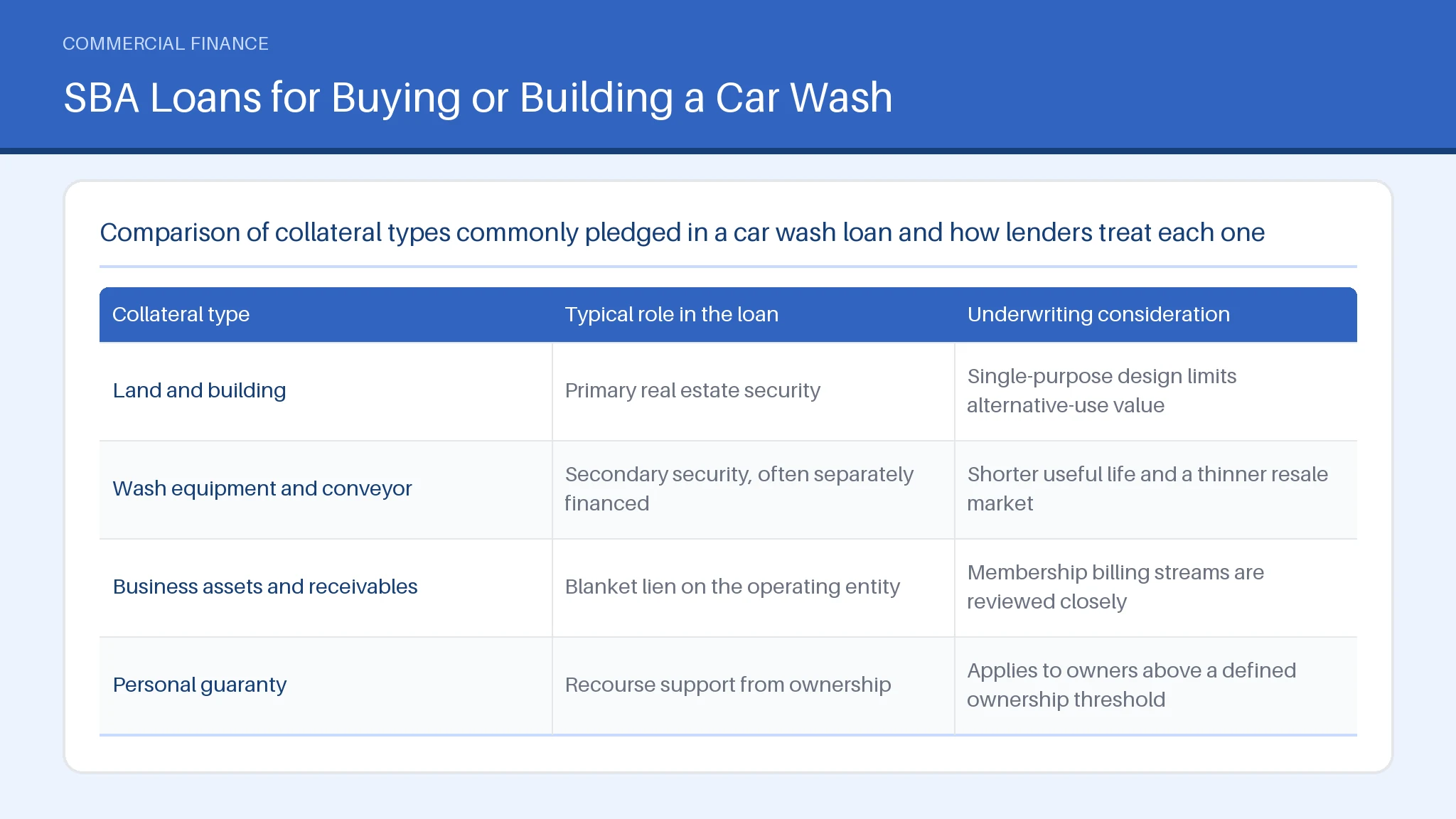
Collateral on a car wash loan is layered rather than singular. Most lenders take a first lien on the land and building, a security interest in the wash equipment and point-of-sale systems, an assignment of the business entity's assets, and a personal guaranty from any owner holding a meaningful stake. The reason for the stack is simple: no single piece of collateral recovers the full loan balance if the operation closes, so the lender assembles coverage from several sources.
Equipment is the most misunderstood layer. Tunnel conveyors, dryers, water reclaim systems, and payment terminals depreciate on a faster schedule than the structure, and their resale market is thinner than a lender would like. Real estate typically carries the longest amortization in a car wash financing package, while equipment is matched to shorter terms that reflect its working life.
| Collateral type | Typical role in the loan | Underwriting consideration |
|---|---|---|
| Land and building | Primary real estate security | Single-purpose design limits alternative-use value |
| Wash equipment and conveyor | Secondary security, often separately financed | Shorter useful life and a thinner resale market |
| Business assets and receivables | Blanket lien on the operating entity | Membership billing streams are reviewed closely |
| Personal guaranty | Recourse support from ownership | Applies to owners above a defined ownership threshold |
Car Wash Financing Options for Owners and Operators
Owners generally choose among five routes, and the right one depends on whether the wash already produces cash flow. Government-guaranteed small business loans dominate acquisitions and ground-up builds by owner-operators. Conventional bank loans appear when the borrower has strong liquidity and a track record across several sites. Equipment finance agreements and leases handle retrofits and tunnel upgrades without disturbing the mortgage. Sale-leaseback transactions release equity from the real estate for operators who would rather deploy capital into new locations than hold property. Short-term bridge debt covers timing gaps, such as buying a distressed site that needs stabilization before permanent debt is available.
The trade-off runs along a predictable line. Cheaper, longer money demands more documentation, more equity, and more proof of operating history. Faster money costs more and usually carries shorter terms. Car wash financing decisions get easier once you know which side of that line the deal sits on. Investors weighing whether to hold the property or recycle capital often benchmark the exit using the same logic covered in cap rate and NOI analysis.
How the Car Wash Loan Process Works Step by Step
The process moves through six recognizable stages. First comes deal framing, where the borrower defines purchase price or build budget, equity available, and whether equipment is included. Second is preliminary review, in which a lender looks at credit, liquidity, industry experience, and the site's trade area. Third is the term sheet, which sets the proposed amount, amortization, rate structure, and conditions.
Fourth is third-party diligence. Expect an appraisal that values the property as a going concern rather than bare land, an environmental site assessment because washes handle chemicals and wastewater, and an equipment condition review on an existing tunnel. Fifth is credit approval, where the file is tested against coverage and leverage standards. Sixth is closing, including lien filings on equipment and confirmation of insurance.
Timelines depend most on the environmental report and the appraisal, not on the borrower's paperwork. Gathering three years of tax returns, a membership report, and a current equipment list before the lender asks will compress the middle of the schedule. Car wash financing files that stall almost always stall on missing operating detail. The lender matching process follows a similar sequence of information gathering before any introduction is made.
Buying a Car Wash With Little Money Down
Low-equity acquisitions are possible but rarely mean zero cash. Government-guaranteed programs allow relatively modest borrower injections compared with conventional commercial debt, and part of that injection can sometimes come from a seller note placed on full standby, meaning the seller receives no payments until the senior loan is satisfied. That structure is the most common way buyers reduce cash at closing without misrepresenting their equity position.
Other levers exist. Sellers occasionally retain a minority interest and stay on during transition, which reduces the purchase price financed and reassures the lender about continuity. Equipment can be financed separately from the real estate, so the buyer is not asked to inject equity against depreciating assets at the same ratio. Some buyers bring in a partner with direct operating experience, which improves both the equity picture and the management story.
The limitation worth stating plainly: lenders will still want post-closing liquidity. A buyer who empties every account to reach the down payment is a weaker credit than one who contributes less but retains reserves for the first slow winter. Car wash financing approvals hinge on the cushion as much as the contribution. continue with the qualification form below.
SBA Loans for Buying or Building a Car Wash
SBA requirements for car wash loans center on eligibility, owner involvement, and repayment capacity rather than on the property type itself. The business must operate for profit, meet the applicable size standard for its industry, be based in the United States, and be owned by someone of good character with no disqualifying criminal or federal debt history. Passive investment is not eligible, so the borrower must operate the wash rather than lease it to a third party and collect rent. Owners holding twenty percent or more are generally required to provide a personal guaranty, and the agency expects the borrower to have tried and been unable to obtain credit on reasonable terms elsewhere.
Two programs dominate. The 7(a) program is flexible enough to cover real estate, equipment, working capital, and business acquisition in a single loan, which suits buyers purchasing an operating wash with its equipment intact. The 504 program pairs a bank loan with a certified development company debenture and is aimed at long-lived fixed assets such as land, buildings, and heavy equipment, often with a lower borrower injection and a long fixed-rate second position. The comparison of SBA 504 and 7(a) structures explains the trade-offs in more detail, and the SBA 504 requirements guide walks through documentation. For ground-up projects, expect construction draws, a fixed-price contract, and interim interest carried in the budget. SBA routes remain the backbone of car wash financing for first-time owner-operators.
Using a Startup Loan to Open a New Car Wash
Startup washes face a harder credit test because there is no operating history to underwrite. Lenders substitute projections, and projections only carry weight when they are tied to verifiable inputs: average daily traffic counts from a state or county transportation source, population and household income within a defined radius, the number of competing tunnels within a few miles, and realistic ramp assumptions for membership sign-ups over the first eighteen to twenty-four months.
Budgeting discipline matters more at this stage than at any other. A startup budget should include site work, utility connections, wastewater and reclaim compliance, signage, the full equipment package, initial chemical and supply inventory, marketing during the ramp period, and several months of operating reserve. Underfunded openings are a leading cause of early distress, because a new wash typically does not reach stabilized volume in its first season.
Borrowers should also expect interest-only periods during construction and a conversion to amortizing payments at completion. Car wash loans financing a new build are sized against stabilized projections but tested against the slower early months, so the reserve line in the budget is doing real underwriting work, not just filling space on a spreadsheet.
Comparing Loan Structures Available to Car Wash Businesses
Structure choice changes the monthly payment, the flexibility, and the exit cost far more than a small difference in rate does. A twenty-five-year amortization on real estate produces a materially lower payment than a ten-year equipment term on the same dollar amount, which is why blended packages are common. A car wash business that finances the tunnel package over the same long horizon as the building will still be paying for equipment that has already been replaced.
Prepayment terms deserve equal attention. Some structures carry declining prepayment fees, others use step-downs tied to the fixed-rate period, and a few impose defeasance that makes an early sale expensive. An operator planning to sell or refinance within five years should price that exit before signing. Rate mechanics matter too, and the difference between a fixed coupon and an index-plus-spread structure is set out in the guide to index plus spread pricing.
Coverage requirements are the third variable. Most lenders size car wash financing packages so that net operating income covers debt service with a cushion, and a single-purpose asset usually draws a higher required cushion than a stabilized apartment property. A wash business with lumpy seasonal revenue should model coverage month by month rather than annually, because a strong summer can hide a January shortfall. Operators running more than one site should also check whether the lender underwrites each car wash business separately or cross-collateralizes the portfolio, since that decision affects future borrowing capacity at every location.
Financing Car Wash Equipment to Protect Working Capital
Car wash financing is funding used to acquire, construct, refinance, or re-equip a wash facility, and the equipment portion is the piece that most directly protects day-to-day cash. Paying cash for a conveyor, arches, dryers, reclaim system, and payment kiosks can consume a full year of operating reserve in a single week. Financing that same package converts one large outflow into scheduled payments matched against the revenue the equipment produces.
The proceeds can cover a wide range of uses. Borrowers apply car wash financing toward buying an existing site, acquiring land and building a new tunnel, replacing aging tunnel components, adding vacuum stations or pay stations, installing water reclaim to cut utility costs, refinancing higher-cost debt, funding franchise fees, and holding working capital through a ramp period. Some structures allow several of those purposes inside one facility, while others restrict proceeds to fixed assets only.
Qualifying for car wash equipment financing rests on a short list of factors. Lenders review personal and business credit, time in business, available liquidity after closing, the revenue and coverage the site produces or is projected to produce, the age and condition of existing equipment, and whether the applicant has run a wash before. A vendor quote, an equipment schedule with serial numbers, and recent financial statements are the standard document set. Because the equipment itself secures the transaction, approval can be quicker and less property-dependent than a mortgage request.
Convenience stores and fuel sites benefit from this structure in a specific way. A c-store adding an in-bay automatic already owns the real estate and already draws traffic, so the incremental capital need is the machine, not the dirt. Car wash equipment financing lets that operator add a high-margin revenue line without refinancing the underlying property, without disturbing existing fuel supply arrangements, and without draining the inventory and payroll cash that a retail operation needs weekly. The wash also lifts fuel and in-store sales, which means the equipment payment is often measured against combined site revenue rather than wash revenue alone. Operators who want the underlying coverage math should review the debt service coverage ratio formula before committing to a payment schedule, and car wash business financing decisions get sharper once that number is modeled honestly.
Why Car Wash Industry Experience Matters in Underwriting
Operating experience functions as a credit enhancement in this sector. A single-purpose asset recovers value only if it keeps running, so a lender is effectively underwriting the operator's ability to keep a tunnel open, staffed, and full. Someone who has managed chemical titration, conveyor maintenance schedules, labor coverage across weekend peaks, and membership churn presents a lower probability of early distress than a first-time buyer with the same balance sheet.
Inexperienced buyers are not shut out, but they are asked to compensate. Common mitigants include retaining the seller's site manager, signing a franchise agreement that supplies training and operating systems, bringing in an equity partner with tunnel experience, contributing additional equity, or agreeing to larger reserves held at closing. Documenting a transition plan in writing addresses the concern directly rather than leaving the credit committee to assume the worst.
Car wash business financing outcomes also improve when the borrower can speak fluently about unit economics: cars per hour at peak, labor as a percentage of revenue, chemical cost per car, and member retention rate. Those figures signal operator competence more convincingly than a polished summary page. Background on how introductions are prepared is covered on the about page.
Summary
Car washes are financed as two assets at once, a single-purpose property and a depreciating equipment package, and the strongest borrowers structure each on a term that matches its life. SBA programs carry most owner-operator acquisitions and builds, equipment agreements protect working capital for C-stores and retrofits, and seller notes on standby remain the practical route to a smaller cash injection. Experience, post-closing liquidity, and recurring membership revenue drive credit decisions more than the appraisal does. A useful next step is assembling three years of financials, a current equipment schedule, and a membership report, then reviewing the frequently asked questions about how CRE Loans USA introduces borrowers to independent lenders.
You may also find these related guides helpful: Commercial Construction Loans: How They Work and Qualify and Commercial Property Insurance: What It Covers and Costs.
Frequently asked questions
How much money do you need to invest in a car wash?
Cash requirements vary widely by format. An in-bay automatic added to an existing convenience store site is the lightest entry, because the land and traffic already exist and the spend is concentrated in the machine and bay work. A self-serve bay facility sits in the middle. A full express tunnel with vacuum stations, water reclaim, and site work is the heaviest, since land acquisition, sitework, utilities, and the equipment package all land in the same budget. Financing changes the question from total project cost to required equity plus post-closing reserves, and lenders want to see both. Building a line-item budget with a contingency of roughly ten percent is the honest way to answer this for a specific site rather than relying on a generic figure.
What is the payment on a $1,000,000 business loan?
Payment on a million-dollar business loan depends on three variables: the interest rate, the amortization period, and whether there is an interest-only period. The mechanics are straightforward. Longer amortization lowers the monthly payment but increases total interest paid, while a shorter equipment-style term raises the payment and reduces total interest. A twenty-five-year schedule and a ten-year schedule on the same balance and rate produce dramatically different monthly obligations. Rather than quoting a number, run the amortization on the actual terms offered, then test the result against projected net operating income using the coverage math in the debt yield and loan sizing guide.
How profitable is owning a car wash?
Profitability at a car wash comes from volume, throughput, and membership penetration rather than from price per wash. Express tunnels with strong subscription enrollment convert a variable transaction business into recurring monthly revenue, which stabilizes cash flow and improves margins because incremental washes carry low marginal cost. The main drags on profit are labor during peak hours, chemical and water costs, utility load, and equipment maintenance. Sites on high-traffic corridors with good ingress and egress consistently outperform hidden locations with similar equipment.
Are car washes still a good investment?
Car washes remain a viable investment when the site fundamentals are sound, though the easy-entry window has narrowed in saturated metros. The attraction is durable: recurring membership income, cash-based simplicity, low tenant risk because the owner operates the asset, and equipment-driven scalability. The risks are equally real, including single-purpose property resale limits, local competition arriving within the same trade area, and weather sensitivity. The investment case now rests on site selection and operating discipline rather than on the sector being new.
What are the weaknesses of a car wash business?
Weaknesses of the model start with the building itself. A wash is a single-purpose structure, so alternative-use value is limited and resale usually depends on finding another operator. Revenue is weather-sensitive and seasonal in northern markets. Equipment is capital intensive and requires ongoing replacement. Labor turnover is high at entry-level positions. Local competition can appear quickly because a new tunnel takes months rather than years to build. Water and wastewater regulations add compliance cost and can restrict where a site may be developed.
What's the best car wash franchise to buy?
Franchise selection should be judged on operating systems rather than brand recognition. The factors that matter are training depth, site selection support, equipment specification and supply relationships, membership platform technology, marketing support during the ramp period, total initial fee and royalty load, and territory protection. Lenders often view a franchise agreement favorably for a first-time operator because it substitutes documented systems for personal experience. Reviewing the franchise disclosure document with an attorney and speaking with existing franchisees about actual unit economics is more informative than any ranking.
Is car washing a good side hustle?
Car washing works as a side hustle at the mobile or detailing end of the spectrum, where startup cost is low and scheduling is flexible. A fixed-site tunnel is not a side hustle. It requires daily oversight, staffing, maintenance response, and active membership management, and lenders underwrite it as an owner-operated business precisely because absentee management correlates with poor performance. Investors who want passive exposure to real estate typically look at leased commercial assets instead, a topic covered across the commercial real estate lending overview.