
Fix and Flip Loans New York describes short term, renovation-focused real estate debt used by investors who buy a distressed property, improve it and sell it within roughly six to eighteen months. These loans are underwritten mainly on the property: the purchase price, the renovation scope, and the value the finished house should support once the work is signed off. Income documentation still matters, but it rarely drives the decision the way it does on a conventional mortgage.
That difference exists because the deal itself is temporary. A thirty year mortgage assumes a borrower lives in the home and repays slowly. A flip assumes the opposite: the debt is designed to be retired quickly from a sale or from a refinance into longer term rental financing. Lenders price that short horizon with points at closing, interest-only payments during the hold, and a balloon at maturity. For a full grounding in the structure, read Fix and Flip Loans: How They Work and How to Qualify, which covers the product category in detail across every state.
New York adds its own friction. Housing stock in Westchester County and across the Hudson Valley is old, which means lead paint, knob and tube wiring, failing oil tanks and asbestos tile show up in scopes far more often than they do in newer Sun Belt markets. Municipal permitting runs through dozens of separate village, town and city building departments, each with its own queue. Transfer taxes and mansion tax thresholds take a bite out of resale proceeds. Those factors do not make a fix and flip loan New York investors use unworkable, but they do change the math on timeline and contingency.
This guide walks through how flips actually run in Westchester County, which loan structures flippers use, how draw schedules and payoff work, where short term renovation debt hurts borrowers, and how hard money and private money differ in practice. The goal is a clear view of the trade-offs before a deal is under contract rather than after.
Key takeaways
- Fix and Flip Loans New York are short term, asset-focused loans sized against purchase price and renovation budget, not against a borrower's salary.
- Rehab money is almost always released in draws after inspection, so a flipper needs working capital to pay trades before each reimbursement arrives.
- New York carrying costs are unusually heavy: property taxes in Westchester County, transfer taxes on resale, permit timelines and winter weather all stretch the hold period.
- Hard money and private money overlap but differ in process, documentation and flexibility, and that difference shows up in points, term length and extension terms.
- Lender fit depends on exit credibility: a documented scope, a defensible resale value and a realistic timeline matter more than a perfect credit file.
How House Flipping Works in Westchester County, New York
House flipping in Westchester County follows a predictable sequence: acquire a dated or distressed property below market, complete a defined renovation scope, and resell into a market where buyer demand for move-in-ready inventory is strong. What varies between deals is how long each stage takes and how much capital sits idle while permits clear. Investors evaluating Fix and Flip Loans New York should model the full cycle, not just construction weeks.
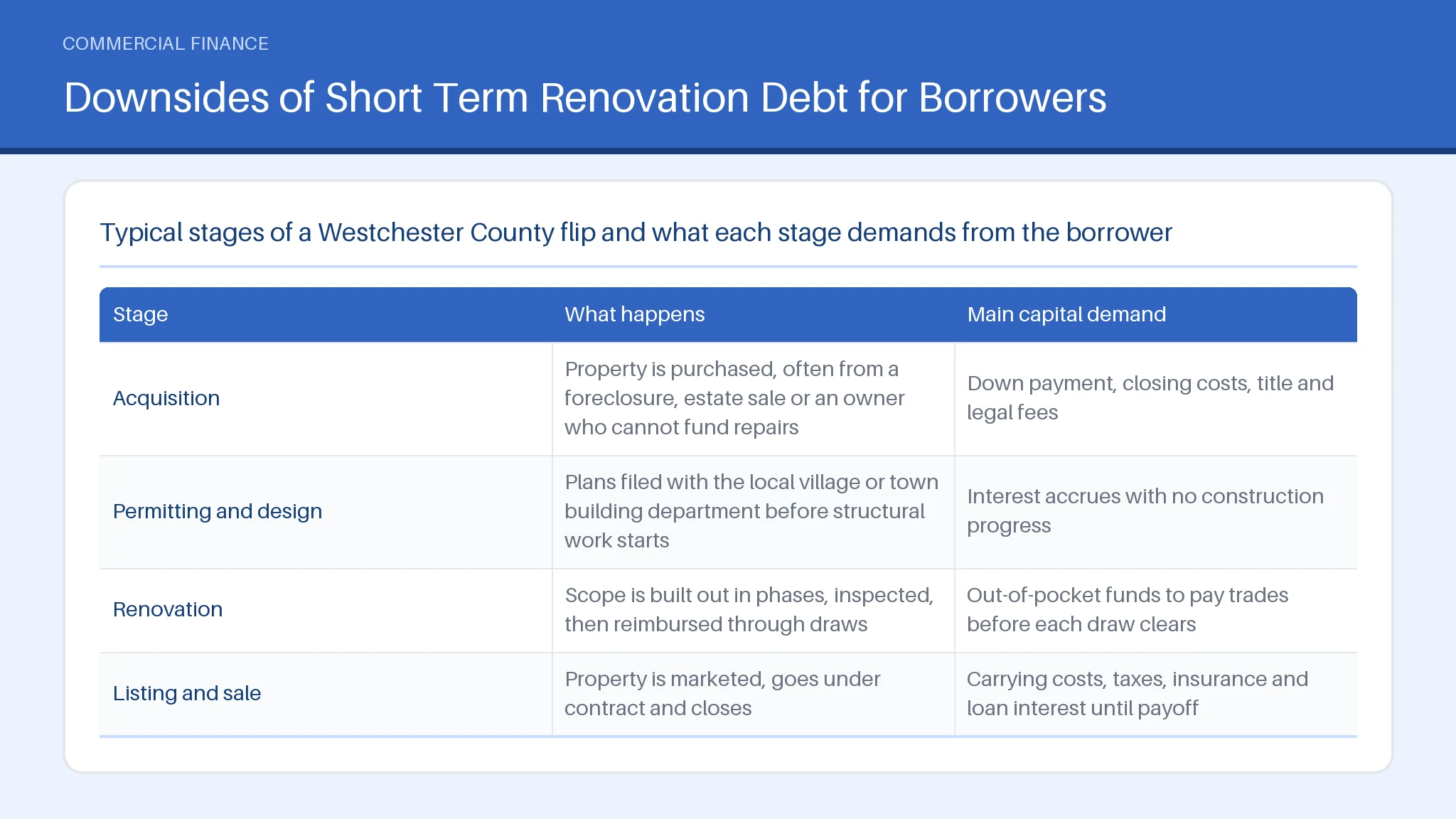
| Stage | What happens | Main capital demand |
|---|---|---|
| Acquisition | Property is purchased, often from a foreclosure, estate sale or an owner who cannot fund repairs | Down payment, closing costs, title and legal fees |
| Permitting and design | Plans filed with the local village or town building department before structural work starts | Interest accrues with no construction progress |
| Renovation | Scope is built out in phases, inspected, then reimbursed through draws | Out-of-pocket funds to pay trades before each draw clears |
| Listing and sale | Property is marketed, goes under contract and closes | Carrying costs, taxes, insurance and loan interest until payoff |
The stage most new flippers underestimate is permitting. Interest runs from the day of funding, so a property waiting on an approval is still costing money. Experienced operators build that dead time into the budget rather than treating it as an exception.
Benefits of Using Renovation Financing on a Flip
Renovation financing lets an investor control a property without draining every dollar of liquidity into a single address. That is the practical benefit. When the rehab budget is financed alongside the purchase, cash stays available for carrying costs, overruns, and the next contract. Investors using Fix and Flip Loans New York typically run two or three projects at once precisely because the structure preserves working capital.
A second benefit is speed. Sellers of distressed property in competitive Westchester submarkets often prefer a buyer who can close in two or three weeks over a buyer waiting on a conventional underwriting queue. Asset-focused lenders can move faster because the diligence centers on the property, the scope and the exit rather than on tax returns and employment verification.
Third, the draw structure imposes discipline. Because rehab funds release against completed and inspected work, the budget becomes a schedule rather than a guess. That stops a project drifting into unfunded scope creep, which is the most common way a profitable flip turns into a break-even one.
Finally, leverage amplifies return on invested equity when the deal performs. It also amplifies losses when it does not, which is why the downside section below matters as much as this one.
Loan Products Available to Flippers in Westchester County
Flippers in Westchester County generally choose among four financing categories. Purchase-plus-rehab bridge loans are the most common: one facility funds a share of the acquisition and holds the renovation budget in reserve for draws. Pure acquisition bridge debt funds the purchase only and leaves the rehab to the borrower's own cash, which suits light cosmetic work. Business lines of credit and cross-collateralized facilities let an established investor draw against equity in other holdings. Partnership or joint venture equity covers the gap when a borrower cannot meet the required cash contribution.
Government-backed options rarely fit a true flip. FHA programs are designed for owner occupants, and the renovation variants carry consultant requirements and timelines that conflict with a fast resale. Conventional investment mortgages generally will not advance renovation funds at all.
Deal size also steers the choice. Smaller single-family rehabs usually sit with asset-based lenders, while larger mixed-use or multi-unit conversions can push a borrower toward structures covered in commercial real estate debt financing. Where a flipper intends to keep the finished property as a rental, the exit may be a cash flow product rather than a sale, and the sizing logic in DSCR loan requirements becomes the relevant test. Fix and Flip Loans New York borrowers should pick the product that matches the intended exit, not the one with the lowest headline rate.
Terms, Draw Schedules and Payoff on a Flip Loan
A fix and flip loan exists to solve a timing problem: the property needs money spent on it before it is worth what the investor believes it is worth, and no conventional lender will fund that gap. That is the honest answer to why investors use one. Terms reflect that narrow purpose. Most facilities run six to eighteen months, charge interest only during the hold, carry origination points at closing, and mature in a single balloon payment at sale or refinance.
Rehab money sits in a holdback rather than landing in the borrower's account at closing. The borrower funds a phase of work, requests a draw, an inspector verifies completion, and the lender reimburses. Draw turnaround is a real underwriting variable: a week of delay on every draw across a six-draw budget adds six weeks of interest. Ask how inspections are ordered, whether remote photo inspections are accepted, and what the draw fee is.
Payoff is where projects go wrong. Maturity arrives on a fixed date whether or not the property has sold. Extension options, their cost, and whether they are discretionary or contractual belong in the conversation before closing. Interest reserves, if offered, cover monthly payments out of loan proceeds and reduce out-of-pocket strain, but they also increase the balance due. The broader mechanics of draws and payoff across renovation and multifamily construction financing follow the same logic at different scale. For Fix and Flip Loans New York, build the exit date backwards from a realistic listing date, then add a buffer.
Downsides of Short Term Renovation Debt for Borrowers
Short term renovation debt is expensive, unforgiving on timing, and personally guaranteed in most cases. Those three facts account for nearly every bad outcome investors report. Points and interest are priced for a short hold, so every month beyond the projected timeline erodes profit that was never large to begin with on a thin deal.
Personal recourse is the detail borrowers skim. Most flip facilities include a full personal guarantee, meaning the lender's remedy is not limited to the property. Investors who assume otherwise should read how limited-recourse structures actually work in Non Recourse Commercial Loan: Limits and Carve-Outs before assuming their entity shields them.
Timeline risk compounds in New York specifically. A surprise asbestos abatement, a village inspector backlog, or an oil tank remediation can add months. Meanwhile Westchester property taxes, insurance on a vacant structure, and utilities keep running. Fix and Flip Loans New York borrowers who budget a contingency of ten percent on cost and sixty days on schedule survive those surprises; those who budget zero rarely do.
Finally, resale risk is real. If the market softens between purchase and listing, the borrower carries the gap, not the lender.
Borrowing From Private Lenders to Fund a Flip
Private lenders fund flips with their own capital or capital raised from a small group of investors, which makes them the most flexible source in the market and often the least standardized. A private lender can underwrite a property that an institutional credit box rejects: an unusual mixed-use configuration, a partially demolished structure, or a borrower whose tax returns do not reflect real earning power.
That flexibility is paid for in other ways. Private capital is finite, so a lender may fund one deal and decline the next for reasons that have nothing to do with the borrower. Documentation varies widely, and terms negotiated verbally can appear differently on paper. Prepayment language, minimum interest periods and default rates deserve line-by-line reading.
Relationships matter more here than anywhere else in real estate finance. A borrower who delivers on a first project typically gets better pricing and faster decisions on the second, because the lender's main risk is execution, not credit score. For a fix and flip loan New York investors want closed quickly, a private source with local market knowledge and a track record in the same county is usually worth more than a marginally cheaper rate from a lender who has never underwritten a Hudson Valley rehab. A commercial mortgage broker can help map which private sources are actually active in a given submarket.
Hard Money Lending Options Operating in New York
Hard money lenders operating in New York fund against collateral value and a defined exit, and they have built standardized processes to do it repeatedly. The category covers balance sheet lenders who hold loans, conduit-style operators who sell them on, and funds that pool investor capital. From a borrower's seat, the practical distinctions are leverage, draw administration speed, and how much the lender cares about experience.
Experience tiering is the mechanic most first-time flippers miss. Many hard money programs set leverage by completed project count. A borrower with no track record may be offered a lower advance against purchase price and a smaller rehab holdback than a borrower with several documented exits, on the same property. Building verifiable history, with closing statements and before-and-after scopes, directly improves future terms.
Geographic appetite also narrows in New York. Some lenders actively avoid specific municipalities because of permit timelines or rent regulation exposure on multi-unit stock. Others cap loan size in markets where resale comparables are thin. Confirming that a lender genuinely lends in the target village, not just the state, saves weeks. For a fix and flip loan New York investors are racing to close, that confirmation should happen before the inspection contingency expires. The commercial loan application process sets out the documents that speed this up.
Hard Money Versus Private Money: Key Differences
Hard money and private money are often used interchangeably, but the operational differences affect how a deal closes. Hard money generally refers to lending institutions and funds that run a repeatable program: published leverage tiers, a standard term sheet, third-party inspections, and defined draw procedures. Private money refers to individual investors or small groups deploying personal capital with bespoke terms.
Hard money is more predictable. A borrower can usually anticipate the documents required, the appraisal or valuation approach, and the closing timeline, because the lender closes similar deals every week. Private money is more negotiable. Loan-to-cost, interest accrual, draw mechanics and extension rights can all be shaped around a specific project, and some private lenders will fund scopes an institution will not touch.
The cost comparison is not uniform in either direction. Hard money often carries lower points on straightforward deals because of volume; private money can undercut it when the lender knows the borrower well, and can exceed it substantially when the deal is unusual.
For most investors the decision comes down to certainty of close versus flexibility of structure. A clean cosmetic rehab with good comparables suits hard money. A complicated property with an irregular story often needs private capital.
Hard Money Financing for New York Real Estate Deals
Profit from New York real estate comes from three sources, and flippers need to be honest about which one a given deal actually relies on. The first is forced appreciation: buying below market and adding verifiable value through renovation, which is the only source an investor controls. The second is market appreciation during the hold, which is a hope rather than a plan on a six-month timeline. The third is cash flow, which only applies if the property is held as a rental instead of sold. A flip underwritten on forced appreciation alone, with market movement treated as upside rather than as a requirement, survives a flat market. One that needs prices to rise does not.
Hard money lenders are used for New York real estate because speed and asset-based underwriting match how distressed property trades in this state. Estate sales, foreclosure auctions and off-market deals in Westchester County frequently require proof of funds and a short closing window. A conventional mortgage cannot meet that window, and it will not finance a house with no functioning kitchen or an open roof. Hard money will, because the lender is underwriting what the property becomes rather than what it is.
The practical trade-off is cost against access. Paying several points and double-digit interest for nine months is expensive in isolation and reasonable if it buys a property at a discount that conventional buyers could not pursue. Investors who refinance into long term debt instead of selling should model the refinance costs and terms alongside the flip exit, because the two paths produce very different after-tax results. More market-level explainers sit in the commercial real estate finance guides.
Summary
Fix and Flip Loans New York work when the deal is underwritten on forced value, a documented scope and a realistic exit date, and they fail when a borrower treats the timeline as optimistic rather than binding. Draw administration, extension terms, personal recourse and New York carrying costs do more to decide profitability than the headline interest rate. Hard money offers predictability; private money offers flexibility; the right choice follows the property, not the pitch. CRE Loans USA is a lender-matching service that connects borrowers with independent third-party finance providers who make all lending and pricing decisions. Learn how CRE loan matching works, or continue with the qualification form below.
You may also find these related guides helpful: Commercial Real Estate Debt Funds: How They Work and Invest.
Frequently asked questions
Is it possible to get a loan to flip a house?
Yes, loans specifically designed for flipping a house exist and are widely used across New York. They are short term, secured by the property, and typically fund both a portion of the purchase price and a renovation budget released in draws. Qualification rests on the property's projected finished value, the credibility of the renovation scope, the borrower's cash contribution and, increasingly, documented experience with prior projects. Conventional owner-occupant mortgages are not designed for this and generally will not advance rehab funds.
What are some major finance companies based in New York City?
New York City is the largest financial center in the United States and hosts global banks, investment managers, insurers and private credit funds, many headquartered in Manhattan. Naming specific institutions is not useful for a flipper, because the firms that dominate headlines rarely write single-property rehab loans. The capital that funds residential flips in Westchester County comes from regional banks, specialist asset-based lenders and private funds, most of which operate well outside the public spotlight.
Who Are Fix and Flip Loans For?
Fix and flip loans suit active investors who buy, renovate and resell property as a business rather than as a residence. That includes full-time flippers, contractors expanding into ownership, buy-and-hold landlords repositioning a tired asset before refinancing, and small development partnerships. They do not suit owner occupants, buyers who need a long amortization, or anyone without liquid reserves to carry payments and fund work between draws. Detailed eligibility criteria sit in the pillar guide on how these loans work and how to qualify.
What New York Investors Need to Know?
New York investors need to plan for older housing stock, fragmented municipal permitting and heavy transaction costs. Pre-1978 homes bring lead paint obligations, and many Hudson Valley properties carry oil tanks, outdated electrical service or asbestos materials that inflate scopes after demolition starts. Each village and town runs its own building department with its own queue. State and county transfer taxes, plus the mansion tax on higher-value resales, reduce net proceeds. Winter weather compresses the exterior work window. Every one of those factors should appear in the budget before an offer is made.
Why is a fix and flip loan in New York a smart investment?
A fix and flip loan in New York is a reasonable tool when the discount at acquisition is real and the exit is documented, not because the loan itself creates value. Strong buyer demand for renovated inventory in commuter markets means a well-executed project can sell quickly, and the short term structure lets an investor recycle capital into another deal rather than tying it up for decades. The investment case fails the moment the purchase price is not low enough to absorb financing cost, carrying cost and a renovation overrun.
How to qualify for an FHA loan in NY?
FHA loan qualification in New York runs through an FHA-approved lender and requires the borrower to occupy the property as a primary residence. Standard criteria include a minimum down payment set by FHA program rules, an acceptable credit profile, documented income and debt-to-income ratios within program limits, plus mortgage insurance premiums for the life of most loans. County loan limits apply and differ sharply between downstate and upstate New York. Because occupancy is mandatory, FHA financing cannot be used for a conventional flip, though the renovation variant is sometimes used by owner occupants improving a home they will live in.
How much do you need?
The cash a flipper needs usually combines a down payment of roughly twenty to thirty percent of purchase price, closing costs, and enough liquidity to fund the first phase of renovation before the first draw is reimbursed. On top of that, lenders commonly want reserves covering several months of interest, taxes and insurance. A borrower who arrives with exactly the minimum down payment and nothing else is the most likely to stall mid-project. Hedge fund investing, by contrast, generally requires accredited investor status and large minimum commitments with lock-up periods restricting withdrawals to scheduled redemption windows, which makes it a fundamentally different and far less liquid use of capital than a property rehab. Readers comparing capital uses can browse the cap rate fundamentals guide or read about CRE Loans USA and the frequently asked questions about lender matching.
Part of Fix and Flip Loans: How They Work and How to Qualify