

Fix and flip loans are short-term real estate loans used to buy a property, pay for renovation work, and repay the balance when the finished home sells or refinances into longer-term debt. They are secured by the property itself, usually run between six and twenty-four months, and are underwritten around the project rather than around a salary. That single difference explains almost everything else about how they behave: the appraisal focuses on after repair value, the renovation budget is held back and released in stages, and the lender cares intensely about how the borrower plans to get out.
Most investors arrive at this topic after discovering that a conventional mortgage does not fit a distressed purchase. A bank underwriting a thirty-year loan wants a habitable house, a stable income record, and a long occupancy horizon. A flipper wants speed, a renovation reserve, and permission to sell in ten months without a prepayment penalty eating the margin. These short-term facilities exist to close that gap, and the trade-off is higher carrying cost, a shorter runway, and closer scrutiny of the scope of work.
The practical problem is not finding a category name. It is deciding which structure suits a specific deal, and knowing which numbers a lender will test before the file moves. A cosmetic refresh on a single-family home in a liquid suburb is a different credit risk from a gut rehab with permits and a structural engineer. A first-time flipper with two months of reserves is a different borrower from an operator who closed nine projects last year.
This guide walks through the main funding structures, how draw schedules and payoff actually work, what leverage limits such as loan to cost mean in practice, realistic renovation budgets and timelines, and the eligibility factors that decide whether a project gets a serious look. Where relevant, it flags the details that other guides tend to skip, including extension mechanics and the cash you need beyond the down payment.
Key takeaways
- These facilities are short-term and asset-backed, sized against purchase price, renovation budget and after repair value rather than long-term rental income.
- Most structures release renovation money in draws after inspection, so the borrower needs cash on hand to complete each stage before reimbursement arrives.
- Exit planning matters more than headline pricing: extension terms, prepayment language and payoff mechanics decide whether a thin margin survives a slow sale.
- Experience, liquidity and credit profile drive leverage more than the property alone, and lenders commonly cap advances at a share of total cost as well as of after repair value.
- Independent third-party finance providers set all terms and make every lending decision; a matching service only helps route a project to lenders active in that property type and state.
What Are Fix and Flip Loans and Who Uses Them?
Fix and flip loans are project-based facilities for investors who buy underperforming property, improve it, and sell within a defined window. The typical borrower is an active real estate investor, a small builder, or a business owner adding a renovation project alongside a rental portfolio. Occupancy is not the goal, so these facilities are business-purpose loans and sit outside the consumer mortgage framework.
Demand is heaviest in states with high transaction volume and visible price spreads between distressed and renovated stock. Investors seeking fix and flip loans in Florida, for example, are usually working condo conversions, coastal single-family stock, or hurricane-damaged inventory where insurance and permitting timelines drive the schedule as much as the construction crew does.
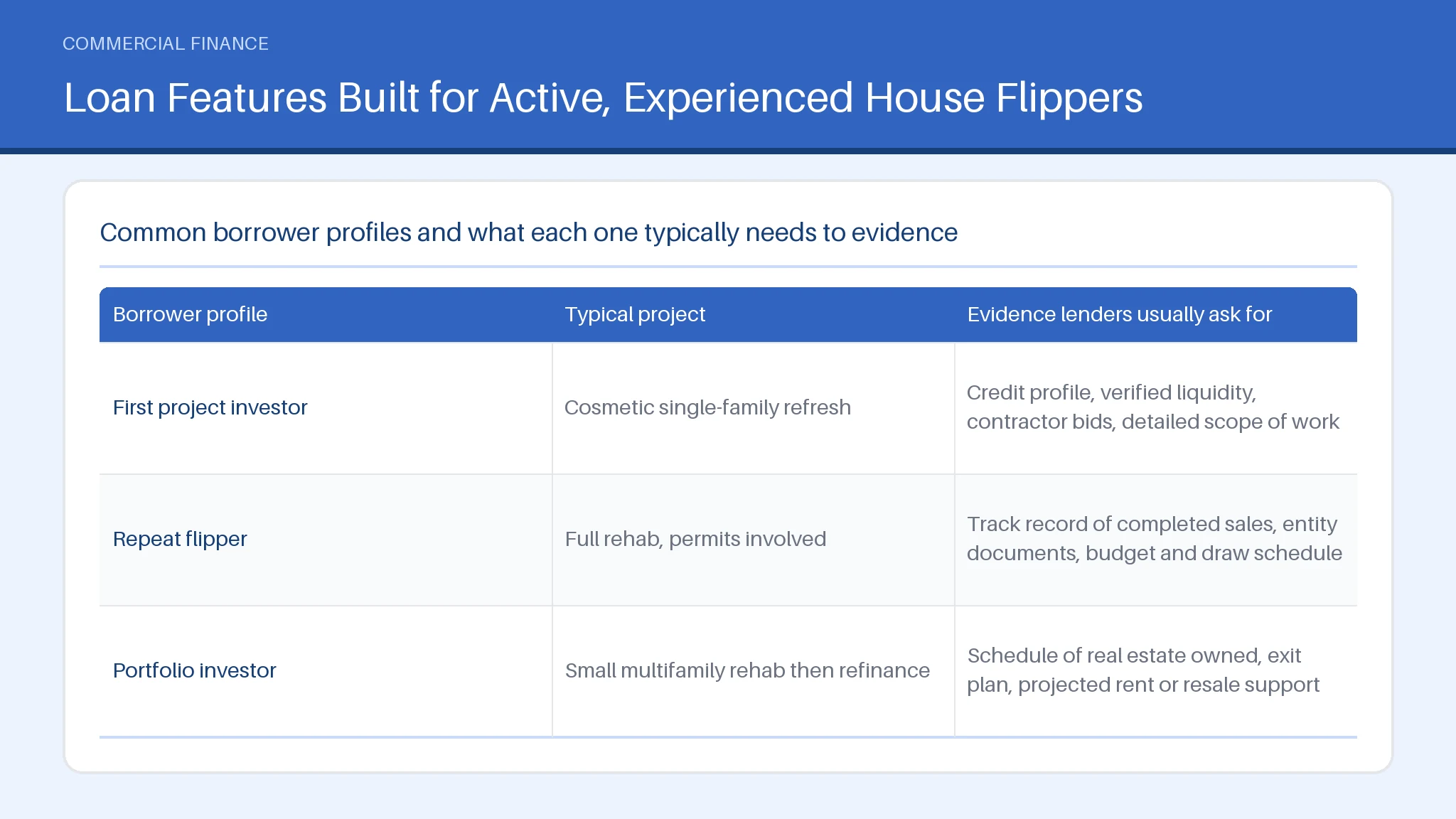
| Borrower profile | Typical project | Evidence lenders usually ask for |
|---|---|---|
| First project investor | Cosmetic single-family refresh | Credit profile, verified liquidity, contractor bids, detailed scope of work |
| Repeat flipper | Full rehab, permits involved | Track record of completed sales, entity documents, budget and draw schedule |
| Portfolio investor | Small multifamily rehab then refinance | Schedule of real estate owned, exit plan, projected rent or resale support |
Across all three profiles the questions are the same. Does the scope of work match the budget, is the after repair value defensible, and can the borrower carry interest and overruns if the sale takes longer than planned?
Loan Options Available for Funding a House Flip
Several structures fund the same project in different ways, and the right one depends on how much of the renovation you can carry yourself and how fast you need to close.
- Short-term rehab facilities. Purchase money plus a held-back renovation reserve, released in draws. The standard tool for a scoped project with contractor bids in hand.
- Bridge financing. Interest-only funds to secure a property quickly, often used when the renovation is light or self-funded and the exit is a sale or refinance.
- Home equity borrowing. A line or second lien against a property you already own, which converts trapped equity into project cash but puts that asset at risk.
- Cash-out refinance. Pulling equity from a stabilized rental to fund the next acquisition, usually slower to close but cheaper to carry.
- Portfolio and business credit lines. Revolving capacity for investors running several projects at once, priced on the relationship rather than one address.
Regional practice shapes availability. Investors comparing fix and flip loans in Florida quickly find that insurance binders, wind mitigation reports and condo association documents sit on the closing checklist alongside the appraisal. Deals in judicial foreclosure states can also carry different assumptions about how long a lender needs to recover collateral, which feeds into leverage. For deeper background on structures and underwriting logic, our Commercial Real Estate Finance Guides cover adjacent facilities in detail.
How the Loan Process Works From Draws to Payoff
The mechanics of these facilities follow a predictable sequence, and understanding it prevents the cash-flow surprises that sink first projects.
At closing, the lender funds a share of the purchase price and escrows the renovation budget. The borrower then completes work in stages. When a stage is finished, the borrower requests a draw, an inspector or third-party report confirms the work, and the funds are reimbursed. This is reimbursement, not prepayment, so you pay your contractor first and get repaid afterward. Investors who ignore that sequencing run out of working capital halfway through a kitchen.
Interest usually accrues on drawn funds only, and many structures are interest-only with the principal due at payoff. Some use an interest reserve so no cash payment is due monthly, which preserves liquidity but increases the balance you owe at sale.
Payoff happens through a sale or a refinance into longer-term debt. The closing attorney or title company sends a payoff demand, the lender releases the lien, and any remaining escrowed renovation funds are cancelled rather than paid out. Building a buffer of several weeks between projected completion and loan maturity is the single cheapest form of risk control available.
Comparing Short Term Renovation Funding Structures for Investors
Comparing structures on interest rate alone is the most common analytical mistake investors make. On a nine-month hold, the difference between two pricing tiers is often smaller than the cost of one appraisal delay, one failed inspection, or one prepayment penalty.
Fix and flip bridge loans generally trade speed for cost. They can close on a compressed timeline and tolerate a property that is not currently habitable, but they carry origination points and a hard maturity date. Renovation facilities with structured draws cost less in total when the budget is large, because you only pay interest on funds actually released, though the draw administration slows the build.
Equity-based options such as a line against an existing property tend to be the cheapest money available, but they cross-collateralize your portfolio and rarely release funds fast enough to win a competitive auction bid. Renovation borrowing structured as a term facility with extension options sits in between.
Run the comparison on total cost of capital: points, interest over the realistic hold period, inspection and draw fees, extension cost, and the value of certainty at closing. The structure that looks expensive per year is often cheaper per project once the hold period is honest rather than optimistic.
Loan Features Built for Active, Experienced House Flippers
Repeat operators negotiate on features, not headline pricing, because features are what protect margin when a project drifts.
The most valuable term is usually no prepayment penalty. If a renovation finishes early and a buyer appears in month five, an interest minimum or a lockout period can erase weeks of profit. Second is a written extension mechanism: an experienced borrower wants to know before closing what an extension costs, how many are available, and what conditions trigger approval, rather than negotiating under pressure at maturity.
Other features that matter to active flippers include higher advances against total project cost for borrowers with a documented track record, faster draw turnaround measured in business days, the ability to close in an LLC, and cross-project facilities that avoid re-underwriting the same borrower every ninety days. Fix and flip bridge loans sometimes add a rehab holdback increase if change orders are documented and the after repair value supports it.
These facilities reward operational discipline. Lenders reserve their better leverage and their fastest processing for borrowers who submit clean budgets, realistic timelines, and completed project histories with settlement statements attached. Track record is a pricing input, not a formality.
Average Renovation Costs and How Long a Flip Takes
Renovation budgets vary widely by market and scope, so the useful discipline is estimating by category rather than by rule of thumb. A cosmetic refresh covering paint, flooring, fixtures and landscaping sits at the low end. A kitchen and bath remodel with new cabinetry, tile and appliances sits in the middle. Systems work such as roof, electrical panel, plumbing repipe, HVAC replacement or foundation repair sits at the top, and it is also where overruns cluster because problems are only visible after demolition.
Timelines follow the same pattern. Cosmetic work often completes in six to ten weeks. Permitted work adds review and inspection cycles that are outside your control, and municipal backlogs can add months in busy jurisdictions. Then add marketing time, the buyer's own financing period, and any appraisal contingency. A project a flipper describes as a three-month rehab is frequently a seven-month loan.
Closing timelines are a separate question. Fix and flip hard money loans can often close within one to three weeks once title, insurance, appraisal and the scope of work are complete, because underwriting concentrates on the asset. Bank-style facilities take longer. In every case the file, not the lender, is usually the bottleneck: missing contractor bids, an unsigned entity resolution, or an insurance binder that does not name the correct loss payee.
When investors compare the best fix and flip loans for a specific deal, closing certainty and draw speed usually outweigh a fractional rate difference, because carrying an empty house costs money every week.
How Fix and Flip Loans Differ From Traditional Mortgages
Fix and flip loans are short-term, business-purpose loans secured by investment property and sized against the project's economics. Traditional mortgages are long-term consumer loans sized against a borrower's income and the property's current condition. Everything downstream follows from that distinction.
The mechanics work like this. The lender values the property as it is today and as it will be after the planned work, which is where after repair value enters underwriting. Advances are then capped two ways: as a percentage of the as-is purchase price or current value, and as a percentage of total project cost, the metric commonly abbreviated as LTC. A file can clear the after repair value test and still fall short on loan to cost, which is why the borrower's own equity contribution rarely disappears entirely. Estimating that value credibly matters, and our guide to calculating after repair value walks through the comparable selection process.
Traditional mortgages amortize over decades, require the property to be habitable at closing, and verify income through tax returns and pay stubs. Project debt of this kind is typically interest-only, tolerates a property that fails habitability standards, weighs liquidity and experience heavily, and frequently allows early payoff without penalty because the lender expects a fast exit.
Fix and flip hard money loans sit at the asset-focused end of that spectrum, with the property and the exit doing most of the qualifying work. The trade-off is cost and term length. Investors evaluating the best fix and flip loans for a hold longer than two years generally need to plan a refinance into a rental facility rather than extend a short-term product indefinitely.
Financing for Digital Media and Programmatic Advertising Spend
Marketing is a real line item for investors who source deals directly rather than through the MLS, and it does not belong in a property loan. Direct mail campaigns, paid search, programmatic display and lead-generation platforms are operating expenses of the acquisition business, not hard costs improving the collateral. A renovation holdback will not reimburse an advertising invoice, because draw inspections verify completed physical work.
That means marketing spend has to be funded from operating cash, a business line of credit, or working capital facilities underwritten on the company rather than the address. Investors who blur the two frequently find their liquidity reserves depleted at the exact moment a lender is verifying cash to close, which weakens the file on the metric lenders check hardest.
The practical separation is simple. Keep acquisition marketing in the operating entity with its own budget and its own funding source. Keep property costs in the project entity where the loan sits. This also keeps the schedule of real estate owned and the entity financials legible to underwriters.
Commercial fix and flip loans on small multifamily or mixed-use assets follow the same logic, and lease-up marketing for a stabilized property is treated as an operating cost too. Investors pursuing fix and flip loans in California, where acquisition competition pushes marketing budgets higher, should model that spend separately before it distorts project returns.
Check Your Eligibility for Flip Project Funding
Eligibility for a renovation project rests on four things: the asset, the plan, the borrower, and the exit. Before approaching any lender, assemble the file that answers all four.
- Asset. Address, purchase contract, current condition, property type, and whether the unit is legally conforming.
- Plan. A line-item scope of work with contractor bids, permit expectations, and a realistic schedule with a contingency allowance.
- Borrower. Entity documents, credit profile, verified liquidity for down payment plus reserves plus the first draw cycle, and a project history with settlement statements.
- Exit. Comparable sales supporting the resale figure, or projected rent and a refinance path if the plan is to hold.
Underwriting is a matter of independent third-party finance providers applying their own criteria, and those criteria shift by state, property type and market cycle. Commercial loans on mixed-use or five-plus unit assets bring in commercial appraisal standards, environmental screening on some property types, and lease review where tenants remain in place. Investors seeking fix and flip loans in California also encounter local rent regulation and permitting rules that affect scope feasibility.
If you want to understand the routing process before you assemble documents, read how it works, then continue with the qualification form below.
Summary
Fix and flip loans work when the numbers are honest. They are short-term, asset-backed facilities priced for speed, funded through inspected draws, and repaid from a sale or a refinance. The decisions that protect profit are unglamorous: build a contingency into the renovation budget, assume the hold period is longer than the construction schedule, confirm extension terms and prepayment language in writing before closing, and hold enough liquidity to fund work ahead of reimbursement. Leverage is limited by loan to cost as well as after repair value, so plan for genuine equity in the deal. CRE Loans USA is a lender-matching service that routes project details to independent finance providers, who set all terms and make every lending decision.
Frequently asked questions
Are fix and flip loans worth it?
They can be worth it when the projected resale price supports the total cost of capital with room to spare. The honest test is a margin stress test: add three months of interest, a ten to twenty percent renovation contingency, selling costs, and property taxes and insurance for the full hold period, then see whether the project still clears. Deals that only work at the optimistic timeline and the optimistic sale price are the ones that lose money. This kind of borrowing is a tool for compressing time, not a substitute for a genuine spread between purchase price plus rehab and defensible after repair value.
What are fix and flip loans?
They are short-term real estate loans that fund the purchase and renovation of an investment property, secured by that property and repaid when it sells or refinances. Terms usually run six to twenty-four months, payments are commonly interest-only, and the renovation portion is escrowed and released in draws as work is completed and inspected. Because they are business-purpose loans rather than consumer mortgages, underwriting focuses on the asset, the scope of work, the borrower's experience and liquidity, and the exit strategy.
How much money do I need for a fix and flip?
Plan for more than the down payment. A realistic cash requirement includes your equity contribution toward purchase, closing costs and origination points, the first stage of renovation work before the initial draw is reimbursed, interest and carrying costs through the hold period, and a contingency reserve. Lenders generally want to see liquidity remaining after closing rather than a borrower who is fully deployed on day one. The precise figures depend on the deal, the leverage a provider offers, and the local cost of the work.
What credit score do you need for a fix and flip loan?
Requirements vary by lender and are set independently, but most asset-focused programs look at credit as one input among several rather than a single cutoff. Stronger credit typically supports better leverage and pricing, while a thinner or blemished profile is often offset by more equity in the deal, verified reserves, or a documented flipping track record. Recent foreclosures, bankruptcies or unresolved judgments carry more weight than a mid-range score on its own.
What is fix and flip financing?
Fix and flip financing is the broad category covering any funding used to acquire and renovate a property for resale, including short-term rehab facilities, bridge structures, home equity borrowing, cash-out refinances of existing holdings, and business lines of credit. It differs from a standard purchase mortgage in that it anticipates construction, releases renovation money against progress, and expects repayment within months rather than decades.
How do you qualify for a fix-and-flip loan in Texas?
The process is the same as anywhere else in the country, with local specifics layered on. Assemble the purchase contract, a line-item scope of work with contractor bids, entity documents, proof of liquidity, and comparable sales supporting your resale figure. Texas-specific points include property tax rates that materially affect carrying cost, appraisal district valuations that can move after renovation, and county permitting timelines that differ sharply between major metros and unincorporated areas. Independent finance providers assess each file against their own criteria, so the strength of your documentation and your reserves drives the outcome more than geography.