

Commercial real estate debt funds are pooled investment vehicles that make or acquire loans secured by income-producing property, then distribute the interest and fees those loans generate to their limited partners. The fund sits in the lender's seat. It holds a note and a mortgage rather than a deed, which means its return comes from contractual payments and its downside protection comes from the equity cushion beneath it.
For a borrower, that distinction decides how a deal gets underwritten. A bank weighs regulatory capital, deposit relationships and in-place cash flow. A debt fund weighs the business plan, the exit and the sponsor's ability to execute, then prices the risk accordingly. For an investor, the same structure offers a fixed-income style position in real estate with a defined place in the capital stack, ahead of common equity and often ahead of preferred capital.
This guide explains how commercial real estate debt funds raise and deploy capital, how senior, mezzanine and distressed strategies differ, why private lending expanded as bank balance sheets tightened, and which questions separate a disciplined manager from a lucky one. If you are comparing capital sources for a specific deal, the commercial real estate finance guides cover individual loan programs in detail.
Key takeaways
- Commercial real estate debt funds are pooled private credit vehicles that originate or buy property loans and pass interest income through to their investors rather than taking ownership of buildings.
- Most are closed-end structures with a defined investment period and a fixed life, so capital is locked up and returns arrive through interest and fee distributions instead of daily liquidity.
- Strategies range from senior whole loans at conservative leverage to mezzanine, preferred positions and discounted note purchases, with pricing rising as the position moves down the capital stack.
- Borrowers typically turn to these funds for speed, flexible structuring and business-plan lending on transitional assets that bank credit committees decline.
- Evaluating a manager means testing origination sourcing, servicing and workout capability, fund-level leverage, and how fees and the waterfall split income before investors are paid.
How Closed-End Fund Structures Lock Up Capital
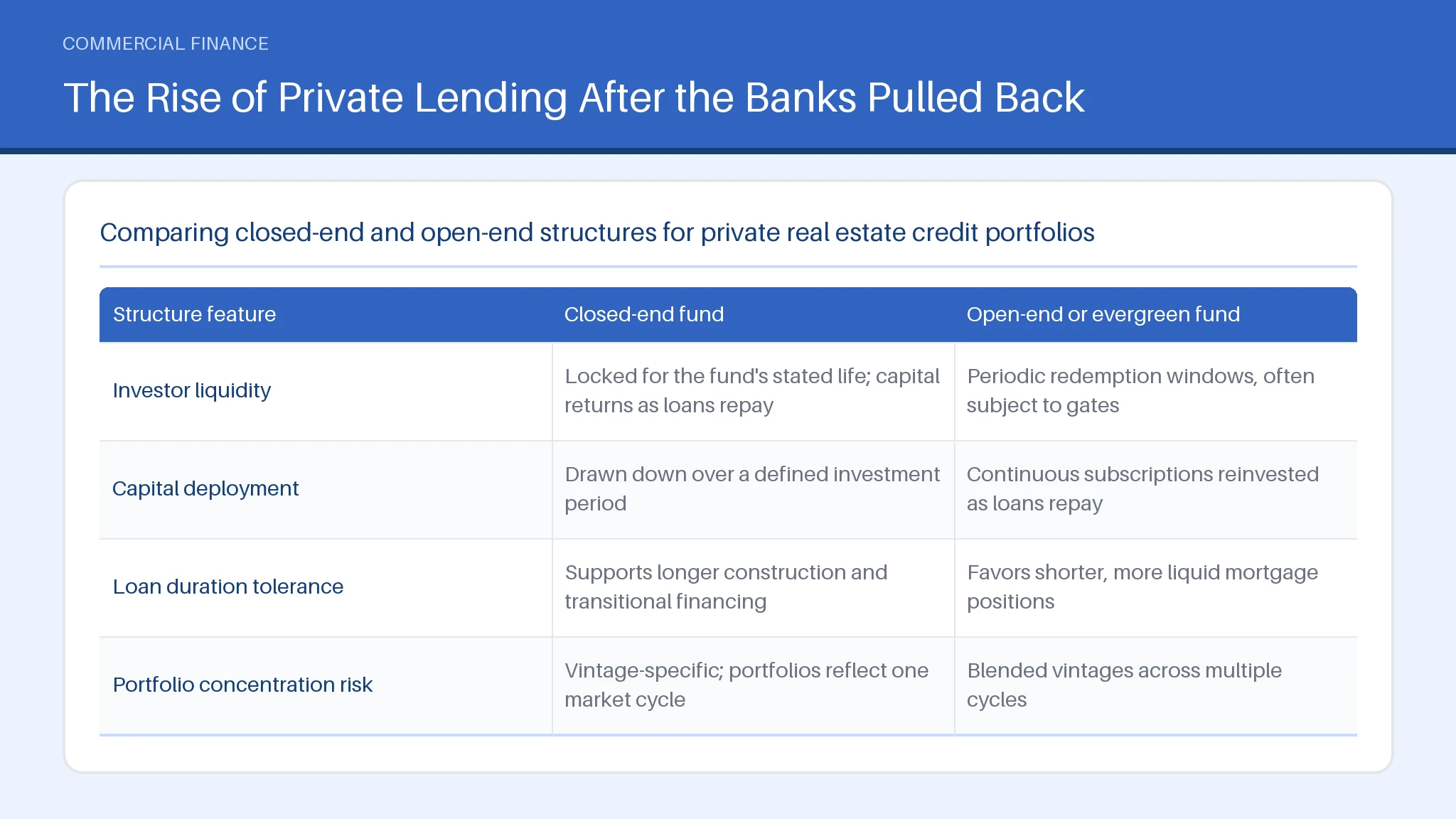
Closed-end commercial real estate debt funds raise a fixed pool of commitments, call capital during a defined investment period, and return principal as loans repay, with no redemption right in between. That lock-up is the price investors pay for the manager's ability to hold illiquid mortgage positions to maturity instead of selling into a weak bid. Open-end and interval vehicles trade some of that freedom for periodic liquidity, which forces the manager to keep cash or short-duration paper on hand. The structure a manager picks shapes the loans it can write, the leverage it can carry, and the expertise it needs on the servicing side.
| Structure feature | Closed-end fund | Open-end or evergreen fund |
|---|---|---|
| Investor liquidity | Locked for the fund's stated life; capital returns as loans repay | Periodic redemption windows, often subject to gates |
| Capital deployment | Drawn down over a defined investment period | Continuous subscriptions reinvested as loans repay |
| Loan duration tolerance | Supports longer construction and transitional financing | Favors shorter, more liquid mortgage positions |
| Portfolio concentration risk | Vintage-specific; portfolios reflect one market cycle | Blended vintages across multiple cycles |
Senior, Mezzanine and Distressed Debt Fund Strategies Compared
Senior, mezzanine and distressed strategies inside commercial real estate debt funds differ mainly by position in the capital stack and by what has to go right for the fund to be repaid. Senior whole-loan strategies write first-lien, secured financing at moderate loan-to-value, accept the lowest coupon and rely on the borrower's equity for protection. Mezzanine and preferred strategies sit behind that first mortgage, earn a higher rate, and depend on the senior lender's cooperation in a default; the mechanics are set out in the guide to mezzanine financing and junior capital. Distressed strategies buy existing notes at a discount, which makes the manager a workout operator as much as a lender.
Investing across all three in one vehicle sounds diversified, but it rarely is. Investors should ask which skill set the team actually has, because originating new loans and foreclosing on old ones are different businesses.
How Debt Funds Raise Capital and Originate Loans
Borrowers turn to commercial real estate debt funds when the deal needs speed, a flexible structure, or credit on a business plan rather than on trailing cash flow. Typical cases include value-add acquisitions with vacancy to lease up, ground-up and heavy renovation projects, near-term loan maturities that need a bridge, and partner buyouts where a bank would want more seasoning. Sponsors of hotels, self storage and other operating-intensive assets also use funds when bank appetite for the property type narrows.
On the capital side, a manager raises commitments from pensions, endowments, insurers, family offices and high-net-worth investors, often adding a credit facility to amplify returns. Origination then runs through brokers, repeat sponsor relationships and direct coverage of local markets. Every loan is secured by a first lien or a pledge, sized against value and coverage, and documented with reserves, draw conditions and completion tests. Borrowers investing in a transitional asset should expect faster decisions and tighter covenants than a bank would impose, and should read the commercial loan application checklist before packaging the file.
Where Private Credit Sits Among Property Investment Options
Private credit occupies the middle ground between core equity ownership and public bonds: contractual income, a defined maturity, and a claim that ranks ahead of the sponsor's capital. Direct equity gives investors unlimited upside and first-loss exposure. Commercial real estate debt funds give up appreciation in exchange for priority of payment and a shorter duration. Public REIT shares and traded mortgage securities offer liquidity but mark to market daily.
Investing in commercial real estate debt financing therefore behaves less like a property bet and more like a credit bet on the sponsor's business plan. The variable that matters most is attachment point: a loan at a conservative basis can absorb a meaningful value decline before principal is impaired, while a stretch position cannot. Many investors pair the two, holding equity for growth and debt for current yield, and lenders price each layer separately. The debt yield formula and loan sizing guide shows how that attachment point is measured.
The Rise of Private Lending After the Banks Pulled Back
Private lending grew because regulated balance sheets retreated from construction and transitional risk, and commercial real estate debt funds stepped into the gap. Post-crisis capital rules made higher-volatility construction exposure expensive for banks to hold. Regional bank stress in 2023 sharpened the effect, pushing many institutions toward existing clients and away from new originations. Federal Reserve surveys of senior loan officers have repeatedly reported net tightening of standards on commercial real estate loans across that period.
Commercial real estate debt financing did not disappear; it moved. Funds now supply much of the bridge and construction market, while banks increasingly provide warehouse lines to those same funds, which recycles bank liquidity one step removed from the property. Insurance companies, agency programs and securitization still anchor stabilized long-term debt, including the fixed-rate route described in the guide to how CMBS loans work. The practical result for sponsors is a wider menu of lenders and a sharper need to compare terms, not just rates.
Today's Credit Conditions and What They Mean for Yields
Credit conditions in the current cycle favor lenders holding floating-rate paper and penalize assets bought at thin going-in yields. Higher base rates lifted coupons on new private loans, while softer values compressed the equity beneath older loans, so the same nominal proceeds now represent more risk than they did at origination. Lenders have responded by cutting proceeds, requiring interest reserves and rate caps, and leaning on coverage tests rather than appraised value.
For investors, that mix produces a wider spread over the index and a stronger attachment point at the same time, which is unusual. The offset is extension risk: when refinancing liquidity is scarce, loans do not repay on schedule and an asset that was meant to turn over in two years ties up capital longer. Sponsors facing that squeeze should model exit proceeds carefully, and the explanation of index plus spread pricing shows how the components move.
What Is a Commercial Real Estate Debt Fund?
A commercial real estate debt fund is a managed pool of private capital that acts as a lender, originating or purchasing loans backed by commercial property and distributing the resulting interest, origination fees and exit fees to its investors. The fund does not take ownership of the real estate unless a loan defaults and it enforces its security. Its asset is the note; its collateral is the building.
Income flows in a defined order. Borrowers make monthly payments on the loan, the servicer collects, the manager deducts management fees and any cost of fund-level borrowing, and the remainder is distributed under the partnership waterfall, often after a preferred return hurdle. A diverse commercial real estate debt fund will spread exposure across property types, geographies and loan maturities to avoid a single sector repricing the whole book.
Compared with bank lenders, these funds can move faster and tolerate business-plan risk, but they charge for it. Compared with equity investments, they trade appreciation for priority. That trade-off, not the headline yield, is what investors are actually buying, and it is why reading the loan documents matters as much as reading the pitch.
What to Look for When Evaluating a Fund Manager
Manager quality shows up in four places: sourcing, underwriting discipline, servicing capability and alignment. Ask where loans come from, because teams that rely on auctioned broker flow tend to win deals on price rather than on terms. Ask how many loans the team has actually worked out, since collecting from a stressed sponsor is a different job from closing one. Then look at fund-level leverage: a repo line or warehouse facility magnifies returns and also magnifies margin-call risk if values fall, and lenders to the fund rank ahead of its investors.
Alignment is measurable. Check the general partner's co-investment, whether fees are earned on invested capital or on committed capital, and whether the waterfall pays a promote before principal is returned. Finally, confirm how the manager values non-performing positions and what happens to equity and ownership of the collateral if it forecloses.
Where Commercial Real Estate Debt Funds Go Next
Private credit is likely to keep a permanent, larger share of commercial property financing rather than retreat when bank appetite recovers. Direct lending funds, which originate and hold whole loans instead of buying syndicated paper, have become the standard structure because they let the manager control documents, covenants and workout rights from day one. That control is the core of how these vehicles work: raise committed capital, originate secured loans against a business plan, collect contractual interest and fees, and recycle principal as loans repay.
Three forces will shape the next phase. Maturing fixed-rate debt written in a cheaper rate environment keeps creating refinancing gaps that bridge and rescue financing can fill. Private equity real estate sponsors increasingly want one capital partner who can deliver senior and junior layers in a single closing, which pushes funds toward unitranche financing. And insurance capital continues to flow into private credit sleeves, broadening the investor base for property financing beyond the traditional private equity fund model.
The benefits for investors stay the same: current income from day one, a position senior to common equity, shorter duration than direct ownership, and exposure to real assets without operating responsibility. The limitations also stay the same, namely illiquidity, concentration in a single vintage, and returns capped at the loan coupon no matter how well the property performs. Sponsors weighing a fund against bank or agency financing should compare total cost, certainty of close and prepayment flexibility together; the lender matching process and the commercial loan questions page explain how an enquiry is structured before lenders review it.
Summary
Commercial real estate debt funds lend against property, earn contractual interest, and sit ahead of sponsor equity in the capital stack. Structure, attachment point, fund leverage and manager workout skill drive outcomes more than headline yield. CRE Loans USA is a lender-matching service, so a described deal is passed to independent finance providers who make all credit decisions. continue with the qualification form below.
You may also find these related guides helpful: Commercial Construction Loans: How They Work and Qualify, Commercial Mortgage Broker: What They Do and How to Choose, Hotel Financing Lenders: Loan Types, Terms and Approval, and Multifamily Construction Financing: Rates, Draws, Terms.
You may also find these related guides helpful: Self Storage Financing: What to Know.
Frequently asked questions
What should you know about how debt funds and traditional lenders collaborate?
Debt funds and traditional lenders work together more often than they compete. Banks commonly provide warehouse lines, repo facilities and note-on-note loans to the funds themselves, which lets regulated capital earn a spread without taking direct construction or transitional risk. On individual deals, a bank may hold the senior first mortgage while a fund supplies the junior layer behind it, or a fund writes the short-term bridge loan and hands the stabilized asset to a bank, insurer or agency program for permanent financing. That relay is why sponsors should plan the takeout before signing the bridge.
What should you know about the role of debt funds in commercial property financing?
Debt funds fill the parts of commercial property financing that regulated balance sheets price poorly: ground-up construction, lease-up, repositioning, partner buyouts and near-term maturity defaults. They underwrite the business plan and the exit, fund in draws against completion milestones, and accept more collateral risk in exchange for higher coupons, origination fees and exit fees. They also close faster, which matters when a purchase contract has a hard deadline. For stabilized, long-hold assets, bank and agency debt usually remains cheaper.
What should you know about key players in the debt fund market?
The market has four main groups of players. Institutional allocators such as pension plans, endowments and insurers supply the capital. Fund managers originate, underwrite and service the loans. Mortgage brokers and matching platforms route borrower demand to the funds with matching appetite. Banks sit behind the funds as providers of leverage and as the eventual takeout lenders. Sponsors, developers and property owners are the borrowers whose business plans set the terms of every loan written. The background on how CRE Loans USA operates explains where a matching platform fits in that chain.