
Commercial real estate debt financing is borrowed money, secured by a lien on an income-producing property, that an owner repays from the property's operating cash flow. The lender takes the building and its rents as collateral, sizes the loan against measurable property performance, and sits senior to every dollar of equity in the deal. That single structural fact explains almost everything else about how a commercial mortgage behaves: why underwriting focuses on net operating income, why lease rollover schedules get read line by line, and why two borrowers with identical credit scores can be offered very different terms on two different buildings.
For most US investors, developers, and owner-occupant business owners, the practical question is not whether debt is available but which part of the market fits the asset and the holding period. A stabilized apartment building with three years of clean operating history, a vacant suburban office floor plate awaiting a repositioning, and a ground-up industrial project all draw capital from different pockets. Banks, credit unions, agency lenders, insurance companies, conduit programs, and private debt funds each price risk differently and each place different limits on leverage, recourse, and flexibility.
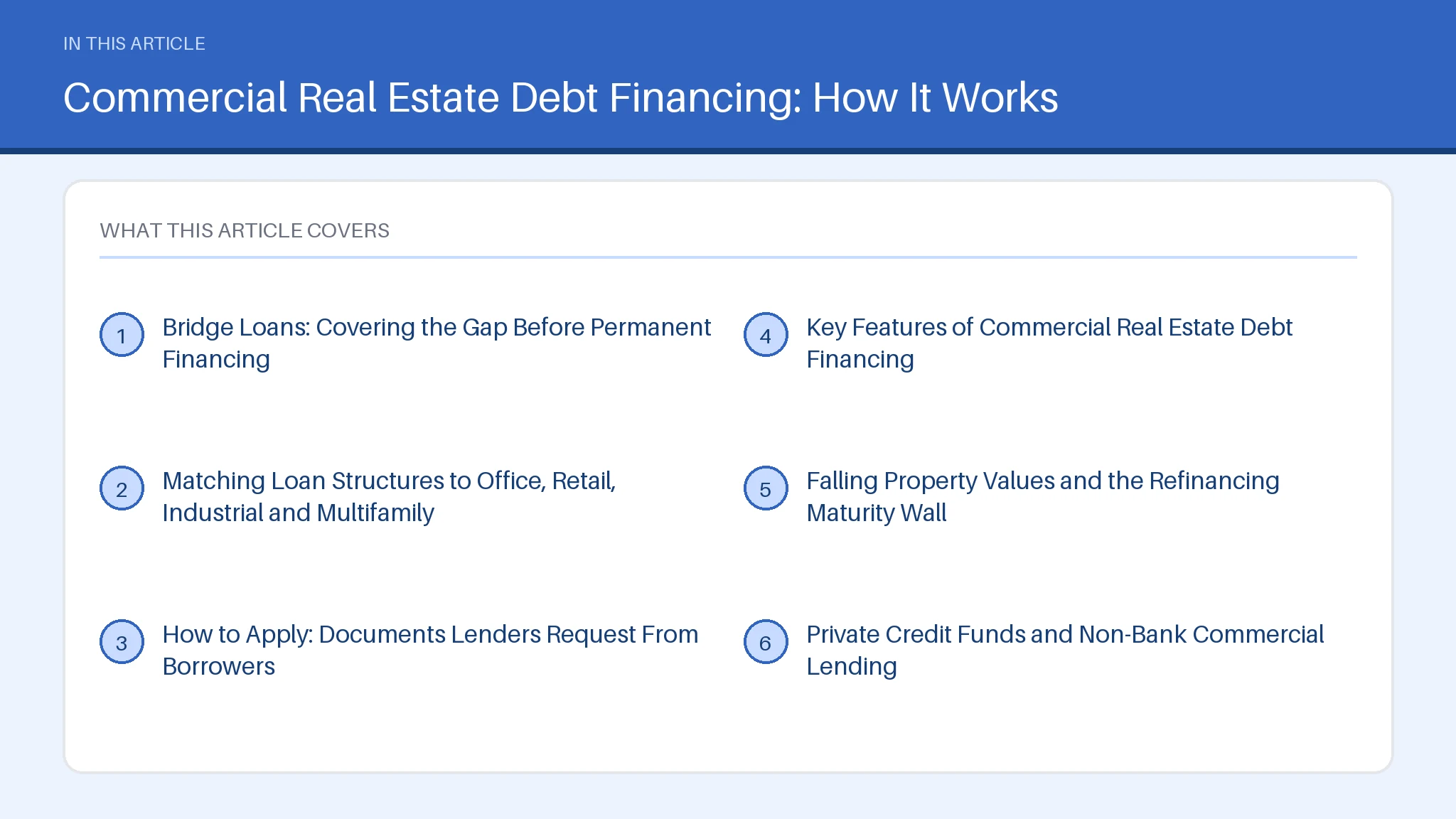
This guide walks through how commercial real estate debt financing actually gets sized and structured, what documents lenders ask for and why, how loan structures map to office, retail, industrial, and multifamily assets, and what the current wave of maturing fixed-rate loans means for owners facing a refinance in a higher-rate environment. It also covers where non-bank private credit fits and what borrowers trade away when they use it.
If you are new to the category, the commercial real estate loans hub lays out the lending landscape at a high level, and the commercial real estate finance guides library goes deeper on individual loan programs and metrics. CRE Loans USA is a lead-generation and lender-matching site, so the explanations below describe how independent third-party finance providers evaluate deals, not offers of credit.
Key takeaways
- Commercial real estate debt financing is borrowed capital secured by income-producing property, where the asset's cash flow, not just the owner's personal income, carries the loan.
- Loan sizing usually comes down to three constraints applied at once: loan-to-value, debt service coverage, and the lender's minimum return on the loan amount. The tightest of the three sets the proceeds.
- Property type drives structure. Stabilized multifamily and net-leased retail support long, low-leverage permanent debt, while transitional office and value-add assets generally rely on shorter-term bridge capital.
- Recourse, prepayment terms, and reserve requirements often matter more to total cost than the headline interest rate, especially if the business plan involves an early sale or refinance.
- A large volume of fixed-rate loans written in a lower-rate era is maturing into higher coverage tests and softer values, which is pushing borrowers toward fresh equity, partial paydowns, or non-bank lenders.
Bridge Loans: Covering the Gap Before Permanent Financing
A bridge loan is short-term, floating-rate debt that carries a property through the period when it cannot yet qualify for permanent financing. The typical candidate is an asset in transition: occupancy sitting below the market level, leases rolling at rents the prior owner never pushed, deferred maintenance suppressing income, or a change of use in progress. Permanent lenders underwrite trailing performance. Bridge lenders underwrite a business plan, which is why they charge more and hold tighter controls.
Bank loans from traditional lenders sit at the other end of that spectrum. A bank or credit union typically wants an existing rent roll, a debt service coverage cushion on in-place income, and a sponsor willing to sign a recourse guarantee. In exchange, bank pricing and fees are usually the lowest available to a borrower who fits the box, and the relationship can extend to deposits, treasury services, and future deals. The trade is rigidity: banks generally lend less against a story, apply conservative LTV, and resize quickly when a property misses projections.
The practical decision for most investors is not which product is better but how long the repositioning will take and what the exit looks like. A bridge loan that carries 24 months of interest, an origination fee, an exit fee, and an interest reserve can easily cost several points more in total than a bank mortgage over the same period. That cost is rational when the plan lifts net operating income enough to support a larger permanent loan or a higher sale price. It is punitive when the plan slips and the sponsor has to buy extensions.
Bridge debt also changes the shape of the capital stack. Higher proceeds mean a thinner equity cushion, and floating payments mean the coverage ratio moves with the index. Many sponsors hedge or buy a rate cap, which is an upfront cost competitors rarely mention when they quote bridge leverage. Our guide to how lenders build commercial loan rates from an index plus a spread explains the mechanics behind those floating payments.
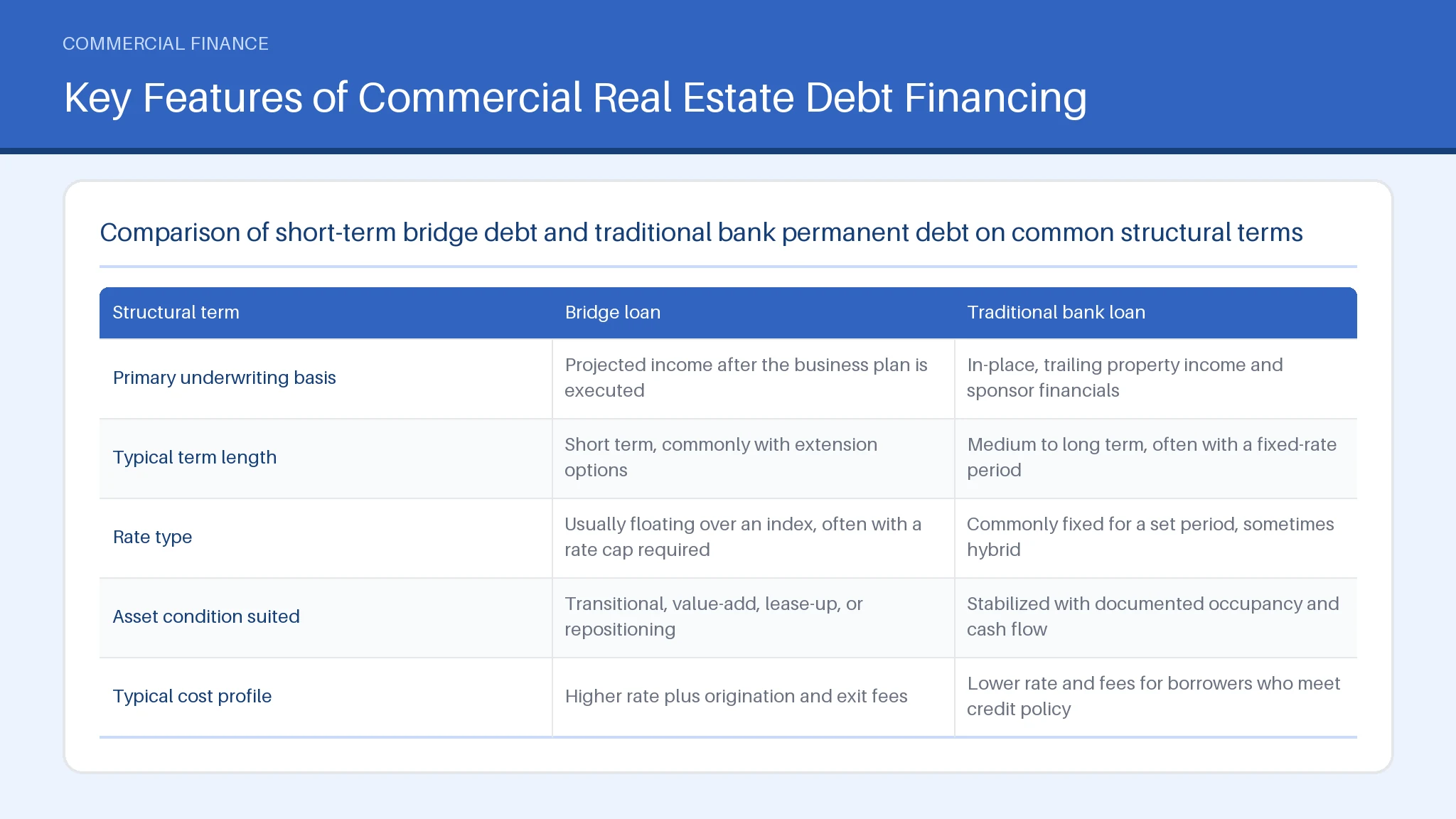
| Structural term | Bridge loan | Traditional bank loan |
|---|---|---|
| Primary underwriting basis | Projected income after the business plan is executed | In-place, trailing property income and sponsor financials |
| Typical term length | Short term, commonly with extension options | Medium to long term, often with a fixed-rate period |
| Rate type | Usually floating over an index, often with a rate cap required | Commonly fixed for a set period, sometimes hybrid |
| Asset condition suited | Transitional, value-add, lease-up, or repositioning | Stabilized with documented occupancy and cash flow |
| Typical cost profile | Higher rate plus origination and exit fees | Lower rate and fees for borrowers who meet credit policy |
Matching Loan Structures to Office, Retail, Industrial and Multifamily
Property type sets the outer boundary of what commercial real estate debt financing can do for a deal, because each asset class carries a different income pattern and a different liquidation story. Lenders price both.
Multifamily draws the deepest capital pool. Hundreds of small leases renew continuously, which smooths income and gives the collateral a broad resale market. That supports the highest LTV, the longest amortization, and the widest availability of non-recourse treatment. Stabilized apartment borrowers often have a genuine choice between a bank mortgage, an agency execution, and a life company loan, and that choice is mostly about prepayment flexibility rather than proceeds.
Industrial sits close behind. Single-tenant distribution and light manufacturing buildings carry long leases and strong tenant demand in most US markets, though a vacant special-purpose facility can be slow to re-let, so lenders test residual value carefully.
Retail underwriting turns on lease quality rather than square footage. A grocery-anchored center with staggered expirations is financed on very different terms than an unanchored strip with month-to-month tenants. Where a single credit tenant covers taxes, insurance, and maintenance, lenders will often look through to the tenant's balance sheet, a dynamic explored in the guide to triple net lease property investment.
Office is the hardest case right now. Lenders model higher releasing costs, longer downtime, and larger capital reserves, which compresses proceeds and raises the equity check even when the current rent roll looks healthy. Many office borrowers find the binding constraint is not the loan-to-value ratio at all but the coverage test on income that excludes expiring leases.
Across all four types, investors should test the structure against the exit. If the plan is to sell in year four or refinance after a lease-up, a loan with heavy prepayment protection quietly taxes that outcome, and the recourse position determines how much of the downside lands on the sponsor's balance sheet rather than the property.
How to Apply: Documents Lenders Request From Borrowers
Lenders assemble a credit file from four document groups: property performance, property condition, borrower financial capacity, and deal mechanics. Knowing the groups makes the request list predictable rather than random.
Property performance means a current rent roll with lease start and expiration dates, two to three years of operating statements, a trailing twelve-month income summary, and the actual leases for major tenants. For a purchase, lenders also want the executed contract and any seller-provided historicals. Gaps here slow a file more than anything else, because an underwriter cannot size a commercial real estate debt financing request on estimates.
Property condition covers the third-party reports: appraisal, property condition assessment, environmental screening, and for some assets a seismic or zoning report. Lenders order these themselves and the borrower pays deposits toward them.
Borrower capacity is where personal documentation enters. Expect a personal financial statement, a schedule of real estate owned, two or three years of tax returns for the borrower and any guarantor, liquidity verification, and a resume showing comparable experience with the asset type. A real estate loan request backed by a sponsor who has operated the same property class before clears credit committee faster, and experience sometimes buys flexibility on a metric that would otherwise fail.
Deal mechanics include the entity organizational documents, the sources and uses, the business plan with a capital budget, and evidence of the equity being contributed. For construction or heavy value-add, add plans, budgets, contractor agreements, and permits.
Two practical points most checklists omit. First, lenders care about the consistency between documents, so a rent roll that does not reconcile to the operating statement triggers a second round of questions. Second, borrower-prepared pro formas carry weight only when the assumptions tie to signed leases or documented market comparables. The detailed walkthrough in the commercial loan application guide maps the sequence and typical timeline, and how CRE Loan matching works explains how a deal summary reaches lenders in the network.
Key Features of Commercial Real Estate Debt Financing
Commercial real estate debt financing works by lending against a property's ability to produce income, then layering protections that preserve the lender's senior position if that income falls short. The loan is secured by a mortgage or deed of trust on the real property, usually supported by an assignment of rents and leases, and the lender's claim sits ahead of every equity dollar in the deal. If the asset underperforms, the loan still gets paid before the owners receive anything.
Sizing follows a repeatable process. An underwriter rebuilds net operating income from the actual rent roll and expenses, applies market vacancy and a management fee whether or not the owner pays one, deducts a reserve for replacements and tenant improvements, and then tests the resulting income against three constraints: the loan-to-value limit, a minimum debt service coverage cushion, and a minimum yield on the loan amount. Whichever constraint produces the smallest number becomes the loan. Many borrowers assume leverage is set by value alone and are surprised when a coverage test or a debt yield floor cuts proceeds, a mechanic covered in the debt yield and loan sizing guide.
The financing process then moves from an indicative term sheet to a signed application, third-party reports, formal underwriting, credit committee approval, legal documentation, and closing. Each stage can resize the loan, which is why experienced investors keep contingency equity available until documents are final.
Types of commercial real estate debt financing fall into recognizable tiers. Senior permanent mortgages carry the lowest cost and the lowest leverage. Bank and credit union loans serve stabilized assets and owner-occupied business property. Government-guaranteed programs such as the SBA 504 program serve owner-users. Securitized conduit loans offer long fixed terms with rigid servicing. Bridge and construction debt fund transitional plans. Subordinate layers, including junior and preferred capital, fill the space between the senior loan and common equity inside the capital stack.
Four terms deserve close reading in any commercial real estate loan document. Recourse determines whether the lender can pursue the guarantor's other assets; a non-recourse loan limits that claim to the property, subject to carve-outs. Prepayment terms set what an early payoff costs, and yield maintenance or defeasance can dwarf a modest rate savings. Reserve and escrow requirements shift cash away from distributions. And repayment structure matters: interest-only periods support a lease-up, while full amortization builds equity over the hold. Terms vary widely by lender category, and the combination, not any single clause, determines what the debt really costs.
Falling Property Values and the Refinancing Maturity Wall
A refinance in today's market is an equity conversation before it is a rate conversation. Loans written when rates were low were sized on income capitalized at low yields. When rates rose, values softened in several property types, and the same building now supports a smaller loan. The resulting shortfall at maturity is what the industry calls the maturity wall, and it is concentrated in office and in floating-rate bridge debt originated at peak values.
The arithmetic is straightforward. If a loan was sized to a value that has since declined and the new lender applies both a lower leverage limit and a higher coverage test on today's higher payments, the proceeds can land well below the existing balance. Closing that gap involves one or more of four moves: contributing fresh equity, accepting a partial paydown, adding a subordinate layer to the capital stack, or negotiating an extension with the incumbent lender. Each has a cost. New equity dilutes existing partners, a paydown consumes reserves, subordinate capital raises blended cost and tightens control rights, and extensions usually come with a fee, a cash sweep, and a reduced distribution right.
Owners who start early have more room. Pulling the loan documents to confirm maturity dates, extension conditions, and prepayment terms a full year ahead gives time to improve the rent roll, trim controllable expenses, and document a cleaner trailing twelve months, all of which lift the sizing test. Where the sponsor holds a non-recourse loan, the negotiation differs sharply from a recourse position, because the lender's leverage over the guarantor's other assets is limited. Investors weighing a cash-out against a straight rate-and-term refinance can compare the two paths in the guide to refinancing commercial property. Lenders that are flexible on structure often are not flexible on proceeds, and that distinction decides outcomes more than pricing does.
Private Credit Funds and Non-Bank Commercial Lending
Private credit funds are non-bank lenders that raise capital from institutional and private investors and deploy it as property-secured debt. Because they are not deposit-funded, they answer to fund mandates rather than bank credit policy, which lets them write loans banks decline: transitional assets, partially vacant buildings, condo inventory, unusual property types, and situations with a tight closing deadline.
Debt fund lending differs from bank lending in four visible ways. Proceeds can run higher, so a sponsor reaches a target LTV with a thinner equity contribution. Rates float and payments move with the index, often with an interest reserve funded at closing. Loans are frequently non-recourse at the borrowing entity level with carve-out guarantees, which changes the sponsor's exposure profile. And structure is negotiable, including future funding facilities for capital work, earnout provisions tied to leasing milestones, and flexible exits that suit a sale or a later refinance.
The trade-offs are equally concrete. Cost is higher in rate, origination, and exit fees. Covenants can be tight, with cash management accounts, minimum coverage tests, and milestone requirements that trigger lender control if leasing slips. Some funds sell or syndicate positions, so the party administering the loan may not be the party that underwrote it. And a short term means refinance risk lands on the borrower at a date the borrower does not choose.
For investors running value-add strategies, a debt fund loan is a tool with a defined job: finance the work, prove the income, then replace the loan with a cheaper permanent commercial mortgage once the asset qualifies. Where that junior slice of the stack sits above the senior loan, the structure resembles the arrangement described in the junior capital guide. The error to avoid is using short-term capital for a long-term hold. continue with the qualification form below for the structures discussed here before locking a business plan to one path.
Summary
Commercial real estate debt financing is sized by the tightest of three tests, leverage, coverage, and lender yield, and structured by terms that often cost more than the rate: recourse, prepayment, and reserves. Property type sets the available pool, transitional assets rely on short-term capital, and maturing loans written at lower rates now need fresh equity or a restructure. The practical next step is to document a clean trailing twelve months and confirm your maturity and prepayment terms. CRE Loans USA is a lender-matching service that passes a described deal to independent finance providers, who make all lending and pricing decisions. The commercial real estate loan questions page answers common process questions.
Frequently asked questions
Can I do a DSCR loan on a commercial property?
A DSCR loan can be used on some commercial properties, though availability narrows as the asset moves away from residential-style rental income. DSCR underwriting qualifies the loan on the property's net income relative to its debt service rather than on the owner's personal income, which suits small multifamily, mixed-use buildings with stable rents, and single-tenant net-leased assets. For larger or more complex commercial deals, lenders usually apply the same coverage math but place it inside a full commercial credit review that also examines lease rollover, tenant credit, and sponsor experience. The deeper mechanics are covered in the DSCR loan requirements guide.
What type of loan is best for commercial property?
The best loan for a commercial property is the one whose term matches the holding period and whose constraints match the asset's current income. A stabilized building held long term generally fits a fixed-rate permanent mortgage with full amortization. An owner-occupied business property often fits a government-guaranteed program with a longer term and a lower down payment. A building that needs lease-up or renovation first fits short-term bridge debt, then a permanent refinance once income is proven. The disqualifying question is rarely which product is cheapest; it is which product survives the exit you actually plan.
What should you know about common equity?
Common equity is the owner's residual ownership position, the share of value left after every debt and preferred layer is satisfied. It sits last in line for payment and first in line for loss, which is exactly why it also captures the upside when a property performs. On a stabilized asset, common equity is roughly market value minus the outstanding mortgage balance and any junior debt. Because it is the most expensive capital in the stack, investors generally use debt to limit how much common equity a deal consumes, then accept the tighter covenants and fixed payments that come with that choice.
What should you know about using equity for debt financing?
Using equity for debt financing means pledging accumulated value in a property as the basis for new borrowing rather than selling the asset. An owner whose building has appreciated or whose loan has amortized can refinance into a larger loan and take the difference as proceeds, subject to the same leverage, coverage, and yield tests that govern any new loan. The appeal is liquidity without a taxable sale; the discipline required is that the new payment has to be serviceable from in-place income, not projected income. The cash-out refinance guide works through the calculation.
What should you know about property types and financing fit?
Property type and financing fit align along two axes: how predictable the income is and how easily the collateral could be resold or re-let. Multifamily scores well on both, so it attracts the deepest lender pool and the most generous terms. Industrial and credit-tenant retail follow. Hospitality and office carry more income volatility or higher releasing costs, which shows up as lower proceeds, larger reserves, and more recourse. Special-purpose assets such as car washes or storage facilities are financed partly as operating businesses. Matching the request to the right lender category early saves weeks of rework.
What should you know about debt fund loans (private lenders)?
Debt fund loans from private lenders are property-secured loans funded by pooled investor capital rather than deposits, which is why they can close on timelines and asset conditions banks avoid. Expect higher rates and fees, floating payments, an interest reserve, and covenants tied to leasing or construction milestones. Expect in return higher leverage, negotiable structure, future funding for capital work, and a non-recourse position at the entity level with carve-outs. The guide to non-recourse commercial loan limits explains how far that protection actually extends.