

Dallas commercial real estate lenders are not one group with one rulebook. The capital available for a Dallas or Fort Worth property comes from regional banks, national banks, credit unions, SBA-backed programs run through certified development companies and participating lenders, life insurance companies, private debt funds, and securitized conduit programs. Each of those sources has a different appetite for property type, a different view of leverage, and a different tolerance for business plans that depend on lease-up or renovation. A borrower who treats them as interchangeable usually spends weeks pursuing the one source least suited to the deal.
The practical problem for an investor or business owner in the Metroplex is matching, not availability. Dallas-Fort Worth remains one of the most actively financed markets in the country, with construction cranes across the northern suburbs and industrial absorption along the interstate corridors. That depth does not mean every building qualifies for every structure. A stabilized single-tenant retail box with ten years of remaining lease term, a half-empty suburban office building, and a ground-up self-storage project describe three unrelated credit conversations, even when they sit within a few miles of each other.
This guide explains how Dallas commercial real estate lenders actually evaluate a deal, what separates a bank term sheet from a bridge or junior capital term sheet, and which numbers decide the loan amount before anyone discusses pricing. It also covers the local cost items that surprise out-of-state buyers, particularly Texas property taxes reassessed at the new purchase price and the insurance premiums that follow hail and wind exposure across North Texas. Those two lines sit inside net operating income, and net operating income sets the ceiling on proceeds. For broader background on how lenders underwrite income-producing property, the explainer on commercial real estate debt financing covers the mechanics in detail.
Key takeaways
- Dallas commercial real estate lenders fall into distinct categories, including regional and national banks, credit unions, SBA-backed programs, life insurance companies, debt funds, and conduit programs, and each category sizes a loan differently.
- Property type and submarket drive terms more than the borrower's zip code. Industrial along the logistics corridors, suburban multifamily, Uptown office, and mixed-use retail each face different vacancy, insurance, and reserve assumptions.
- Texas property taxes and rising insurance premiums reduce net operating income, which directly reduces the loan amount a lender will support even when the purchase price looks reasonable.
- Refinance decisions turn on math, not timing instinct: compare prepayment cost, new closing costs, and the proceeds against the value of locking a term or pulling equity.
- Junior capital such as mezzanine debt or preferred equity fills a gap between senior proceeds and total cost, and it carries intercreditor conditions a borrower should read before signing.
Commercial Financing Options Across the Dallas Fort Worth Metroplex
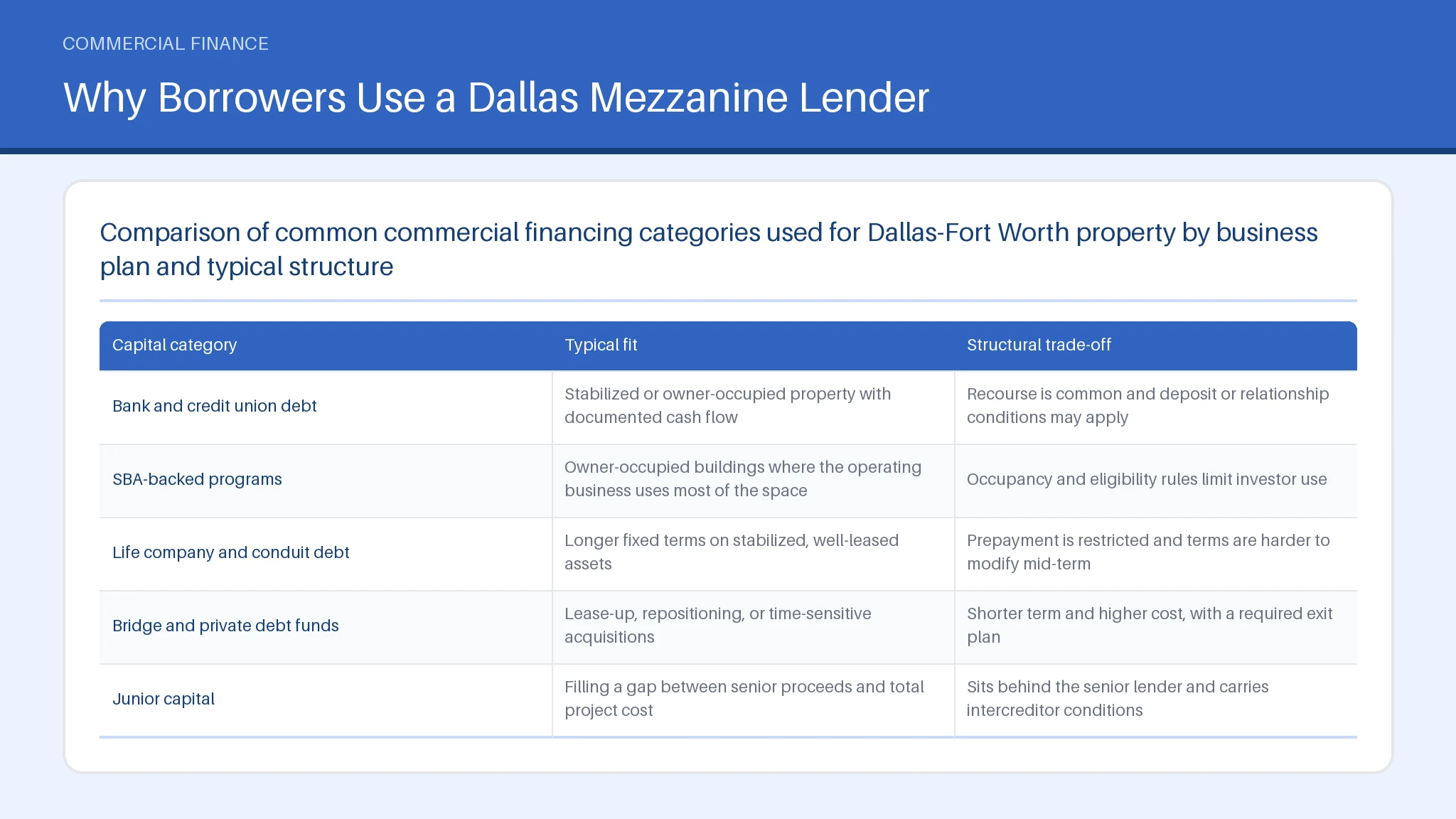
Financing options across the Metroplex sort cleanly by business plan rather than by geography. Stabilized property with steady rent roll suits bank, agency, or conduit debt. Property that needs lease-up, repositioning, or construction suits shorter-term capital that accepts transition risk and prices for it. Owner-occupied buildings where the operating business pays the rent open a separate lane through SBA programs. Dallas commercial real estate lenders in each lane ask for different documentation, and the fastest way to waste a month is to send transitional collateral to a lender that only funds stabilized cash flow.
| Capital category | Typical fit | Structural trade-off |
|---|---|---|
| Bank and credit union debt | Stabilized or owner-occupied property with documented cash flow | Recourse is common and deposit or relationship conditions may apply |
| SBA-backed programs | Owner-occupied buildings where the operating business uses most of the space | Occupancy and eligibility rules limit investor use |
| Life company and conduit debt | Longer fixed terms on stabilized, well-leased assets | Prepayment is restricted and terms are harder to modify mid-term |
| Bridge and private debt funds | Lease-up, repositioning, or time-sensitive acquisitions | Shorter term and higher cost, with a required exit plan |
| Junior capital | Filling a gap between senior proceeds and total project cost | Sits behind the senior lender and carries intercreditor conditions |
Pricing differences between these categories follow the index and spread convention explained in the guide to how commercial loan rates are set, so this article keeps its focus on structure and qualification rather than quoted numbers.
Refinancing an Existing Commercial Property Loan in Dallas
Refinancing a Dallas commercial property loan is an arithmetic exercise, not a timing hunch. Start with three numbers: the exit cost on the existing debt, the all-in cost to close new debt, and the proceeds the new loan supports at current net operating income. Prepayment terms decide the first number, and they vary widely. A bank loan may carry a declining percentage fee, while a conduit loan may require defeasance or yield maintenance that costs far more than borrowers expect in a falling-rate environment.
The second trap is the income side. Dallas County and Tarrant County reassess property after a sale, and the new assessed value often lifts the tax line well above what the prior owner paid. If a borrower underwrote the refinance on trailing twelve-month expenses, the lender's forward-looking expense assumptions can cut proceeds sharply. Insurance renewals across North Texas have moved the same direction, and a lender will underwrite the renewal quote rather than the expiring premium.
Borrowers refinancing to pull equity out should read the detail on how a commercial cash out refinance converts equity into cash, and those weighing total cost against benefit will find the broader analysis in the guide to refinancing commercial property. Dallas commercial real estate lenders generally want a clear reason for the refinance, whether that is term certainty, release of a guaranty, or funding the next acquisition.
Why Borrowers Use a Dallas Mezzanine Lender
Borrowers use mezzanine capital in Dallas when the senior loan stops short of the capital stack they need and writing a larger equity check would damage the return. A senior lender constrained by debt service coverage or debt yield may size to sixty or sixty-five percent of cost on a transitional asset. Junior capital bridges part of the remaining gap, usually secured by a pledge of the ownership interests rather than a mortgage on the building itself.
The trade-offs are concrete. Junior capital prices above senior debt because it absorbs loss first after equity. It also arrives with an intercreditor agreement that governs what the junior lender may do on default, how cure rights work, and whether the senior lender must consent to a transfer of interests. Borrowers often focus on the coupon and overlook the control provisions, which matter far more if a lease-up schedule slips.
Preferred equity performs a similar function with different documentation and different remedies. Both structures demand a credible exit, since the combined cost only works if a sale or permanent refinance retires the stack on schedule. The mechanics of junior positions are set out in the guide to mezzanine financing. When Dallas commercial real estate lenders see junior capital in a stack, they scrutinize the sponsor's track record more closely than usual.
Tailoring a Dallas Commercial Mortgage to Your Business
A Dallas commercial mortgage should be shaped around how long the owner intends to hold the property and how the space is used. An operating business occupying most of its own building has access to owner-occupied programs with long amortization and modest down payments, which preserves working capital for equipment and payroll. An investor holding leased space is underwritten on the rent roll, lease expirations, and tenant credit instead.
Three structural decisions deserve attention before the term sheet is signed. The first is recourse. Full recourse usually buys better pricing, while limited recourse shifts risk to the lender and narrows the lender pool, a trade-off explained in the guide to non-recourse commercial loans and their carve-outs. The second is term length against prepayment flexibility, since a long fixed term protects against rate movement but penalizes an early sale. The third is reserve structure, because lenders funding Texas property often escrow taxes and insurance monthly, which changes monthly cash flow more than borrowers anticipate.
Owner-occupants comparing government-backed options can review how SBA 504 and 7(a) programs differ by property use. Dallas commercial real estate lenders will also ask how the business plan survives a vacancy, so model one.
Loan Products for Buying Commercial Property in Dallas
Loan products for buying commercial property in Dallas divide by what the asset produces on day one. A fully leased industrial building or a net-leased retail property supports permanent debt immediately, and the lender sizes the loan on in-place net operating income tested against a coverage ratio and a debt yield floor. A partially vacant building or a value-add multifamily asset does not clear those tests yet, so acquisition financing is usually short term with an interest reserve and a defined stabilization period.
Property type shapes the lender list more than most buyers expect. Industrial collateral in the Metroplex draws broad interest, and the structures lenders use are covered in the guide to industrial property loans. Self-storage, car wash, and single-tenant assets each carry their own reserve and re-tenanting assumptions.
Two sizing tools decide the number. Debt service coverage measures income against payment, and the debt yield formula measures income against loan amount without reference to rate, which is why it often becomes the binding constraint on larger loans. Buyers valuing the asset should also check the assumptions behind the cap rate calculation. Dallas commercial real estate lenders apply whichever test produces the smaller loan.
Summary
Dallas commercial real estate lenders separate into categories by business plan: stabilized cash flow goes to bank, life company, and conduit debt, transitional property goes to bridge and private capital, and owner-occupied buildings open SBA lanes. In every case the loan amount is set by net operating income tested against coverage and debt yield, and in North Texas that income is pressured by post-sale tax reassessment and rising insurance premiums. Refinance and junior capital decisions come down to documented cost comparisons rather than market sentiment. CRE Loans USA is a lender-matching service that routes a described deal to independent third-party finance providers, who make all lending and pricing decisions. continue with the qualification form below or read how the matching process works.
Frequently asked questions
Have a construction project?
Construction projects in the Dallas-Fort Worth area are financed differently from completed buildings, and the difference starts with how money leaves the lender. A construction facility funds in draws against inspected progress rather than in a single advance at closing, so the borrower carries interest only on the balance drawn to date. Lenders underwrite the total project budget, including hard costs, soft costs, a contingency line, and an interest reserve that covers carrying cost until the property generates rent. They also review the general contractor, the form of construction contract, and whether the budget reflects current subcontractor pricing in a market where labor demand has stayed strong.
Equity timing matters as much as the budget.
Q: Can I use the loan for both property purchases and new development?
A single loan rarely covers both an existing property purchase and new ground-up development, because the two carry different risk profiles and different funding mechanics. A purchase closes in one advance against an appraised, income-producing asset. Development funds progressively against a budget, with inspections and completion risk attached. Lenders usually structure these as separate facilities, or as one facility with distinct phases, pricing, and covenants for each.
There are practical combinations. A borrower buying land or an underused building with the intent to develop may use an acquisition and construction facility from one lender, where the acquisition advance is sized against land or as-is value and the construction advances follow permits and a finalized budget.