
A fix and flip loan calculator is a simple profit model: it takes the after repair value you expect to sell for, subtracts the purchase price, the rehab budget, the cost of borrowing, the cost of owning the property while work is underway and the cost of selling it, and shows you what is left. The arithmetic is not difficult. What separates investors who make money from investors who learn expensive lessons is the quality of the numbers they feed into it and the honesty of the assumptions behind them.
Most free tools online handle purchase price and rehab well, because those two inputs feel concrete. They handle the other three badly. Interest on a short-term investor loan is usually quoted as a rate, but the real cost includes origination points charged up front, fees on each construction draw, inspection charges, and an extension fee if the project runs past the maturity date. Holding costs keep accruing whether or not the contractor shows up. Selling costs, including agent commissions, transfer taxes, title charges and any concession you give a buyer, routinely take 6 to 9 percent of the sale price off the top.
This guide walks through how to build and read a fix and flip loan calculator that reflects those realities, which inputs actually move the result, how to match term length to a realistic schedule, and how to stress test a deal before you commit to a contract price. For background on the debt itself, including draw mechanics, eligibility and payoff, see the pillar guide on how fix and flip loans work and how to qualify. The calculator work here assumes you already know roughly which loan structure you are modeling and want to pressure test the economics of a specific property.
One framing point worth making up front: a calculator tells you whether a deal is worth pursuing at a given price. It does not tell you whether a lender will fund it, at what leverage, or on what terms. Those are separate questions decided by independent finance providers reviewing the property, your scope of work and your track record.
Key takeaways
- A fix and flip loan calculator estimates profit by subtracting purchase price, rehab budget, holding costs, financing costs and selling costs from the after repair value.
- Financing costs are not just the interest rate. Origination points, draw fees, inspection fees, extension fees and two sets of closing costs all land in the same column.
- Holding costs run every month you own the property, so a project that slips from six months to ten can erase a thin margin even when the rehab budget holds.
- Most experienced flippers want a profit that survives a sale price below their after repair value estimate and a rehab overrun of 10 to 20 percent.
- A calculator sizes the deal. Independent lenders set the actual terms, leverage and pricing after they review the property, the scope of work and the borrower.
Fix and Flip Loan Calculator for Estimating Your Deal
A useful fix and flip loan calculator groups its inputs into five cost buckets plus the exit value, because that structure shows you where risk actually sits. Purchase price and rehab are the largest numbers but the easiest to verify. The three smaller buckets are where estimates drift, and they drift in the same direction: upward.
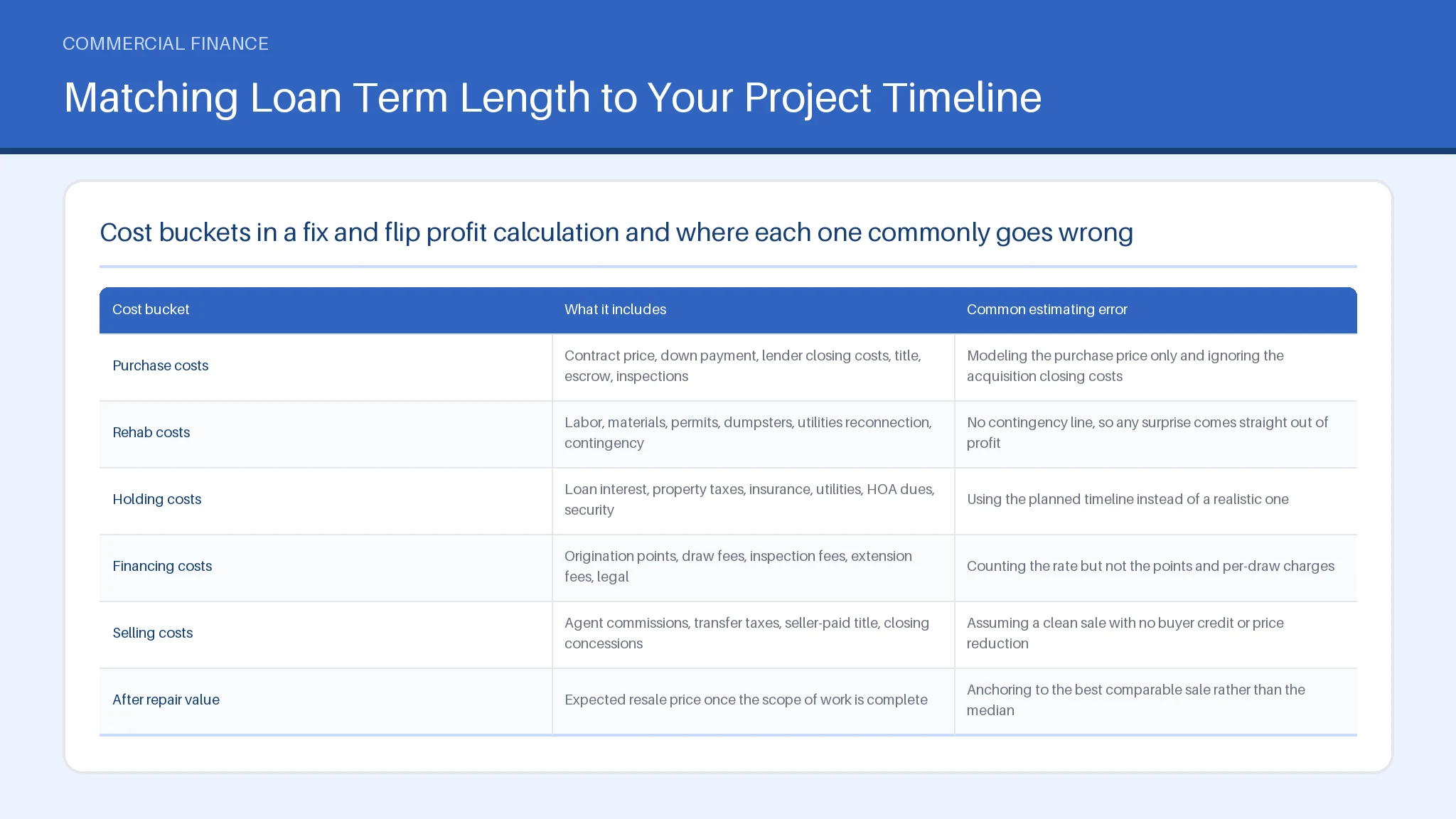
The table below sets out what belongs in each bucket and the common mistake associated with it. Use it as a checklist when you build or audit a spreadsheet.
| Cost bucket | What it includes | Common estimating error |
|---|---|---|
| Purchase costs | Contract price, down payment, lender closing costs, title, escrow, inspections | Modeling the purchase price only and ignoring the acquisition closing costs |
| Rehab costs | Labor, materials, permits, dumpsters, utilities reconnection, contingency | No contingency line, so any surprise comes straight out of profit |
| Holding costs | Loan interest, property taxes, insurance, utilities, HOA dues, security | Using the planned timeline instead of a realistic one |
| Financing costs | Origination points, draw fees, inspection fees, extension fees, legal | Counting the rate but not the points and per-draw charges |
| Selling costs | Agent commissions, transfer taxes, seller-paid title, closing concessions | Assuming a clean sale with no buyer credit or price reduction |
| After repair value | Expected resale price once the scope of work is complete | Anchoring to the best comparable sale rather than the median |
Build the model so each bucket is visible separately. When a deal fails, you want to see which bucket killed it, not just that the profit line turned red.
Holding Costs to Budget While You Own the Property
Holding costs are the recurring expenses that accrue every month you own the property, and they are the bucket most often understated in a fix and flip loan calculator. The predictable items are loan interest, property taxes, hazard insurance and utilities. Builder's risk or vacant property insurance usually costs more than a standard homeowner policy because the building is unoccupied and under construction, and some carriers bill it as a single up-front premium rather than monthly.
The items investors forget tend to be small individually and meaningful together: HOA or condo dues, lawn and snow service to keep the property from drawing code complaints, temporary power during rewiring, a portable toilet and dumpster rental for the duration of the work, permit extension fees, and a security system or boarding if the neighborhood warrants it. Add winterization in cold climates if the project will sit over a freeze.
Model holding costs as a monthly figure multiplied by a realistic month count, then run a second scenario with two or three extra months. On a loan carrying interest, each additional month also adds interest, so the two numbers compound. If a deal only works at exactly six months, it is a deal that depends on nothing going wrong, which is rarely how a renovation behaves.
Estimating Flip Profit With a Fix and Flip Calculator
A good profit on a flip is one that still exists after the sale price comes in below your estimate and the rehab runs over. Many active investors target a net profit of at least 10 to 15 percent of the after repair value, or a dollar floor such as $25,000 to $40,000 per project depending on market and deal size, specifically because that cushion absorbs normal variance. A projected profit of $12,000 on a $300,000 resale is not a thin win, it is a coin flip, because a single $8,000 surprise and a $5,000 buyer concession turn it negative.
When you estimate flip profit with a fix and flip loan calculator, judge the result on three views rather than one. The base case uses your current assumptions. The downside case cuts the after repair value by 5 percent, raises the rehab budget by 15 percent and adds three months of holding costs. The upside case is interesting but should never drive the offer. If the downside case is still positive, the deal has structural room. If only the base case works, the deal is a bet on execution.
Also look at return on cost, which is profit divided by total project cost, alongside the dollar figure. A $30,000 profit on $150,000 of total cost is a different business than $30,000 on $600,000. Return on cost normalizes across deal sizes, and annualizing it by project length lets you compare a fast cosmetic flip to a longer structural rebuild honestly.
Fix and Flip Loan Calculator Questions Investors Ask Most
The questions that come up most about a fix and flip loan calculator are about what the tool is actually modeling. The first is whether to run the numbers with the rehab rolled into the loan or funded from cash. Most short-term investor loans advance rehab in draws after work is completed and inspected, which means you float each stage of the work before reimbursement. A calculator that treats the full rehab as day-one loan proceeds will overstate your cash position even if it gets the profit right.
The second is what leverage figure to assume. Investors often plug in a loan amount sized against purchase price, but lenders commonly size against total project cost or against after repair value, and the binding constraint moves depending on the deal. Running the model at a slightly lower advance rate than you hope for is the safer habit.
The third is how to handle interest when a loan has interest reserves or charges on the full committed amount rather than the drawn balance. Those two conventions produce materially different carry costs on the same stated rate. Pricing structure is a topic in itself, and the mechanics of how indexes and spreads build a rate are covered in the guide to commercial loan rates and index plus spread.
Matching Loan Term Length to Your Project Timeline
Term length should be set against your realistic schedule plus a marketing and closing window, not against your construction schedule alone. A twelve month term on a project with a four month scope of work sounds generous until you add permit review, a contractor who starts three weeks late, a failed inspection, a material lead time, then 30 to 60 days on market and another 30 to 45 days to close with a buyer who needs financing. That sequence consumes a twelve month term more often than investors expect.
The trade-off is cost. Longer terms and interest-only structures reduce the chance of needing an extension, but they usually carry more total interest and sometimes a higher rate. Shorter terms can price better and then expose you to extension fees, which are often charged as points on the outstanding balance, plus the risk of a default rate if no extension is granted. Model both paths in your fix and flip loan calculator and compare the all-in cost rather than the headline rate.
Plan the exit at the same time. If the exit is a sale, build in the listing period. If the exit is a refinance into longer-term rental debt, confirm the seasoning and documentation expectations early, because DSCR loan requirements and approval mechanics differ from short-term renovation lending.
The Formula Behind Flip Profit Calculations
The formula for fix and flip profit is: after repair value minus purchase costs, minus rehab costs, minus holding costs, minus financing costs, minus selling costs. Everything else in a calculator is a way of estimating one of those six terms more carefully.
Each term has its own method. After repair value comes from recent closed sales of comparable finished properties in the same submarket, adjusted for size, condition and lot, and the detail of that estimate is covered in the guide to estimating after repair value. Purchase costs are the contract price plus acquisition closing costs. Rehab is the itemized scope of work plus a contingency, typically 10 to 20 percent of the hard cost line. Holding costs are the monthly carry multiplied by the project duration. Financing costs are origination points plus interest paid plus draw, inspection and extension fees. Selling costs are commissions, transfer taxes, seller-paid closing items and any concession.
Two refinements make the formula more honest. First, separate interest from the rest of the financing bucket, because interest scales with time while points do not. Second, track cash invested separately from profit, since a flip can show a healthy profit while demanding more cash out of pocket than you have. Return on cost and cash-on-cash return answer different questions, and both matter when you are deciding which of two deals to pursue with limited capital.
Inputs and Metrics That Decide Whether a Flip Works
Three inputs decide most outcomes: the after repair value, the rehab scope and the timeline. An error in any one of them moves profit more than a half point difference in interest rate. That is why disciplined investors spend their effort on contractor bids and comparable sales rather than on shopping for the last fraction of a point.
The metrics worth watching alongside raw profit are profit as a percentage of after repair value, return on total cost, cash required to close including the first draw cycle, and break-even sale price. Break-even is the most underused of the four. Knowing the exact price at which the deal returns zero tells you how much room you have to cut the asking price if the property sits, and whether a price reduction is a decision you can afford to make quickly.
Add one sensitivity test: hold everything constant and ask what sale price is needed if the project takes four extra months. If that price exceeds the top of the comparable range, the deal has a timeline problem rather than a pricing problem, and no financing structure fixes it.
Sample Deal Figures You Can Replace With Your Own
Sample figures are useful only as placeholders, so treat every number below as a slot to overwrite with quotes and comparable sales from your own market. A workable template looks like this: enter the contract price, then acquisition closing costs as a separate line rather than folding them into the price. Enter the rehab as the sum of itemized trade bids, then add a contingency line of 10 to 20 percent that you do not spend mentally before the project starts.
Enter holding costs as a monthly figure built from taxes divided by twelve, the insurance premium, utilities, dues and any site services, then multiply by your project month count. Enter financing costs as origination points on the loan amount, plus estimated interest over the hold, plus draw and inspection fees multiplied by the number of draws you expect. Enter selling costs as a percentage of sale price covering commission, transfer tax and seller-paid title, plus a dollar allowance for buyer concessions.
Keep the assumptions visible in their own column. When a lender or partner reviews the deal, the assumptions are what they will question, and a model that hides them behind a single blended percentage is harder to defend. More worked examples across property types sit in the commercial real estate finance guides.
Worked Flip Example Using a $300,000 After Repair Value
Work a $300,000 after repair value through the formula and the structure becomes clear. Say the purchase price is $180,000 with $4,000 in acquisition closing costs, the itemized rehab is $45,000 with a 15 percent contingency of $6,750, and the project runs seven months rather than the five you planned.
Costs stack like this. Purchase plus closing is $184,000. Rehab plus contingency is $51,750. Holding costs at roughly $900 a month for taxes, insurance, utilities and dues across seven months add about $6,300. Financing costs include two points of origination, interest over the hold and three draw and inspection fees, which on a deal this size commonly lands in the mid five figures once interest is included. Selling costs at 7 percent of a $300,000 sale are $21,000. Total project cost sits in the neighborhood of $280,000 to $288,000, leaving roughly $12,000 to $20,000 of profit.
That is the useful lesson. A deal that looks like a $75,000 spread between purchase plus rehab and after repair value compresses to a modest profit once every bucket is filled in. Buying at $165,000 instead of $180,000, or finishing in five months instead of seven, changes the outcome far more than renegotiating the rate.
Summary
A fix and flip loan calculator earns its keep when it forces you to price the three buckets investors skip: holding, financing and selling. Build the model with each bucket visible, add a rehab contingency, run a downside case with a lower after repair value and a longer timeline, and check the break-even sale price before you sign a contract. Judge the result on return on cost and cash required, not on the headline profit alone. A fix and flip loan calculator sizes the deal, but independent third-party finance providers decide leverage, pricing and terms after reviewing the property, scope and borrower. CRE Loans USA matches US investors with those lenders. continue with the qualification form below, or read how CRE loan matching works.
You may also find these related guides helpful: Dallas Commercial Real Estate Lenders: Which Fit Your Deal, Commercial Construction Loans: How They Work and Qualify, Commercial Property Insurance: What It Covers and Costs, Commercial Real Estate Debt Financing: How It Works, Commercial Real Estate Debt Funds: How They Work and Invest, and Hotel Financing Lenders: Loan Types, Terms and Approval.
Frequently asked questions
What is a good profit margin on a flip?
A good profit margin on a flip is generally one that reaches at least 10 to 15 percent of the after repair value and survives a stress test. Experienced investors often also apply a dollar floor, commonly $25,000 to $40,000 per project, because percentage targets flatter small deals where fixed costs such as closing fees and commissions take a bigger bite. The reason for the cushion is not greed, it is variance: resale prices move, rehab scopes expand once walls open up, and timelines slip. A margin that only works in the base case is not a margin, it is an assumption.
How much does hard money financing add to a flip?
Hard money and other short-term investor financing typically adds cost in three layers rather than one. There is the interest rate applied over the hold period, origination points charged at closing on the loan amount, and transaction fees including draw fees, inspection fees, legal or document fees and any extension fee if the project runs past maturity. On a typical short renovation hold, total financing cost often works out to a meaningful share of projected profit, which is why the loan belongs in the model as a full bucket rather than a single interest line. Pricing differs by lender, leverage, property and borrower experience, and those decisions are made by independent finance providers.
What if the flip numbers do not work?
When the flip numbers do not work, the right response is to change the offer price rather than the assumptions. Back into the price the deal supports: start from the after repair value, subtract your required profit, then subtract rehab, holding, financing and selling costs, and the remainder is your maximum purchase price. If the seller will not meet it, walk. The alternative options are narrower than they look, since you can rarely cut selling costs much, and shaving the contingency or assuming a faster timeline simply moves the risk rather than removing it. Occasionally a different exit, such as holding and refinancing into rental debt, rescues a deal the resale math rejects.
How to Run the Numbers Before You Offer?
Running the numbers before you offer means completing the full model with real inputs, not estimates of estimates. Pull three to five closed comparable sales of finished properties in the same submarket and use the median rather than the best one. Walk the property with a contractor and get an itemized scope rather than a per-square-foot guess. Price taxes and insurance from actual records and quotes. Then calculate your maximum offer, your break-even sale price and your downside case. Deals are won or lost at the purchase price, and that is the only variable fully under your control at the moment you write the offer.
How do you calculate profit on a house flip?
Profit on a house flip is calculated as after repair value minus purchase costs, rehab costs, holding costs, financing costs and selling costs. Work left to right and keep each bucket separate so you can see which one is doing the damage when a deal fails. Purchase costs include closing fees, not just the contract price. Rehab includes a contingency. Holding runs monthly for the full ownership period. Financing includes points and fees, not just interest. Selling typically takes 6 to 9 percent of the sale price once commissions, transfer taxes and concessions are counted.
What holding costs do people forget?
The holding costs people forget are the small recurring ones: HOA or condo dues, lawn and snow service, temporary utilities during rewiring, dumpster and portable toilet rental, permit extension fees, winterization, and security or boarding on vacant properties. Vacant property or builder's risk insurance is another surprise, since it usually costs more than a standard policy and may be billed as a single up-front premium. None of these items is large alone. Together, across an extra three or four months of ownership, they regularly account for the difference between a projected profit and an actual one. Detailed project cost benchmarks for renovation work sit in the fix and flip loans guide, and the site FAQ covers how lender matching itself works.
Part of Fix and Flip Loans: How They Work and How to Qualify