
Assisted living facility financing is debt raised against a licensed senior housing property and the care business running inside it. That dual nature is the whole story. A lender looking at a 48-unit community is not simply valuing square footage and a roof; it is testing whether the census holds, whether the payor mix is stable, whether staffing ratios meet state licensure, and whether net operating income after a market management fee still covers debt service.
That is why borrowers who approach a senior care deal like a standard apartment purchase get surprised. Underwriting asks for trailing twelve-month operating statements, a census by unit type, state survey history and the resume of the operator who will actually run the building. Deals with strong real estate and a weak operator stall. So do deals where the sponsor has never managed a licensed care setting.
This guide walks through the realistic capital structures for assisted living facility financing in the United States, from federally insured mortgage programs and SBA business debt through USDA rural options, bridge debt and asset-based hard money. It explains where each one fits, what it costs you in flexibility, and which qualifying factors decide the outcome. For broader background on how commercial debt is sized and priced, the commercial real estate finance guides cover the underlying mechanics.
Key takeaways
- Assisted living facility financing is underwritten as an operating business and real estate together, so census, payor mix and staffing costs matter as much as the building.
- Program categories range from HUD insured mortgage programs and SBA business loans to conventional bank debt, USDA rural programs and short-term bridge or hard money debt.
- Federally insured options generally require a stabilized operating history, licensed beds and third-party reports, which is why many buyers bridge first and take out the bridge later.
- Private pay, long-term care insurance and Medicaid waiver dollars behave differently in underwriting, and a heavy Medicaid payor mix usually tightens proceeds.
- Documentation depth decides timing: trailing twelve-month operating statements, licensure records and an experienced operator are the usual gating items.
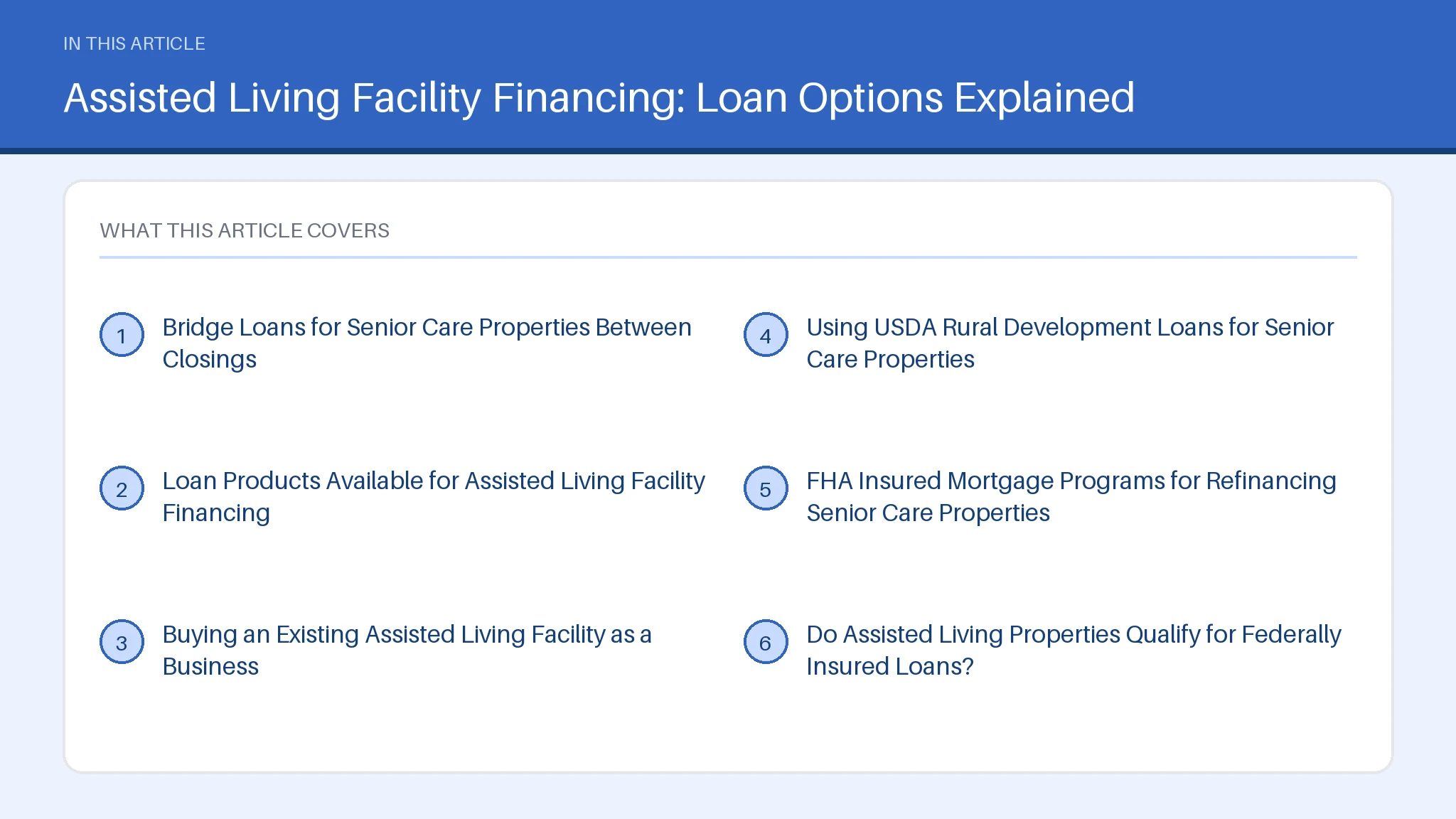
Bridge Loans for Senior Care Properties Between Closings
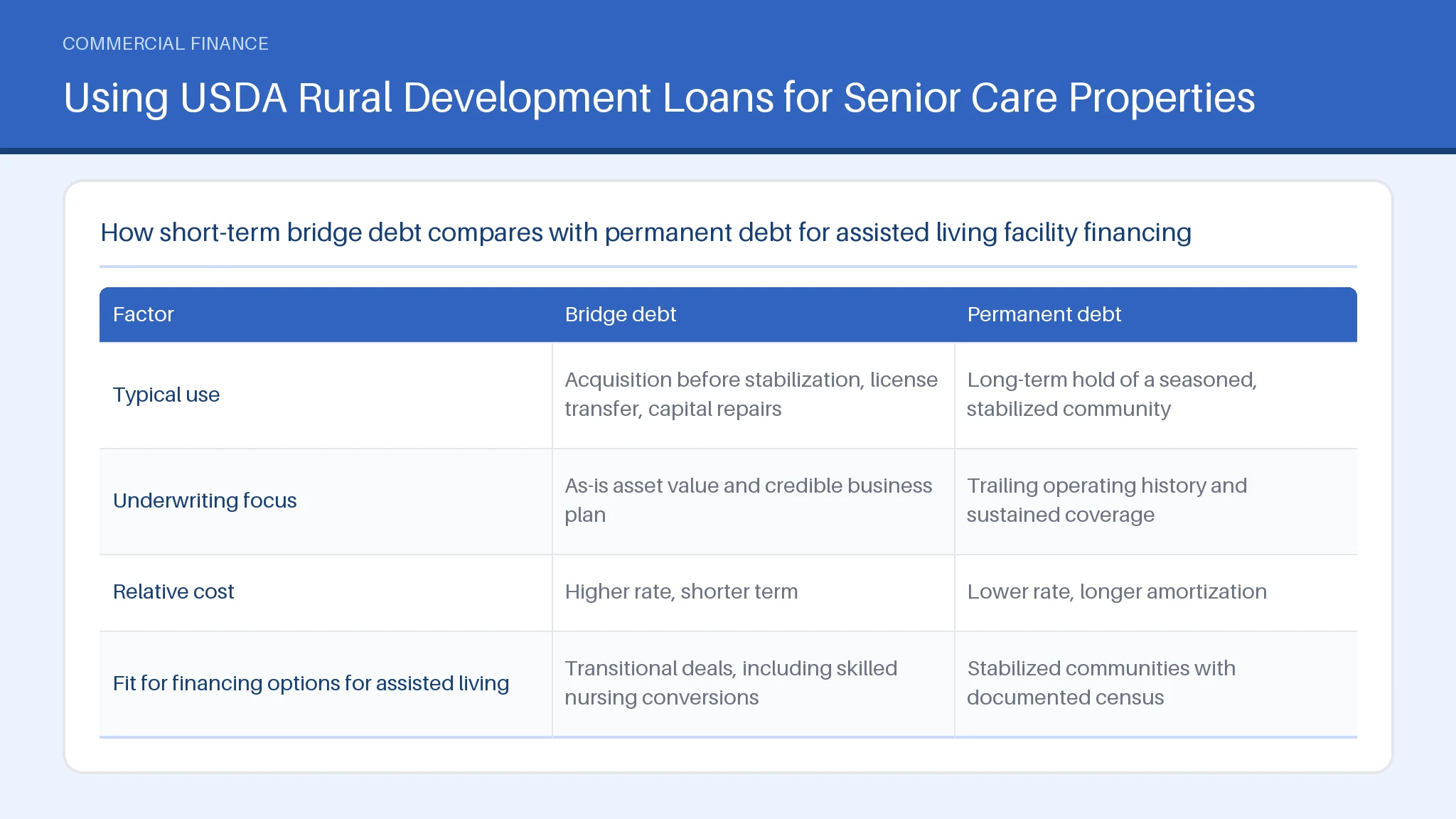
Bridge debt exists to buy time between a purchase and a permanent takeout. A buyer acquiring a community with a soft census, a pending license transfer or deferred capital work rarely qualifies for federally insured debt on day one, because those programs want stabilized trailing performance. Short-term asset-based debt closes the gap, funds the repositioning, and gets retired once the operation seasons. The trade-off is cost and term: faster closings and lighter covenants come with higher pricing and a hard maturity date, so the exit must be planned before the bridge funds. The same logic applies to skilled nursing and memory care assets. Compare the categories below before committing to a lender or a structure, and read our note on refinancing a commercial property for how the takeout is priced.
| Factor | Bridge debt | Permanent debt |
|---|---|---|
| Typical use | Acquisition before stabilization, license transfer, capital repairs | Long-term hold of a seasoned, stabilized community |
| Underwriting focus | As-is asset value and credible business plan | Trailing operating history and sustained coverage |
| Relative cost | Higher rate, shorter term | Lower rate, longer amortization |
| Fit for financing options for assisted living | Transitional deals, including skilled nursing conversions | Stabilized communities with documented census |
Loan Products Available for Assisted Living Facility Financing
Four program families cover almost every assisted living facility financing request in the United States. HUD insured mortgage programs sit at the long end, offering extended amortization and non-recourse structures for licensed residential care properties, including construction and substantial rehabilitation. Getting HUD-assisted living financing starts with a HUD-approved mortgagee, a stabilized or well-supported pro forma, third-party appraisal, market study, environmental and property condition reports, and a lender review that runs several months rather than several weeks. The program trades speed for durability, so it suits owners who intend to hold.
SBA financing can work for your assisted living facility when the transaction is really a business purchase with real estate attached and the sponsor will occupy and operate the property. SBA programs reach smaller residential care homes and owner-operators that institutional capital ignores, and they permit a blend of real estate, working capital and goodwill. Our explainer on SBA 504 versus 7(a) sets out which structure matches which use of funds.
Conventional bank and credit union debt remains the fastest route for experienced operators with banking relationships, usually at shorter terms with recourse. Short-term bridge and asset-based debt handles everything that is not yet stabilized. Mapping the answers to what are the financing options for assisted living comes down to honest sequencing: use transitional capital to fix the operation, then refinance into the program your hold period actually requires.
Buying an Existing Assisted Living Facility as a Business
Buying an existing community is a business acquisition first and a real estate purchase second. Price is usually a function of in-place net operating income after replacing any owner labor with a market-rate management fee, and buyers who skip that adjustment overpay. Credit review will look hard at the licensed bed count, state survey and deficiency history, resident agreements, staffing contracts and whether the license transfers or must be reissued. A gap in licensure between closings can stop revenue cold.
Sponsors new to assisted living usually need an experienced third-party operator on the application to make assisted living facility financing viable. Work through the operating records with the same discipline as a multifamily due diligence checklist, then add census trends, payor mix and turnover data. Those three figures predict post-closing performance better than the asking cap rate does.
Using USDA Rural Development Loans for Senior Care Properties
USDA Rural Development guarantees support business and industry lending in eligible rural areas, and senior care operators in small towns use them where bank appetite is thin. The guarantee reduces a bank's loss exposure, which can unlock an assisted living facility loan in a market with few comparable sales. Eligibility turns on location inside a qualifying rural area, population limits, job and community benefit, and a borrower able to document repayment capacity.
Proceeds typically cover acquisition of land and buildings, equipment, and in many cases the refinance of existing debt where the new structure improves cash flow. Processing involves both the originating bank and the agency, so build extra weeks into the schedule. Skilled nursing and other licensed care uses are reviewed case by case, and a nursing component adds licensure review on top of the standard credit file.
FHA Insured Mortgage Programs for Refinancing Senior Care Properties
FHA insured mortgage programs administered through HUD are the long-term anchor for stabilized senior care properties. The Section 232 program and its 223(f) application insure a mortgage made by an approved lender, which lets owners refinance or acquire licensed residential care facilities with extended amortization, fixed pricing and non-recourse terms subject to standard carve-outs. The insurance protects the lender, not the borrower, so credit standards remain real.
Qualifying hinges on documented operating history, usually several years of stabilized results, acceptable survey history, a replacement reserve and third-party reports. Borrowers accept mortgage insurance premiums, prescribed reserve funding and annual reporting in exchange for terms no bank matches. An assisted living facility loan placed this way often follows transitional debt, which is why exit planning matters from the first day of assisted living facility financing. Our guide to non-recourse limits and carve-outs explains what the structure does not cover.
Do Assisted Living Properties Qualify for Federally Insured Loans?
Licensed assisted living properties do qualify for federally insured mortgage programs, provided the facility meets HUD's definition of a residential care establishment licensed by the state and offers continuous protective oversight with meals and personal care. Independent living units are generally allowed only as a minority share of the community. Unlicensed independent living alone falls outside the program.
HUD 232 loans for the construction of assisted living facilities are available for new construction and substantial rehabilitation, with insured financing covering hard and soft costs, an interest reserve and the conversion into a long-term insured mortgage at completion. Expect a market study proving absorption, a detailed construction budget, a qualified general contractor and a named operator with a track record in the care setting being built. For general background on draw mechanics, see how commercial construction loans work.
SBA loans help assisted living businesses in a different way. They finance the enterprise, including working capital, equipment, goodwill and partner buyouts, at smaller loan sizes with personal guarantees. Federal insurance supports the mortgage; the SBA guarantee supports the business. Many smaller operators use one, then graduate to the other.
Hard Money Lending Against Senior Care Real Estate
Hard money debt is priced off collateral value rather than operating history. A private lender secured by senior care real estate will advance against the as-is value of the building and land, fund quickly, and accept a property that a bank's healthcare credit committee would decline, such as one with a lapsed census, deferred maintenance or an owner in distress. Interest-only payments keep the monthly burden predictable while the operation is repaired.
The limitations are blunt. Advance rates are conservative, terms run short, and the borrower must be eligible for a credible takeout before the note matures. Among the financing options for assisted living, this is the most expensive capital, so it works only when the repositioning adds measurable value and the owner can refinance into bank or insured debt. Compare it with junior capital structures before committing.
Summary
Senior care debt rewards sequencing: bridge or SBA capital while the operation seasons, then HUD, USDA-guaranteed or bank debt for the hold. Census, payor mix and operator experience drive the outcome more than the building does. CRE Loans USA is a lender-matching service, and the quiz routes your scenario to independent finance providers. continue with the qualification form below.
You may also find these related guides helpful: Commercial Property Insurance: What It Covers and Costs and CMBS Loans: How Fixed-Rate CRE Financing Works.
Frequently asked questions
How to pay for assisted living if you can't afford it?
Families who cannot cover the full private rate typically combine sources: Social Security and pension income, proceeds from selling a home, long-term care insurance benefits, Veterans Aid and Attendance benefits, and state Medicaid waiver programs that pay for care services in licensed community settings. Waiver availability and waiting lists vary by state, and many communities cap the number of waiver beds, so the practical answer depends on local program rules.
What are the financing options for assisted living?
Owners and developers fund senior care property through HUD insured mortgage programs, SBA business loans, conventional bank debt, USDA Rural Development guarantees in eligible rural markets, and short-term bridge or asset-based debt used before a property stabilizes. The right choice depends on hold period, stabilization status and operator experience, as set out in how lender matching works.
What happens when you can't afford assisted living anymore?
Residents who exhaust private funds usually move to a Medicaid-certified bed in the same community where one exists, or transfer to a certified provider nearby. Communities must follow state discharge notice rules, so the transition is documented rather than immediate. Owners should track this exposure, because it shifts payor mix and changes underwritten revenue.
How profitable is owning an assisted living facility?
Profitability varies widely with size, payor mix, labor cost and occupancy. Margins compress fast when agency staffing fills open shifts or census slips below the break-even point, which is why credit review tests coverage at a stressed occupancy rather than at the current one. Review the debt yield approach to loan sizing to see how that stress affects proceeds.
How much can you make turning your home into an assisted living facility?
Converting a house into a licensed residential care home produces revenue tied to the licensed bed count and local private rates, minus staffing, food, insurance and compliance costs. Licensing, zoning and fire-code upgrades usually come first, and those capital costs often need financing before any revenue arrives.
What are the disadvantages of living in a 55+ community?
Age-restricted communities limit who may buy or live there, which narrows the resale pool, and they charge association fees that can rise. They also provide no licensed care, so a resident needing personal assistance must arrange it separately or move.
What should you know about HUD 232/223(f) loans for refinancing or acquiring assisted living facilities?
HUD 232/223(f) insures a mortgage for refinancing or acquiring an existing licensed residential care facility, offering long fixed terms and non-recourse structure in exchange for stabilized operating history, third-party reports, funded reserves, mortgage insurance premiums and ongoing reporting. Processing takes months, so most buyers close on transitional debt first. Background on sponsors and eligibility sits on the about page and in the general financing FAQ.