
Hotel construction financing is short-term, draw-based debt that pays for building a hospitality property from the ground up, then gets retired by a sale, a refinance or a conversion to permanent debt once rooms are open and revenue is proven. It is not a mortgage on an existing income stream. At closing, there is no income stream at all, which is why underwriting looks so different from a loan on a stabilized asset.
That difference drives everything a developer experiences. A lender funding a stabilized property can test current net operating income. A lender funding a hotel build has to form a view on construction cost certainty, the general contractor, the brand standards attached to the franchise agreement, the strength of the operator and the realistic pace of occupancy ramp-up in that submarket. The debt is priced and sized against that uncertainty, usually floating, usually interest-only, and usually with a maturity measured in two or three years rather than ten.
Most sponsors searching for hotel construction financing are trying to answer three practical questions at once: how much equity they actually have to write, which capital sources will even look at a ground up hospitality deal, and what happens at maturity if the property opens on time but ramps slower than the pro forma. This guide works through structures, equity expectations, interest reserves, draw mechanics and SBA eligibility, and it is deliberately specific about the trade-offs that generic lists of loan products leave out. For broader background on how building loans function across asset classes, see the overview of commercial construction loans.
Key takeaways
- Hotel construction financing is usually a short-term, interest-only facility that funds land, hard costs and soft costs through a draw schedule, then gets repaid by a sale or by permanent debt once the property stabilizes.
- Sponsors should expect to contribute real equity, often 25 percent to 40 percent of total project cost, plus a completion guaranty and a funded interest reserve covering the pre-opening period.
- Lenders underwrite the brand, the flag or franchise agreement, the operator track record and a feasibility study, not just the land value or the construction budget.
- SBA 7(a) and 504 structures can work for smaller owner-operated hotels, while bridge, bank and debt-fund capital dominate larger ground up builds.
- The riskiest line in a hotel build is the gap between certificate of occupancy and stabilized occupancy, so model at least 12 to 24 months of ramp-up before permanent debt is realistic.
Using a Bridge Loan to Fund Hotel Construction
A hotel bridge loan is short-term debt, typically 12 to 36 months, used to carry a project through construction, opening and the early ramp-up period until the asset qualifies for long-term financing. In ground up hospitality, bridge capital usually comes from debt funds and private credit groups rather than depository banks, and it trades speed and flexibility for higher pricing and tighter covenants.
Bridge debt is most useful in three situations: when the construction loan matures before the hotel reaches stabilized occupancy, when a partially built project changes hands and the new sponsor needs to fund completion, and when a franchise-mandated property improvement plan must be finished before an agency or conventional lender will quote long-term terms. In each case the exit is the whole conversation. Lenders want a credible refinance or sale path documented before they fund the first draw.
The trade-off is cost of carry. Bridge pricing usually floats over a short-term index, and a hotel that opens into a soft quarter burns its interest reserve faster than the model assumed. Sponsors who negotiate an extension option, with a clear performance test and a stated fee, give themselves room if the ramp runs long.
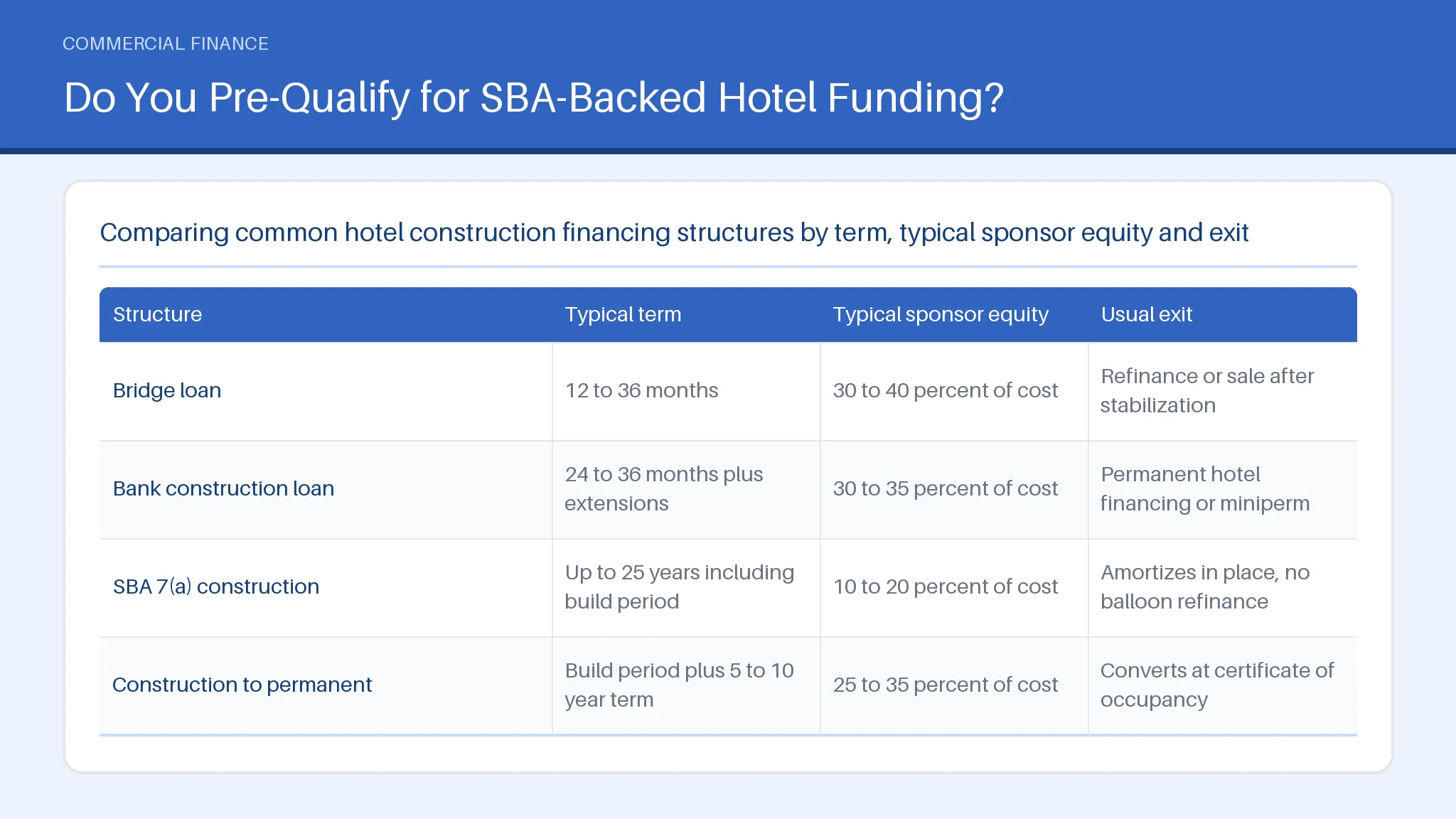
| Structure | Typical term | Typical sponsor equity | Usual exit |
|---|---|---|---|
| Bridge loan | 12 to 36 months | 30 to 40 percent of cost | Refinance or sale after stabilization |
| Bank construction loan | 24 to 36 months plus extensions | 30 to 35 percent of cost | Permanent hotel financing or miniperm |
| SBA 7(a) construction | Up to 25 years including build period | 10 to 20 percent of cost | Amortizes in place, no balloon refinance |
| Construction to permanent | Build period plus 5 to 10 year term | 25 to 35 percent of cost | Converts at certificate of occupancy |
Loan Products That Finance Ground Up Hotel Development
Four capital categories realistically fund ground up hospitality development in the United States: regional and community bank construction loans, SBA-backed programs for owner-operated properties, private debt funds, and construction to permanent facilities that close once and convert at completion. Each category draws a different line on leverage, recourse and speed.
Bank construction financing is the cheapest option when a sponsor qualifies, but banks usually require full recourse, deep local relationships and deposits, and they size conservatively on cost rather than on projected value. SBA programs push leverage higher for smaller flags and owner-operators, at the price of longer document cycles and personal guarantees. Debt funds will fund larger, more complex or non-recourse-leaning deals and will move faster, but their pricing reflects that. Single-close construction to permanent structures remove refinance risk at maturity, which matters when rate volatility is the main threat to a project, though few lenders offer them for hospitality.
Capital stack add-ons also appear on larger builds. Preferred equity, franchisor key money and subordinate debt can close a funding gap; junior capital mechanics are covered in the explainer on mezzanine financing. Developers comparing structures across asset types often review multifamily construction financing first, because draw and inspection mechanics carry over even though hotel construction financing underwrites an operating business.
Do You Pre-Qualify for SBA-Backed Hotel Funding?
SBA-backed hotel funding generally requires an owner-operator structure, a for-profit US business that meets SBA size standards, demonstrated management experience in hospitality, acceptable personal credit, and an owner who will occupy and operate the property rather than lease it to a third party. Passive ownership is the most common disqualifier, because SBA programs are designed for operating businesses.
Beyond eligibility rules, lenders apply their own credit screens. Most want to see liquidity after closing equal to several months of debt service and operating expenses, a personal financial statement showing net worth that is meaningful relative to the loan request, and relevant experience running or managing hotels of similar size and service level. First-time operators are not automatically excluded, but they usually need a seasoned management company under contract and more cash in the deal.
Project-level requirements matter just as much. Expect a third-party feasibility study, a signed franchise agreement or a defensible independent-brand plan, a fixed-price or guaranteed-maximum-price construction contract, and an appraisal that supports the as-completed value. Environmental review and appraisal timelines are the most common cause of delay. A realistic document checklist is set out in the guide to the commercial loan application, and sponsors weighing programs can compare SBA 504 against 7(a) before committing to one path for hotel construction financing or permanent hotel financing.
How the SBA 7(a) Program Works for Hotels
The SBA 7(a) program lets an approved lender make a loan to an owner-operated hospitality business while the Small Business Administration guarantees a portion of it, which reduces lender loss exposure and allows higher leverage and longer amortization than conventional construction financing normally supports. The maximum 7(a) loan amount is 5 million dollars, and real estate loans can amortize up to 25 years with no balloon payment.
For a ground up hotel, the construction period is built into the same facility. The loan funds in draws during construction, interest-only payments apply while the property is being built, and full amortization begins after completion. That single-structure design removes the refinance risk that sits at the end of most short-term construction debt, which is a meaningful advantage for a first or second hospitality asset.
The constraints are real. Rates on 7(a) loans are typically variable and tied to a published base rate plus a spread within SBA maximums, so debt service can move during the ramp-up period. Personal guarantees are required from owners of 20 percent or more, and SBA 7(a) will not support passive investment structures. Lenders also apply overlay conditions on liquidity, franchise approval and construction contingency. Pricing mechanics on floating commercial debt are explained in the guide to commercial loan rates, which applies to hotel construction financing as directly as it does to stabilized debt.
Pros and Cons of Hotel Construction Financing
The core advantage of hotel construction financing is that it funds an asset at cost basis rather than at market price. A developer who builds at 180,000 dollars per key in a submarket where comparable assets trade higher captures that spread as equity, and a new build opens with current brand standards, no deferred maintenance and no inherited property improvement plan. Draw-based financing also protects cash, because interest accrues only on funds actually advanced rather than on the full commitment.
The disadvantages are structural rather than incidental. Construction financing carries completion risk, cost-overrun risk and absorption risk at the same time, and the sponsor absorbs all three through guarantees. Most ground up hospitality financing is full recourse with a completion guaranty, so a personal balance sheet is exposed until conversion. Pricing floats, which means rising rates raise carry during the months when revenue is zero.
Timing is the sharpest constraint. If permanent financing is not in place when the short-term facility matures, the sponsor is negotiating a refinance from a weak position. Three practical defenses help: size the interest reserve for a slower ramp than the feasibility study projects, negotiate extension options up front, and fund a contingency of at least 5 to 10 percent of hard costs. Conservative financing assumptions cost less than an emergency recapitalization. Sponsors weighing other property-level financing paths can review the commercial real estate finance guides.
Summary
Building a hotel means carrying construction risk, cost risk and ramp-up risk at once, and the debt structure chosen at the start decides how much of that risk lands on the sponsor. Bridge debt buys speed, bank loans buy price, SBA 7(a) buys amortization and removes refinance risk for owner-operators. Equity, interest reserve and exit planning matter more than headline rate. CRE Loans USA is a lender-matching service that connects borrowers with independent third-party finance providers, who make all lending and pricing decisions. continue with the qualification form below.
Frequently asked questions
Do I need 20% down for a construction loan?
A 20 percent down payment is rarely enough for a ground up hotel. Most conventional and bridge lenders size construction debt at 60 to 70 percent of total project cost, so sponsor equity usually lands between 30 and 40 percent. SBA-backed structures for owner-operators can reduce the injection to roughly 10 to 20 percent, and land already owned at an appraised value above its purchase price can count toward equity. Lenders also want post-closing liquidity on top of the injection, so the cash requirement is higher than the stated loan-to-cost ratio implies.
What's the monthly payment on a $200,000 construction loan?
Monthly cost on a 200,000 dollar construction loan depends on how much has been drawn, because interest accrues only on funds advanced. If the full balance were outstanding at an 8.5 percent interest-only rate, the monthly payment would be about 1,417 dollars. Early in a build, when only a quarter of the loan has funded, the payment on that same facility would be closer to 354 dollars. Once the loan converts and amortizes over 25 years at the same rate, the payment rises to roughly 1,610 dollars per month. Actual rates are set by the lender.
How much does a 300 room hotel cost to build?
A 300 room hotel costs widely different amounts depending on service level, location and land basis. Select-service builds commonly run 150,000 to 250,000 dollars per key, while full-service and upper-upscale projects regularly exceed 350,000 dollars per key before land. At those ranges, a 300 room project spans roughly 45 million to well above 105 million dollars, and soft costs, furniture, fixtures and equipment, and pre-opening expenses typically add 15 to 25 percent on top of hard construction costs.
What are the typical terms of a construction loan?
Typical construction loan terms are interest-only during the build, floating rate priced over a short-term index, 60 to 70 percent loan to cost, a funded interest reserve, monthly draws released against inspection, a completion guaranty and personal recourse. Expect origination fees of around 1 percent, a construction contingency line, retainage held back from each contractor draw, and covenants requiring the project to stay on budget and on schedule.
How long are construction loan terms?
Construction loan terms usually run 18 to 36 months for a hotel, often with one or two six-month or twelve-month extension options tied to completion and performance tests. Single-close construction to permanent facilities extend further, converting into a five to ten year term at completion, while SBA 7(a) real estate loans can amortize up to 25 years including the construction period.
How to Access Hotel Renovation Financing?
Hotel renovation financing is accessed through several routes: a cash-out refinance of existing equity, a bridge loan sized on as-renovated value, SBA 7(a) proceeds for owner-operators, or franchisor key money contributed toward a brand-mandated property improvement plan. Lenders will want a scope of work, contractor bids, a displacement plan showing how many rooms go out of service, and a revenue forecast reflecting that disruption. Equity-release mechanics are covered in the guide to commercial cash out refinance.
What is a hospitality loan?
A hospitality loan is commercial debt secured by a lodging property such as a hotel, motel or resort, underwritten against the operating business as well as the real estate. Because revenue reprices nightly and expenses are labor-heavy, lenders treat hospitality as higher risk than most asset classes and apply lower leverage, higher coverage minimums and closer scrutiny of brand, management and market. Loan types, approval factors and pricing benchmarks are detailed in the guide to hotel financing lenders, and the matching process itself is explained on how it works.